Words: 1045 | Estimated Reading Time: 6 minutes | Views: 16
On October 1, 2026, Nerima Ward published its “Oedo Line Extension: Neighborhood Design Along the Route.” Three stations are provisionally planned—Doshida, Oizumicho and Oizumigakuencho—with opening targeted for around 2040. For investors, the central question is not simply whether the extension will open, but whether rents and yields already reflect a premium during the decade-plus before the stations arrive. Current listings show no identifiable premium.
What the Plan Establishes—and What Remains Unsettled
According to Nerima Ward’s published design and media reports, the established details include the locations of the three provisional stations, an opening target of around 2040, and the ward’s accumulated extension fund: approximately ¥12.5 billion as of fiscal 2025, with a further approximately ¥3 billion reportedly added in fiscal 2026. Land acquisition for Auxiliary Road No. 230 is approximately 73% complete.
The Type I urban redevelopment project planned for the area in front of Oizumigakuencho Station has yet to get off the ground. Slow progress in securing landowner agreement, combined with insufficient project profitability under scenic-district restrictions, is currently seen as a bottleneck. Forming a redevelopment organizing committee in fiscal 2027 and presenting a preliminary urban planning proposal in fiscal 2028 remain targets only. In short, 2040 is a target, not a contractual commitment.

Current Asking Rents: A Roughly Thirty Percent Gap Between Station Areas and Bus-Dependent Neighborhoods
We used Urbalytics rental listings to compare two neighborhoods along the planned route with nearby existing station areas. Data were extracted on October 28, 2026; figures are monthly asking rents in yen per square meter.
Within a 10-minute walk of Hikarigaoka Station: 3,371 yen/sq m
Within a 10-minute walk of Oizumigakuen Station: 3,187 yen/sq m
Oizumigakuencho: 2,303 yen/sq m
Oizumicho: 2,238 yen/sq m
Source: Urbalytics rental listings, extracted on October 28, 2026. The Hikarigaoka Station sample contains only 5 listings and is provided for reference only.
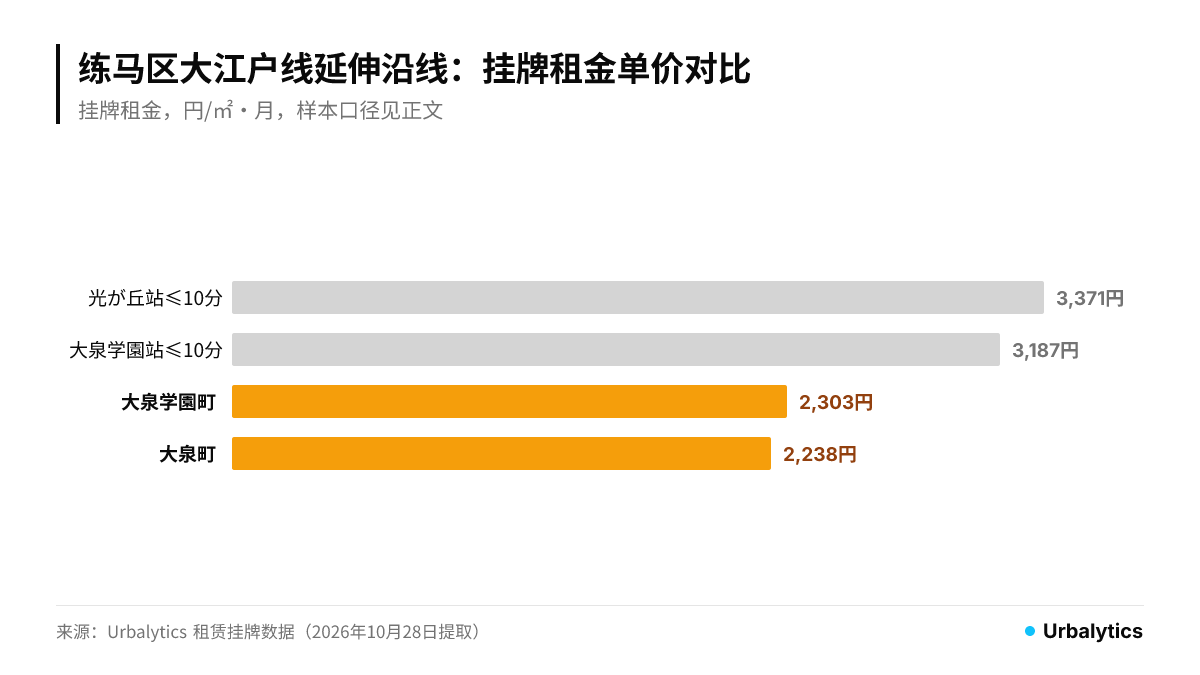
Asking rents in Oizumigakuencho and Oizumicho are approximately 2,240–2,300 yen/sq m, roughly thirty percent below the 3,190–3,370 yen/sq m in existing station areas. The basis of comparison matters: these are asking rents, not rents agreed in signed leases. Both neighborhoods are predominantly bus-dependent, and differences in the share of new-build properties and larger units also affect the figures. The gap cannot simply be read as room for a future station premium.
No Visible Distance Discount: What That Does—and Does Not—Tell Us
If the market were already pricing in the future stations, we would expect rents within each neighborhood to rise as properties get closer to the provisional station sites. The data do not show that pattern:
Oizumigakuencho, within a 10-minute walk: 2,157 yen/sq m
Oizumigakuencho, a walk of 15 minutes or more: 2,490 yen/sq m
Oizumicho, a walk of 15 minutes or more: 2,352 yen/sq m
Source: Urbalytics rental listings, extracted on October 28, 2026. Walking times are to the nearest existing station.
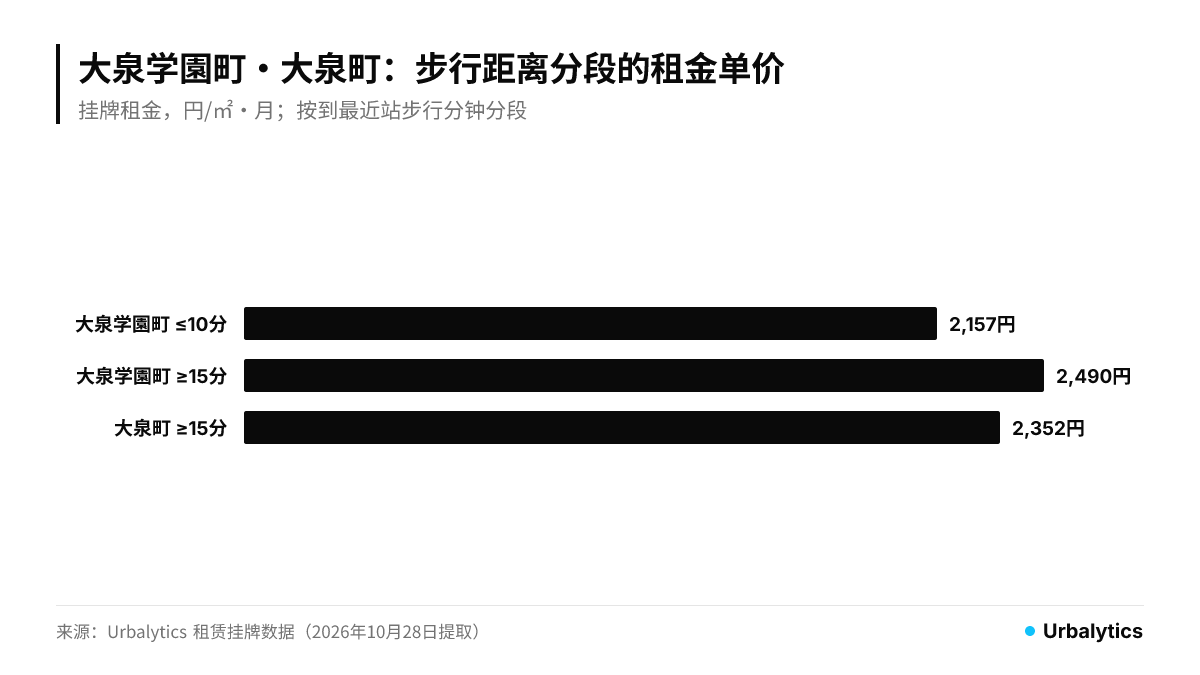
The band with walks of 15 minutes or more actually has higher asking rents: 2,490 yen/sq m versus 2,157 yen/sq m. This is more likely to reflect the mix of new-build properties and unit layouts than greater value farther from a station. The conclusion is deliberately limited: current asking rents show neither an identifiable premium for the expected extension nor an identifiable distance discount. This is a cross-sectional comparison of different properties, not rent growth at the same property, so it cannot serve as evidence for or against an extension effect.
The Buyer’s View: Yields Reflect the Price of Cash Flow
The sample of whole-building sale listings within a 15-minute walk of Oizumigakuen Station contains 31 gross-yield observations.
P10: 3.90%
Lower quartile (P25): 4.57%
Median: 5.46%
Upper quartile (P75): 6.00%
P90: 6.56%
Source: Urbalytics sale listings, extracted on October 28, 2026; sample size: 31.
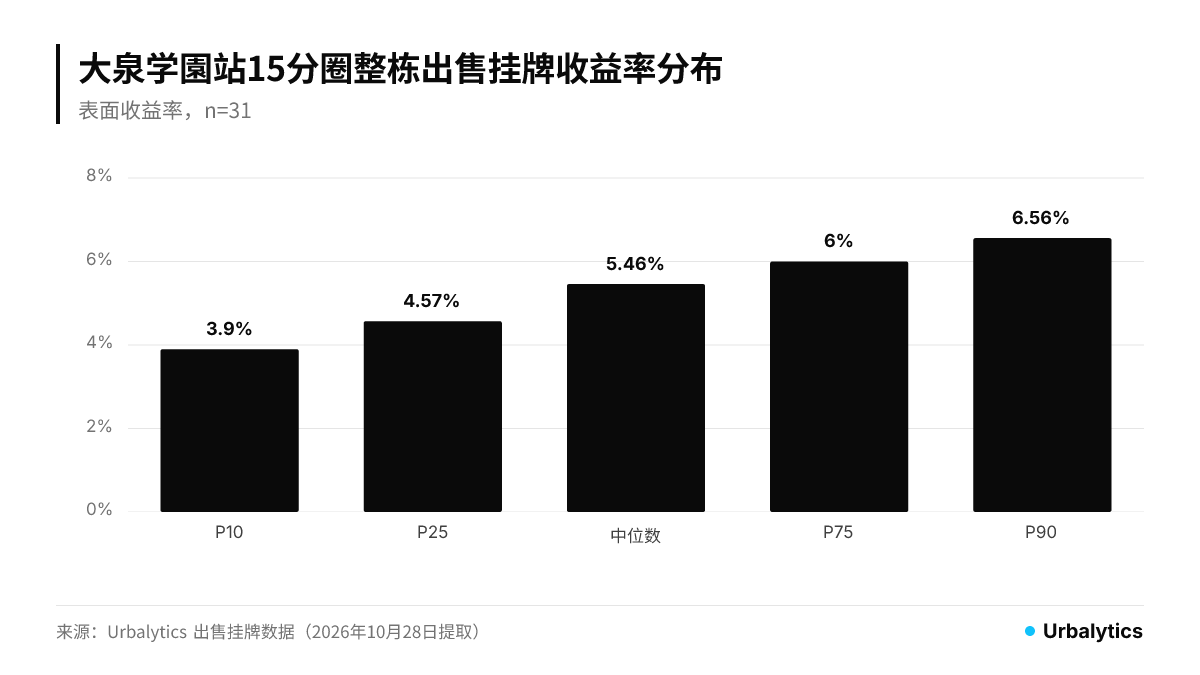
The median gross yield of 5.46% reflects sellers’ asking prices, not transaction prices, and is before operating expenses. It indicates that sellers in this station area have not built the stations targeted for 2040 into their asking prices. An investment thesis based on this extension is therefore a bet on the option value of a long-term holding, not on a certain return already visible in prices.

Three Milestones to Watch
First, watch whether the redevelopment organizing committee is formed in fiscal 2027; this is a prerequisite for construction in front of Oizumigakuencho Station. Second, check whether the preliminary urban planning proposal is presented as scheduled in fiscal 2028. Third, monitor continued accumulation of the extension fund and progress in land acquisition for Auxiliary Road No. 230. A delay in any of these would put pressure on the 2040 target.
For comparable extension projects, see our earlier articles: Will the Oedo Line Reach Saitama? Central Niiza’s ‘Railway White Space’ and a New Station Still on Paper, and Same “30 minutes to Shinjuku,” yet a ¥30 million gap: Two imprints of the brand-line premium. For the broader context on Tokyo rents and yields, see Tokyo Market Report.
The Bottom Line
The Oedo Line extension is a long-term investment option dependent on redevelopment progress. Current data show asking rents along the planned route roughly thirty percent below existing station areas, with no visible premium for the expected extension. Gross yields on whole-building listings, meanwhile, reflect ordinary station-area pricing. If you expect the extension to open around 2040, current prices do not require an extra payment for that prospect. If you expect delays, progress at the redevelopment milestones should be a prerequisite for your exit decision. This article compiles public information and listing data and does not constitute investment advice.
Tags
#NerimaWard #OedoLineExtension #Oizumigakuen #Oizumicho #Doshida #Redevelopment #AskingRents #GrossYield #WholeBuildingApartments #TokyoInvestment #StationAreas #ScenicDistrict
References
Nerima Ward, “Oedo Line Extension: Neighborhood Design Along the Route” (adopted on October 1, 2026)
Kenbiya report on the fiscal 2026 addition to the Oedo Line extension fund
Urbalytics rental and sale listings, extracted on October 28, 2026
Copyright: This article is original content by the author. Please do not reproduce, copy, or quote without permission. For usage requests, please contact the author or this site.