Words: 1698 | Estimated Reading Time: 9 minutes | Views: 21
With part of the Kururi Line no longer set to resume rail service, landlords along the route need to reassess the journeys tenants can actually make each day.
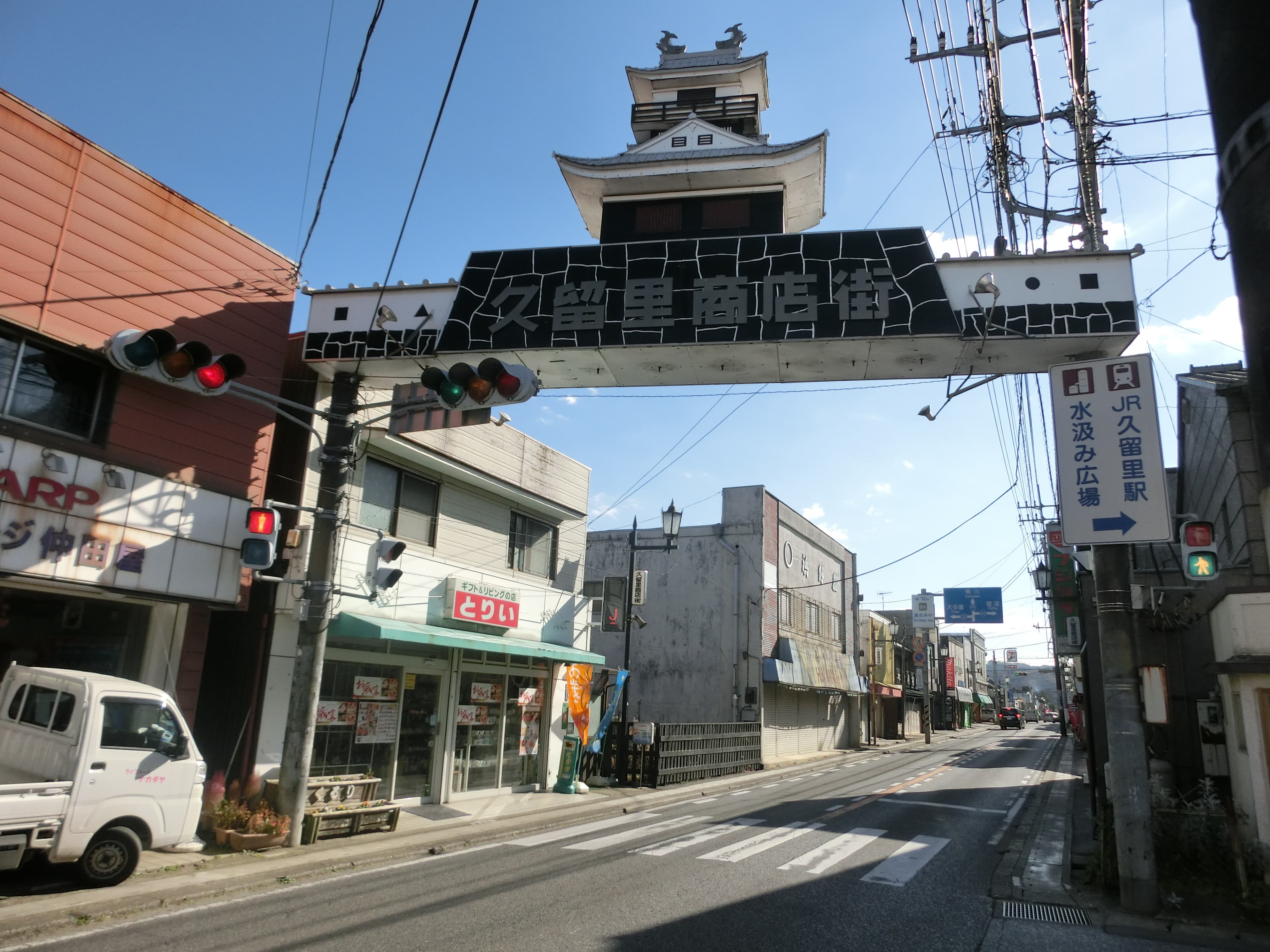
Heavy rain cut short what was supposed to be a farewell period lasting several more months. On 23 October, Kimitsu City announced that the track bed between Kururi and Kazusa-Kameyama had sustained severe damage. Repairs were expected to take about half a year from the start of work, so rail service would not be restored. On 25 October, Rakumachi reported on the change and its implications for transport along the line.
For rental property owners, the change exposes a gap between listing descriptions and cash-flow assumptions: a property may still be just minutes from the old station, but tenants' routes to school, hospitals or work may have changed. An unchanged walking distance to the station does not mean the same transport access is still available.
The planned closure and the decision not to restore service are separate milestones
JR East had already filed notice to discontinue railway operations between Kururi and Kazusa-Kameyama on 9 March 2026. The heavy rain did not determine the section's future for the first time. The new development is that the line, already in a transition period before closure, will not be repaired to allow trains to resume.
According to Kimitsu City's latest announcement, JR will continue replacement transport using buses and other means until 31 March 2027. The immediate task is therefore to check replacement service frequencies, boarding points, connections and capacity—not to assume that the end of train services means the entire area has no public transport.
Nor should the entire Kururi Line be treated as having the same service status. Kimitsu City's transport announcement dated 22 October stated that normal service between Kisarazu and Kururi had resumed on 2 October. Property comparisons must distinguish the section south of Kururi, where rail service will not resume, from sections that still have train services.
Other railway sections disrupted by the same heavy rain have their own recovery schedules. Service between Anegasaki and Nagaura on the Uchibo Line is targeted to resume with the first train on 9 November; at this article's cutoff, that remained a scheduled date. Conflating temporary suspensions, target reopening dates and confirmed decisions not to repair a line risks presenting short-term commuting difficulties as permanent changes to a location.
The rental impact depends on which tenants must change their routines
How a railway change affects a rental property depends first on whom the property serves. Households that drive to work and have dedicated parking may experience the same suspension very differently from residents who rely on trains for school or medical visits. These demand effects need to be assessed property by property. The available evidence does not support a uniform rent discount.
For residents who depend on public transport, whether buses retain the former train departure times answers only part of the question. Kimitsu City's replacement transport notice warns that journey times and passenger capacity differ from those of trains. Missed onward connections, an inability to reach an early shift or no way home at night could rule out a property for certain tenants, even if it remains “near the station” on paper.
Landlords can turn this review into a practical journey checklist: start at the property entrance, travel to the replacement service boarding point and continue to tenants' usual destinations, checking weekday mornings, evenings and weekends separately. If the target tenants mainly drive, also check whether parking is included in the lease, whether vehicle access is convenient and whether reaching everyday amenities requires driving the entire way. The old walking distance to the station cannot substitute for these checks.
Long-term arrangements for replacement transport also exist. A basic agreement signed by JR East and Kimitsu City in February 2026 specifies a JR contribution toward city-operated road transport of 2 billion yen, covering 18 years of costs, alongside support for improvements to the Kururi transport interchange, transport hubs in the Matsuoka and Kameyama districts, and bus stop facilities.
This shows that funding and infrastructure arrangements are in place for the transport transition. But the agreement's funding amount alone does not demonstrate better commuting access for any particular property. Useful evidence for rental marketing still consists of operational stops, timetables and actual connections. Planned improvements should remain clearly identified as plans.
Kisarazu has 131 rental samples; Kururi still lacks enough data to estimate local market levels
To assess whether market data from elsewhere on the same line could inform a property's asking rent, we queried Urbalytics' rental and whole-building investment property listing statistics. The first finding was uneven coverage: within this query window, Kururi Station had 0 apartment samples, while detached houses and whole-building investment properties each had just 1 listing. This does not prove that local rental demand is absent, nor does it provide enough evidence to calculate reliable local rents or yields.
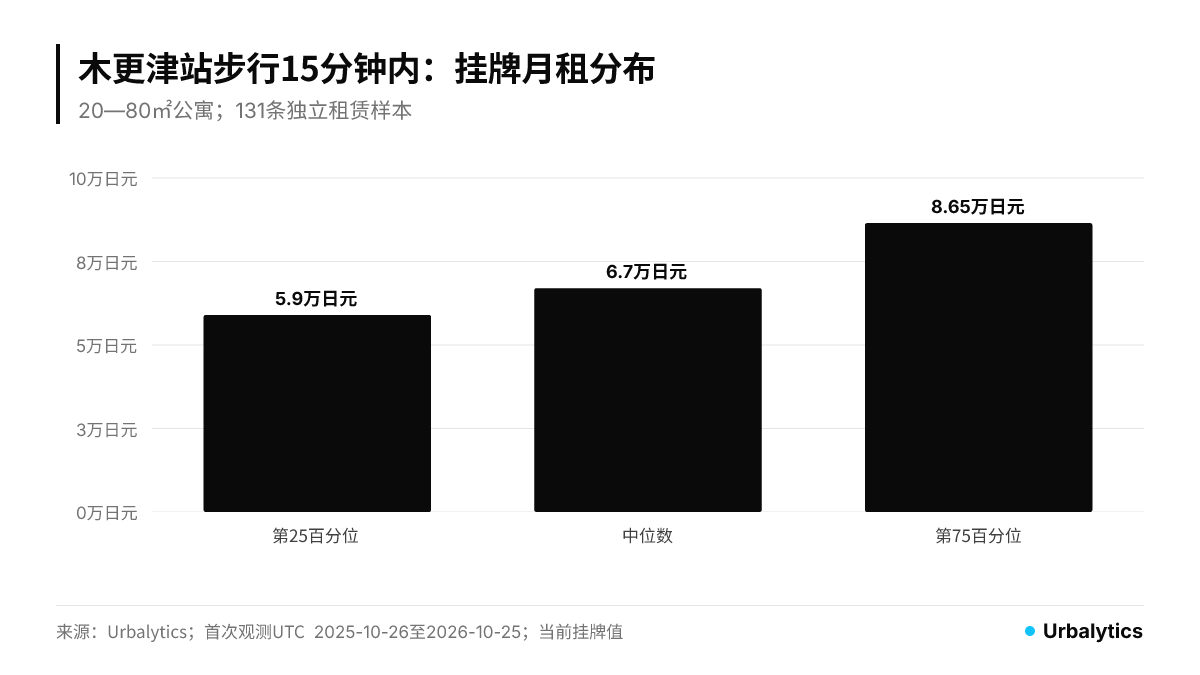
Coverage was stronger at Kisarazu Station. After filtering apartment rental listings for properties within a 15-minute walk of the station and measuring 20–80 square metres, the valid sample totalled 131 listings, with a median monthly base asking rent of 67,000 yen; the 25th and 75th percentiles were 59,000 and 86,500 yen, respectively. These figures describe the asking-rent distribution in this Kisarazu Station apartment sample. They are not target rents that can be applied directly to homes along the Kururi Line.
A separate sample covers whole-building investment properties. Within the same time window and a 15-minute walk of Kisarazu Station, the valid sale listings totalled just 8 buildings, with a median gross yield of 6.50%, and 25th and 75th percentiles of 5.32% and 9.17%. This small sample can serve as a reference for individual property reviews, but it cannot establish the required return for the entire Kisarazu market.
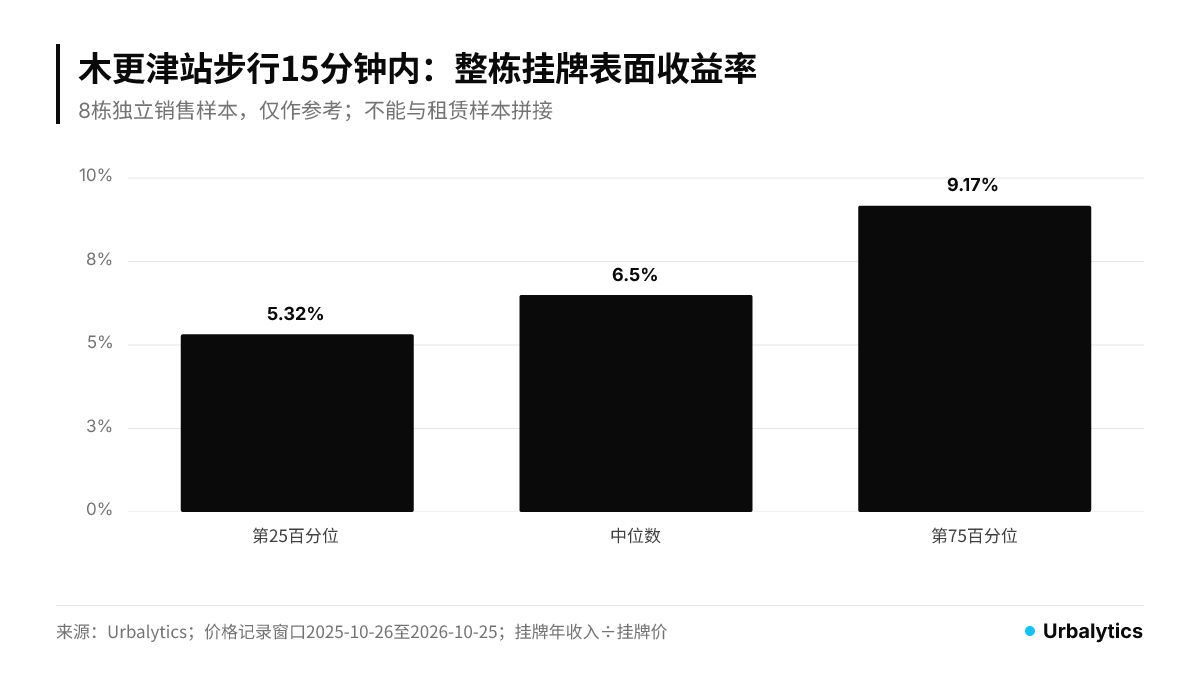
The charts distinguish between two questions: what asking rents tenants face and what advertised gross yields buyers face. They cannot tell us how much the railway closure has reduced property prices. Measuring the impact of a transport event requires continuous records of comparable properties before and after the event, controlling for floor area, building age, parking and repair condition. This query cannot isolate that effect.
Methodology: the first-observed window ran from 26 October 2025 to 25 October 2026, with the observation-window date boundaries defined in UTC. The query retrieved listing values stored as of 25 October, not completed transactions or monthly trends. Rental figures are base asking rents. Whole-building gross yield is advertised annual income divided by asking price, before vacancy, management, repairs, taxes or borrowing costs. Of the original 10 whole-building records, 8 remained after deduplication and outlier treatment. The samples cover different property types and use different denominators; they cannot be converted into one another.
For further coverage of local areas and different property types, use the Chiba Prefecture market report to access Kisarazu and Kimitsu. The citywide reports use different filters from this article's station, floor-area and time criteria. Citywide medians are not direct substitutes for station-level figures.
Revise property assumptions before discounting an entire area
Owners of properties along the affected section should first check whether their listings still imply normal rail service, then clearly describe current replacement transport and verifiable journeys. Next, review enquiries and reasons for tenants leaving. If concerns centre on public transport connections, adjust the rental offering for the relevant tenant groups. If demand mainly comes from driving households, parking and property condition may deserve more investment.
Buyers considering an acquisition should ask sellers for in-place leases and current marketing details for vacant units, then separately account for potentially longer vacancies, letting costs and necessary repairs in their cash-flow projections. Even a high advertised gross yield cannot replace an assessment of these expenses. With Kururi's sparse sample in particular, buyers should not fill gaps in unit-level rental data with Kisarazu Station rents and then work backwards to a purchase price using yields from a separate sample.
How transport commitments enter a valuation is explored in Niiza City's Oedo Line extension debate through the example of a new station that has not yet materialised. Here, the issue is the withdrawal of an existing train service. Both require a clear distinction between access available today and longer-term arrangements. For why prices can differ despite similar commuting times, see the analysis of price differences along routes 30 minutes from Shinjuku, rather than treating a railway label as a complete description of a location.
The next evidence that could justify changing rents or bids along the Kururi Line is whether target tenants' journeys remain viable, whether replacement transport improves connections once implemented, and the actual letting outcomes of local comparable properties. Only by establishing that evidence for individual properties can owners assess how much income a transport change has affected.
References
Rakumachi, 小川裕夫: The Kururi Line and the question of restoring rail service after heavy rain, 25 October 2026.
Kimitsu City: Latest announcement on rail service restoration, 23 October 2026.
Kimitsu City: Replacement transport and service status on JR lines, updated 22 October 2026.
JR East: Notice to discontinue railway operations between Kururi and Kazusa-Kameyama, 9 March 2026.
JR East Chiba Branch: Basic agreement on funding replacement transport, 17 February 2026.
Urbalytics rent_stats and building_cap_rate_stats, queried 25 October 2026; see the article for filters and methodology.
Author: Li Xiao | 25 October 2026
Tags: Kururi Line, Kururi, Kisarazu, Kimitsu City, Chiba Prefecture, railway closure, replacement transport, rental housing, rental property management, asking rents, gross yield, property valuation
Copyright: This article is original content by the author. Please do not reproduce, copy, or quote without permission. For usage requests, please contact the author or this site.