Words: 1582 | Estimated Reading Time: 8 minutes | Views: 36
Around Niiza Station, the median gross yield for whole-building assets is 8.30%, while at Hikarigaoka—the Oedo Line terminus—it is just 5.45%. That spread is the price the market assigns to having, or not having, direct metro access.
Both sit on the Musashino Terrace and are only a few kilometers apart, yet the median gross yield for whole-building income properties around the two stations differs by nearly three percentage points. Why? One is Hikarigaoka (光が丘), the terminus of the Toei Oedo Line (都営大江戸線); the other is Niiza City in Saitama Prefecture, which rail lines have largely bypassed.
On October 1, 2026, Kenbiya reported on Niiza City’s station-area planning tied to a potential Oedo Line extension. Following that coverage, we reviewed Niiza’s March 2026 policy document and resident survey results, and used the Urbalytics platform to pull rent and yield data for five stations along the corridor.
Bottom line up front: this is a low-certainty, long-timeline theme, but it neatly illustrates one of the most basic rules in valuing suburban Japanese real estate.
1) A city ‘bypassed’ by rail
Niiza City lies at the southern tip of Saitama Prefecture, with a population of roughly 166,000, about 25 km from central Tokyo, bordering Nerima-ku, Nishi-Tokyo, Higashikurume, and Kiyose to the south. It hosts historic assets such as Heirin-ji and the Nobidome Yosui canal, and three universities including Rikkyo University’s Niiza Campus.
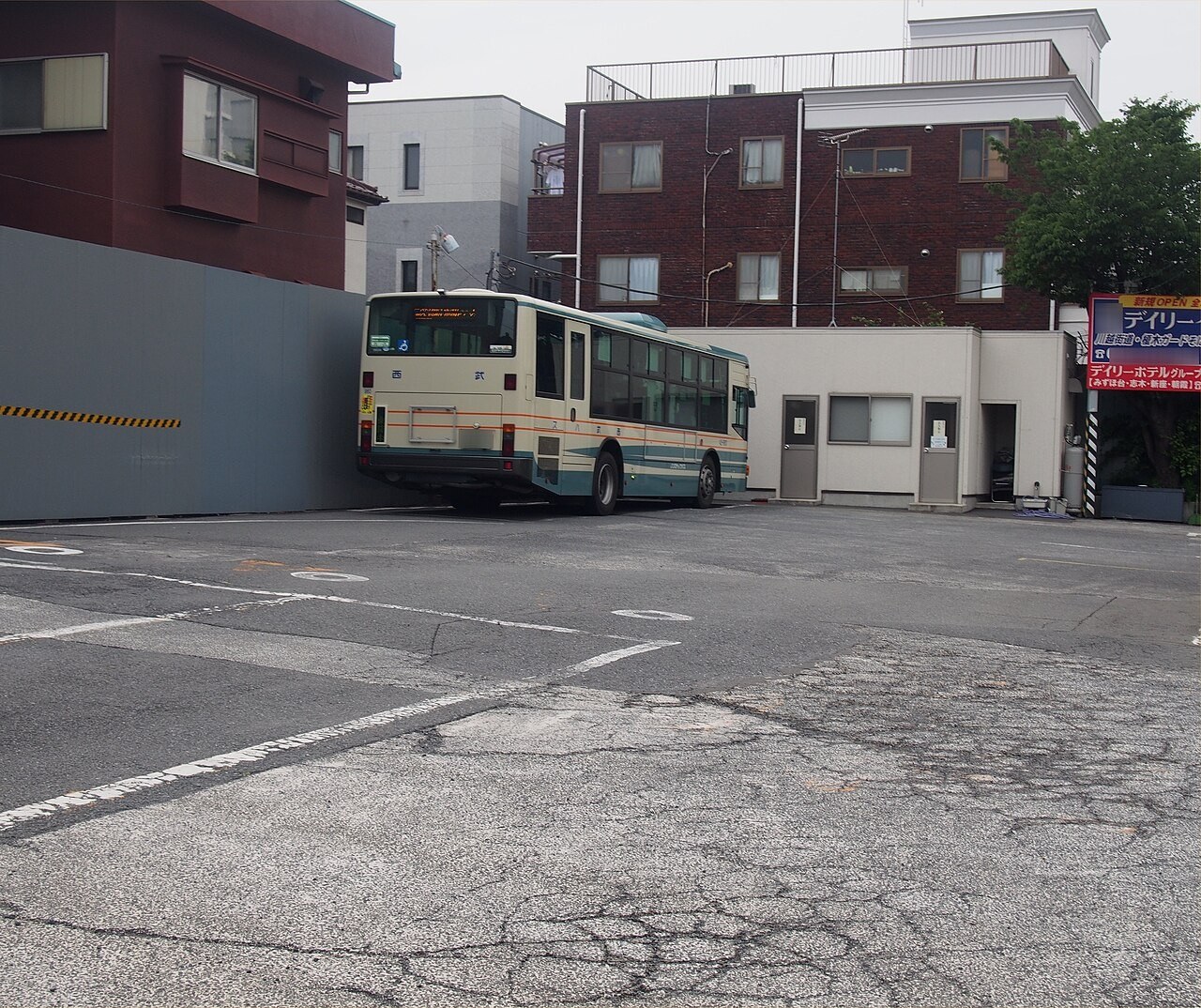
The challenge is rail alignment. Since the high-growth era, housing development in Niiza has clustered around stations on the Seibu Ikebukuro Line to the south and the Tobu Tojo Line to the north; the city’s only JR Musashino Line stop, Niiza Station, also sits off to one side. Niiza itself labels the city’s central band a ‘railway white space’ (鉄道空白地域).
Niiza’s 2025 survey quantifies the split: among 472 respondents identifying their primary departure station, 140 use Asakadai/Kit-Asaka, 102 depart from Hibari-gaoka (ひばりヶ丘) on the Seibu Ikebukuro Line to the south, and only 70 use Niiza Station. The city concludes that rail usage has ‘polarized to the northeast and the south.’
For residents in the central area, daily commuting, schooling, medical visits, and shopping typically start with a bus ride or a drive to stations near the city boundary. This also explains why many for-sale ‘closest to Niiza Station’ whole-building samples on Urbalytics show walk times of 25 minutes or more.
2) Urbalytics data: the valuation gap between a metro terminus and a ‘white space’
To gauge what ‘with or without metro access’ means for pricing, we used Urbalytics to compare five stations: Niiza, Shiki, and Hibari-gaoka (ひばりヶ丘) around Niiza, plus Hikarigaoka and Oizumigakuen along the prospective Oedo Line extension.
Rents first. Median monthly rent per m² for rental apartments: Niiza ¥2,219 (n=123), Shiki ¥2,354 (n=408), Hibari-gaoka ¥2,348 (n=198). Hikarigaoka is ¥2,772 (n=182) and Oizumigakuen ¥2,792 (n=426), about 25% higher than Niiza.
Now whole-building assets. Around Niiza Station, the median gross yield on listings is 8.30% (n=33), versus 7.46% in Shiki and 7.13% in Hibari-gaoka; at Hikarigaoka and Oizumigakuen, it drops to 5.45% and 5.51%, respectively.
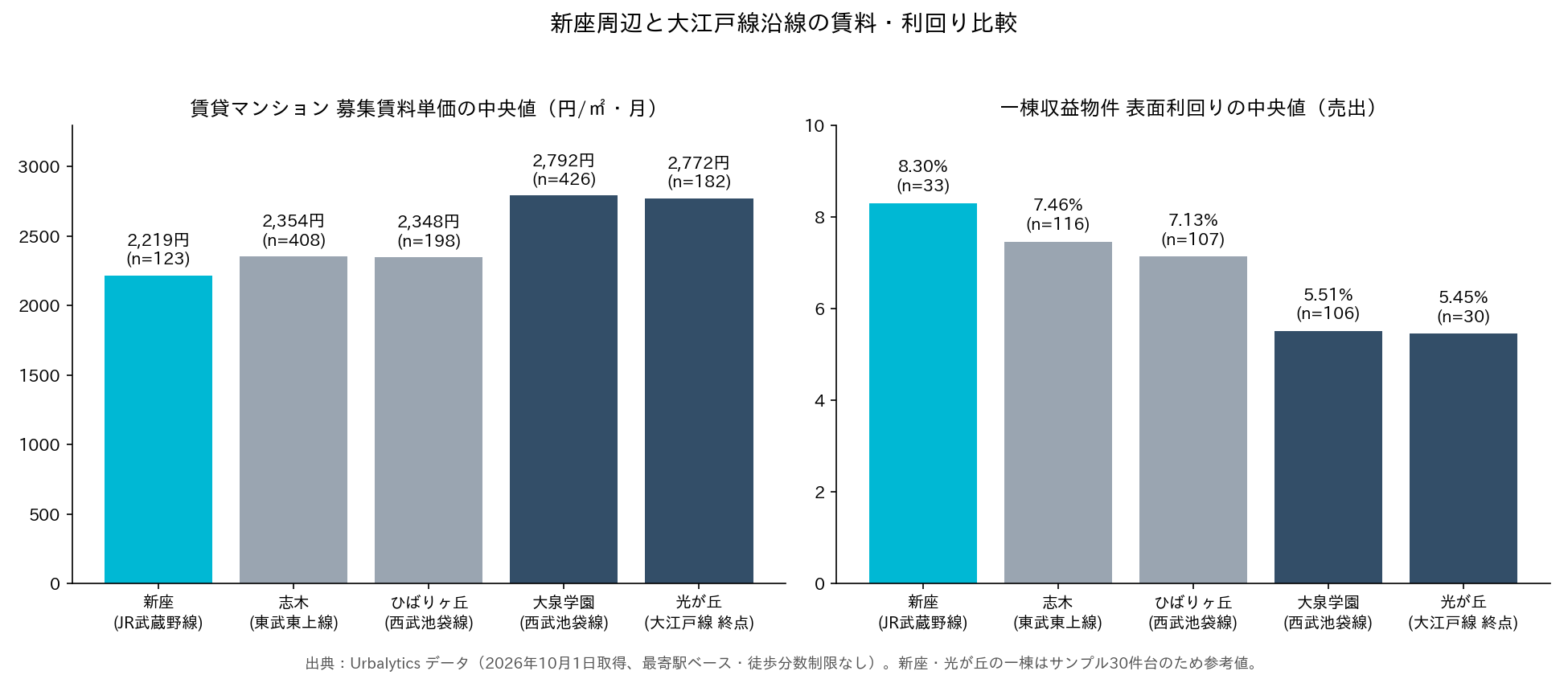
Note: Hikarigaoka and Oizumigakuen are in Tokyo’s 23 wards, so part of the spread is a ‘Tokyo address’ premium, not purely metro access. Niiza and Hikarigaoka whole-building samples number only in the 30s, so treat as reference values.
Urbalytics Insight Even without benchmarking to the 23 wards, if Niiza’s yield compresses from 8.30% toward Shiki’s 7.46%, the same rent level implies roughly a 10% valuation uplift; that is the portion of the extension story most likely to be priced first.
More granular area data are available in the Niiza City whole-building market report and the Nerima-ku resale condominium market report.
3) What the policy says: from ‘wait for rail’ to ‘build the city first’
The Oedo Line fully opened in December 2000, spanning 40.7 km; its current terminus is Hikarigaoka. The extension concept would run via Oizumigakuen-cho into Niiza, ultimately linking to Higashi-Tokorozawa Station on the JR Musashino Line. Niiza’s proposed new stop is tentatively ‘Niiza Chuo Station,’ located across parts of Baba 1-chome and 4-chome and Nobidome 2-chome.
What blocks the line are funding and ridership. Niiza cites an April 2016 report from the Ministry of Land, Infrastructure, Transport and Tourism’s Council for Transport Policy: the extension’s ‘project viability faces challenges’ and requires corridor development to secure viability. In short, the national stance is: prove demand first, then discuss construction.
Niiza’s approach this time is to design the station-area city first. In FY2024 staff ran five workshops and produced two options; in July–August 2025 the city surveyed residents and landowners, receiving 516 responses, then merged the options into one and, in March 2026, adopted the ‘(tentative title) Niiza Chuo Station Area Urban Development Policy (まちづくり方針)’.
The policy sets out three themes:
1) ‘A compelling Niiza that attracts large footfall.’ Place commercial facilities at the station front, create recreation zones for outdoor activities and sports, and count workers at existing logistics facilities as part of the visitor base. The vision map even sketches a sports arena for about 5,000 people.
2) ‘Build a wide-area transport network.’ Centered on the new station, connect a Smart IC on the Kan-Etsu Expressway and planned urban roads, add a station plaza and park-and-ride, and include a ‘highway oasis’ (ハイウェイオアシス) so drivers can transfer to rail here.
3) ‘Restorative spaces rich in nature.’ Leverage the greenery of Heirin-ji and the Nobidome Yosui to provide habitats, terraces, pedestrian spaces, healthcare facilities integrated with nature, and a water park that also serves flood control.
The timeline is explicit: by March 2027 Niiza aims to complete the city-building concept; in FY2027–2028 it will study economic ripple effects; around 2029 it will consult the Council for Transport Policy; and FY2031 is the scheduled timing for a report.
4) What this means for investors
Niiza’s most straightforward figure: travel time from Niiza Chuo Station to Shinjuku would drop from about 52 minutes today to around 35 minutes. About 89% of survey respondents support the extension, with 68% ‘strongly in favor.’
A closer read of the survey adds nuance: among anticipated uses after the extension, shopping accounts for 32%, leisure 29%, while commuting is only 20%. Niiza accordingly centers its policy on ‘weekend draw,’ not merely a commuter stop.
For different investors, the implications vary:
1) For cashflow-focused whole-building investors, yields around 8% in the Niiza area are attractive in their own right; the extension is an out-of-the-money ‘option’ not to be priced in. Underwrite off today’s rents and avoid paying a premium for the extension story.
2) For land or unit investors betting on the extension, time cost is the biggest variable. Even with a favorable FY2031 report, you still face sponsor determination, urban planning decisions, land acquisition, and construction—opening is likely in the late 2030s or later.
3) For landholders near the planned site, the policy itself is information. Land use and road networks will be planned together with the station; future uses and scale may be redefined. At the concept stage, however, none of this is legally binding.
Risk warning Whether a new station will be built—and where—remains undecided; the extension itself has not been approved. Paying a premium today on the assumption that ‘the metro is coming’ could mean a 10+ year holding period of high uncertainty, and the valuation uplift may never materialize.
Another often-overlooked risk: the policy envisions large crowd-drawing facilities such as an arena and a highway oasis, which would change traffic volumes and living conditions in what are now quiet residential areas. Kenbiya also cautions that without careful green-space protection, the area around the new station could become just ‘another generic suburban station-front.’
Conclusion: the spread is already written into today’s data
Whether the Oedo Line reaches Saitama may not see an interim answer until after FY2031. But Urbalytics data already make one point: on Tokyo’s outer rim, with similar topography and lifestyles, ‘how close you are to the metro’ directly sets the band for rents and yields.
In prior analysis we discussed the reuse of the former Hachioji Medical Prison site south of Hachioji Station. Once large suburban parcels are replanned, the surrounding valuation logic gets rewritten.
Another piece documented record-high studio rents in Tokyo’s 23 wards. The outward spillover in rents is putting border areas like Niiza back on investors’ radar.
If you want station-by-station distributions for rent per m² and whole-building yields, Urbalytics’ station-area data can help parse how much of a property’s price reflects today’s rent versus expectations about the future.
#OedoLineExtension #Niiza #NiizaChuoStation #SaitamaRealEstate #Hikarigaoka #Oizumigakuen #Nerima #RailwayWhiteSpace #UrbanPlanning #SuburbanJapanInvestment #WholeBuildingIncomeProperty #Yield #JapanRealEstateInvestment #Urbalytics
References
- Kenbiya, “Promoting town-building with a new station in Niiza, Saitama: How will the city’s central area change with an Oedo Line extension?”, 2026, https://www.kenbiya.com/ar/ns/region/shutoken/10512.html
- Niiza City, “(Tentative) Niiza Chuo Station Area Town-Building Policy (March 2026)”, 2026, https://www.city.niiza.lg.jp/uploaded/attachment/70439.pdf
- Niiza City, “Survey results related to town-building around the new station”, 2025, https://www.city.niiza.lg.jp/uploaded/attachment/69583.pdf
- Niiza City, “Town-building in the area around the new station”, 2026, https://www.city.niiza.lg.jp/site/12go/matidukuri.html
- Niiza City, “Promotion activities for extension of Urban High-speed Railway Line 12 (Oedo Line): Overview”, 2026, https://www.city.niiza.lg.jp/site/12go/12gou-gaiyou.html
- Urbalytics Market Report: Niiza City, Whole-building, 2026, https://www.urbalytics.jp/market/area/saitama/niiza-shi/building
- Urbalytics Market Report: Nerima-ku, Unit Condominiums, 2026, https://www.urbalytics.jp/market/area/tokyo/nerima-ku/mansion
Copyright: This article is original content by the author. Please do not reproduce, copy, or quote without permission. For usage requests, please contact the author or this site.