Words: 1622 | Estimated Reading Time: 9 minutes | Views: 27
The new Monzen-nakacho district puts for-sale housing, senior residences, and everyday shopping on the same block. Opportunities for nearby rentals should be assessed by target segments and daily-use routes.
By Luo | Data verified as of October 16, 2026
780 units coming to Etchujima: start by asking whom they serve
On October 16, Nomura Real Estate announced the overall plan for "TOKYO BLUE LINC." The project sits in 1-chome Etchujima, Koto Ward, on about 1.7 hectares owned by Institute of Science Tokyo, concentrating condominiums, senior rental housing, and retail. For nearby landlords, this creates a concrete competitive set: households will compare the new district’s layouts, shared amenities, and shopping convenience against the monthly outlay in existing homes.
Of the 780 units in total, Proud City Monzen-nakacho accounts for 667, including 47 non-sale residences; 620 are market-facing for-sale units. OUKAS Monzen-nakacho adds 113 units of senior rental housing with health-support services. These two components differ in move-in criteria, fee structures, and living needs, and should not be lumped together as 780 standard rental units.
For existing family rentals, the more direct impact comes from the for-sale condos. Families planning to stay long-term may put renting and buying on the same short list. Senior housing serves a different set of needs; whether it overlaps with conventional rentals depends on eligibility and service fees. Judging competitive intensity by unit counts alone will be misleading.
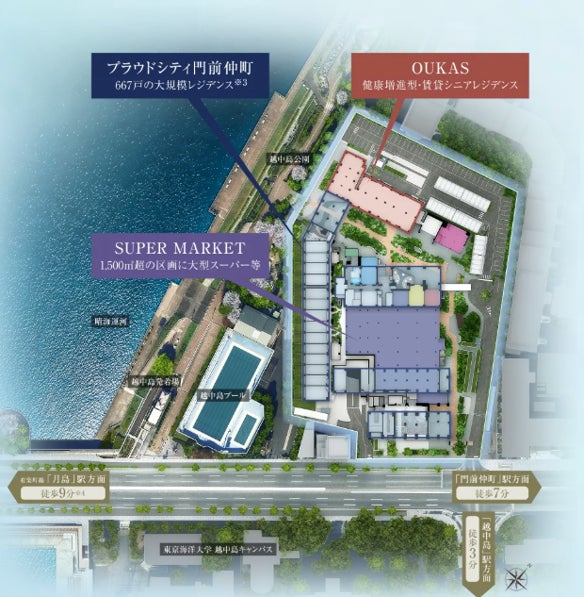
District layout rendering. Source: Nomura Real Estate press release, October 16, 2026. For-sale residences, senior residences, and retail are within the same development area; this is a plan, not an as-built photo.
The developer’s timeline: for-sale units are slated to begin sales in mid-November 2026, complete in late December 2027, and start move-ins in late March 2028; the retail and the community-shared building are scheduled to open in FY2028. Residential occupancy and store openings are not the same milestone. Nearby landlords’ leasing copy and underwriting should align to these two separate dates.
New homes change the comparison set; retail changes daily routes
The residences are a 3-minute walk to Etchujima Station and 7 minutes to Monzen-nakacho Station, with access to the Keiyo, Tozai, and Oedo lines. The location straddles Monzen-nakacho’s lifestyle area and Etchujima’s waterfront. Whether surrounding rentals share this convenience depends on the actual route from the building entrance to stations and supermarkets; "being in Monzen-nakacho" alone is not enough.
The planned retail includes a supermarket zone exceeding 1,500 sqm plus four daily-convenience blocks. For nearby families, whether grocery shopping is on the way and accessible with children or strollers may matter more than building height. Actual rental performance will need to be tested after opening through usage and leasing feedback.
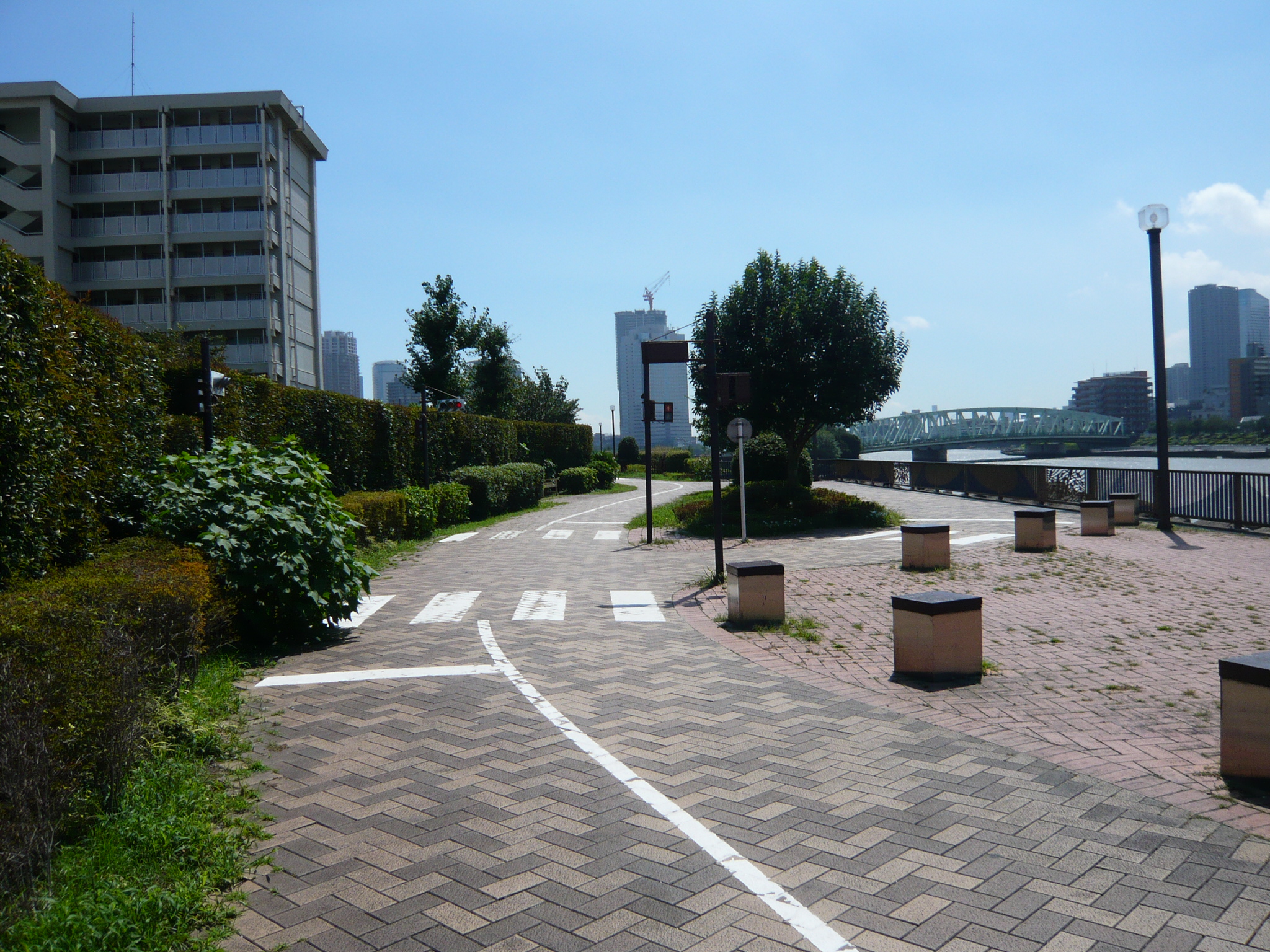
Etchujima Park waterfront, illustrating the existing pedestrian environment around the project, not the construction site. Photo by Ryoma35988, taken September 9, 2007 / Wikimedia Commons, CC BY-SA 3.0, original aspect ratio preserved.
The new community’s shared spaces and equipment will also raise reference standards for some families when viewing homes. Older stock need not replicate big-project amenities, but should explain what it offers: more usable area, a lower monthly outlay, a room suitable for working from home, or convenience along commute and school-run routes. These differences can be verified in a single viewing and are more persuasive than generic claims of "benefiting from large-scale development."
Same-day reporting by Impress Watch noted planned pricing for a 3LDK around 70 sqm starting from JPY 97 million. This is release-phase guidance, not closing records and not a uniform price across all layouts. For rent-to-buy families, it provides a new comparison anchor; for rental landlords, it means you must more clearly present monthly rent budgets versus living conditions.
This comparison also involves tenure. The project uses a general fixed-term land leasehold of about 70 years; do not line it up solely by gross price against freehold condos. Buyers should itemize ground rent, management fees, repair reserves, and other long-term outlays. This article does not have the complete final cost schedule and therefore does not convert planned prices into "buy is cheaper than rent." Our earlier condo holding-cost analysis discusses how monthly outlays shift the buy-vs-rent comparison.
First set a rent baseline for existing family-sized units
To judge who nearby rentals can compete with, first look at the asking-rent band for the same size bracket. Here we limit Urbalytics condo-apartment samples to Monzen-nakacho Station, within a 15-minute walk, 60–80 sqm, to reduce single-occupancy micro-units’ influence.
The effective sample is 17 units. The lower quartile of base monthly rent is JPY 249,000, the median is JPY 290,000, and the upper quartile is JPY 353,000. The middle half falling between JPY 249,000 and JPY 353,000 shows that even within this size range, households operate at different budget tiers.
Calculating rent per area first for each unit and then taking the median yields about JPY 4,051/sqm/month. Total monthly rent helps gauge a household’s monthly burden, while rent per sqm helps compare a target listing’s size and condition against peers. They answer different questions; do not multiply the per-sqm median by the new project’s size and treat that as its future achievable rent.
For ~70 sqm units preparing to re-lease, JPY 290,000 can serve as a starting point to review competing listings. Final pricing should then adjust for building age, floor, layout usability, and the latest leasing feedback. To reach the ~JPY 350,000 budget tier, the unit should demonstrate advantages in size or living conditions, rather than merely citing news about the new project.
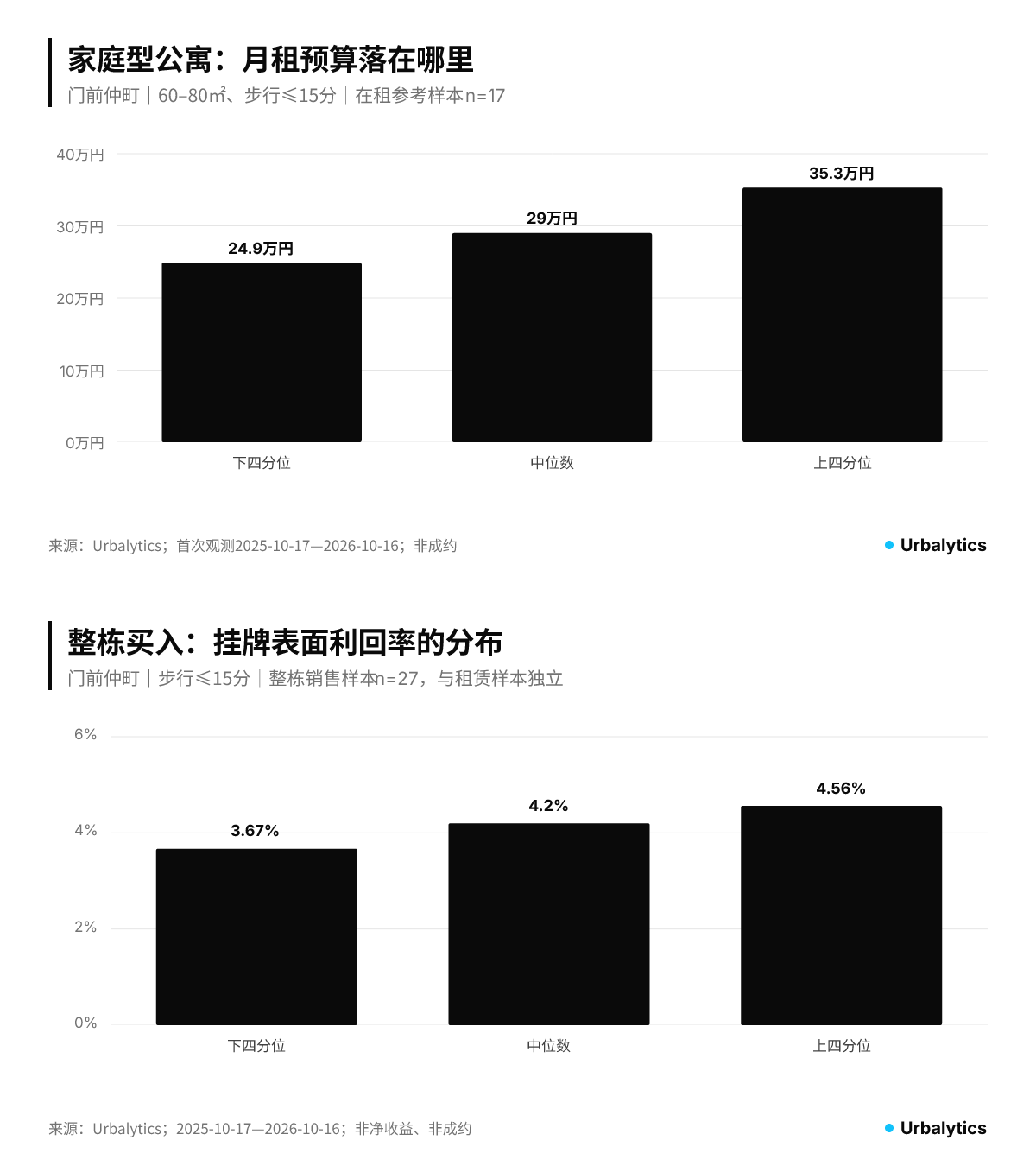
The top panel shows base monthly rents for 17 condos of 60–80 sqm; the bottom panel shows another set of 27 whole-building sales listings’ gross yields. The two samples are independent and are not merged into a hypothetical income property. Data and charts: Urbalytics, queried October 16, 2026.
When acquiring entire buildings, also examine price and listed income. In the same station area and observation window, the 27 valid listing samples show gross listing yield lower quartile around 3.67%, median around 4.20%, and upper quartile around 4.56%. This is a reference for how nearby buildings are being quoted, not a promise of net returns after expenses.
This distribution helps frame due-diligence questions: Are the building’s annual revenues based on in-place leases or a full-occupancy assumption? At what rent are vacant units underwritten? If the price only pencils out by relying on rent increases after the retail opens, the investor is effectively bearing a period of waiting for amenity delivery. Isolate that assumption and keep a purchase baseline calculated on current income.
Data notes: Observation window is October 17, 2025 to October 16, 2026. Leasing uses the UTC first observed date, currently saved LISTED condo-apartment records, and base rent, excluding management and other fees; the 17 units are a small reference sample, not the full station market and not executed leases. Whole-building stats cover records that listed or repriced within the window; cross-platform duplicates deduplicated; contracted and OFFLINE and outlier yields excluded. Listed annual income may be in-place or full-occupancy and is before vacancy and operating costs. Building age and micro-location are not harmonized; neither cross-section measures rent uplift from this development.
For broader regional context, see the Tokyo public market report. The station-area samples here and the report’s monthly area aggregates use different filters and should not be spliced into a single appreciation curve.
Around 2028, adjust leasing materials and income assumptions separately
For landlords already holding family-sized units, you can now benchmark same-size listings and organize base monthly rent, other charges, and property conditions. If a tenant is considering buying, offering a reason to stay based on reasonable outlay is more relevant today than raising rents to chase the new project’s guide prices.
As residential handover nears, track the actual move-in pace and any new rental supply around the project. Some for-sale units may later enter the rental market, but there is no verifiable rental ratio today; do not count all 620 for-sale units as comps. When real listings appear, re-compare by layout, rent, and time on market.
After the retail opens, walk the route from your building to the entrance again and confirm hours and tenant mix suit your target renters. If convenience truly improves, your leasing materials can show that specific route; your income model should be updated with subsequent asking and signed rents. Our earlier analysis of phased redevelopment in Roppongi also distinguished construction milestones from usable conditions, but here judgments should be anchored to Monzen-nakacho’s own move-in and opening progress.
When evaluating an acquisition near Monzen-nakacho, place the target on the project layout map and list the next expected lease turnover alongside the retail’s projected opening. If the current property can already compete within local family budgets, the new amenities are a verifiable upside; if the price only makes sense by pulling forward future rent growth, what needs adjusting now is the offer price—not writing unearned income into the rent roll.
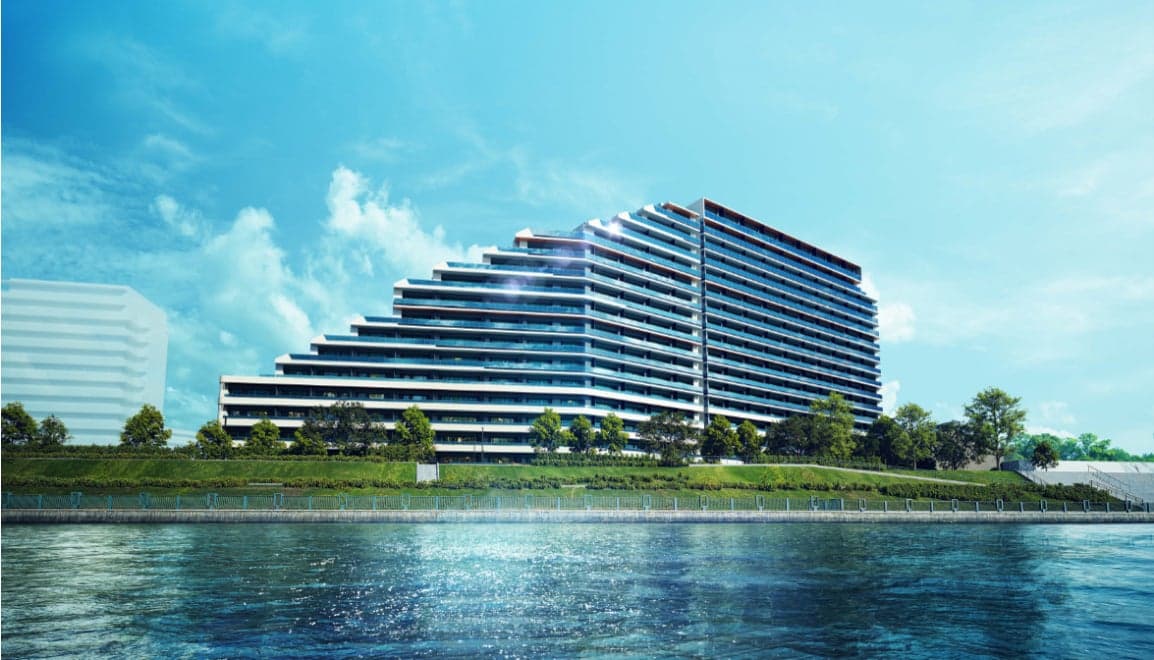
Cover image: Proud City Monzen-nakacho rendering. Source: Nomura Real Estate press release, October 16, 2026; not as-built. Project images are used to support news analysis of the project; rights belong to the original holders.
Tags
#MonzenNakacho #Etchujima #KotoWard #TOKYOBLUELINC #NomuraRealEstate #FamilyHousing #ResidentialLeasing #SeniorHousing #FixedTermLandLeasehold #RetailAmenities #GrossListingYield #JapanRealEstate #Urbalytics
Sources
1. Nomura Real Estate, October 16, 2026: 780-unit integrated resi-retail development in Monzen-nakacho announced, including timeline and project overview.
2. Impress Watch, October 16, 2026: TOKYO BLUE LINC coverage, planned pricing information.
3. Proud City Monzen-nakacho official site, unit count and project location, verified October 16, 2026.
4. Urbalytics Tokyo market report. Filters, samples, and units for rent_stats and building_cap_rate_stats are detailed in Data Notes above.
5. Etchujima Park photo and license, Ryoma35988, September 9, 2007, CC BY-SA 3.0.
Copyright: This article is original content by the author. Please do not reproduce, copy, or quote without permission. For usage requests, please contact the author or this site.