Words: 1560 | Estimated Reading Time: 8 minutes | Views: 63
Construction of the two-story “Zushi Station Building (tentative name)” began at the end of September at the east exit of JR Zushi Station, with opening scheduled for spring 2028. With a total floor area of about 1,870㎡, it is a modest project. What matters for investors who own rental property nearby is that the building will house a new ticket gate on its second floor and create a pedestrian route linking Nagisa-dori to the station.
A single commercial building is unlikely to move land prices in Zushi. However, when Urbalytics listing data are split by distance from the station, asking rents per square meter in Zushi differ by about 13% on either side of the 7-minute walk line. What the new gate may change is not how the whole town is valued, but how many minutes each property is from the station.
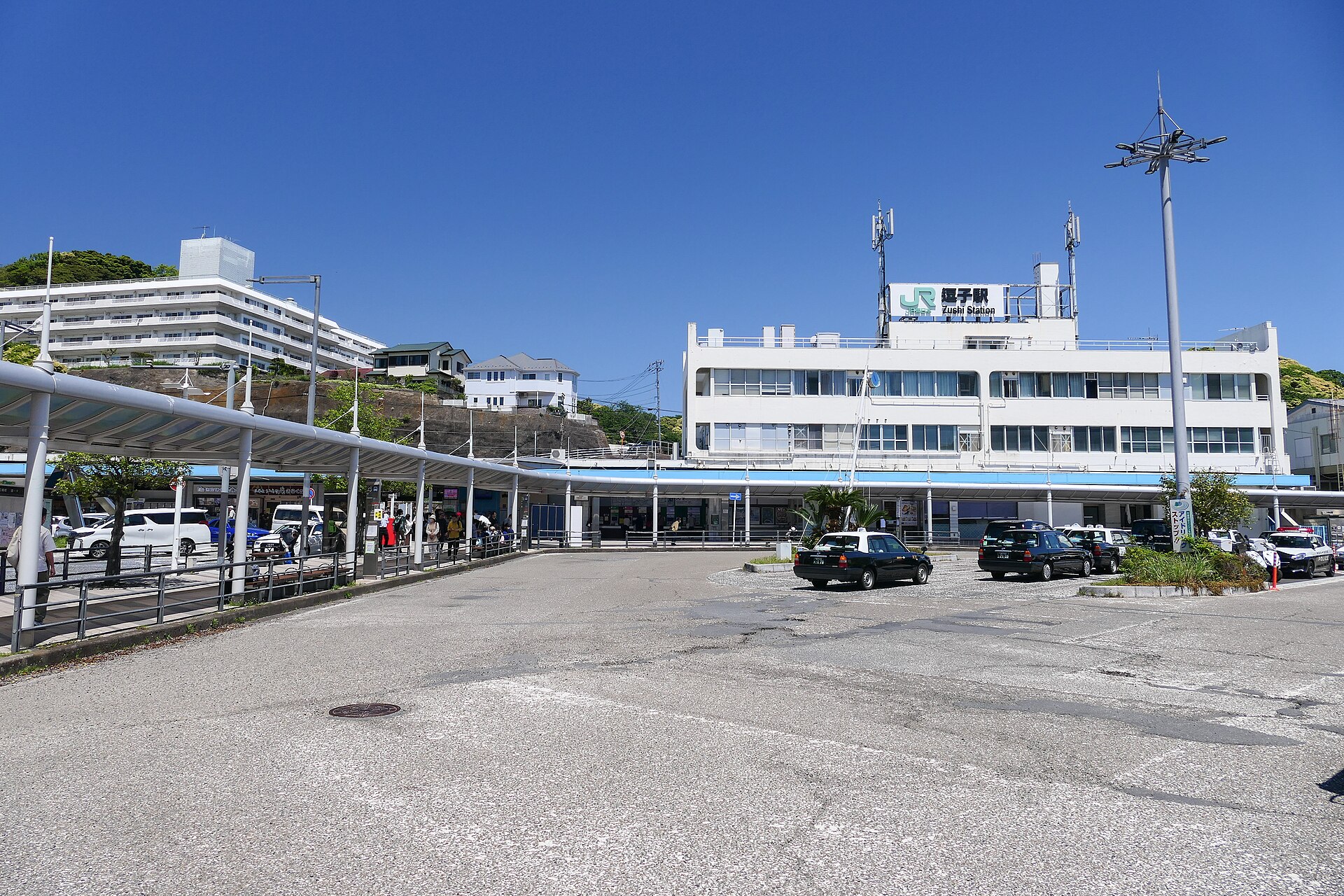
What has been decided: a 1,870㎡ commercial building and a second-floor gate
According to materials JR East released on September 29, the building will stand at 1-1-10 Zushi, Zushi City, on a site of about 1,910㎡, with a total floor area of about 1,870㎡ in a two-story steel structure. It will be used for retail, with Daiwa Lease handling design and construction and JR Yokohama Shonan City Create running the facility. The construction period runs from the end of September 2026 to spring 2028.
JR East describes it as a “community-based commercial facility.” Working with Zushi City’s station-area transport measures, it will create a route from Nagisa-dori into the station via the second floor of the building. The roof is planned as a tsunami evacuation area. The tenant mix has not yet been announced.
Given its scale, this is a project that renews one corner of the station front. A Kenbiya article also concludes that there is little basis for expecting the opening to cause large swings in nearby property prices. We agree. The question investors should check is which properties the change in pedestrian flow will actually reach.
The new gate changes the route of people who use the station every day
JR East data for fiscal 2024 show an average of 25,635 passengers boarding at Zushi Station per day, of whom 15,979, or about 62%, used commuter passes. At neighboring Kamakura Station, commuter-pass holders account for only about 42% of 41,247 daily passengers. Compared with tourist-heavy Kamakura, Zushi is primarily a commuter station.
According to Kenbiya, the number of tourists visiting Zushi City in 2025 fell 0.9% year on year. That the building is designed for daily use rather than tourist traffic fits this passenger profile. For rental property, the residents who stand to benefit are those who use the station every day, and what they value is less shopping convenience than the time and ease of the walk from home to the gate.
If the new gate opens on the Nagisa-dori side, routes to the station from that side may become shorter and easier to follow. On the other hand, foot traffic in front of the existing east exit may shift, and some parts of the station-front shopping streets could see fewer passers-by. Which way it goes depends on the gate’s location, operating hours and tenants; for now, we can only wait.
Zushi asking rents differ by about 13% between 7 minutes or less and 8 to 15 minutes
We used Urbalytics rental listing data to check how much rents vary with distance from the station. The sample covers apartment listings whose nearest station is JR Zushi or Keikyu Zushi-Hayama, over the 24 months from November 2024 to November 2026, with asking rents excluding management fees.
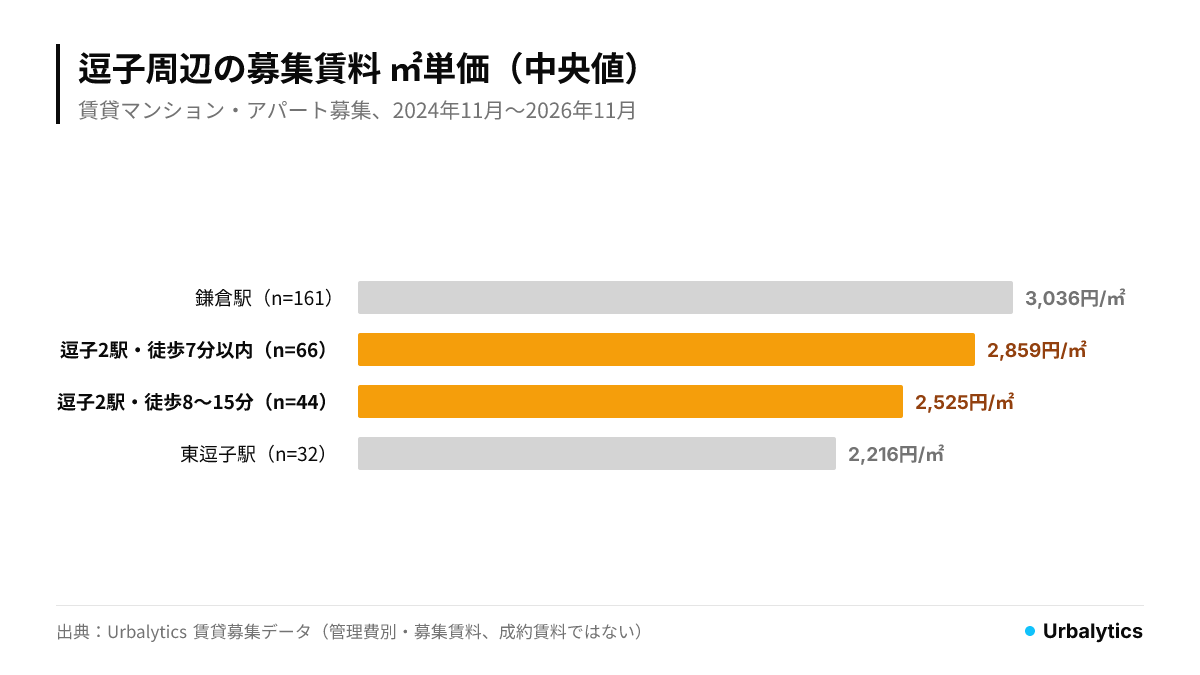
The median rent for listings within a 7-minute walk (66 listings) was ¥2,859 per square meter, against ¥2,525 for 8 to 15 minutes (44 listings), making the closer band about 13% higher. Only five listings were 16 minutes or more away, so that figure is for reference only: a median of ¥1,764.
Unit size does not easily explain the gap. Rent per square meter is usually higher for smaller units, yet here the average unit within 7 minutes is 62.7㎡ versus 43.8㎡ at 8 to 15 minutes, and the band with larger units still has the higher unit rent. The more natural reading is that proximity to the station is reflected in rents.
Compared with nearby stations, Zushi’s within-7-minute band is about 6% below Kamakura (161 listings, ¥3,036) and well above Higashi-Zushi (32 listings, ¥2,216). In other words, Zushi properties near the station already command rents close to Kamakura levels.
Urbalytics Data
Monthly trends in asking prices and yields for Zushi City as a whole are available in the Zushi City real estate market report. The comparison by walking distance serves as a guide when applying a property’s walk time.
Whole-building yields are 1.6 points higher than in Kamakura
On the sale side, among whole-building income properties listed or repriced between December 2024 and November 2026, the median gross yield for the 31 properties nearest Zushi Station was 7.14%. The median asking price was ¥59.8 million, and the middle half of yields fell between 6.00% and 8.45%.
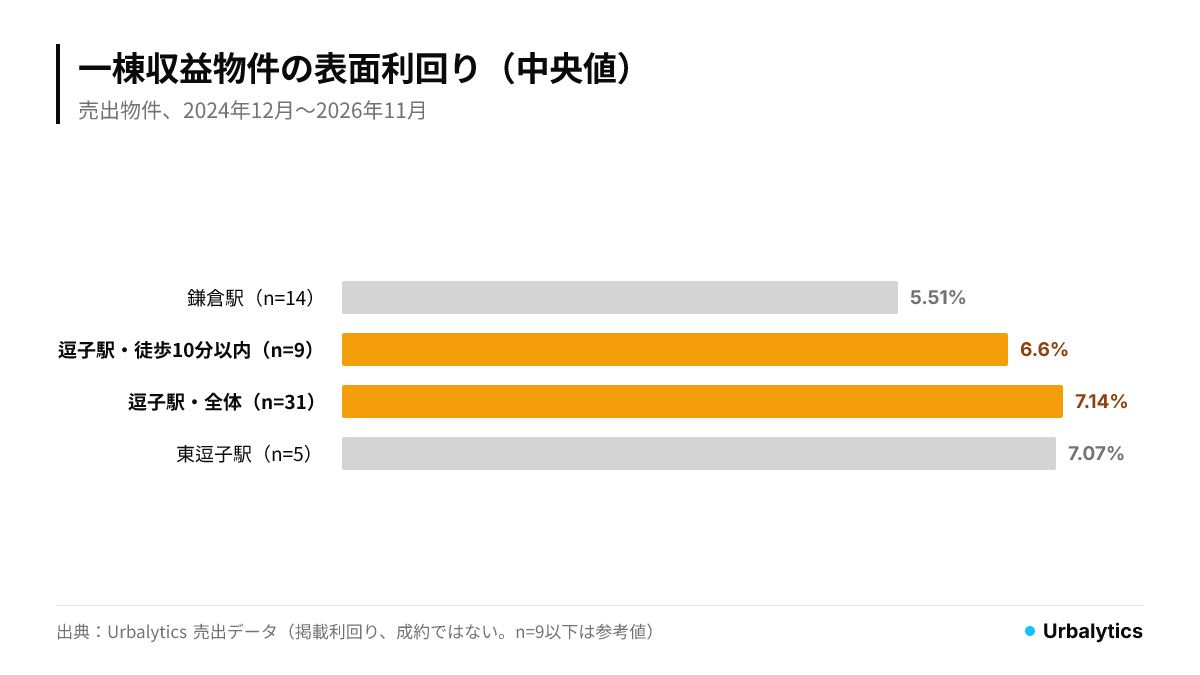
The median at Kamakura Station (14 properties) was 5.51%, so Zushi is 1.6 points higher. Limiting Zushi to properties within a 10-minute walk gives 6.60% across nine properties, meaning yields near the station are already lower and prices higher. Higashi-Zushi showed 7.07% across five properties. All of these samples are small, and a single asking price can move the median.
Rents near Zushi Station are close to Kamakura’s, yet yields are clearly higher. This suggests that Zushi’s whole-building market is priced on rental income rather than on the scarcity value of a tourist destination. Current data offer no basis for buying at Kamakura-level yields on the strength of the opening.
Before the opening, check each property’s walk time
The key is how walk times in property advertisements are calculated. Under the enforcement rules of the fair competition code administered by the Fair Trade Council of Real Estate in the Tokyo Metropolitan Area, walking time is calculated at one minute per 80 meters of road distance, and the end point on the station side is the facility’s entrance. However, only entrances that can be used at all times during operating hours count.
If the new gate opens as an entrance usable at all times, advertised walk times for some properties on the Nagisa-dori side could become shorter. Since Zushi data show a roughly 13% gap in unit rents at the 7-minute line, a property that goes from 8 minutes to 7 could be positioned differently in the rental market. Conversely, if the gate’s hours are limited, it may not count as an end point.
In practice, when considering a property around the east exit or Nagisa-dori, first build the cash-flow estimate using the walk time from the current gate and current rents. Then measure the road distance from the building entrance to the station building on a map and check how many minutes it would take via the new gate. Properties near the 7-minute boundary are the most likely to see their rental positioning change.
Any rent upside should be factored in only after the gate’s location and hours are fixed and it can be confirmed in actual post-opening listings. Until then, pricing should be judged against the current yield level of 6.60% for properties within a 10-minute walk.
The approach of gauging how far a small station-front renewal reaches into rents is shared with our analysis comparing nearby rents ahead of the Omiya Sakuragi PPJ opening. Set alongside our analysis of Kamakura’s historic district plan, also on the Yokosuka Line, where small rent gaps were the issue, the contrast is clear: Zushi is a market valued on rental income rather than scarcity.
About the data
Rents are asking rents (excluding management fees) from rental listings collected by Urbalytics, not contract rents. The period is November 28, 2024 to November 28, 2026 (based on first observation date), with properties whose nearest station is JR Zushi or Keikyu Zushi-Hayama grouped by walk time. Yields are gross yields calculated from asking prices and listed annual income for whole-building income properties; whether income assumes full occupancy or current occupancy depends on the listing, and these are not net yields after expenses. The period is December 1, 2024 to November 28, 2026, with duplicate listings across sites merged into one. All figures are cross-sectional comparisons between stations and do not measure the effect of the station building’s opening.
#ZushiStation #ZushiStationBuilding #ZushiCity #NagisaDori #YokosukaLine #Kamakura #HigashiZushi #StationRedevelopment #AskingRent #BuildingYield #IncomeProperty #WalkTime #Kanagawa #JapanRealEstate #Urbalytics
References
JR East, “Construction begins on the (tentative) Zushi Station Building,” September 29, 2026 https://www.jreast.co.jp/press/2026/20260929_ho01.pdf
JR East, “Passengers by station, fiscal 2024” https://www.jreast.co.jp/company/data/passenger/2024_01.html
Kenbiya, “New station building in front of JR Zushi Station to open in spring 2028,” November 28, 2026 https://www.kenbiya.com/ar/ns/region/shutoken/10704.html
Fair Trade Council of Real Estate in the Tokyo Metropolitan Area, “Enforcement rules of the fair competition code concerning real estate advertising” https://www.sfkoutori.or.jp/webkanri/kanri/wp-content/uploads/2019/01/h_sekoukisoku.pdf
Wikimedia Commons, “JRE Zushi-STA East-side.jpg” (CC0) https://commons.wikimedia.org/wiki/File:JRE_Zushi-STA_East-side.jpg
Copyright: This article is original content by the author. Please do not reproduce, copy, or quote without permission. For usage requests, please contact the author or this site.