Words: 1784 | Estimated Reading Time: 9 minutes | Views: 69
On November 25, 2026, construction began on Phase II of Cross Kanamachi, on the block formerly occupied by Ito-Yokado Kanamachi and Kanamachi Driving School outside JR Kanamachi Station’s north exit. The project includes a residential tower with 40 above-ground stories and approximately 850 homes, with completion scheduled for the end of April 2031. The MARK IS Katsushika Kanamachi shopping complex opened in 2025; now it is the residential component’s turn. For nearby rental properties, the question is specific: will the tower lift local asking rents, or which existing properties will it compete with for tenants when completed?
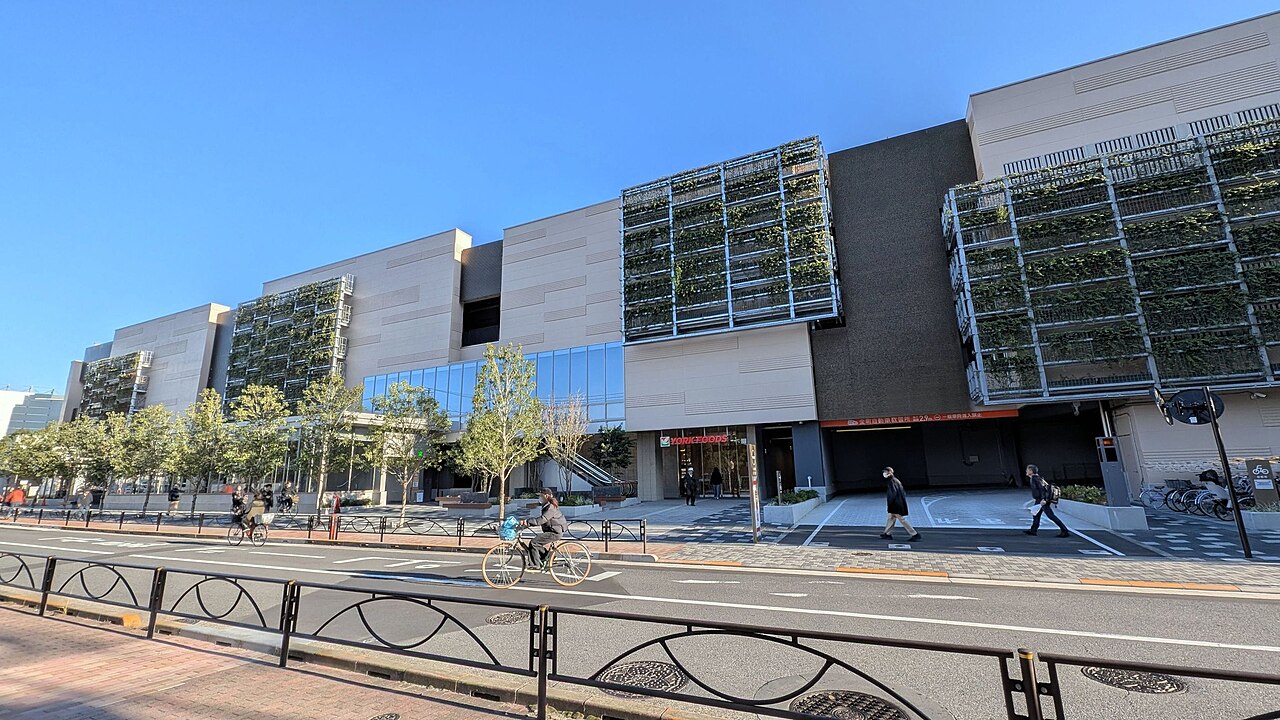
What Is Under Construction: 40 Stories, About 850 Homes, More Retail Space and Ward Services
Officially named the Higashi-Kanamachi Itchome West District Type I Urban Redevelopment Project, the scheme is led by a redevelopment association, with Mitsubishi Estate, Mitsubishi Jisho Residence and Mitsui Fudosan Residential as participating members. Its address is Higashi-Kanamachi Itchome, lot 3700, Katsushika Ward. The entire block covers approximately 24,755 m², with total floor area of approximately 159,290 m² and a floor-area ratio of approximately 452%.
The project has two phases. Phase I was completed in 2025: Kanamachi Driving School and the ward-operated underground bicycle parking facility opened in August, followed by MARK IS in September. The driving school relocated from the Phase II site to the rooftop of the Phase I building. Phase II, which broke ground today, includes a residential tower with approximately 850 homes and a height of about 150 m, additional MARK IS retail space, and facilities to accommodate the relocation of Katsushika Ward’s residents’ service office and district center. Rika Daigaku-dori, the street facing the block, is also being widened to serve as the main pedestrian route. AXS Satow is the designer and Fujita the contractor.
The schedule shows a steady sequence of milestones: the city planning decision in November 2019, approval of the rights conversion plan in August 2022, the start of Phase I construction in October 2022, and now the start of Phase II. The association is scheduled to dissolve in 2033. The announcement did not disclose how the 850 homes would be split between units for sale and rental housing, or announce prices.
What Has Already Arrived—and What Has Not
For nearby landlords, the redevelopment’s effects need to be separated into two parts. The improvement in everyday convenience has already happened: the large shopping complex and north-exit pedestrian spaces opened in 2025, and current asking rents already reflect that benefit. What has yet to arrive is the housing supply: approximately 850 homes are due to be delivered together in 2031.
Current asking-rent evidence therefore cannot tell us how much the tower might lift rents. It can only show Kanamachi’s rental structure and where the additional homes arriving in 2031 might fit. We originally intended to compare asking rents before and after MARK IS opened, but every quarter of 2025 had fewer than 10 listings, making that comparison impossible.
Kanamachi’s Rental Market: A Wide Age Gap, with Few and Cheaper Family Homes
Urbalytics compiled residential listings first observed over the past 12 months whose nearest station was Kanamachi—the JR Joban Line and Keisei Kanamachi Line station group—and which were within a 10-minute walk. Breaking the sample down by building age reveals a clear gap. For homes completed in or after 2015 and measuring 20–80 m², the median asking base rent per square meter was ¥3,715/m² (188 listings, median monthly asking rent of ¥97,000, and average area of approximately 28 m²). For homes completed in or before 2005, it was just ¥2,380/m² (70 listings, median monthly asking rent of ¥78,500, and average area of approximately 42 m²).
Newer listings are mainly homes for single occupants, with high asking rents per square meter but modest total monthly rents. Older homes are larger, but their asking rents per square meter are roughly a third lower. Kanamachi effectively has two rental markets.
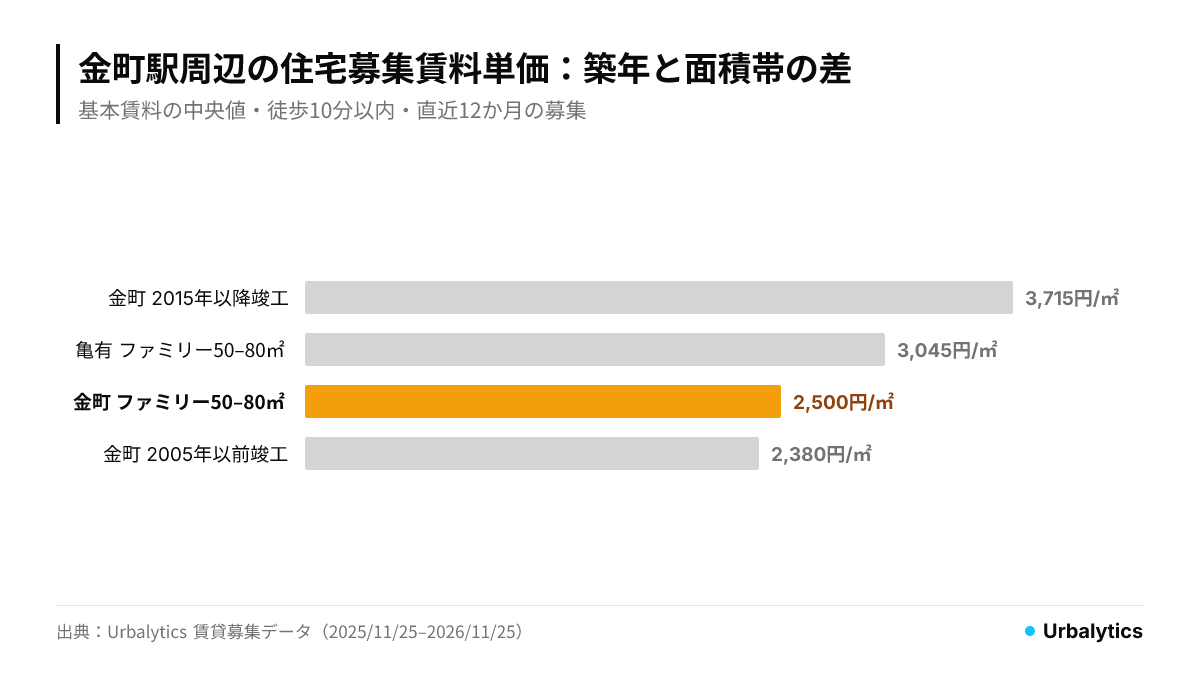
The tower will primarily contain family-size homes, making the 50–80 m² segment more relevant. Over 12 months, Kanamachi had only 39 listings in this segment, with a median asking rent per square meter of ¥2,500/m² and a median monthly asking rent of ¥138,000. Under the same criteria, Kameari, one stop away on the Joban Line, had 27 listings, a median asking rent of ¥3,045/m² and a median monthly asking rent of ¥175,000. Kanamachi’s family rentals are both scarce and cheaper than those at the neighboring station, with older properties making up most of the supply.
For comparison, Venasis Kanamachi Tower Residence, an existing north-exit tower completed in 2009, recorded 5 listings over the past three years, with a median asking rent of approximately ¥3,493/m². This is a sample from just one building and cannot represent the area, but it shows that tower rentals in Kanamachi can sit in the newer-property rent band rather than the older family-home band.
Urbalytics Data Insights
The sales market presents a different picture. According to the Kanamachi Station Condominium Market Report, the median asking price per square meter of floor area for individually owned condominiums listed near Kanamachi Station in October 2026 was ¥934,000/m², 21.9% above the Katsushika Ward average. Asking rent including management fees, meanwhile, was ¥3,018/m², 15.4% below the ward average. City Tower Kanamachi, completed in 2016, was approximately ¥3,730,000 per tsubo, a Japanese floor-area unit; Proud Tower Kanamachi, completed in 2021, was approximately ¥4,200,000 per tsubo. Kanamachi’s property prices are already high by ward standards, but asking rents have not kept pace.
Which Rental Segment Could 850 Homes Affect?
The following is a hypothesis, but the mechanism is fairly clear. When a new condominium tower is delivered, some owners invariably choose to rent out their units, concentrating listings in the first year or two after completion. Kanamachi had only 39 listings a year for homes measuring 50–80 m² within a 10-minute walk. Even if just 5% of the 850 homes entered the rental market, that would mean approximately 42 homes—equivalent to an entire year’s listings in this segment.
These new listings would most likely be priced against new towers rather than the median of ¥2,500/m². Their most direct competitors would be existing north-exit towers and family-size apartments completed from the 2010s onward. Older, lower-rent 2DK and 3DK apartments—layouts with bedrooms plus a dining-kitchen—serve a different, budget-constrained tenant group. Their exposure is indirect: when total monthly asking rents approach those of new tower rentals, some tenants will choose to upgrade.
The impact on homes for single occupants is much smaller. The tower does not directly add 1K units, a layout with a separate kitchen. Nor are the jobs associated with the relocated residents’ service office and retail expansion sufficient on their own to reshape single-occupant rental demand. For Kanamachi’s compact apartments, building age and amenities remain the main drivers of asking rent; redevelopment will not erase the gap between ¥3,715/m² and ¥2,380/m².
How Whole-Building Investors Can Use These Figures
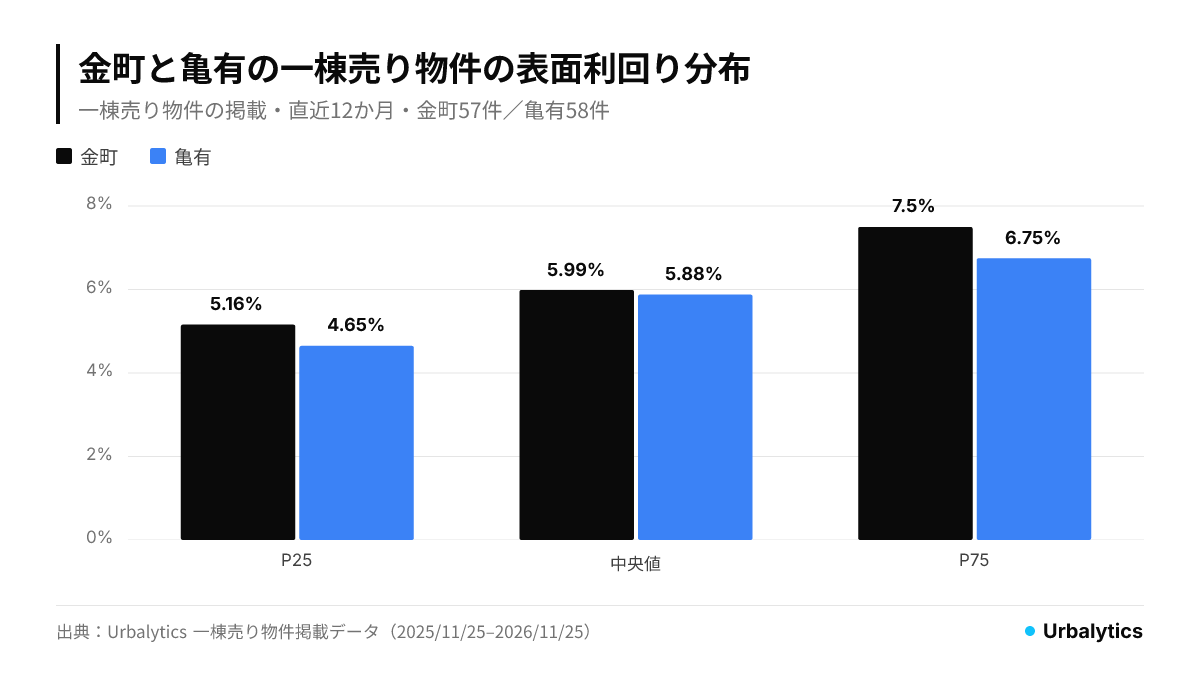
The whole-building sales market does not yet show a redevelopment premium. Over the past 12 months, the median gross yield for whole buildings listed for sale in Kanamachi was 5.99% (57 listings; lower quartile, P25, of 5.16%; upper quartile, P75, of 7.50%; and median asking price of approximately ¥122 million). Kameari’s median was 5.88% (58 listings; lower quartile, P25, of 4.65%; upper quartile, P75, of 6.75%). The medians were almost identical, with Kanamachi’s distribution slightly higher.
In practice, investors can approach this in three steps. First, value the property using current rents and building age. For single-occupant units in older buildings, rent assumptions should be benchmarked against the ¥2,380/m² band, not the ¥3,715/m² seen in newer listings. If a seller cites the north-exit redevelopment to justify a high price, check whether the rent roll already assumes future increases.
Second, landlords holding family-size homes should treat the year or two after completion in April 2031 as a period of leasing competition. Plan lease renewals, vacant-unit renovations and any decision to sell before delivery ahead of that milestone.
Third, check the walking route from the property to the north exit. The convenience gains from widening Rika Daigaku-dori and expanding MARK IS are clear, but the most direct beneficiaries are properties within walking distance of north-exit shops—not all of Kanamachi. Before buying, use the Tokyo Market Overview to compare local prices and asking rents, then check them against the income presented by the seller.
For examples of how nearby asking rents change before and after a station-front tower enters the market, see our analysis of Noborito’s 38-Story Station-Front Tower and Nearby Asking Rents and our case study on Tenant Competition After Ogawa’s Station-Front Tower Opened.
Data Notes
Rents are asking base rents from rental listings, excluding management fees, not achieved rents. The sample covers residential listings whose nearest station is Kanamachi—the station group comprising the JR Joban Line and Keisei Kanamachi Line—and which are within a 10-minute walk. It covers the past 12 months by first-observed date (November 25, 2025–November 25, 2026). Building-age groups use completion year. Family-size homes are defined as 50–80 m², regardless of age. The individual tower sample comprises 5 listings over the past 36 months and is for reference only. Asking rents per square meter in the market report include management fees and are calculated as average rent divided by average area; they are not directly comparable with the medians above. Whole-building yields are gross yields shown in sales listings, calculated as annual income divided by price. Depending on the listing provider, annual income may assume full occupancy or reflect current income. Cross-sectional differences do not establish changes over time or the redevelopment’s effect on asking rents. The assumption that 5% of homes enter the rental market illustrates scale; it is not a forecast.
Tags
#Kanamachi #KatsushikaWard #CrossKanamachi #MARKISKatsushikaKanamachi #TokyoRedevelopment #ResidentialTowers #FamilyRentals #AskingRentPerSquareMeter #WholeBuildingInvestment #GrossYield #Kameari #JobanLine #JapanRealEstate #Urbalytics
References
Higashi-Kanamachi Itchome West District Urban Redevelopment Association, Mitsubishi Estate, Mitsubishi Jisho Residence and Mitsui Fudosan Residential, “Construction Begins on Cross Kanamachi Phase II, Higashi-Kanamachi Itchome West District Type I Urban Redevelopment Project,” November 25, 2026. Link
Impress Watch, “Redevelopment of Kanamachi’s Former Driving School Site: Construction Begins on 40-Story Residential Tower; Directly Connected MARK IS Retail Space to Expand,” November 25, 2026. Link
Urbalytics, “Kanamachi Station Condominium Market Report,” October 2026. Link
Urbalytics rental listings and whole-building sales listings (November 25, 2025–November 25, 2026).
Copyright: This article is original content by the author. Please do not reproduce, copy, or quote without permission. For usage requests, please contact the author or this site.