Words: 2064 | Estimated Reading Time: 11 minutes | Views: 27
At a glance: Public facilities opened in November in the 27-story redevelopment tower at Ogawa Station’s west exit. Rental listings began appearing in a cluster in October, with asking rents per square meter well above those of existing family apartments nearby. For local rental buildings, the immediate changes are better amenities and a wave of competing listings—not an area-wide rise in rents.
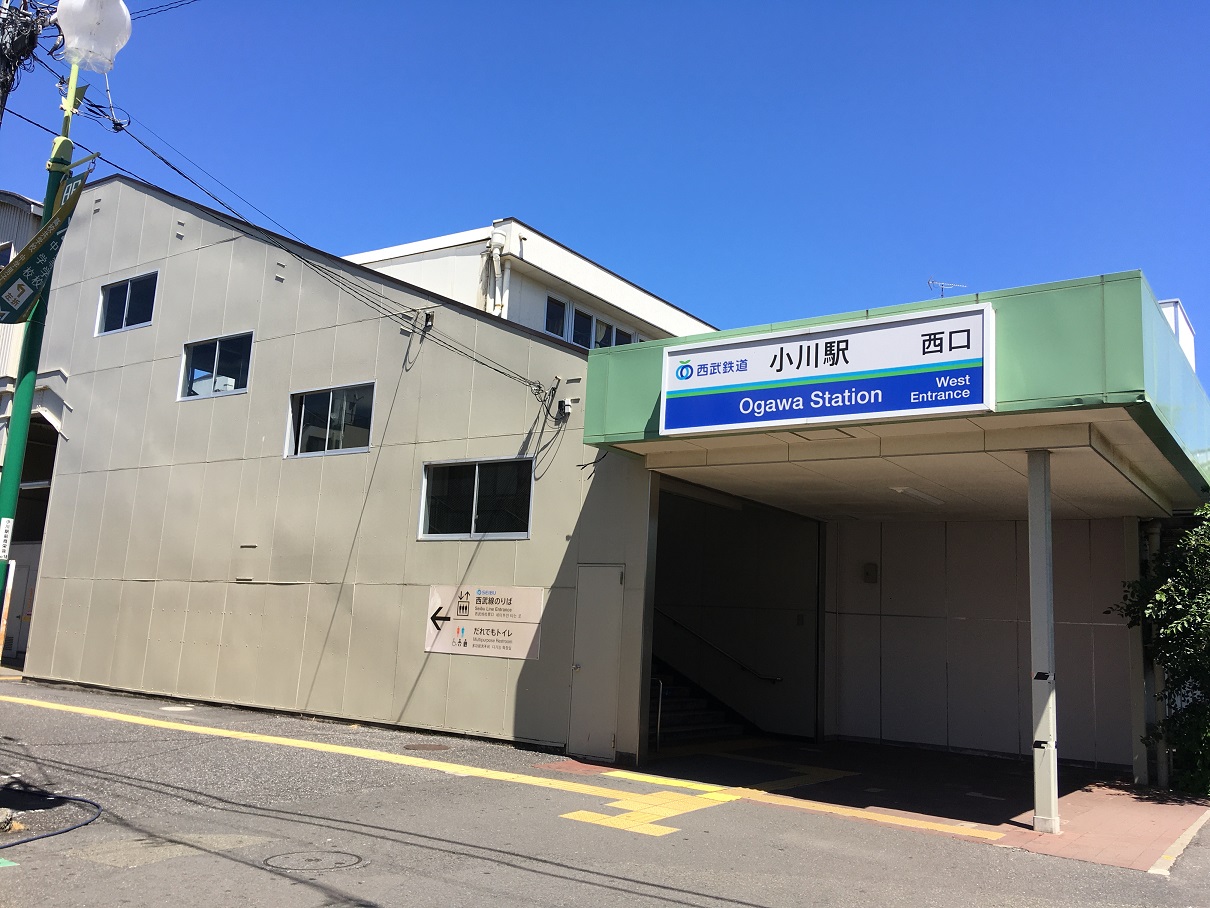
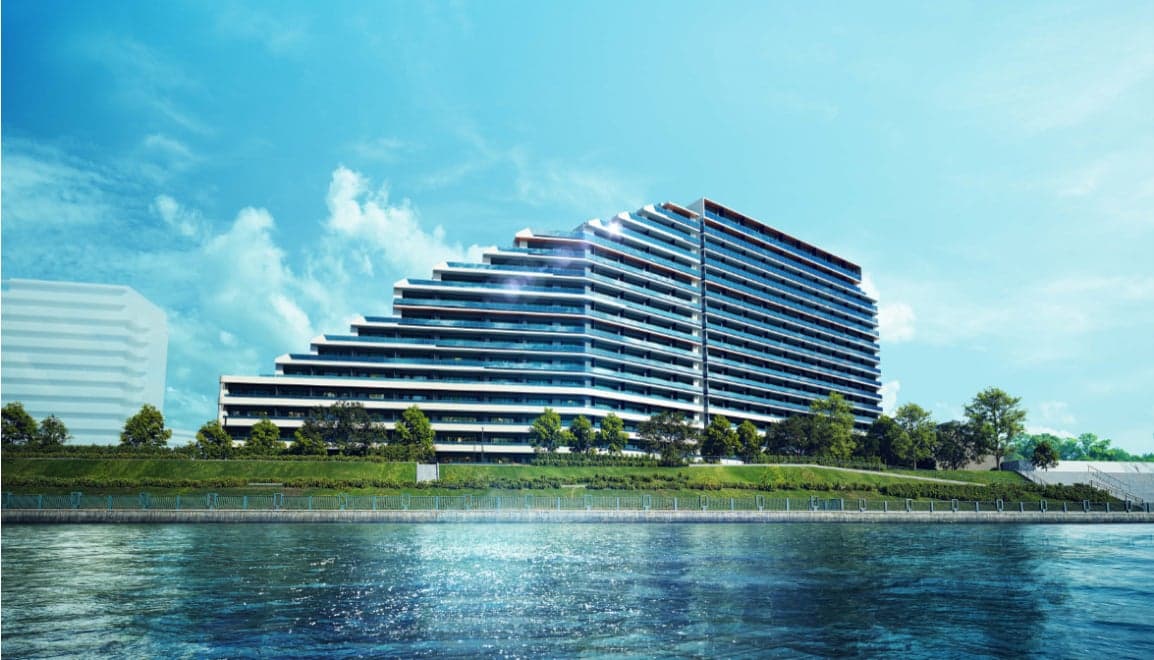
On November 1, 2026, the public facilities in Atlas Tower Kodaira Ogawa opened in front of Ogawa Station in Kodaira, Tokyo, where the Seibu Kokubunji and Haijima lines meet. According to Kenbiya’s on-site report dated November 12, the Co-op Mirai supermarket on floors 1–2 had already opened. Floor 3 houses Medical Square Ogawa Ekimae, a cluster of clinics, while floors 4–5 contain Ogawa Palette, a municipal complex with a library, the city’s western branch office, soundproof practice rooms and multipurpose rooms.
What does this mean for nearby landlords? A new tower outside a station often raises hopes that surrounding rents will rise. Yet Urbalytics rental-listing data suggest that the tower has initially introduced a new price tier and a batch of family-sized rentals listed at the same time. This article uses data from the tower, existing apartments around Ogawa Station and neighboring stations to assess how the redevelopment should factor into local rental-building valuations.
Where the project stands
Officially named the Ogawa Station West Exit District Type I Urban Redevelopment Project, the development is being carried out by a redevelopment association. According to the Tokyo Metropolitan Government’s Bureau of Urban Development project page, the site covers approximately 1.2 hectares and includes 218 homes, alongside retail, business premises, public facilities and parking. Total floor area is approximately 40,269 m², with a total project cost of approximately ¥25.2 billion. The plan for reallocating property rights was approved in January 2023, and building work began in December of the same year. Building completion was scheduled for fiscal 2026.
The tower has 27 above-ground stories. Ogawa Palette’s official website confirms that it occupies floors 4–5 at 4-16-1 Ogawa Nishimachi. It is listed as a 1-minute walk from Ogawa Station’s west exit and remains open until 10 p.m. The building has timed paid parking for 59 cars and 288 bicycles.
Work outside the station is not yet complete. The transport forecourt, covering approximately 3,700 m² as part of the planned urban road, and a separate plaza of approximately 1,000 m² remain under construction. Kenbiya reports that the forecourt is intended primarily for the Burube-go community taxi service, passenger drop-offs and pickups, and taxis. There are currently no plans to introduce large scheduled buses.
The station itself has a longer timetable. In an announcement dated November 13, 2024, Seibu Railway said that it and Kodaira City had signed a basic agreement covering a public passageway and railway-facility improvements, targeting completion in fiscal 2031. The current station building spanning the tracks opened in 1964 and is the oldest surviving example of this type on the Seibu network. Kenbiya reports that construction is expected to begin around fiscal 2028, although Seibu’s announcement does not specify a start year. Before then, a temporary pedestrian bridge will connect floor 2 of the tower to the ticket gates.
Property assessments should therefore distinguish between two changes. The supermarket, clinics, library and municipal service counters are already available, delivering tangible everyday convenience. The transport forecourt, pedestrian bridge and new station building are still under construction or in design, so improvements to access remain several years away.
Tower rentals: a month’s listings exceed the surrounding area’s two-year total
Urbalytics rental-listing records show that Atlas Tower Kodaira Ogawa had 26 residential rental listings over the past 12 months, of which 24 first appeared in October 2026. The units average approximately 71.6 m² and are mainly 2LDK and 3LDK layouts—bedrooms plus a living, dining and kitchen area. The median monthly asking rent was ¥216,000, with a median asking rent per m² of ¥3,048. Lower-floor 3LDK units were mostly listed at just over ¥200,000 a month, while larger units on floor 27 were listed at ¥289,000–¥339,000.
By comparison, existing apartments of 50–90 m², built in 2025 or earlier and within a 15-minute walk of Ogawa Station, had only 14 listings over the past 24 months. Median monthly asking rent was ¥110,000, or ¥1,934 per m². The tower’s asking rent per m² was approximately 58% higher, and its family-sized listings in a single month exceeded the existing local apartment stock’s two-year listing total.
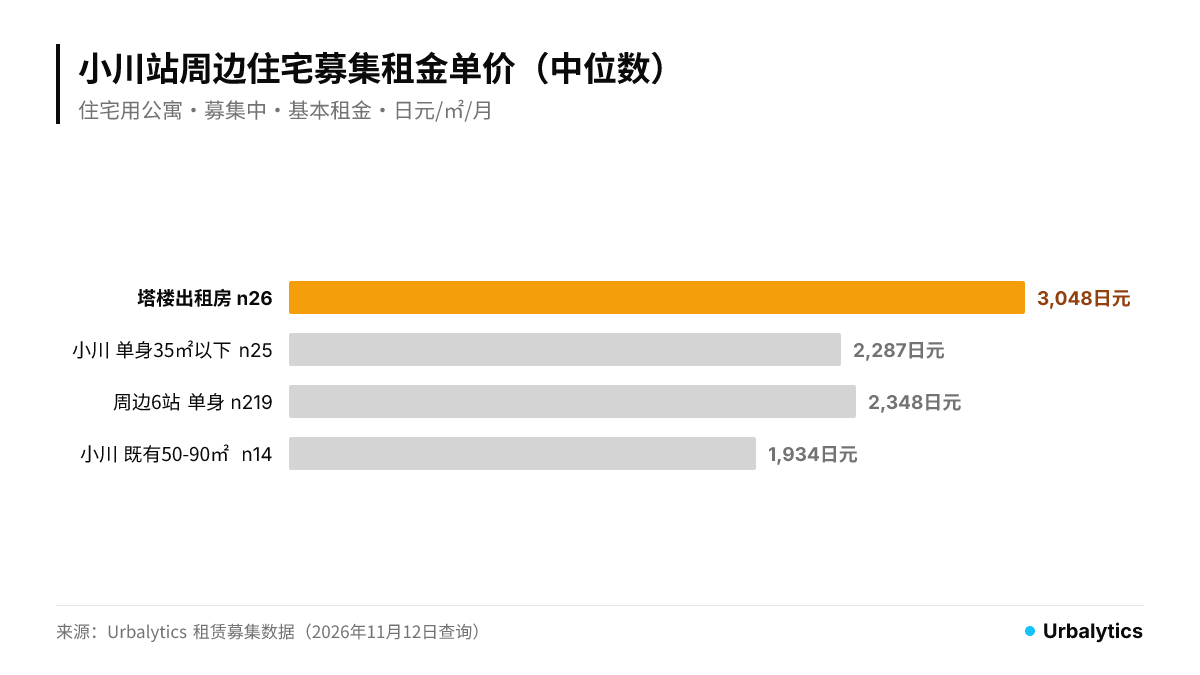
That 58% gap does not mean that redevelopment has raised Ogawa rents by 58%. The tower is a new high-rise with direct station access, a supermarket and public facilities. Existing family apartments nearby are mostly low- and mid-rise buildings from the 1990s through the 2000s. These are different products. A more accurate reading is that the Ogawa Station area now has, for the first time, a family-rental tier asking around ¥3,000 per m².
There is no sign of a spillover into single-occupant apartment rents either. Apartments of 15–35 m² within a 10-minute walk of Ogawa Station generated 25 listings over the past 12 months, with a median monthly asking rent of ¥55,000, or ¥2,287 per m². Across the 6-station area including Higashi-Yamatoshi, Hitotsubashi-Gakuen, Kodaira, Takanodai and Hagiyama, the figure was ¥2,348 per m² across 219 listings. Ogawa’s single-occupant apartments are not more expensive than those around neighboring stations.
Competition is the near-term issue to watch. The tower’s 26 rentals are simultaneously seeking households whose annual incomes can support monthly rent of ¥200,000 or more—a relatively small tenant pool. Some units will move down in price through negotiation, competing with better-quality existing 3LDK apartments nearby. Over the coming months, vacancy periods and rents agreed for existing family apartments deserve closer attention than the tower’s asking rents.
Tower sale prices are high, but the surrounding market has not followed
Resale listings have also appeared in the tower. Of the 4 listings recorded by Urbalytics, 3 units measuring 74–75 m² are asking ¥82.8 million–¥84.8 million, or approximately ¥1.1 million per m². Two have been reduced from ¥85.8 million. A 62.71 m² 2LDK is listed at ¥56.8 million.
A rough comparison with similarly sized rental listings in the same building puts monthly asking rent for a roughly 74 m² 3LDK at approximately ¥210,000. Against an asking sale price of around ¥83 million, that implies a gross yield of approximately 3.0%. For the 2LDK, using an asking rent of ¥189,000 for the same floor area gives approximately 4.0%. These are rough listing-to-listing calculations across different floors, before management fees and repair reserve contributions.
For the same period, Urbalytics’ Ogawa Station condominium market report shows a median asking price of ¥378,000 per m² for individually owned apartments listed around the station in October 2026, below Kodaira City’s ¥527,000 per m², with a sample of 12 listings. Kenbiya also reports that resale 3LDK–4LDK apartments within a 15-minute walk are still mostly priced at ¥20 million–¥60 million, with no evident redevelopment premium.
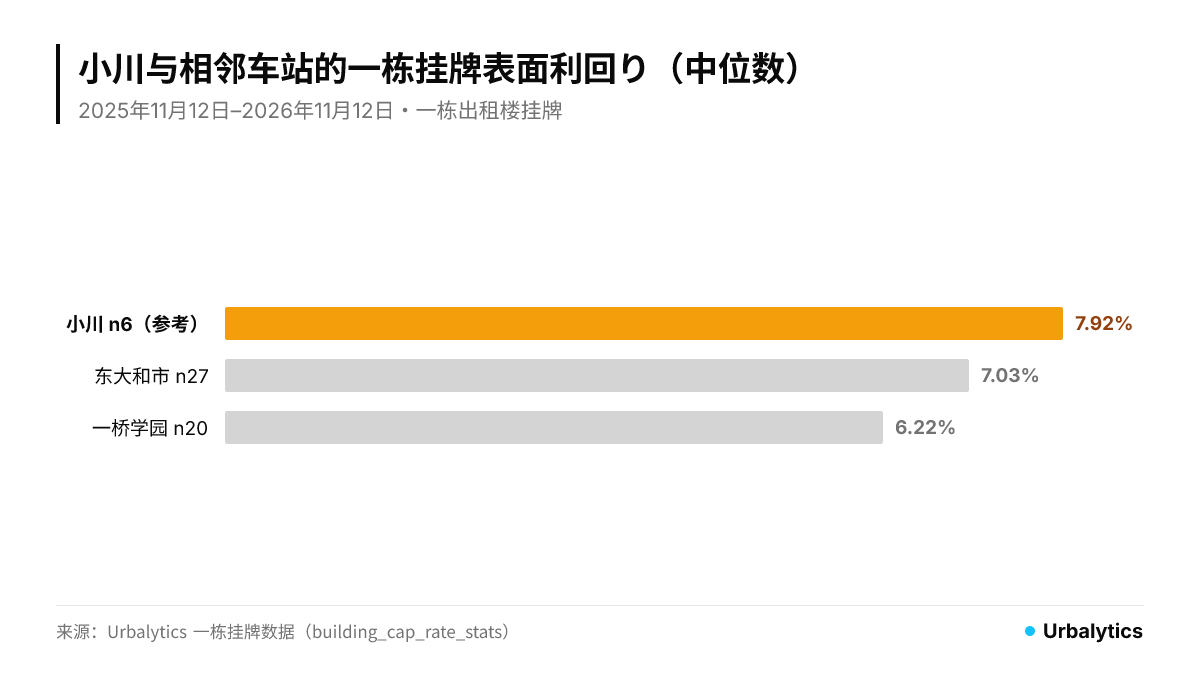
Whole rental buildings also remain priced like suburban investments. Listings over the past 12 months show a median gross yield of 7.92% around Ogawa Station, although the sample of just 6 buildings makes this indicative only. Higashi-Yamatoshi, also on the Haijima Line, recorded 7.03% across 27 buildings, while Hitotsubashi-Gakuen on the Seibu Tamako Line recorded 6.22% across 20 buildings. There is no sign that the station-front tower has compressed yields in Ogawa.
How to value existing rental buildings
Owners and prospective buyers of existing rental buildings around Ogawa Station can assess the redevelopment in three parts.
First, consider the amenities already delivered. A large supermarket, clinics and a library open until 10 p.m. offer a tangible improvement for both single occupants and families within walking distance. This is more likely to support faster leasing and shorter vacancies than immediate rent increases. It can support the stability of current rents in a valuation, but does not justify pricing in a rent uplift in advance.
Second, consider competition from the tower. The large rent gap limits direct substitution between its units and existing family apartments. Still, good-quality existing 3LDK units asking ¥130,000–¥140,000 a month may attract tenants who cannot afford the tower—or lose tenants if tower rents are reduced. Owners of these properties should monitor their own inquiries and rents agreed over the coming months rather than rush to follow the tower’s pricing.
Third, separate out access improvements that have yet to arrive. The transport forecourt, temporary pedestrian bridge and new station building targeted for completion in fiscal 2031 will improve east–west movement and passenger pickup and drop-off access. Their effect on rents, however, must be assessed after completion and should not be included in current income for valuation purposes.
With advertised whole-building gross yields still in the 7–8% range, buying a rental building around Ogawa today is primarily a purchase of existing income and improved local amenities. Potential upside from the future station rebuild has not, at least in asking prices, been widely priced in.
In practice, owners of family-sized units within a 5-minute walk of the station can review actual leasing outcomes for lower-floor 3LDK units in the tower before deciding whether to adjust rent at the next tenant turnover. Prospective buyers can use Urbalytics’ Kodaira City whole-building market report to check advertised yields, underwriting current fully occupied rental income and vacancy periods rather than hypothetical rents after the station rebuild.
For a comparison with other station-front redevelopment projects, see How Kami-Itabashi’s South Exit Transport Forecourt Affects Rental-Building Valuations; for demand spillover and price divergence along the Haijima Line, see Diverging Markets in Outer Tokyo: Ukima-Funado and Higashi-Yamatoshi; and for the competition facing existing rentals when new family housing arrives in a concentrated wave, see Assessing 780 New Homes in Monzen-Nakacho. For Kodaira City’s broader whole-building and condominium markets, consult Kodaira City Whole-Building Investment Property Market Report, Ogawa Station Condominium Market Report and Tokyo Market Report.
Data notes
All rents are asking rents recorded in Urbalytics rental listings, based on base rent excluding management fees. They do not represent rents agreed in signed leases. Tower data were retrieved by building name and cover residential listings of all statuses over the past 12 months (26 listings). The existing-apartment sample around Ogawa Station covers actively marketed residential apartments of 50–90 m² within a 15-minute walk, built in 2025 or earlier, over the past 24 months. The sample is small, at 14 listings.
Single-occupant apartments are 15–35 m² units within a 10-minute walk, listed over the past 12 months. Whole-building yields use listing data from November 12, 2025 to November 12, 2026, with duplicate listings consolidated and outliers below 1% or above 25% excluded. Ogawa has only 6 buildings in the sample, so its results are indicative only. Resale prices are asking prices, and gross yields are rough calculations using listings on different floors.
#OgawaStation #Kodaira #SeibuHaijimaLine #SeibuKokubunjiLine #StationFrontRedevelopment #AtlasTowerKodairaOgawa #TokyoTama #RentalApartments #FamilyApartmentRents #WholeBuildingGrossYields #JapanRealEstateInvestment #RentalMarket #Urbalytics
Sources
Kenbiya, 2026, Completion of the Redevelopment Tower at Seibu’s Ogawa Station, Kodaira, Tokyo: https://www.kenbiya.com/ar/ns/region/tokyo/10690.html
Tokyo Metropolitan Government Bureau of Urban Development, Ogawa Station West Exit District Type I Urban Redevelopment Project, updated October 31, 2025: https://www.toshiseibi.metro.tokyo.lg.jp/machizukuri/shigaichi_seibi/sai-kai/saikaihatsu/ogawa__02
Seibu Railway, 2024, Basic Agreement on a Public Passageway and Railway-Facility Improvements at Ogawa Station on the Kokubunji Line: https://www.seiburailway.jp/file.jsp?id=23291
Ogawa Palette, Kodaira City’s Ogawa Station West Exit Municipal Complex, official website: https://ogawa-palette.jp/
Traffic News, 2023, Construction Begins on a 27-Story Redevelopment Tower Directly Connected to Ogawa Station: https://trafficnews.jp/post/129817
Urbalytics, Ogawa Station Condominium Market Report (October 2026): https://www.urbalytics.jp/market/station/tokyo/%E5%B0%8F%E5%B7%9D/mansion
Copyright: This article is original content by the author. Please do not reproduce, copy, or quote without permission. For usage requests, please contact the author or this site.