Words: 1627 | Estimated Reading Time: 9 minutes | Views: 22
Tokyo Midtown Nihonbashi was completed on September 30, 2026, with Nomura Holdings, Daiichi Sankyo's headquarters and Bank of America's Japan operations moving in progressively. Owners of rental buildings around Ningyocho, Kayabacho and Kodemmacho need to distinguish between demand already in place and demand that may not arrive until 2027 or even 2040—and assess how much of that expectation is already reflected in the gross yields advertised for nearby buildings.
What has been completed, and what has yet to open
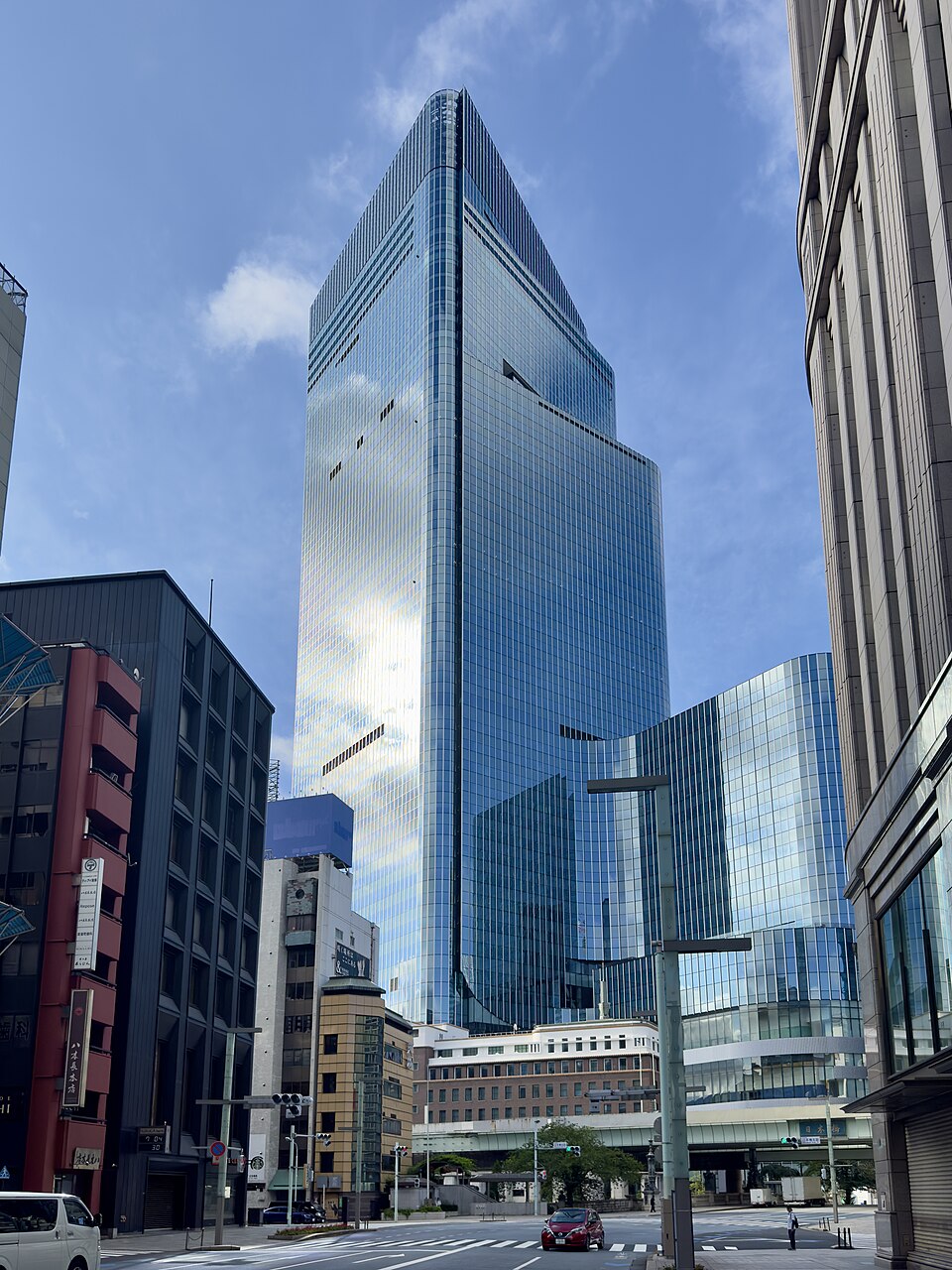
The Nihonbashi Itchome Central District Type One Urban Redevelopment Project covers approximately 3 hectares. With Mitsui Fudosan and Nomura Real Estate participating, it comprises Blocks A, B and C plus the existing Nihonbashi Itchome Mitsui Building in Block D. The development connects directly to Nihonbashi Station on the Ginza, Tozai and Asakusa lines.
The main building, Nihonbashi Nomura Mitsui Tower in Block C, has 52 floors above ground and 5 basement floors, and stands approximately 284 meters tall. Floors 10–20 and 22–38 house offices, with typical floor plates of approximately 1,970 tsubo and 1,370 tsubo, respectively. Tsubo is a Japanese unit of floor area.
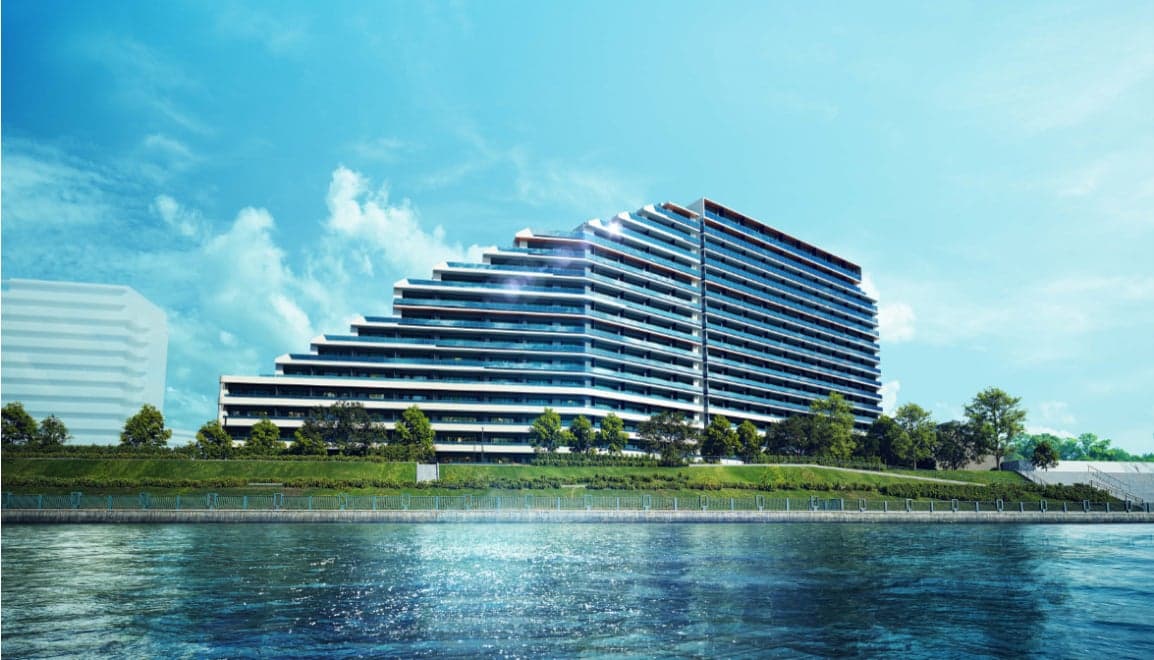
Floors 39–47 house Hilton's Waldorf Astoria hotel (197 guest rooms), while floors 48–51 contain 71 rental apartments at Waldorf Astoria Residences Tokyo Nihonbashi, with rental apartments measuring approximately 60–430 m². Nihonbashi Riverside Terrace in Block B contains a further 48 units of housing.
According to Mitsui Fudosan's announcement dated October 8, office tenants are the first occupants following completion. The MICE facilities—meetings, incentives, conferences and exhibitions—on floors 5–8, including two halls of approximately 1,500 m² each, each accommodating around 1,600 people, are scheduled to open in October 2027; the retail area, covering approximately 20,000 m² with around 100 units, is planned to open during 2027. The former COREDO Nihonbashi temporarily closed for renovation on October 15. The district's grand opening is also scheduled for 2027.
This building is only the first phase of Nihonbashi Riverwalk. An area of approximately 11 hectares along the Nihonbashi River includes 5 redevelopment projects, alongside the relocation of the Nihonbashi section of the Shuto Expressway underground. Removal of the elevated expressway is expected around 2040.
Which homes could attract new demand?
Office tenants arrive first, bringing demand for convenient commutes. Some employees at these headquarters-level offices will choose homes within walking distance or a single subway stop away. That demand would most directly benefit 1K to 1LDK layouts suited to singles and dual-income couples without children; K denotes a kitchen, while LDK denotes a living, dining and kitchen area. This is a proposed demand mechanism, not an observed result: no public figures currently show how many employees will move in or how many will rent nearby.
The hotel and MICE facilities bring overnight guests and visitors, with limited impact on conventional monthly residential rentals. Their effects are more likely to appear first in restaurant and retail tenants' businesses. The tower's 71 rental residences target affluent tenants and do not compete in the same market as the area's typical compact apartments of 20–40 m².
Residential stock immediately around Nihonbashi and Mitsukoshimae stations is limited. Over the past 12 months, Urbalytics recorded only 112 residential rental listings within a 7-minute walk of these stations. Over the same period, the Ningyocho–Suitengumae area recorded 790 listings, and the Kodemmacho–Higashi-nihombashi area recorded 627 listings. If office workers look for homes nearby, leases are more likely to be signed around these stations farther out.
Current asking rents: higher per square meter at core stations, similar monthly totals
Median asking rents per square meter, calculated from base rent excluding management fees, divide the four station areas into two groups:
Kayabacho: asking rent per m² of 5,381 yen, median monthly asking rent of 164,000 yen; 192 listings
Nihonbashi–Mitsukoshimae: asking rent per m² of 5,365 yen, median monthly asking rent of 164,000 yen; 112 listings
Ningyocho–Suitengumae: asking rent per m² of 4,975 yen, median monthly asking rent of 174,000 yen; 790 listings
Kodemmacho–Higashi-nihombashi: asking rent per m² of 4,974 yen, median monthly asking rent of 165,000 yen; 627 listings
The gap in asking rent per square meter between the two core stations and the Ningyocho area is approximately 390 yen. Monthly totals show the reverse pattern: Ningyocho has a higher median because its listed apartments average approximately 37.2 m², compared with about 33.8 m² in Nihonbashi–Mitsukoshimae. To estimate the rental ceiling for your own property, compare rents per square meter rather than monthly medians directly.
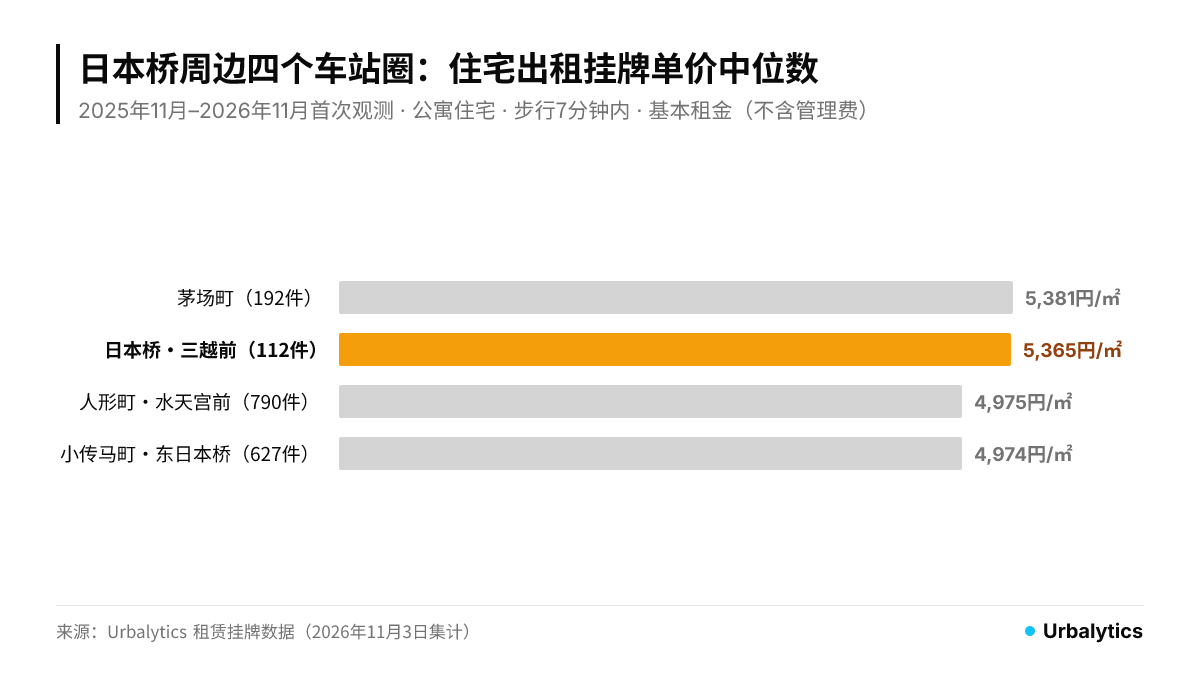
These figures compare different locations over the same period. They reflect location and the mix of building ages, not rent increases caused by Tokyo Midtown Nihonbashi. The sample mix also changes substantially between quarters, so quarterly figures cannot be treated as rent growth for the same properties. A meaningful test of the project's impact is whether asking rents per square meter around Ningyocho and Kodemmacho converge toward core-station levels around the opening of the MICE facilities and retail area in 2027.
Whole-building gross yields are already thin
Asking prices for nearby income-producing buildings deserve closer scrutiny. Among whole buildings listed or repriced over the past 12 months, the Ningyocho station area had 9 buildings with a median advertised gross yield of 3.97%, while the Kodemmacho station area had 6 buildings with a median of 3.64%. Kayabacho had only 3 buildings, with a median of 4.33%, and the Nihonbashi station area had no observations.
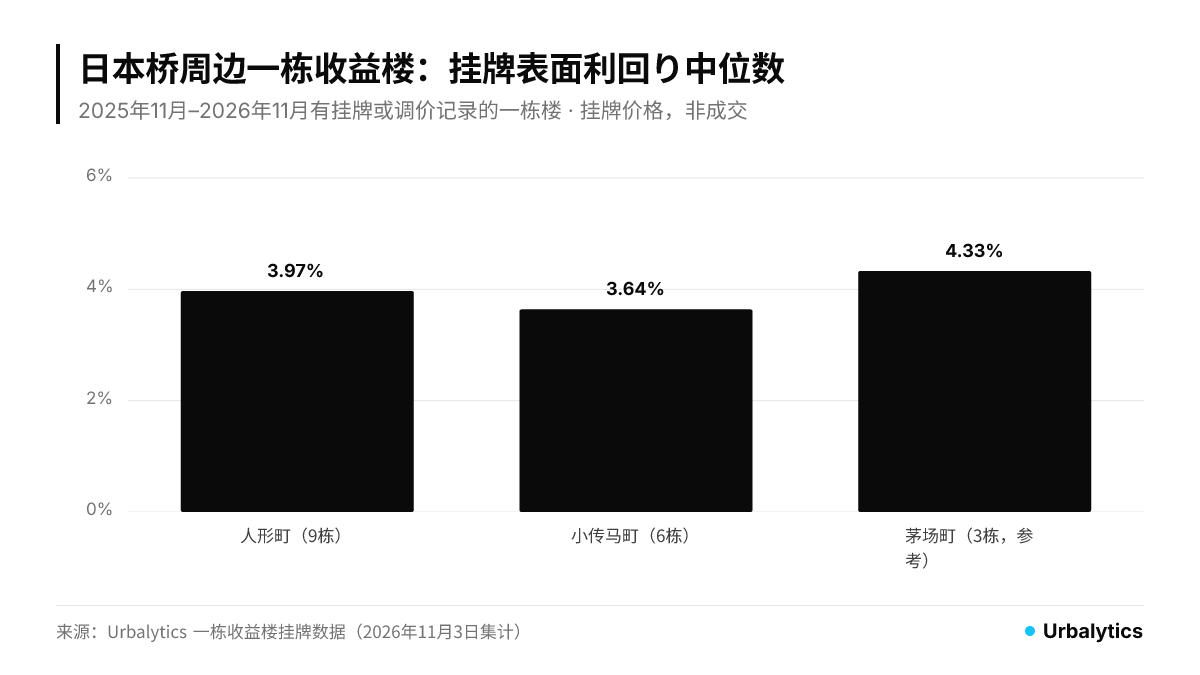
These yields are not particularly low relative to Chuo Ward as a whole. Urbalytics' published Chuo Ward Whole-Building Investment Property Monthly Market Report reports a whole-building gross yield for Chuo Ward in September 2026 of 2.77% (33 listings), compared with a Tokyo-wide average of 5.00%. Stations farther out from central Nihonbashi offer slightly higher gross yields than the ward average, but remain well below 5%.
Gross yield is calculated by dividing advertised annual income by the asking price, before deductions for management, repairs or vacancy. Buying at a gross yield of 3.6% to 4.0% leaves a lower return after expenses, and improving income depends on rent increases. Buyers incorporating Tokyo Midtown Nihonbashi into their income projections need to validate those increases against actual leasing outcomes.
Urbalytics Data Insights
Filter Urbalytics rental statistics by station, walking time and floor area to compare your property's asking rent per square meter with the distribution of comparable properties in Ningyocho or Kodemmacho. Across the four station areas here, the lower quartile (P25) was approximately 4,450–4,770 yen per m², and the upper quartile (P75) was approximately 5,430–6,070 yen per m².
Implications for valuation and property management
Owners of rental buildings around Ningyocho and Kodemmacho can start by comparing their available units' asking rents per square meter with the core-station benchmark of 5,365 yen per m². For units well below that level, modest increases can be tested when leases are renewed or units are marketed to new tenants. Actual signed leases should guide decisions, rather than a blanket increase based on completion news.
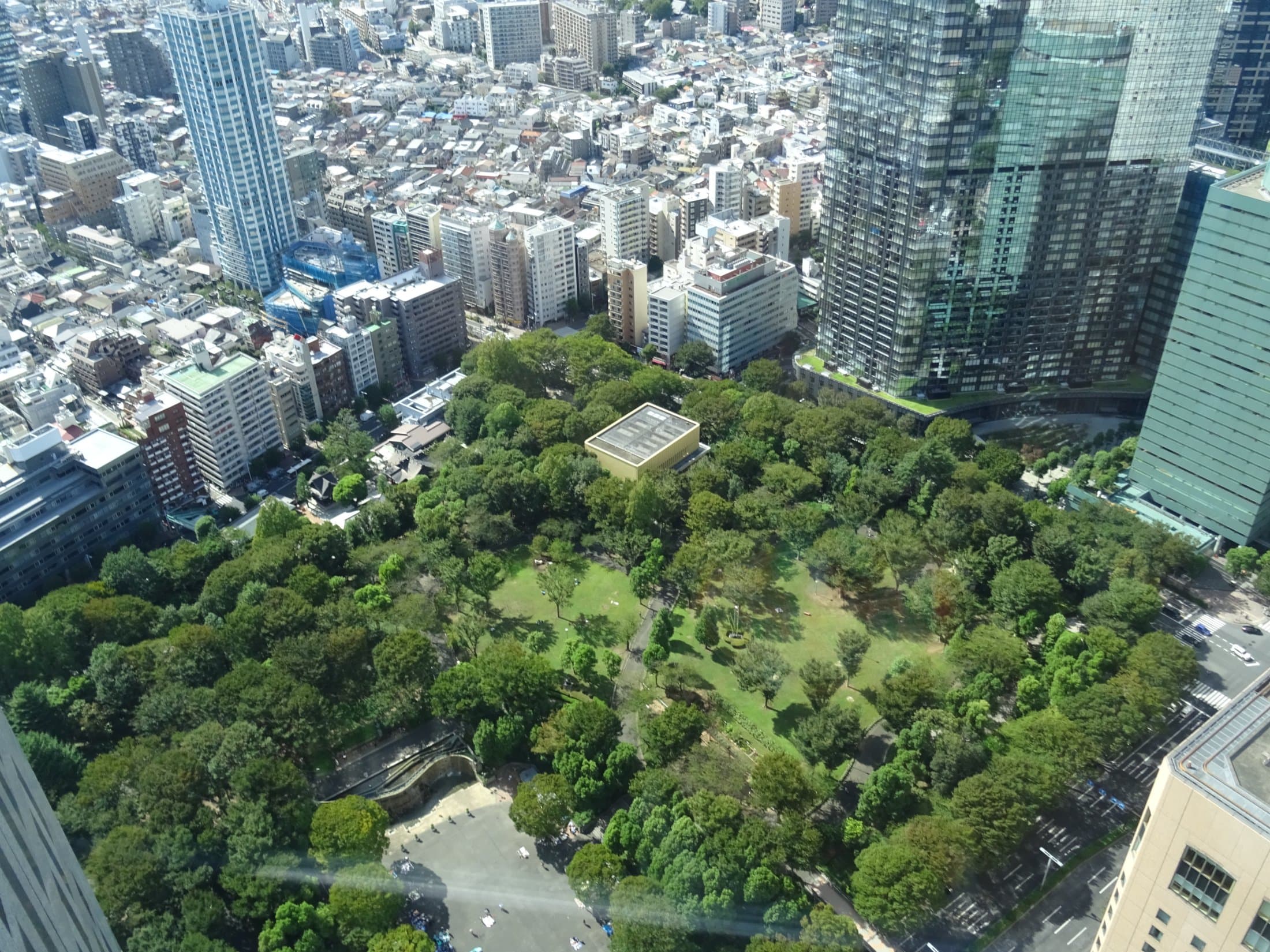
For valuation purposes, office tenants moving in is an established fact. The MICE facilities and retail area are not scheduled to open until 2027 and should remain items to monitor. Removal of the elevated Shuto Expressway is expected around 2040, more than a decade away, and should not be included in current rent assumptions. As earlier analyses illustrate, the phased redevelopment of the Roppongi Gochome West District and the proposed 39-story development northwest of Shinjuku Central Park likewise require a year-by-year distinction between completed work and planned phases.
Investors considering whole buildings in Ningyocho or Kodemmacho at gross yields in the 3% band should first check whether each unit's rent per square meter on the rent roll already exceeds the station-area median. Where rents are already high, the project's effect may already be reflected in in-place leases, leaving limited additional rental upside. Buildings with rents still below the median and predominantly 1K to 1LDK layouts offer more tangible scope for adjustment.
Data notes
Rental data consists of asking rents collected by Urbalytics—base rent excluding management fees, with tax treatment unspecified—not rents agreed in signed leases. The sample comprises apartment listings in Tokyo first observed from November 3, 2025 to November 3, 2026, within a 7-minute walk of the relevant stations. “Kodemmacho–Higashi-nihombashi” groups Kodemmacho and Higashi-nihombashi stations, including Bakurocho and Bakuro-yokoyama.
Whole-building yields are advertised gross yields for income-producing buildings listed or repriced during the same period. Duplicate listings across websites have been consolidated, and yields below 1% or above 25% have been excluded. Depending on the listing provider, annual income may assume full occupancy or reflect current occupancy.
Kayabacho's whole-building sample contains only 3 buildings and is indicative only. Chuo Ward's 2.77% figure comes from the published monthly market report for September 2026. Its monthly aggregation differs from the station areas' 12-month window, so the figures should not be compared by directly subtracting one from the other.
#TokyoMidtownNihonbashi #NihonbashiRedevelopment #NihonbashiRiverwalk #Ningyocho #Kodemmacho #Kayabacho #ChuoWard #TokyoRents #WholeBuildingInvestment #GrossYield #JapanRealEstateInvestment #Urbalytics
Sources
Mitsui Fudosan, 2026, “Tokyo Midtown Nihonbashi Completed on September 30, 2026” https://www.mitsuifudosan.co.jp/corporate/news/2026/1008_01/
Nomura Real Estate, 2026, “District Name Announced for the Nihonbashi Itchome Central District Type One Urban Redevelopment Project” https://www.nomura-re.co.jp/cfiles/news/n2026042106653.pdf
Impress Watch, 2026, “Tokyo Midtown Nihonbashi Completed” https://www.watch.impress.co.jp/docs/news/2146690.html
Kenbiya, 2026, “Tokyo Midtown Nihonbashi Completed: Mixed-Use Tower Approximately 284 m Tall” https://www.kenbiya.com/ar/ns/region/tokyo/10662.html
Urbalytics, 2026, “Whole-Building Investment Property Market in Chuo Ward, Tokyo” https://www.urbalytics.jp/market/area/tokyo/chuo-ku/building
Cover image: Nihonbashi Bridge and the elevated Shuto Expressway (Photo: ayumi kubo / Unsplash)
Copyright: This article is original content by the author. Please do not reproduce, copy, or quote without permission. For usage requests, please contact the author or this site.