Words: 1665 | Estimated Reading Time: 9 minutes | Views: 49
At a glance: With completion of Nishi-Shinjuku’s planned 37-story concert hall tower not due until 2031 and its housing count still undisclosed, nearby rentals should be priced against the existing rent gap between newer and older buildings.
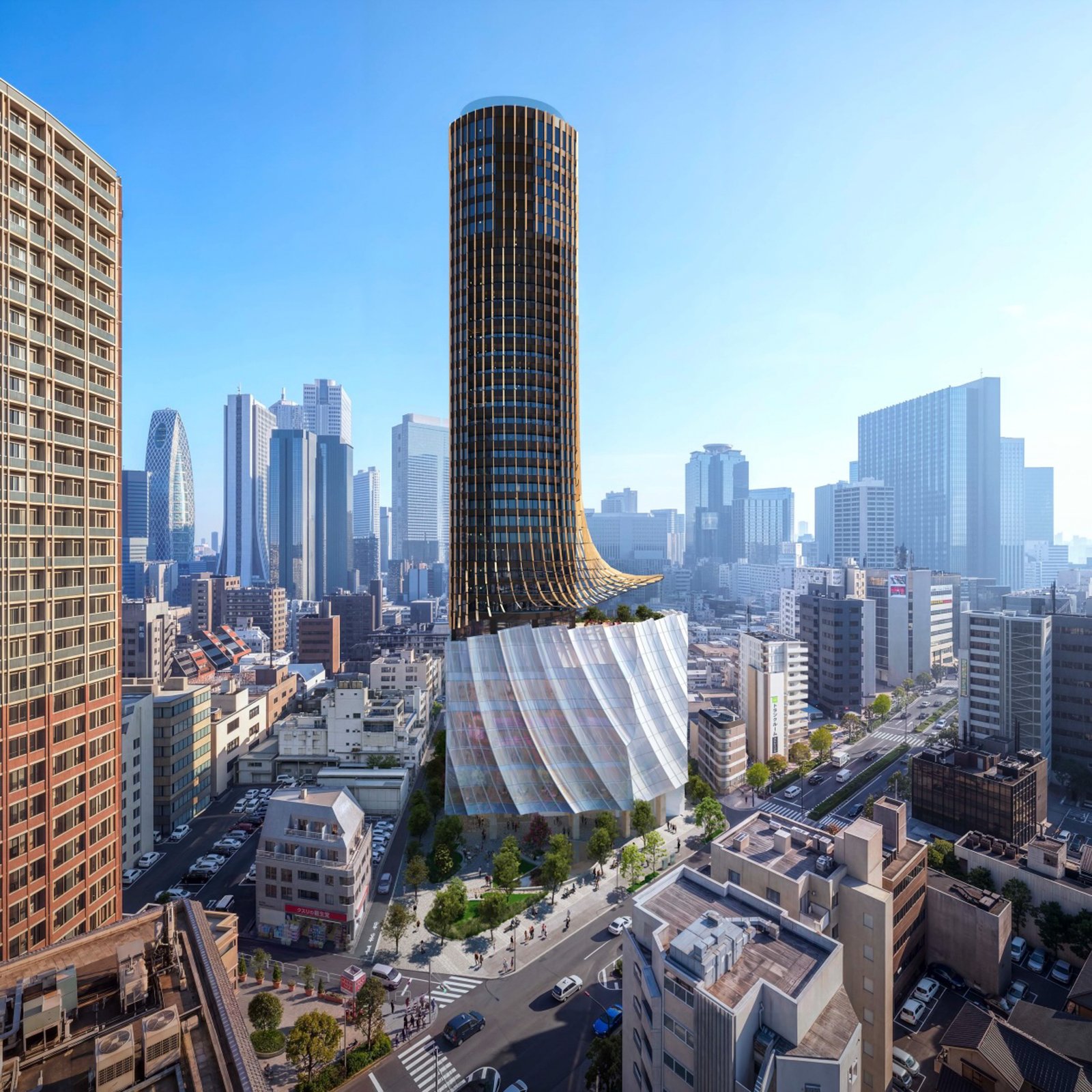
Sanwa Real Estate announced the provisionally named Nishi-Shinjuku Hachome Project on its website on November 14, with multiple media outlets reporting on it from November 18. The plan calls for a mixed-use building on Shinjuku Zeimusho-dori in Nishi-Shinjuku Hachome, Shinjuku Ward, with 2 basement levels, 37 above-ground stories and a height of approximately 150 meters. A concert hall would anchor the development, alongside apartments, offices and shops. Frank Gehry’s Gehry Partners is designing the concert hall and lower floors, while Kengo Kuma & Associates is responsible for the tower’s exterior and the interiors of its common areas.
For investors who own or are considering buying rental property near Nishi-Shinjuku Station, the questions are specific: could this building change nearby rents and property values? If so, when and how?
What has been announced—and what remains undecided
Sanwa Real Estate’s release sets out the building specifications: commercial zoning, a site of approximately 3,860 m², a building footprint of approximately 2,000 m² and total floor area of approximately 45,700 m². Construction would be reinforced concrete, with some steel-reinforced concrete and steel sections. Index is managing the project, Kume Sekkei is coordinating the basic design, and Nagata Acoustics is designing the concert hall’s acoustics, with Yasuhisa Toyota as adviser. A contractor is still being selected.
The timetable comes from media reports, not the release itself: both Sankei Shimbun and Nikkan Kensetsu Kogyo Shimbun report a construction start in August 2027 and completion in March 2031. According to Nikkan Kensetsu Kogyo Shimbun, the site includes lot 129-1 in Nishi-Shinjuku Hachome, approximately 400 meters northwest of Nishi-Shinjuku Station on the Tokyo Metro Marunouchi Line. Sankei Shimbun adds that the land formerly housed the Asuka Hotel, which closed in 2013, and an adjoining building, and is currently used as a parking lot.
The information rental investors need most has not yet been disclosed: the number of homes, the unit-size mix, whether the apartments will be sold or retained for rental, and the concert hall’s seating capacity. Without these details, the amount of supply the project could add to the local rental market cannot be estimated.
Which nearby properties could be affected?
Based on what is known, the effects fall broadly into two phases, neither of which is immediate.
Construction is scheduled from August 2027 to March 2031. Small rental buildings along Shinjuku Zeimusho-dori immediately adjoining the site may face construction noise and works traffic, requiring more explanation to prospective tenants. This is a general inference; the actual impact depends on the construction plan, for which no public information is currently available.
From 2031 onward, if the tower’s apartments enter the rental market, they would compete with nearby newer, high-rise, well-equipped properties—not older low-rise buildings a few minutes’ walk away. The concert hall can bring foot traffic and attention to the neighborhood, but there is currently no verifiable evidence that it would raise rents for nearby one-bedroom apartments. That possibility should not be included in valuations.
Another major project is planned nearby: the Nishi-Shinjuku Rokuchome West District redevelopment, northwest of Shinjuku Central Park. Plans call for 39 above-ground stories, a height of approximately 160 meters and approximately 400 homes, with construction scheduled to begin in fiscal 2031 and finish in fiscal 2037. Both projects are more than five years away; current rents will not price them in ahead of time.
Rents near Nishi-Shinjuku Station: building age drives the gap
What, then, does the current market pay a premium for? Using Urbalytics residential rental listings from the past 12 months, we selected properties of 20–80 m² whose nearest station is Nishi-Shinjuku and compared median monthly asking rent per square meter by completion year.
All listings: JPY 5,310/m² (345 listings; median monthly asking rent: JPY 180,000)
Completed in 2016 or later: JPY 5,876/m² (144 listings; median monthly asking rent: JPY 224,000)
Completed in 2015 or earlier: JPY 4,931/m² (198 listings; median monthly asking rent: JPY 160,000)
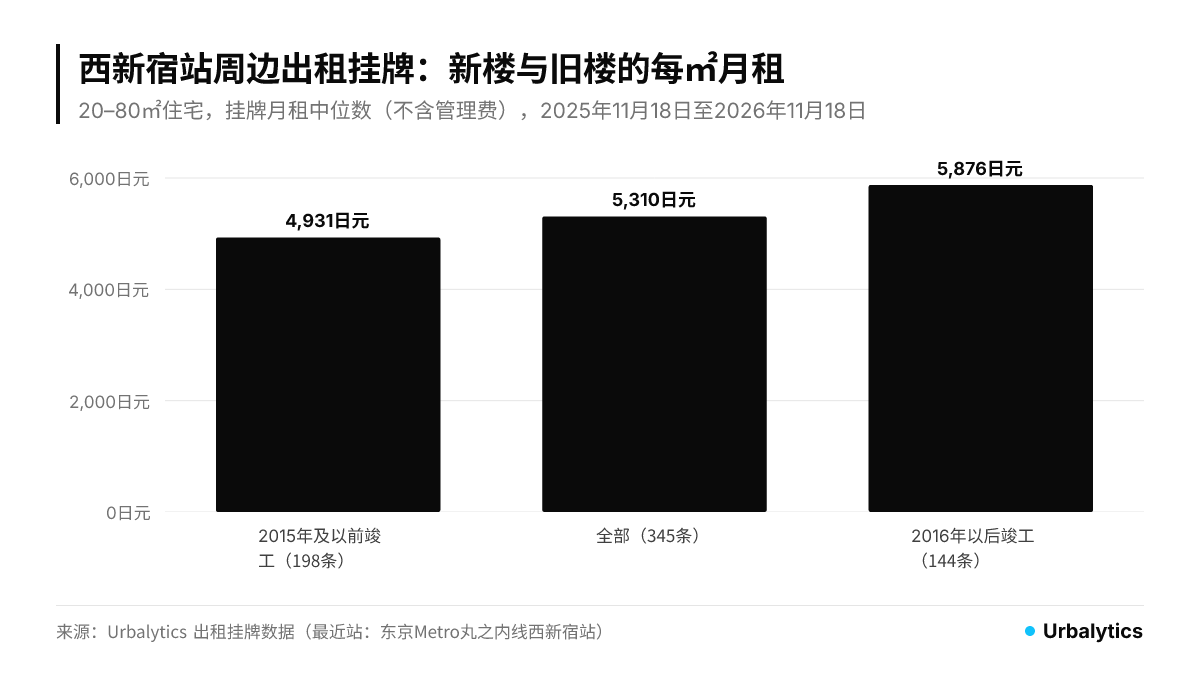
The group completed in 2016 or later has asking rents approximately 19% higher than the group completed in 2015 or earlier. The newer group includes a concentration of listings in ZEH rental apartments—housing designed for net-zero energy consumption—completed in 2026, as well as a small apartment building in Hachome completed in 2024. Typical properties near the older group’s median are apartments for single occupants completed between 2006 and 2008. In other words, a clear premium for newer buildings already exists near Nishi-Shinjuku Station. It developed before the Hachome project was announced and is unrelated to it.
These figures help assess the Hachome tower’s impact in two ways. First, if it offers rental apartments from 2031 onward, its most direct effect would be to increase supply in the newer-building group, competing for the same tenants. Second, properties completed in 2015 or earlier already compete on lower asking rents per square meter. They will be another five years older when the tower is completed, making the gap with newer buildings more likely to widen than narrow.
Urbalytics Data Insight
Filtering Urbalytics rental data by nearest station, floor area and completion year helps isolate the premium for newer buildings around a station. For this segment near Nishi-Shinjuku Station, the monthly asking-rent gap is approximately JPY 945 per square meter—a more reliable benchmark for valuing nearby older buildings.
Whole-building gross yields: a small sample for reference only
Over the same period, Urbalytics recorded only 8 whole rental buildings with Nishi-Shinjuku as their nearest station and a listing or price revision, after consolidating 1 duplicate listing. The median gross yield was 4.10%, with lower and upper quartiles of approximately 3.39% and 4.4%, and a median asking price of approximately JPY 140 million. Typical examples include buildings in Hachome completed in 1985 and 2015, a 1–2 minute walk from the station, and small buildings in Kita-Shinjuku Itchome and Nichome, an 8–9 minute walk away.
These are gross yields calculated from asking prices and advertised annual income, not transaction results, and they do not deduct vacancy losses or expenses. The sample of 8 buildings is also too small to represent area-wide statistics. It indicates only that sellers’ asking prices for whole buildings near Nishi-Shinjuku Station already imply low gross yields of around 4%, with location value already priced in. Paying an additional premium for a tower not due for completion until 2031 would further reduce the buyer’s margin of safety.
How to factor the project into a purchase or existing holding
For rental properties in Nishi-Shinjuku Hachome and Kita-Shinjuku, consider the following approach:
Value properties using current rents. For older buildings, check rents against the per-square-meter asking rents of comparable properties completed in 2015 or earlier. Do not mark rents up in advance because of the concert hall or tower.
If a seller cites the Hachome project to justify a lower gross yield, ask for supporting evidence. Only the building outline has been disclosed; the housing count, rental share and concert hall operating arrangements remain unpublished.
For properties directly along Shinjuku Zeimusho-dori and adjoining the site, factor the construction period from August 2027 to March 2031 into leasing and repair plans.
Key milestones to monitor are the contractor appointment, whether construction starts as scheduled in August 2027, and disclosure of the housing count and whether units will be sold or rented. Only then can the tower’s actual contribution to rental supply be estimated.
In short, the Hachome project offers Nishi-Shinjuku a new landmark from 2031 onward—not a reason to raise rents in 2026. The existing rent gap between newer and older buildings is what can inform today’s calculations.
Track changes in Shinjuku Ward’s asking prices per square meter, gross yields and listing inventory in the Urbalytics Shinjuku Ward Market Report. For another major project in the same area, see our analysis of the planned 39-story development northwest of Shinjuku Central Park and valuations of nearby rental buildings; for a comparison of rents in new towers and nearby older buildings, see our rental analysis of the new tower outside Noborito Station.
Data notes
Rental data consists of residential rental listings recorded by Urbalytics, first observed from November 18, 2025 to November 18, 2026, with Nishi-Shinjuku Station on the Tokyo Metro Marunouchi Line as the nearest station, floor areas of 20–80 m² and active listing status. Rents are monthly asking rents excluding management fees, not achieved rents. The sample includes purpose-built rental buildings, and repeated listings of the same unit may be counted more than once. Of the 345 listings, 3 lack a completion year and are excluded from the grouped comparison. Differences between groups reflect building age and sample composition, not the Hachome project’s impact. Whole-building gross yields cover rental buildings listed or repriced over the same period. Gross yield equals advertised annual income divided by asking price; whether income assumes full occupancy or reflects current occupancy depends on the listing source. Duplicate listings across platforms have been consolidated, and yields below 1% or above 25% have been excluded.
#NishiShinjuku #NishiShinjukuHachome #ShinjukuWard #NishiShinjukuStation #SanwaRealEstate #ConcertHall #HighRiseTower #Redevelopment #KengoKuma #FrankGehry #RentalApartments #WholeBuildingGrossYield #Tokyo23WardRents #JapanPropertyInvestment
Sources
Sanwa Real Estate, “Notice Regarding the Provisionally Named Nishi-Shinjuku Hachome Project,” 2026, https://sanwagrp.com/news/
Sanwa Real Estate, “Provisionally Named Nishi-Shinjuku Hachome Project,” press release (PDF), 2026, https://sanwagrp.com/wp-content/uploads/20261114.pdf
Sankei Shimbun, “37-Story Building with Concert Hall Planned for Nishi-Shinjuku, Tokyo,” 2026, https://news.yahoo.co.jp/articles/bb48f84c67bb54462c7a868e9f002ccf9e0288be
Nikkan Kensetsu Kogyo Shimbun, “Sanwa Real Estate Plans Large Mixed-Use Facility in Tokyo’s Shinjuku Ward,” 2026, https://www.decn.co.jp/?p=189397
Impress Watch, “Major 37-Story Tower Development in Nishi-Shinjuku, Tokyo: Concert Hall and Apartments,” 2026, https://news.yahoo.co.jp/articles/08ef527cf88355d94aa65864fb7565407a397f83
Kenbiya, “Redevelopment Takes Shape Northwest of Shinjuku Central Park, Tokyo,” 2026, https://www.kenbiya.com/ar/ns/region/tokyo/10607.html
Urbalytics, “Shinjuku Ward Real Estate Market Report,” 2026, https://www.urbalytics.jp/market/area/tokyo/shinjuku-ku
Copyright: This article is original content by the author. Please do not reproduce, copy, or quote without permission. For usage requests, please contact the author or this site.