Words: 1744 | Estimated Reading Time: 9 minutes | Views: 79
Overview: Koto Ward plans to trial AI-powered on-demand transit in Minamisuna from May 2027, but the service has just one 9-seat vehicle and is scheduled to run only through the end of March 2028. For rental valuations in parts of Minamisuna and Higashisuna far from a station, distance from Toyocho Station remains the key consideration.
On October 21, Koto Ward released a preliminary draft of its Local Public Transport Plan, covering fiscal years 2027–2036. Public comments are open until November 20, with finalization targeted for March 2027. The draft identifies north–south travel in the Joto area—Kameido, Ojima, Sunamachi and Minamisuna—as a challenge and includes an AI-powered on-demand transit trial in Minamisuna. For investors who own or are considering rental properties around Minami-sunamachi and Toyocho stations, the question is specific: could this service lift rents and valuations for properties farther from a station?
What the draft says—and what has been decided
Koto Ward’s railways run mainly east–west: the JR Sobu Line, Tokyo Metro Tozai Line and Toei Shinjuku Line all cross the ward, while north–south travel in the Joto area relies mainly on scheduled buses. The ward’s survey classifies residential areas more than 500 meters from a railway station and 200 meters from a bus stop as difficult to serve by public transport. Parts of Kameido, Ojima, Kitasuna and Higashisuna fall into this category.
The draft contains two types of measures. The first sets out policy directions: retaining major bus routes along Meiji-dori, Maruhachi-dori and Banshobashi-dori, and studying express or articulated buses between major railway stations. Kenbiya reports that these proposals do not yet have specific routes or schedules. The other measure, Minamisuna’s AI-powered on-demand transit trial, has already entered implementation preparations.
According to Koto Ward’s website, updated on November 5, the trial is planned as follows:
Period: May 2027 through March 31, 2028 (scheduled), operating daily from 7:30 to 19:00, except during the year-end and New Year holiday period.
Vehicle: one 9-seat Toyota Hiace, operated by Sanyo Automobile Transportation, with MONET Technologies providing the dispatch system.
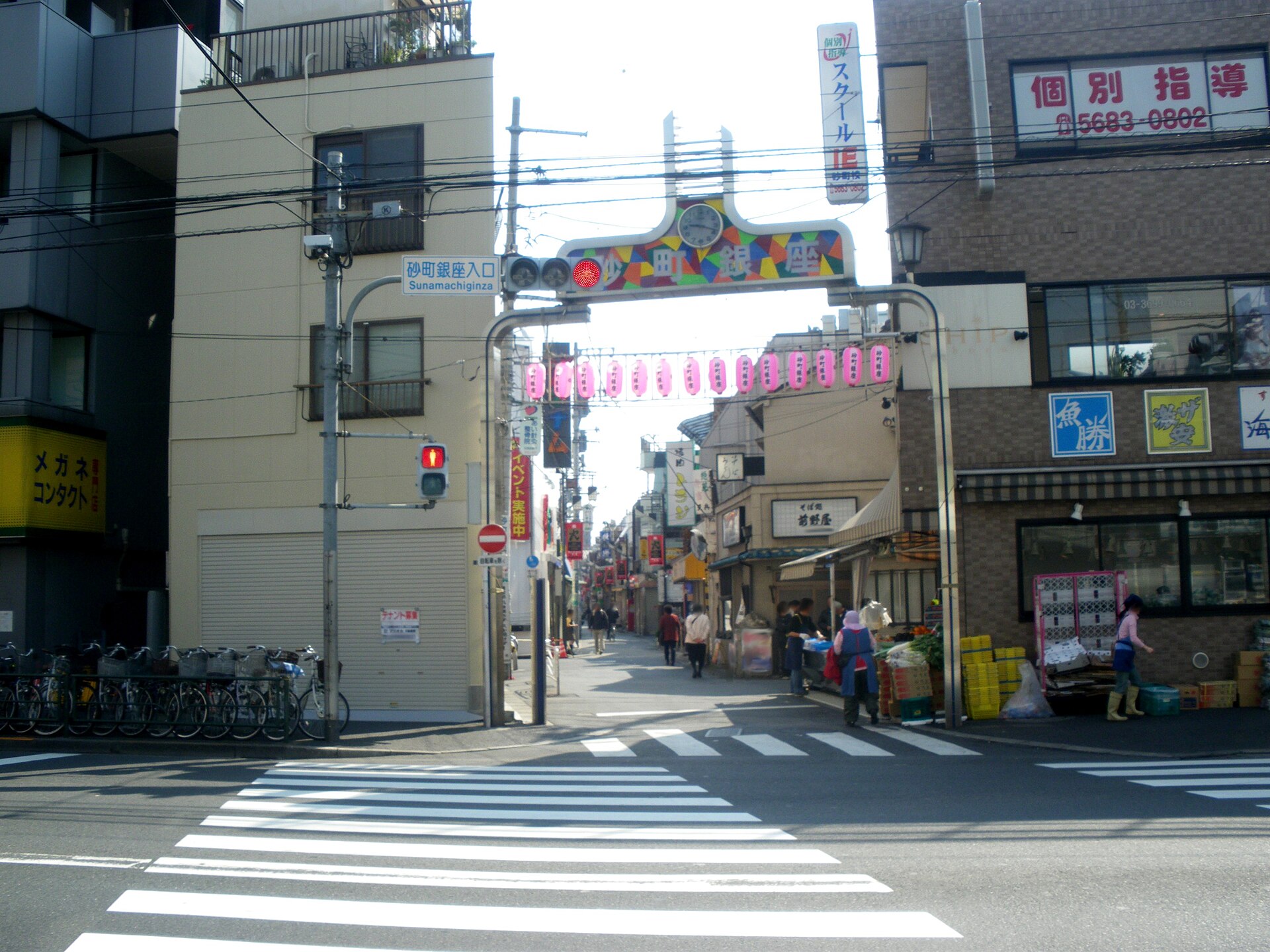
Service area: Minamisuna’s first through seventh chome, Higashisuna’s sixth through eighth chome, and parts of Shinsuna’s first through third chome—chome being numbered neighborhood subdivisions. The area covers approximately 2.72 square kilometers, with 24 pickup and drop-off points, including Minami-sunamachi Station, Toyocho Station, Koto Ward Office, Juntendo Tokyo Koto Geriatric Medical Center and retail facilities.
Fares: standard fare ¥500; ¥300 for passengers aged 65 or older, guardians in families raising children, and people with disabilities; ¥150 for elementary school pupils; free for preschool children. Reservations can be made through the MONET app, LINE or by phone.
No decision has been made on whether the service will become permanent after the trial.
Who is the service designed for?
The operating hours, fares and pickup points suggest a service designed for older residents and families with young children making everyday trips within the ward: to hospitals, the ward office, supermarkets and onward to railway stations. The ward also chose Minamisuna because it has many residents aged 65 or older, some of whom cannot walk as far as a bus stop.
That does not closely match the main rental audience. Listings around Minami-sunamachi and Toyocho stations are dominated by units for singles and two-person households, whose key need is reaching the station during the morning rush. A reservation-only 9-seat vehicle that does not start until 7:30 in the morning cannot replace walking or commuting by bus. For rental buildings made up mainly of single-occupancy units, this trial therefore does not justify higher rents or lower gross yields. Potential beneficiaries include family-oriented units with 2 or more bedrooms plus living, dining and kitchen space (LDK), aimed at longer-stay tenants, as well as properties close to pickup points that are also far from existing bus stops. Any such benefit, however, needs to be assessed using trial data.
Market data: which station matters, not just the walk
A large discount for distance from a station would suggest greater potential upside from improved transport. We grouped Urbalytics’ residential rental listings from the past 12 months—20–70 m², excluding management fees—by nearest station and walking time, then compared median monthly asking rent per square meter:
Toyocho Station, within a 7-minute walk: ¥5,194/m² (274 listings; median monthly asking rent ¥159,000)
Minami-sunamachi Station, 8–12 minutes on foot: ¥4,279/m² (162 listings)
Toyocho Station, 13 minutes or more on foot: ¥4,119/m² (60 listings; median monthly asking rent ¥156,000)
Minami-sunamachi Station, within a 7-minute walk: ¥3,920/m² (46 listings)
Minami-sunamachi Station, 13 minutes or more on foot: ¥3,739/m² (119 listings; median monthly asking rent ¥110,000)
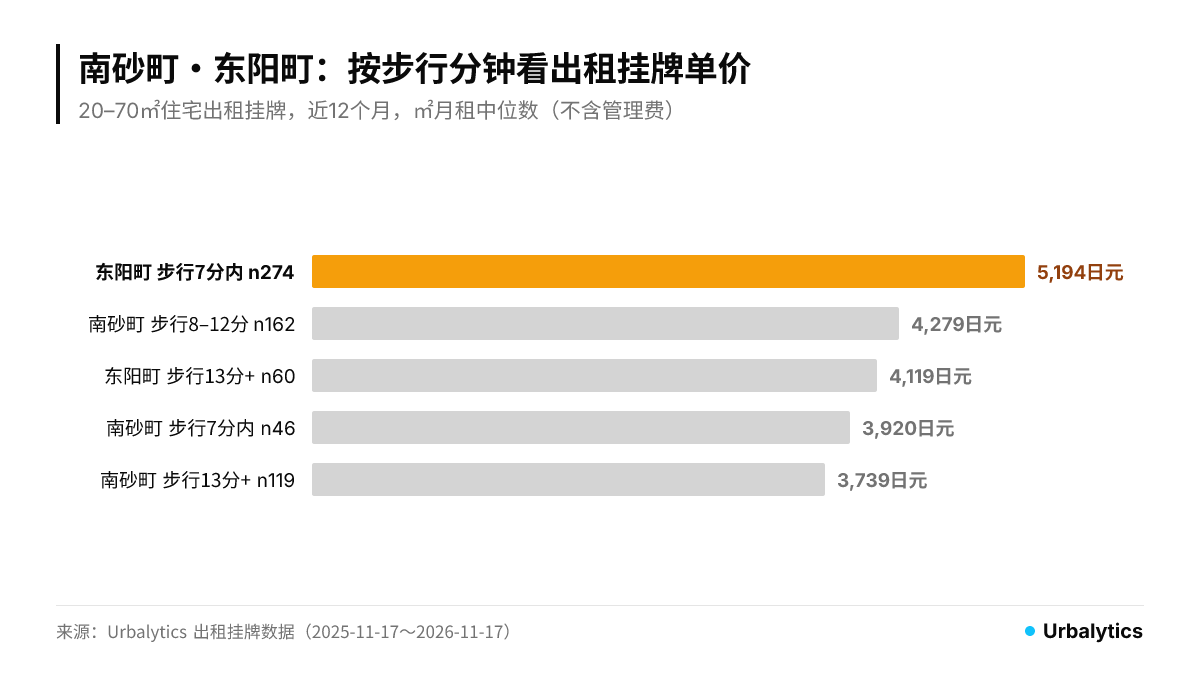
At 80 meters per minute, a 7-minute walk represents roughly 560 meters, broadly comparable to the ward’s 500-meter station-distance threshold. Two patterns stand out.
First, walking time has only a weak relationship with asking rents within the Minami-sunamachi groups. The group at least 13 minutes away is only about 5% below the group within 7 minutes, while the 8–12-minute group has the highest figure. That middle group includes clusters of listings in rental apartment buildings completed in 2021 and 2026. Sample composition clearly affects the result; it should not be read as evidence that a longer walk commands higher rent.
Second, the clear gap is between properties close to Toyocho Station and every other group. Listings at least 13 minutes from Toyocho are mostly in Minamisuna’s first and second chome, with asking rents per square meter close to the 8–12-minute Minami-sunamachi group. The group within 7 minutes of Toyocho, by contrast, is more than a fifth higher. Toyocho serves the ward office and office buildings, and is set to become an interchange between the Tozai and Yurakucho lines following the Yurakucho Line extension. The rental premium is tied to proximity to Toyocho Station, not simply to convenient transport in general. Minamisuna’s trial vehicle will also stop at Toyocho Station, but carrying a few more people there each day is not enough to change this structure.
Gross yields on whole rental buildings
Among whole rental buildings listed on Urbalytics during the same period, 25 named Minami-sunamachi as their nearest station. Their median gross yield was 5.60%, with a lower-to-upper quartile range of 4.34%–6.51%, and the median asking price was ¥160 million. Typical properties were in Higashisuna, Kitasuna and Minamisuna’s fifth chome, 14–17 minutes on foot from the station—within or adjacent to the on-demand transit service area. Only 5 buildings named Toyocho as their nearest station, with a median gross yield of 4.44%; that sample is too small for more than a reference point.
These gross yields are calculated from asking prices and advertised rental income, not completed transactions, and do not deduct vacancy losses or expenses. They indicate that whole-building asking prices around Minami-sunamachi already offer higher yields than properties close to Toyocho Station, reflecting longer walks and reliance on buses. Until trial results are available, there is no reason for buyers to accept lower gross yields.
Implications for valuation and rental management
Investors buying or holding rental properties in Minamisuna, Higashisuna and Kitasuna can take the following approach:
Continue to value properties using current walking times and bus access, without paying a premium for AI-powered on-demand transit. This is a single-vehicle trial lasting about 11 months, with no decision on continuation.
For family-oriented units with 2 or more bedrooms plus living, dining and kitchen space (LDK), proximity to a pickup point can be mentioned as a neighborhood amenity in rental marketing, but should not be presented as part of the property’s transport access.
The draft’s express and articulated bus proposals could make a more meaningful difference to north–south travel. Once the plan is finalized, targeted for March 2027, check which corridors and stops receive concrete arrangements.
A longer-term factor is the Yurakucho Line extension from Toyosu to Sumiyoshi, approximately 5.2 kilometers, with opening targeted for the mid-2030s. Tokyo Metro began construction in November 2024. Toyocho is set to become a two-line interchange, with a new station provisionally named Sengoku to its north. This provides a basis for the premium near Toyocho Station to persist, while the Minami-sunamachi side does not benefit directly.
In short, the useful evidence from Minamisuna’s trial will be its usage data: how many people book, whether passengers frequently cannot secure a ride, and whether the ward decides to make the service permanent. Until then, rental investments farther from stations should be underwritten on current conditions.
Track local asking prices per square meter, gross yields and listing inventory in Urbalytics’ Koto Ward Market Report and Tokyo Market Report. For more on when transport plans begin to affect rents, see our analyses of the Oedo Line extension in Nerima and the Kami-itabashi Station south-exit transport plaza.
Data notes
Rental data consists of active residential rental listings recorded by Urbalytics, first observed from November 17, 2025 to November 17, 2026, with floor areas of 20–70 m². Rents are monthly asking rents excluding management fees, not achieved rents. Repeated listings of the same unit may be counted more than once, and building ages and unit layouts differ across groups. Walking times refer to the nearest station stated in each listing. Whole-building gross yields cover rental buildings listed or repriced during the same period. Gross yield equals advertised annual income divided by asking price; whether income assumes full occupancy or reflects current occupancy depends on the listing source. Duplicate listings across platforms have been consolidated, and yields at or below 1% or at or above 25% have been excluded.
#KotoWard #MinamiSunamachi #Toyocho #Higashisuna #Kitasuna #AIOnDemandTransit #LocalPublicTransportPlan #YurakuchoLineExtension #PropertiesFarFromStations #RentalApartments #WholeBuildingGrossYields #Tokyo23WardRents #JapanRealEstateInvestment
References
Kenbiya, “Tokyo’s Koto Ward seeks to strengthen north–south transport in the Joto area; Minamisuna AI on-demand transit trial to begin in 2027,” 2026, https://www.kenbiya.com/ar/ns/region/tokyo/10694.html
Koto Ward, “Koto Ward AI On-Demand Transit Trial,” 2026, https://www.city.koto.lg.jp/470900/demand-responsive-transit/about.html
Koto Ward Bulletin, “Public Comments Invited on the Preliminary Draft of the Koto Ward Local Public Transport Plan,” 2026, https://www.city.koto.lg.jp/011501/kuse/koho/kuho/r08/text/102105.html
Koto Ward, “Subway Line 8 (Yurakucho Line) Extension” leaflet, 2026, https://www.city.koto.lg.jp/397101/kurashi/kotsu/kokyo/documents/20261030115221.pdf
Tokyo Metro, “Construction to Begin on the Yurakucho Line Extension (Toyosu–Sumiyoshi) and Namboku Line Extension (Shinagawa–Shirokane-takanawa),” 2024, https://www.tokyometro.jp/news/images_h/metroNews241105_73.pdf
Urbalytics, “Koto Ward Real Estate Market Report,” 2026, https://www.urbalytics.jp/market/area/tokyo/koto-ku
Cover image: Toei Bus route Kame 26 (Photo: R TLGD / Wikimedia Commons, CC BY-SA 4.0)
Copyright: This article is original content by the author. Please do not reproduce, copy, or quote without permission. For usage requests, please contact the author or this site.