Words: 1873 | Estimated Reading Time: 10 minutes | Views: 69
At a glance: Tokyo-backed affordable housing in Nishi-Kasai is offering 51 m² apartments with 3 rooms plus a dining-kitchen area from ¥67,000 a month—roughly half the median asking rent for older buildings near the same station. But its target tenants do not fully overlap with those of nearby private rentals. Landlords should focus on the pace of supply and its concentration in Edogawa Ward.
On October 28, the Tokyo Metropolitan Government’s Bureau of Industrial and Labor Affairs announced the first tenant applications in Edogawa Ward under its public-private affordable housing fund. An existing apartment property near Nishi-Kasai Station on the Tokyo Metro Tozai Line initially offered 2 units of 51 m², with monthly rent, including common-area charges, of ¥67,000–¥69,000. According to Kenbiya’s on-site report dated November 10, both units have 3 rooms plus a dining-kitchen area. The respective rents are ¥64,000 plus a ¥3,000 management fee, and ¥66,000 plus a ¥3,000 management fee.
The two buildings date from 1993 (precast concrete construction) and 1985 (steel construction), each a little over ten minutes’ walk from the station.
For investors who own family-sized rentals in Tokyo, this raises a practical question: could government-backed, lower-rent housing nearby depress rents or draw tenants away from 3DK apartments (rooms plus a dining-kitchen area) and 2LDK apartments (bedrooms plus a living-dining-kitchen area)? We examine Tokyo government sources and Urbalytics asking-rent data around the same station.
How the fund works: Tokyo funding, private management and below-market rents
In February 2026, Tokyo formally selected four operating consortia. Total funding exceeds ¥20 billion, including ¥10 billion from Tokyo, with approximately 350 affordable homes planned. Three consortia set rents at roughly eighty percent of market levels. The Nishi-Kasai property belongs to the consortium of LivEQuality Oyasan, Resona Real Estate Investment Advisors and MAX-REALTY. Its fund totals ¥8 billion (including ¥4 billion from Tokyo), runs for 10 years and targets approximately 70 homes at an average of about 75% of market rent.
The Nishi-Kasai property has more specific rules. It primarily targets families raising children with annual household income below ¥6,000,000, with priority for Tokyo residents. Tenancies are 2-year fixed-term leases. The child-rearing support rent generally applies for 4 years; from year 5, tenants move to ordinary leases at standard rents, with income rechecked before expiry. The operator recommends a minimum annual income of ¥2,800,000. Both buildings were acquired with in-place leases: existing tenants will not be displaced, and units will be offered as they become vacant. The property is ultimately planned to provide 23 affordable homes.
How much cheaper is ¥67,000?
Tokyo’s announcement states that the two units are priced at roughly sixty percent of market rent. Working backward from that proportion puts the government’s market-rent benchmark at a little over ¥110,000 (our estimate).
For comparison, Urbalytics recorded 26 residential listings over the past 12 months near Nishi-Kasai Station for 45–60 m² units in buildings completed before 1995. Median monthly asking rent, including management fees, was ¥142,500, with a lower quartile of ¥118,300 and a median asking rent per square metre of approximately ¥2,675. Under the same size and location criteria, 36 listings in newer buildings completed in 2015 or later had a median of ¥236,000.
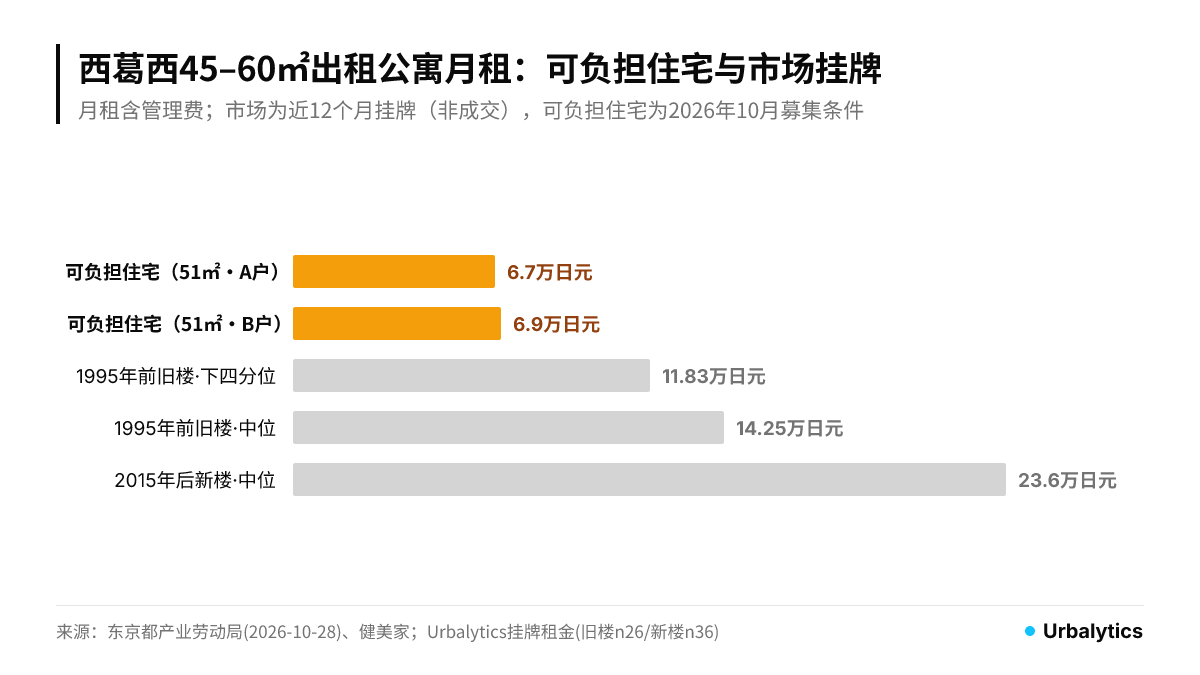
Tokyo’s market-rent benchmark sits near the lower quartile for older buildings, rather than the median. That fits the properties’ characteristics: more than 30 years old and a little over ten minutes’ walk from the station. Narrowing the comparison to older buildings at least 10 minutes away on foot leaves just 3 listings over the past two years. These include a 3DK built in 1993, a 15-minute walk away, asking ¥133,000, and a 3DK built in 1991, a 14-minute walk away, asking ¥116,000. This very small sample is only indicative, but broadly aligns with the implied benchmark of a little over ¥110,000.
The comparison therefore needs a clear basis. Against current asking rents for comparable properties in older buildings, the affordable units are about ¥40,000–¥50,000 cheaper per month. Against the median for older buildings around the station, the gap is approximately ¥70,000. Much of that wider gap reflects walking distance and building condition, not just the policy discount.
Whose tenants could it attract?
Such a large rent gap sounds threatening to nearby landlords. But income eligibility determines the competitive overlap. At ¥69,000 a month, annual rent is approximately ¥830,000, or roughly thirty percent of the recommended minimum annual income of ¥2,800,000 (our estimate). Households at this income level would already struggle to afford a 3DK at ¥110,000–¥140,000. The operator’s typical target is a single-parent household with a permanent employee working reduced hours, living farther out with a long commute because closer housing is too expensive.
In other words, housing like this in Nishi-Kasai primarily draws in families living farther out, rather than taking tenants from private rentals next door. The most exposed properties may be small, older units at the bottom of the rent range that attract families through low prices. The scheme may also absorb some demand from households waiting for public housing.
Another consortium in Edogawa Ward offers a counterpoint. Kenbiya reports that the Nomura Real Estate consortium allocated 31 of 90 units across two new apartment buildings to affordable housing. The 50–56 m² units ask approximately ¥150,000–¥170,000 a month, or 75%–80% of market rent, and target families raising children with annual income no higher than ¥8,000,000. At the end of October, about half the designated units in one building and about a third in the other remained unoccupied.
Annual rent of ¥1,800,000–¥2,040,000 already represents thirty percent or more of a household income of ¥6,000,000 (our estimate). Even discounted new apartments remain beyond the reach of some target households. A substantial discount does not automatically bring a surge in demand.
Timing matters too. The 23 Nishi-Kasai units will be released individually as existing tenants leave. With 2-year fixed-term leases and a 4-year discount period, the first tenants will face a choice between renewing at standard rents or moving out in year 5. For comparison, Urbalytics observed only 26 listings in Nishi-Kasai over the past 12 months for 45–60 m² units built before 1995. In this segment, 23 units are not negligible, but their release over several years means they will not hit the market in a single leasing season.
The buyer’s perspective: will the fund compete for buildings?
The fund also buys older buildings. In an interview, the operator said it plans further acquisitions, mainly existing apartment buildings, totalling approximately 200 units, of which around 70 would become affordable housing. Rising property prices are the obstacle: few buildings can support discounted rents on some units while keeping the overall finances viable.
Consider that model against Nishi-Kasai property prices. Urbalytics recorded 20 whole rental buildings near Nishi-Kasai Station with listing or price-change activity over the past 12 months. Their median gross yield was 5.49%, with a lower-to-upper quartile range of 4.79%–6.35%. Across Edogawa Ward, the figure in October 2026 was 5.40%, above the Tokyo average of 5.11%.
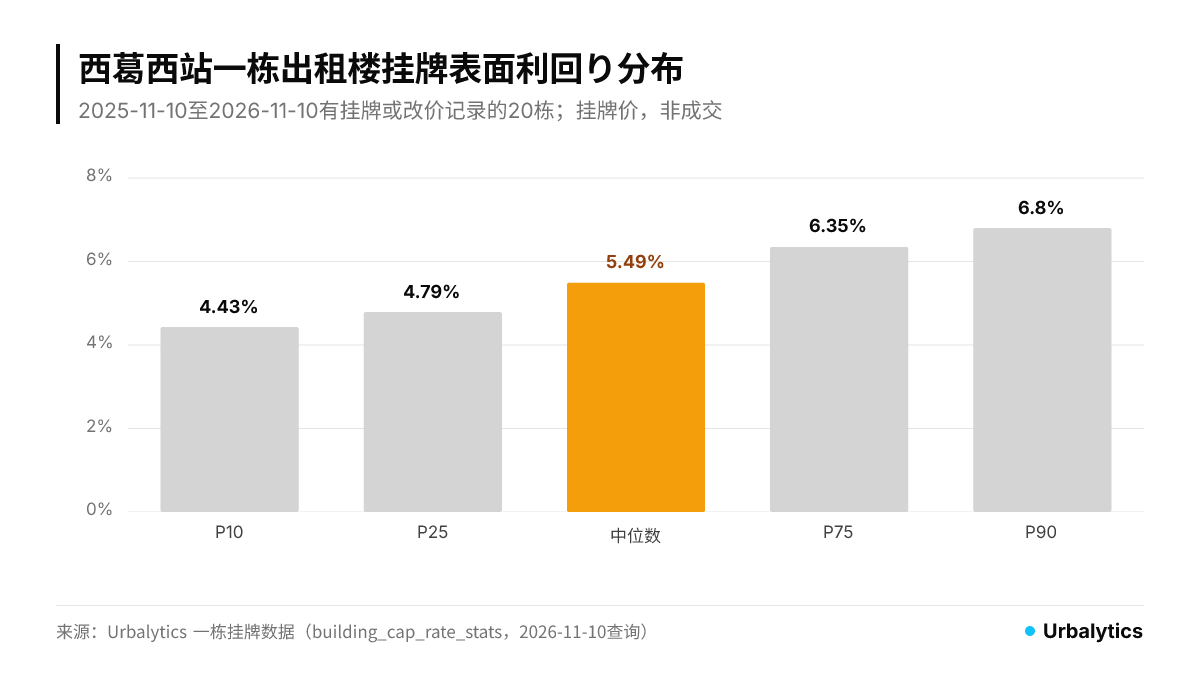
If 35% of a building’s units rent at 75% of market levels, total rental income falls by approximately 9%. At a purchase price corresponding to the median yield, gross yield would fall from 5.49% to around 5.0% (our estimate, before vacancy and expenses). To preserve returns, the fund must either buy more cheaply or accept a lower yield. Neither helps it outbid private buyers. At least based on this consortium’s structure, it looks more likely to pursue buildings with particular circumstances than to drive prices in Nishi-Kasai’s whole-building market.
What this means for landlords in Nishi-Kasai and Edogawa Ward
For nearby owners of family-sized units in older buildings, this supply will not impose a ceiling on market rents of ¥110,000–¥140,000. Affordable housing and private rentals serve different income groups, units are released gradually as vacancies arise, and the fund’s acquisitions are constrained by returns. Direct pressure on prices is limited.
Three developments deserve attention:
First, two consortia already have projects in Edogawa Ward. If further acquisitions remain concentrated along the Tozai Line, small, low-rent units in older buildings will feel the competition first.
Second, starting in June, JKK Tokyo is offering approximately 20 homes a month at eighty percent of contractual rent, covering homes of at least 45 m² or with at least 2 rooms. The combined supply of discounted housing within Tokyo’s public housing system and fund-backed units is the real competitor for lower-end family rentals.
Third, when standard rents resume from year 5, some households will stay and renew at market rates, while others may move into nearby private rentals. This second-round market effect will not become visible until the early 2030s.
For landlords setting asking rents for older 3DK apartments in Nishi-Kasai, the more useful benchmark is ¥110,000–¥120,000, near the lower quartile for older buildings—not ¥67,000. Listings above the median need to justify their premium through proximity to the station, renovation quality or amenities.
Track whole-building gross yields and rental trends in Edogawa Ward in the Edogawa Ward Whole-Building Investment Property Market Report. For a case study of an older building converted to rentals in the same ward, see Funabori Rent Analysis: A 34-Year-Old Employee Dormitory Converted into 80 Rental Units; for the spread between rent increases and borrowing costs, see Residential REIT Rent Increases on Tenant Turnover Versus New Borrowing Rates.
Data notes
Urbalytics rents are asking rents, including management fees, not achieved rents. The observation window is 2025-11-10 to 2026-11-10, extended to 24 months for properties at least 10 minutes’ walk from the station. Listings are counted by first observation date and include only apartments for residential use measuring 45–60 m². Whole-building gross yields use asking prices and advertised annual income. Advertised income mixes assumed full-occupancy income and current income, without deductions for vacancy or expenses.
“Roughly sixty percent of market rent” and “approximately 75%” are the benchmarks used by Tokyo and the operator. Their precise method for calculating market rent has not been disclosed. Figures labelled “our estimate” are calculations in this article based on published figures.
#TokyoAffordableHousing #AffordableHousing #NishiKasai #EdogawaWard #TozaiLine #PublicPrivateFund #FamiliesWithChildren #FamilyRentals #OlderRentalBuildings #GrossYield #AskingRents #FixedTermLeases #JKKTokyo #JapanRealEstateInvestment #Urbalytics
References
Tokyo Bureau of Industrial and Labor Affairs, 2026, Nishi-Kasai tenant application announcement, Public-Private Affordable Housing Supply Promotion Fund: https://www.metro.tokyo.lg.jp/information/press/2026/10/2026102805
Tokyo Metropolitan Government, 2026, Governor’s press conference materials: selection of fund operators: https://www.metro.tokyo.lg.jp/documents/d/tosei/2026_0220_03
Tokyo Metropolitan Government, 2026, Governor’s press conference materials: first tenant applications and JKK Tokyo: https://www.metro.tokyo.lg.jp/documents/d/tosei/2026_0529-04
Tokyo Metropolitan Government, 2025, Governor’s press conference materials: selection of prospective operators: https://www.metro.tokyo.lg.jp/documents/d/tosei/2025_1107_05
Kenbiya, 2026, “A Public-Private Fund Takes Shape: Rents Set an Average 25% Lower for Households Earning No More Than ¥6,000,000 a Year—A Visit to Tokyo’s Affordable Housing”: https://www.kenbiya.com/ar/ns/policy/system/10684.html
Urbalytics, 2026, Edogawa Ward, Tokyo: Whole-Building Investment Property Market Report: https://www.urbalytics.jp/market/area/tokyo/edogawa-ku/building
Cover image: street scene in Nishi-Kasai 3-chome, shown only to illustrate the neighbourhood (Photo: Nagono / CC BY-SA 3.0, Wikimedia Commons).
Copyright: This article is original content by the author. Please do not reproduce, copy, or quote without permission. For usage requests, please contact the author or this site.