Words: 1713 | Estimated Reading Time: 9 minutes | Views: 24
Removal of the 3 railway crossings between Keikyu Shinagawa and Shimbamba stations, whose barriers are rarely open for more than a few minutes, has been pushed back from FY 2029 to FY 2036. Project costs have also risen from ¥124.7 billion to ¥223 billion. For rental buildings around Kita-Shinagawa, the question is straightforward: will the seven-year delay depress rents, or had the market never priced in the crossings’ removal?
What is delayed: 1.7 km, 3 crossings and a seven-year extension
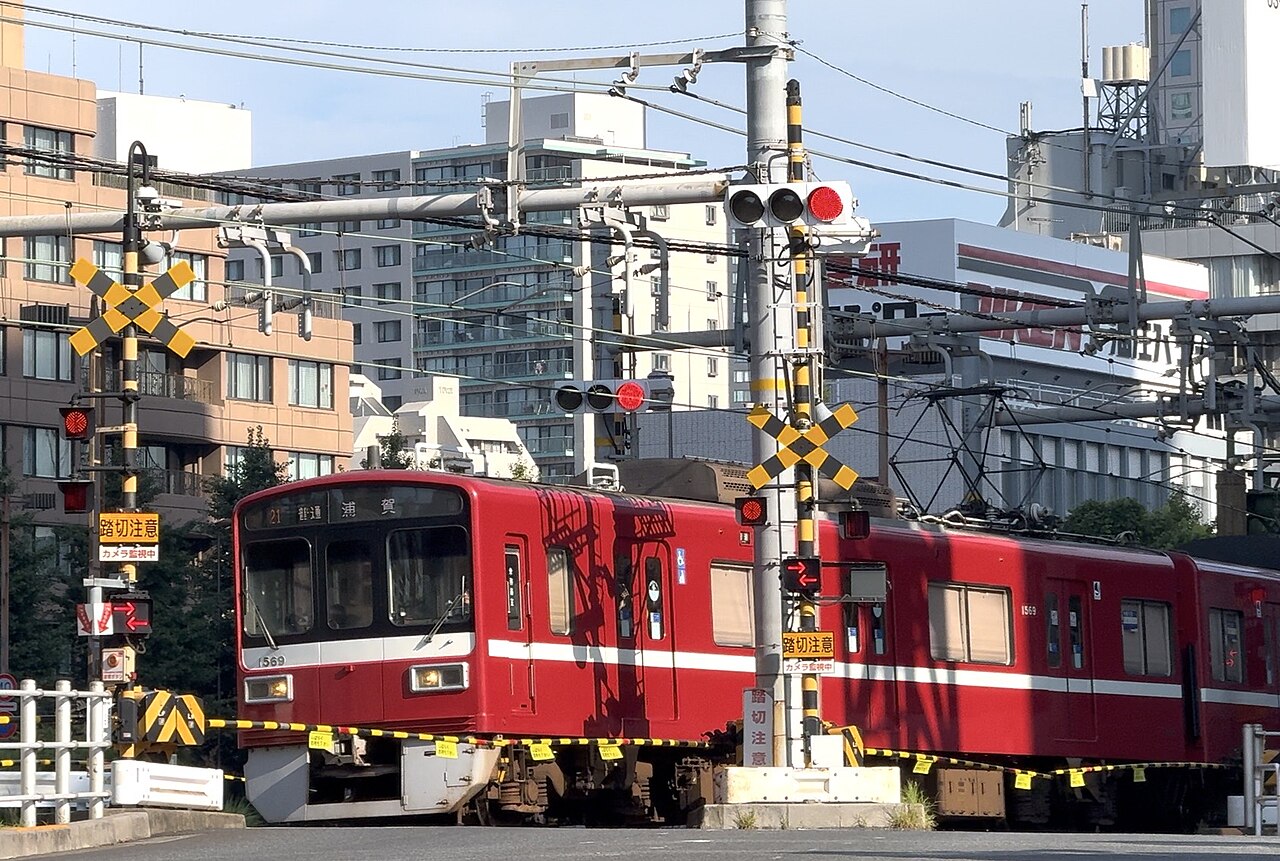
Officially called the Keikyu Main Line Continuous Grade Separation Project between Sengakuji and Shimbamba stations, the scheme separates roads and railway tracks. The Tokyo Metropolitan Government’s Bureau of Construction leads the project in partnership with Keikyu. It extends from Takanawa 2-chome in Minato Ward to Kita-Shinagawa 2-chome in Shinagawa Ward, covering approximately 1.7 km, with the aim of removing 3 crossings: Shinagawa No. 1, Shinagawa No. 2 and Kita-Shinagawa No. 1.
The project does not involve elevating the entire line. Keikyu Shinagawa Station is to move from its current elevated position to ground level, with 2 platforms and 4 tracks, while the line around Kita-Shinagawa Station is to be elevated. Tokyo’s FY 2022 reassessment documents show that, during a 1-hour peak period in FY 2019 (Reiwa 1), Shinagawa No. 1 crossing was closed for 57 minutes, while Kita-Shinagawa No. 1 crossing was closed for 54 minutes—leaving the barriers down almost continuously.
According to Kenbiya’s report dated November 23, Tokyo’s Bureau of Construction presented a proposal at the second project evaluation committee meeting of FY 2026 (Reiwa 8), held on October 9, to move the scheduled completion date from FY 2029 to FY 2036. As of the end of FY 2025, total project costs stood at ¥223 billion, an increase of ¥98.3 billion from the ¥124.7 billion estimated at the FY 2022 evaluation. Tokyo and other public-sector bodies are to bear ¥174.4 billion (78.2%), with the railway side bearing ¥48.6 billion (21.8%). Tokyo’s committee meeting notice confirms the project under review; the specific cost and schedule figures come from metropolitan government materials as cited in the report.
Why the delay: inflation, archaeological remains and overlapping construction
The report identifies three categories of cost increases. Higher construction material and labor costs account for ¥36.5 billion, while changes to construction methods to accommodate archaeological investigations add another ¥14.1 billion. A prominent example is the Takanawa Embankment, built on reclaimed land for the railway in the early Meiji period. Discovered during development around Shinagawa Station, it requires both preservation and investigation.
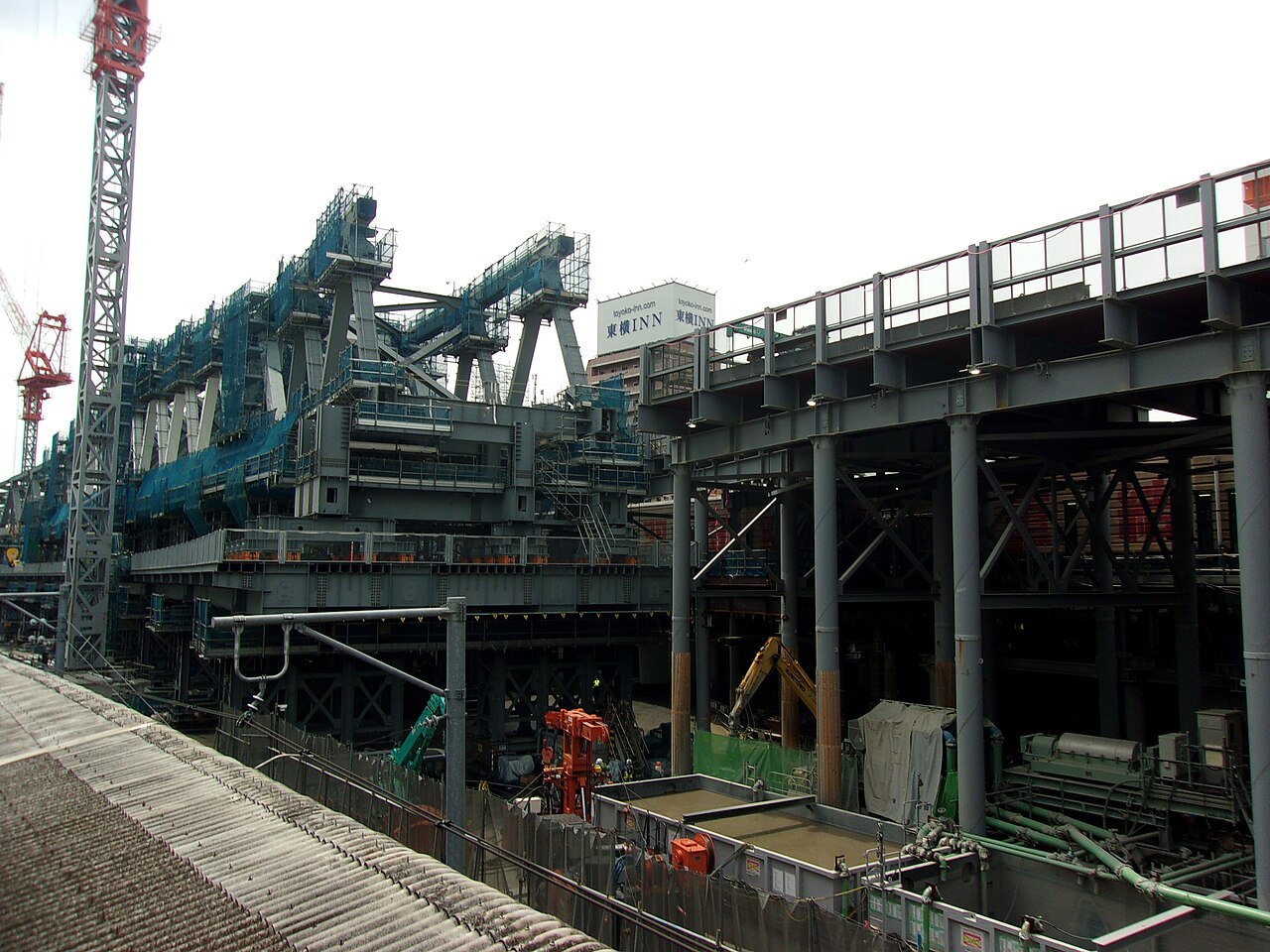
The third category is overlapping construction. Station-area development, Ring Road No. 4, infrastructure works at Shinagawa Station’s west exit and the Tokyo Metro Namboku Line extension are all proceeding around Shinagawa Station. Keikyu must coordinate with these projects while working alongside an operating railway. Work has not stopped: in February 2026, the Yatsuyama railway overpass, weighing approximately 3,300 tonnes, was installed using an incremental launching method. In FY 2026, Keikyu is also progressing the switch to a temporary southbound track between Sengakuji and Shinagawa, removal of Shinagawa Station’s main roof and construction of the permanent viaduct at Kita-Shinagawa Station.
The progress figures nevertheless show that most of the work remains. Overall progress measured by project expenditure is 34.4%, with construction expenditure at 31.8% and land expenditure at 92.1%; land acquisition has reached 98.2%. In other words, the land is largely secured, but the capital-intensive civil engineering work is only about a third complete.
Such delays are not unusual in Greater Tokyo. The Tokyo-led project to put the Seibu Shinjuku Line underground between Nakai and Nogata—approximately 2.4 km, removing 7 crossings—has undergone two revisions since approval in FY 2013. Its project period now runs through the end of FY 2033.
No clear railway-crossing discount in asking rents
If the crossings are depressing Kita-Shinagawa rents, a seven-year delay would mean another seven years of that discount. Using Urbalytics rental listings, we compared residential properties of 20–60 m² within a 10-minute walk of several Keikyu stations, based on base asking rents over the past 12 months.
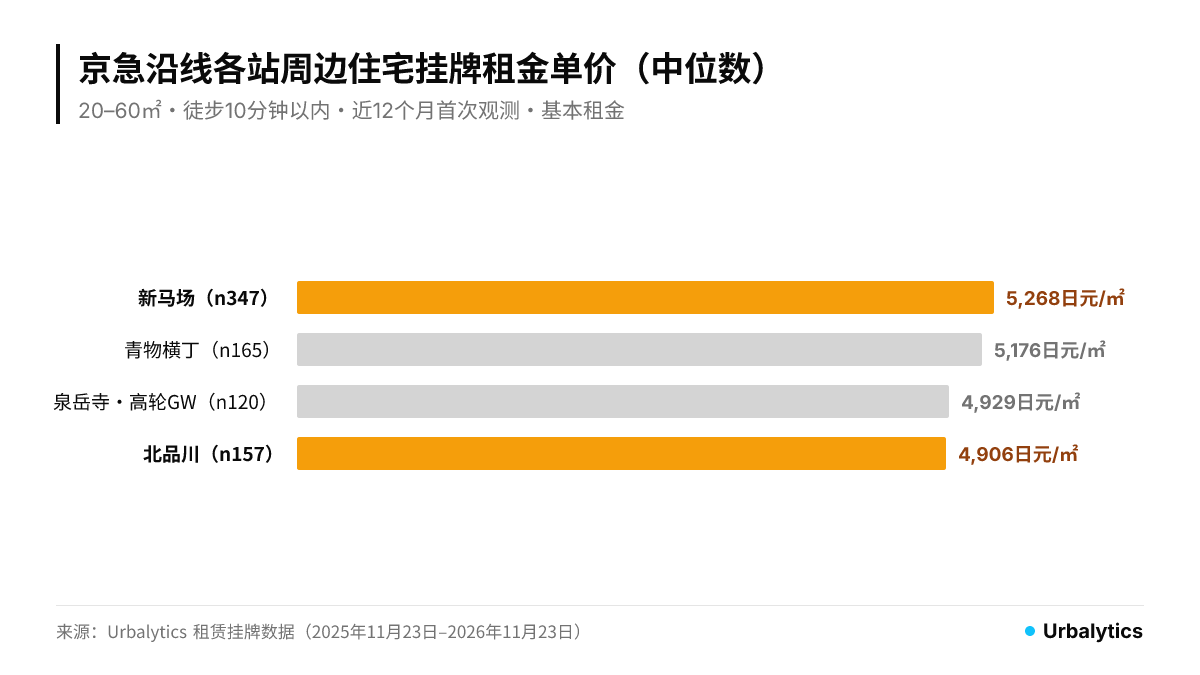
Shimbamba: median asking rent per square meter 5,268 yen/m², median monthly asking rent 132,000 yen (n=347)
Aomono-yokocho: 5,176 yen/m², median monthly asking rent 137,000 yen (n=165)
Sengakuji / Takanawa Gateway: 4,929 yen/m², median monthly asking rent 137,000 yen (n=120)
Kita-Shinagawa: 4,906 yen/m², median monthly asking rent 139,000 yen (n=157)
The four groups differ by less than 10%. Shimbamba, immediately beside the crossings, actually has the highest asking rent per square meter. Kita-Shinagawa is slightly lower but almost identical to Sengakuji / Takanawa Gateway at the other end of the area, with no clear discount for being divided by railway crossings.
A breakdown by address offers another perspective. Pooling the Kita-Shinagawa and Shimbamba station samples, listings with Kita-Shinagawa addresses—the neighborhood containing the three crossings—have a median asking rent of 5,247 yen/m² (n=228). Those in Higashi-Shinagawa, the waterfront residential area on the canal side, have a median of 5,218 yen/m² (n=171). The figures are almost identical. Higashi-Shinagawa’s higher median monthly asking rent of 173,000 yen mainly reflects its larger average floor area.
This suggests that, at least for homes suited to singles and small households, Kita-Shinagawa’s asking rents are already on a par with nearby station areas. There is no apparent rental discount corresponding to the potential access improvements from removing the crossings. Conversely, the delay appears unlikely to push existing rents lower.
Yields are already low: what are buyers paying for?
The sales market presents a different picture. In Urbalytics whole-building sales listings with a listing or price-change record over the past 12 months, Kita-Shinagawa’s median gross yield was 4.82% (n=8), compared with Shimbamba at 3.94% (n=7) and Aomono-yokocho at 4.12% (n=5). Each sample contains fewer than 10 properties, so these figures should be treated only as indicative.
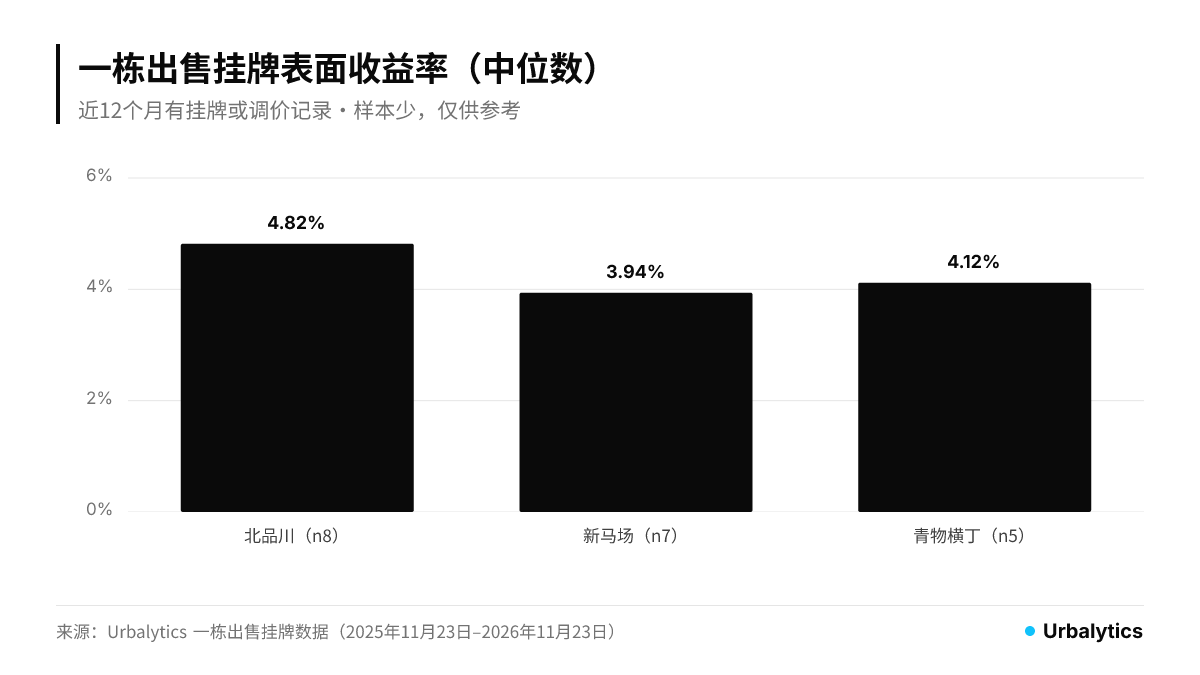
With gross yields around 4%, returns after management, repairs and fixed asset tax are lower still. Since asking rents are no higher than in surrounding areas, buyers’ willingness to accept these prices likely rests partly on expectations of a better future for the Shinagawa area. Those expectations include bringing Keikyu Shinagawa Station to ground level, elevating the line at Kita-Shinagawa and developing station plazas. These benefits may now materialize only after FY 2036.
Another milestone falls in the same year. Keikyu’s “South-a” development in the southern part of the Shinagawa Station district is also scheduled for completion in FY 2036. It has a planned gross floor area of approximately 201,000 m² and is to house Keikyu Shinagawa Station’s railway facilities. The broadly completed vision for Kita-Shinagawa and the area around Shinagawa Station is therefore concentrated around 2036.
Implications for valuation and operations
For investors considering whole buildings or individual condominium units in Kita-Shinagawa and Shimbamba, the delay has three practical implications.
First, value the property using current rents only. The data above show no current asking-rent discount attributable to the crossings, so there is no automatic post-removal catch-up increase to build into income forecasts. If a seller markets environmental improvements following completion in FY 2029, revalue those benefits using FY 2036 instead—or exclude them altogether.
Second, treat the construction period as part of the operating environment. Viaduct construction around Kita-Shinagawa Station will continue at least into the mid-2030s. Allow for noise, temporary roads and nighttime work when planning leasing and maintenance for properties along the line. The closer a property is to the construction zone, the more important it is to verify working hours and the location of temporary facilities on site.
Third, revisit your exit timing. If the original plan was to sell after Shinagawa’s infrastructure was complete, the holding period needs to extend beyond FY 2036. If a longer hold is not feasible, current yields of around 4% become harder to justify. Before acquiring a property, use Urbalytics’ Kita-Shinagawa Station Market Report and Tokyo Market Overview to check prices and asking rents per square meter, then compare them with the seller’s stated income.
For the development rationale on the other side of Shinagawa Station, see our earlier analyses of Shinagawa Takanawa Exit Redevelopment and Takanawa Gateway City; for differences in yields between station areas, see Shinagawa and Osaki Yield Comparison.
Data notes
Rents are base asking rents from rental listings, excluding management fees, not achieved rents. The sample covers residential listings of 20–60 m² within a 10-minute walk, with one of the stations above identified as the nearest station, first observed during the past 12 months. The address-level analysis pools the Kita-Shinagawa and Shimbamba station samples. Yields are gross yields from whole-building sales listings, calculated as annual income divided by price. Depending on the listing, annual income may assume full occupancy or reflect in-place leases; each sample contains fewer than 10 properties. Cross-sectional differences do not establish changes over time or the project’s effect on rents. Project cost and schedule figures come from Kenbiya’s reporting on Tokyo Metropolitan Government materials. FY 2022 figures and crossing closure times were checked against Tokyo’s FY 2022 reassessment documents.
Tags
Keikyu Main Line, Kita-Shinagawa, Shimbamba, Shinagawa Station, railway grade separation, railway crossings, Takanawa in Minato Ward, Shinagawa Ward, Tokyo redevelopment, rental apartments, asking rent per square meter, gross yield, whole-building investment, Japanese real estate, Urbalytics
References
Kenbiya, “Keikyu Main Line Sengakuji–Shimbamba Grade Separation Project Delayed by 7 Years to FY 2036: Sharp Cost Increase and Implications for Shinagawa Redevelopment,” November 23, 2026.Link
Tokyo Metropolitan Government Bureau of Construction, “Notice of Project Evaluation Committee Meeting” (second meeting of FY 2026, held October 9, 2026), September 28, 2026.Link
Tokyo Metropolitan Government Bureau of Construction, “Keihin Electric Express Railway Shonan Line and Line No. 1 Branch Line: Reassessment Materials” (FY 2022).Link
Tokyo Metropolitan Government Bureau of Construction, “Reassessment Checklist: Keihin Electric Express Railway Shonan Line and Line No. 1 Branch Line” (FY 2022).Link
Urbalytics rental listings and whole-building sales listings, November 23, 2025 to November 23, 2026.
Copyright: This article is original content by the author. Please do not reproduce, copy, or quote without permission. For usage requests, please contact the author or this site.