Words: 1436 | Estimated Reading Time: 8 minutes | Views: 0
A new residential development in Shibayama officially opened today, with the mayor hoping to attract Narita Airport employees. The airport workforce is projected to grow from about 40,000 to about 70,000 following expansion, but the completion deadline for Runway C has been moved to the end of 2034. For nearby rental buildings, the more immediate question is which properties already command an asking-rent premium—and which gains remain expectations.
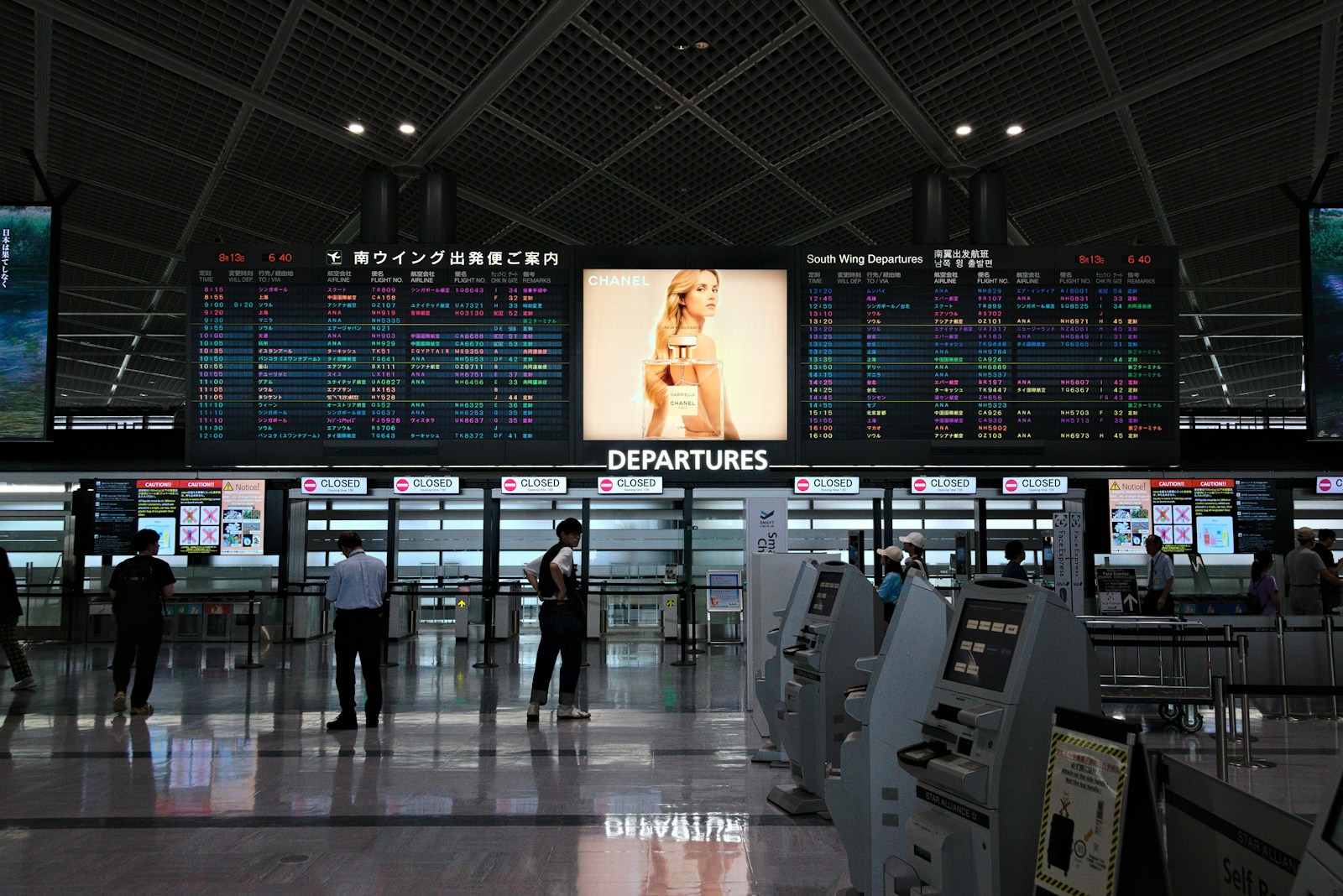
Shibayama’s New Residential Development Targets Buyers Putting Down Roots Near the Airport
According to a Mainichi Shimbun report dated November 22, View Garden Minorista Shibayama, a residential development jointly delivered by Shibayama Town and developer Yamaman, has been completed. An opening ceremony was held that day. Located in Iwayama, Shibayama, southwest of the airport, the development covers approximately 4 hectares, with around 110 plots, with ready-built detached homes priced from ¥40 million to ¥60 million. Since August, 11 homes have been released for sale, with move-ins starting as early as December.
Mayor Takayuki Aso was direct: he hopes airport employees will move here and that the development will also accommodate residents displaced by the airport expansion. In other words, this is primarily an owner-occupier development for households willing to settle near the airport for the long term, rather than an addition to rental supply.
Investors should pay attention because the project brings a central question into focus: as the airport expands and workers arrive, where will they live? The answer determines which rental buildings around Narita can actually capture that demand.
A Workforce of 70,000 Is an Expected Benefit—and the Timeline Has Slipped
Chiba Prefecture’s materials clearly set out the expected effects of expansion: as annual aircraft movement capacity rises from 300,000 to 500,000, annual passenger numbers would increase from 40 million to about 75 million, and the airport’s workforce would rise from 40,000 to about 70,000. The same page notes that these are “expected effects,” not guaranteed outcomes.
Timing matters even more. Aviation Wire reported on November 21 that Runway C, originally scheduled to open at the end of March 2029, had been delayed by difficulties acquiring land. On October 19, Narita International Airport Corporation (NAA) filed a revised planned completion date for Runway C and related facilities of December 31, 2034, with an opening targeted for the first half of the 2030s. Separately, Kyodo News reported on November 11 that NAA plans to apply to the transport minister for compulsory land acquisition as early as December.
Industrial development around the airport may arrive before the runway. A September report by Kenbiya outlined plans for WING NRT, an air logistics facility being developed by Hulic and JAL in Narita’s Shimofukuda and Kamifukuda areas, with construction planned for 2027 and opening for 2029. A major logistics hub is also planned in Tako. These facilities are expected to create jobs earlier, but no verifiable public figures are currently available on the scale or target workforce.
The additional 30,000 employees should therefore be treated as demand that materializes gradually during the 2030s—not as a figure to build into next year’s rent roll.
Current Market Evidence: Newer Small Apartments Carry a Clear Asking-Rent Premium
We analyzed Urbalytics residential rental listings from the past 12 months around Narita, Keisei Narita, Kozunomori, Shibayama-Chiyoda and Higashi-Narita stations. Figures are base asking rents, excluding management fees.
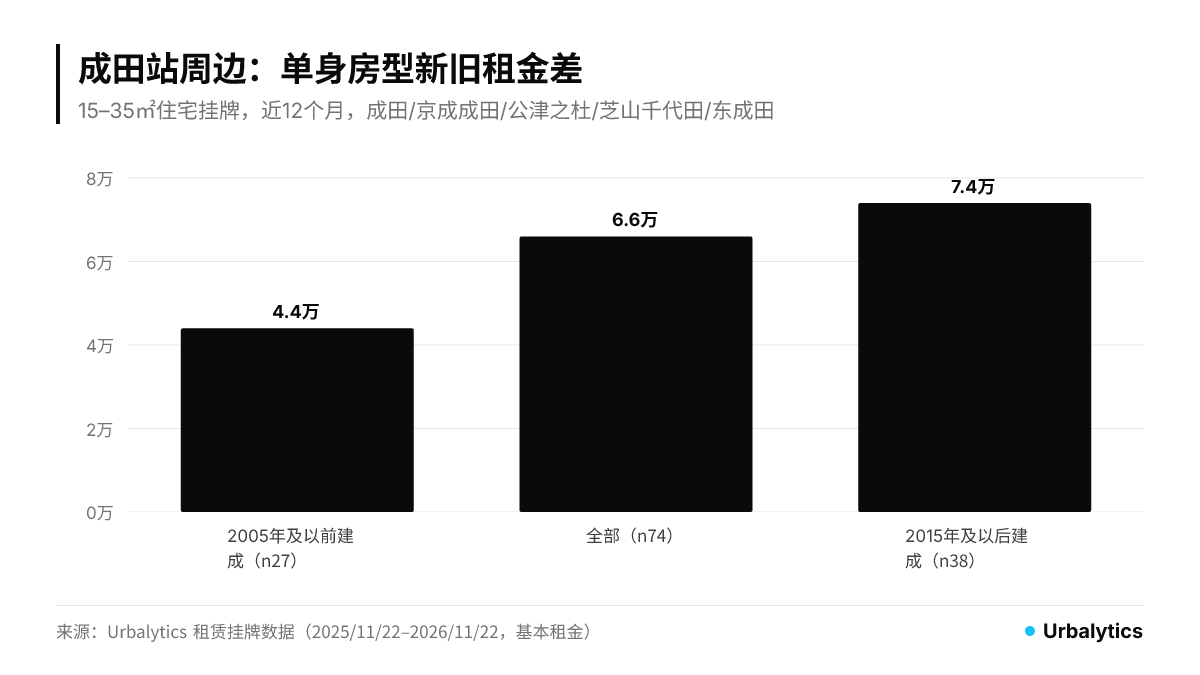
All small apartments (15–35 m²): 74 listings; median monthly asking rent ¥66,000, or approximately ¥2,470 per m².
Built in 2015 or later: 38 listings; median monthly asking rent ¥74,000, or approximately ¥2,658 per m².
Built in 2005 or earlier: 27 listings; median monthly asking rent ¥44,000, or approximately ¥1,829 per m².
All family-sized apartments (50–90 m²): 114 listings; median monthly asking rent of ¥108,000, or approximately ¥1,828 per m².
Within the small-apartment category, newer units have monthly asking rents ¥30,000 higher than older ones, with a premium of approximately 45% per m². This gap reflects a combination of building age, amenities, location and other factors; it should not be read as rent growth caused by airport expansion. What it indicates is that tenants willing to pay more in Narita’s current rental market favor newer small apartments, while older units have to compete on lower rents.
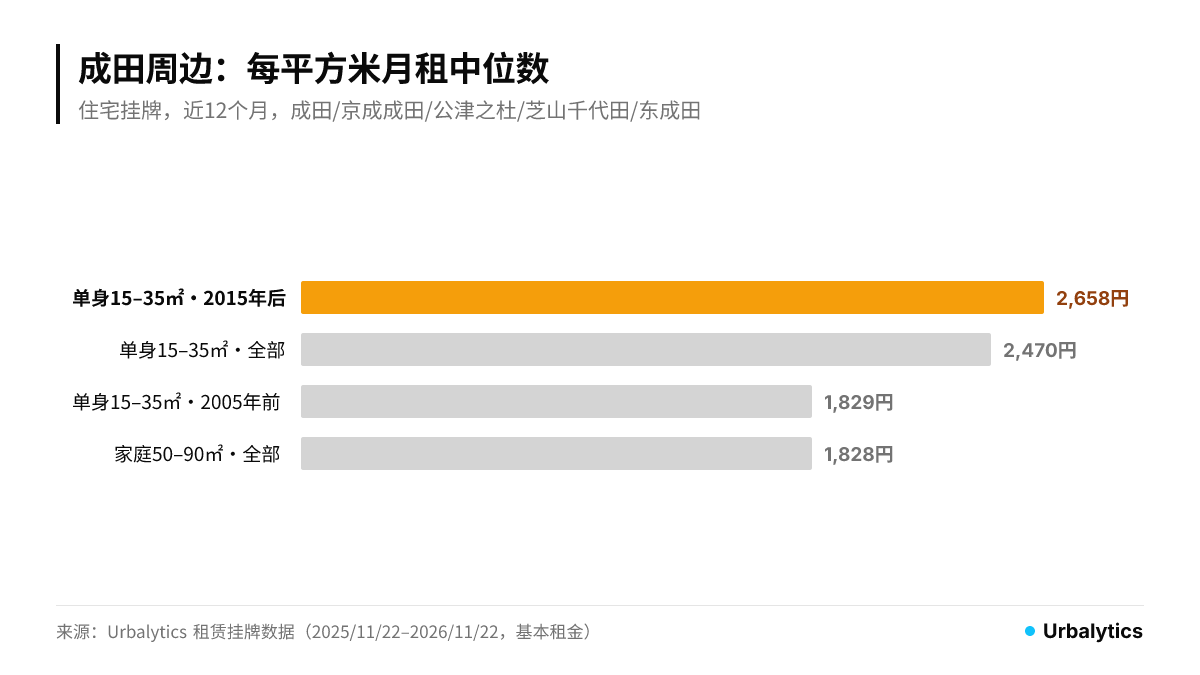
Asking rents per m² for family-sized apartments are almost level with older small apartments, but their distribution is wide: the lower and upper quartiles are ¥84,000 and ¥172,000. This points to substantial variation within the family rental market. If detached homes priced at ¥40 million to ¥60 million, like those in Shibayama, continue to come onto the market, they could draw some households planning to settle long term away from renting. This is a hypothesis and depends on the scale of future supply.
What Does a Whole-Building Gross Yield of 8.88% Buy?
Over the same period, the median advertised gross yield for whole buildings listed for sale around Narita Station was 8.88% (25 listings; the middle 50% ranged from 7.74% to 11.97%), with a median asking price of ¥45 million. Kozunomori Station had only 8 listings, with a median gross yield of 8.81%, so that figure is indicative only.
Several listings close to the median were buildings dating from the late 1980s to the early 2000s. Their high gross yields reflect current rent levels and future repair and vacancy risks. They do not price in airport workforce growth, and buyers should not pay sellers for that growth in advance. In other words, gross yields of 8% to 9% mostly buy buildings of a similar vintage to the older small apartments with monthly asking rents around ¥44,000.
How to Factor Airport Expansion into a Valuation
When valuing an older apartment building around Narita, start with an income-based valuation using current rents and a realistic vacancy rate. Treat airport workforce growth only as an upside scenario for the 2030s, not as part of base-case rents. If the seller’s assumed fully occupied rents approach the ¥70,000 level of newly built small apartments, but the building predates 2000, check in-place leases and recent letting records unit by unit.
For exposure to airport-related demand, a more direct approach is to target properties that can compete with comparable properties asking around ¥74,000: newer small apartments, or units whose amenities and sound insulation can approach new-build standards after renovation. Also watch progress on NAA’s compulsory land acquisition application, alongside logistics facility openings and hiring plans. The former determines the timeline for a workforce of 70,000; the latter determines which employees will be looking for housing first.
To compare prices and gross yields elsewhere in Chiba Prefecture, see Chiba Prefecture Real Estate Market Report. For small retail space asking rents near Narita Station, see Narita Roman Village: Small-Shop Rents and the Economics of Vacant-Property Regeneration; for the relationship between new arrivals and target tenants, see New Arrivals and Rents in Kiyose and Nagareyama.
Data Notes
Rents are base asking rents recorded by Urbalytics, excluding management fees, not achieved rents. The sample covers residential listings identifying any of the stations above as their nearest station, first observed within the past 12 months. Some properties are in neighboring municipalities, including Tomisato. Yields are advertised gross yields for whole buildings listed for sale, calculated as annual income divided by price. Depending on the listing provider, annual income may be based on assumed full occupancy or current income. Cross-sectional differences do not establish changes over time.
Tags
Narita Airport, Shibayama, Narita City, Chiba Prefecture, airport expansion, Runway C, rental apartments, small apartments, asking rent, gross yield, whole apartment buildings, logistics facilities, real estate investment, Urbalytics
References
Mainichi Shimbun (Yahoo! News), “‘For People Working at the Airport’: New Residential District Opens in Shibayama, Chiba, Ahead of Narita Airport Expansion,” November 22, 2026 Link
Chiba Prefecture, “Action Package Built Around Narita Airport’s ‘2nd Opening,’” pp. 6–7 (Narita Airport Expansion Project) Link
Aviation Wire (Yahoo! News), “Transport Ministry Approves New Taxiways and Aprons in Narita Airport’s New Cargo Area; Completion at End of ’34,” November 21, 2026 Link
Kyodo News (Yahoo! News), “Final Local Briefing on Compulsory Land Acquisition at Narita; Airport Operator Plans Application in December,” November 11, 2026 Link
Kenbiya, “Narita Airport’s ‘2nd Opening’ Takes Shape: New Terminal and Station Plans, While Private Development Moves Ahead Nearby,” September 6, 2026 Link
Urbalytics rental listings and whole-building sale listings (November 22, 2025–November 22, 2026)
Copyright: This article is original content by the author. Please do not reproduce, copy, or quote without permission. For usage requests, please contact the author or this site.