Words: 2131 | Estimated Reading Time: 11 minutes | Views: 78
On November 16, the Liberal Democratic Party's land and transport policy division called for heavier taxes on buyers who purchase new condominiums without occupying them and resell within 1 year. According to the Asahi Shimbun, the government and ruling parties are considering raising the individual capital gains tax rate on these resales by about 10 percentage points to around 50%, with plans to include the proposal in the fiscal 2027 tax reform outline to be compiled in December. For Tokyo investors, the question is not just the tax rate, but who would actually fall within the rule's scope.

What the policy division is calling for
According to Kyodo News, the request covers both individuals and companies: higher tax rates should apply to new condominiums sold within 1 year of purchase without being used as a residence. The Asahi Shimbun reports that the specific approach under consideration is to add about 10 percentage points to the current individual short-term capital gains tax rate, alongside higher real estate acquisition taxes on speculative transactions.
Only the broad policy direction is clear so far. Whether the “1 year” starts from registration or contract signing, how residential use is determined, which taxes apply to companies, and which year's transactions would first be covered all await the year-end outline and subsequent legislation. For now, the existing rules and published registry data offer a basis for assessing whose investment calculations could change.
The 1-year cutoff would affect only a narrow part of the current system
Under National Tax Agency rules, an individual's holding period for land and buildings is measured as of January 1 of the year of sale. Holdings exceeding 5 years qualify as long-term; those of 5 years or less are short-term. Short-term gains attract income tax of 30%, plus the special reconstruction income tax and resident tax of 9%, bringing the total to approximately 39.63%; the combined long-term rate is approximately 20.315%.
In other words, individuals selling within 5 years of purchase already face tax of roughly forty percent on their gains. The proposal would add about 10 percentage points for the shortest part of that period. Consider a simplified example: a property bought for ¥100,000,000 and sold within 1 year for ¥110,000,000. Ignoring expenses, the gain is ¥10,000,000, with tax of approximately ¥3,960,000 under current rules. At a rate around 50%, tax would be roughly ¥5,000,000, an increase of about ¥1,000,000. Selling after holding for a full 1 year would still attract tax of about 39.63% until the long-term holding requirements are met.
For individuals, the proposal's direct effect would therefore be to delay the “win a purchase lottery, then sell” strategy, rather than make short-term resales unprofitable. Its deterrent effect would depend on the size of the resale profit and the cost of holding for several additional months.

Who resells within 1 year? The registry evidence
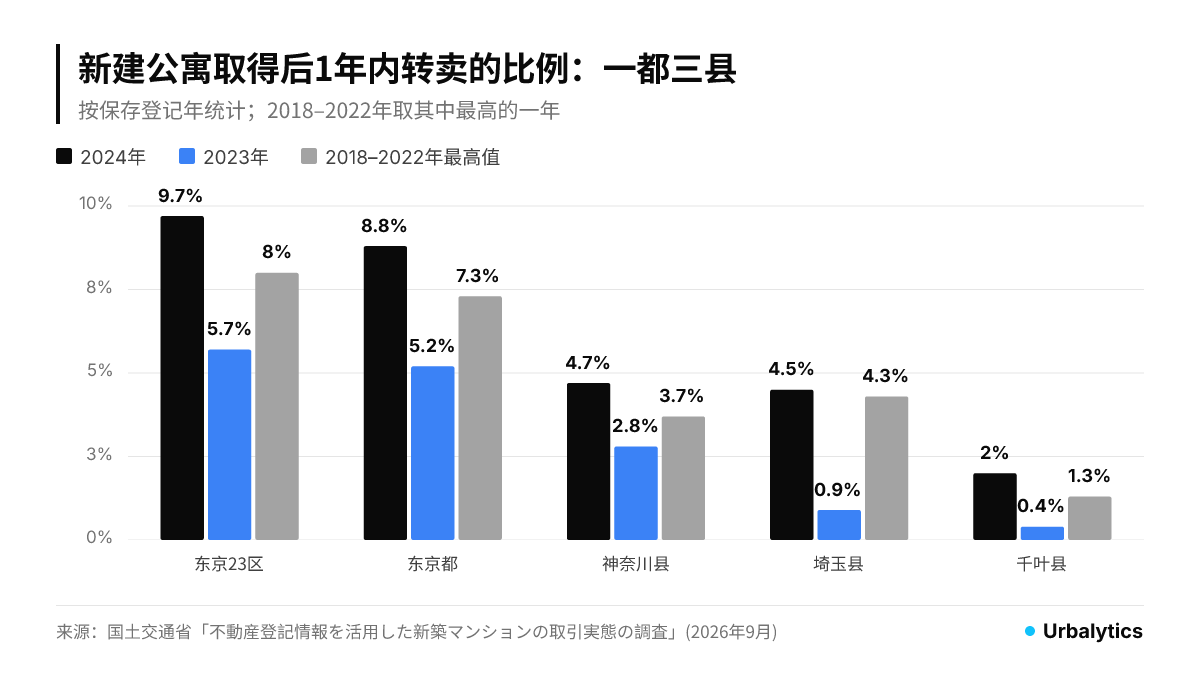
A Ministry of Land, Infrastructure, Transport and Tourism (MLIT) study published in September 2026 used property registry information supplied by the Ministry of Justice to measure the share of new condominiums with a sale-related ownership transfer registered within 365 days of their initial ownership registration. It excluded cases where developers sold all condominium titles in a building in bulk to an intermediary for subsequent individual sales. For new condominiums initially registered in 2024, the regional shares were:
Tokyo's 23 wards: 9.7% (compared with 5.7% in 2023; the peak during 2018–2022 was 8.0% in 2021)
Tokyo Metropolis: 8.8% (5.2% in 2023; a peak of 7.3% in 2021)
Kanagawa Prefecture: 4.7% (2.8% in 2023; a peak of 3.7% in 2020)
Saitama Prefecture: 4.5% (0.9% in 2023; a peak of 4.3% in 2020)
Chiba Prefecture: 2.0% (0.4% in 2023; a peak of 1.3% in 2020)
The same study contains two further findings directly relevant to the proposed rules. First, among short-term resales in the 23 wards, companies account for more than four-fifths of transactions, although their share has declined over the past two years. Second, the short-term resale rate among owners with overseas addresses was 5.7% in 2024. The study also states that it found no tendency for owners with overseas addresses to actively engage in short-term trading of high-priced properties worth ¥200,000,000 or more in the central 6 wards.
Rates vary widely by ward. MLIT also cautions that the particular developments supplied in a given year can cause substantial fluctuations. Higher resale rates in 2024 included Katsushika at 26.5%, Shinjuku at 20.0%, Sumida at 17.0%, Shibuya at 15.2%, Ota at 13.4% and Chuo at 12.8%. Lower rates included Koto at 3.9%, Bunkyo at 1.7%, Meguro at 1.2% and Edogawa at 0.1%.
The corporate rules have yet to be set out
The increase of “about 10 percentage points” reported by the Asahi Shimbun concerns individual income and resident taxes. Companies' property sale profits are included in corporate income and subject to corporate tax, without a distinction based on holding period. A separate additional tax regime exists for gains on land held briefly by companies, but it has long been suspended. The Reiwa 8 fiscal-year tax reform outline extended that suspension by another 3 years, through the end of March 2029.
With companies accounting for more than four-fifths of short-term resales, and the policy division explicitly calling for their inclusion, the corporate rules would determine the reform's practical impact. No details have been published on whether there would be a separate surcharge for new condominiums resold within 1 year, or whether the existing additional land taxation regime would be revived or revised. Changing individual rates alone would affect a minority of transactions.
Resale rates do not track asking-price growth
The policy starts from the premise that resales are one contributor to rising prices. Yet comparing resale rates in the 10 wards above with the annual change in median asking prices per square meter for resale condominium units in Urbalytics market reports reveals no pattern of “more resales, faster price growth”:
Katsushika: resale rate 26.5%; asking price per square meter ¥634,000 → ¥766,000 (+20.8%)
Shinjuku: 20.0%; ¥1,301,000 → ¥1,488,000 (+14.4%)
Sumida: 17.0%; ¥968,000 → ¥1,056,000 (+9.1%)
Shibuya: 15.2%; ¥1,663,000 → ¥1,998,000 (+20.1%)
Ota: 13.4%; ¥852,000 → ¥926,000 (+8.7%)
Chuo: 12.8%; ¥2,075,000 → ¥1,947,000 (−6.2%)
Koto: 3.9%; ¥1,260,000 → ¥1,358,000 (+7.8%)
Bunkyo: 1.7%; ¥1,311,000 → ¥1,539,000 (+17.4%)
Meguro: 1.2%; ¥1,356,000 → ¥1,648,000 (+21.5%)
Edogawa: 0.1%; ¥700,000 → ¥828,000 (+18.3%)
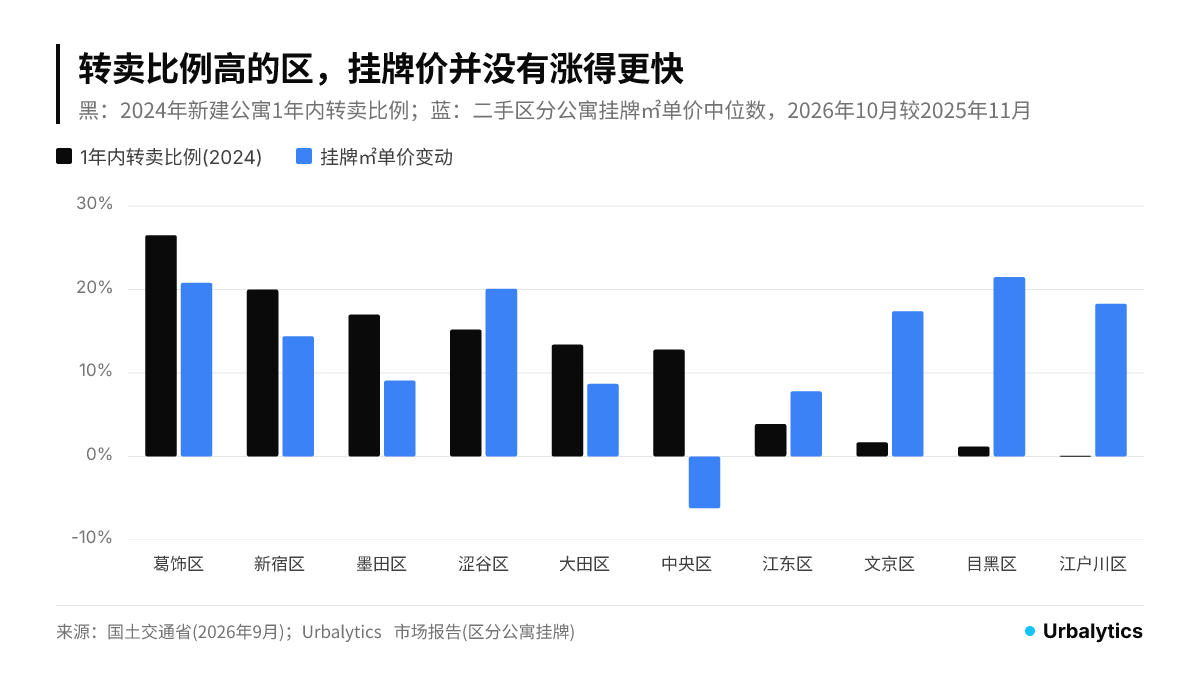
In Meguro and Edogawa, where resale rates were close to zero, asking prices per square meter rose by roughly a fifth over a year, comparable to Katsushika, which had the highest resale rate. Chuo, with a mid-ranking resale rate, was the only one of the 10 wards to record a decline. This is a cross-sectional comparison, and the two datasets cover different years, so it cannot prove that resales are unrelated to property prices. It does suggest, however, that resales are not the main variable explaining price differences, at least in ward-level asking-price data.
Investors holding resale condominium units or entire buildings should therefore avoid treating this proposed tax hike as a switch that would cool the whole market. Interest rates, construction costs and new housing supply have a more direct effect on prices. A tax increase is more likely to alter the timing of transactions during the first year after a new property's handover.
Rental implications: more new homes held beyond 1 year
If selling within 1 year attracts roughly 10 additional percentage points of tax, one option is to rent the property out first and sell after 1 year. In the simplified example above, the additional tax is about ¥1,000,000, while a year's rental income could exceed that amount. Urbalytics rental listings first observed over the past 12 months, covering homes completed in 2024 or later and measuring 40–80 m², show the following median monthly asking rents in three wards with relatively high resale rates:
Shinjuku, within 2 km of the ward office: ¥302,000, approximately ¥6,198 per m², from 291 listings
Sumida, within 2.5 km of the ward office: ¥230,000, approximately ¥5,011 per m², from 911 listings
Katsushika, within 3 km of the ward office: ¥163,000, approximately ¥3,239 per m², from 284 listings
In Sumida, for example, annualizing the monthly asking rent gives approximately ¥2,760,000. Before deducting management fees, repair reserve contributions, fixed asset tax and vacancy costs, that exceeds the additional tax in the example above. Some properties that would otherwise have been listed for resale a few months after handover may therefore enter the rental market first. For nearby landlords with comparable properties, this would mean greater competition around handover periods, particularly in wards where new building completions are concentrated.
However, the policy division's request targets resales of properties “not used as a residence.” Whether renting a property out falls within that definition, and whether selling after a full 1 year of ownership puts it entirely outside the new rules, will depend on the final wording.
Three things to watch before year-end
First, how the “1 year” is measured. Current short- versus long-term classifications use January 1 of the year of sale, while MLIT's statistics measure 365 days between registrations. Which approach the new rules adopt would determine how long after handover an owner must wait to sell. Second, the corporate tax structure, which would determine whether the four-fifths of short-term transactions undertaken by companies are covered. Third, how “speculative” transactions are defined for real estate acquisition tax, which would directly affect purchase costs.
Before the rules are finalized, buyers purchasing new homes for resale should recalculate their income and expenses on the assumption of holding for at least 1 year and renting the property out in the meantime. Landlords in areas with concentrated new-building handovers can use Urbalytics' Tokyo market reports to track listing volumes and asking prices per square meter by ward, watching for new rental listings around handover periods.
At the end of September, we examined Tokyo's stance on property speculation in its housing policy and resales at Harumi Flag. For related analysis, see: Tokyo Finally Takes a Position on Property Flipping: After Harumi Flag, How Much Room Remains for Short-Term Resales?; for the LDP's proposal on foreign land purchases from the same period, see LDP Proposes a Permit System for Foreign Land Buyers: Implications for Tokyo Real Estate.
Data notes
MLIT data: based on initial ownership registrations and ownership transfer registrations recording a sale as the registration cause. “Short-term resale” means a transfer registered within 365 days of initial ownership registration. Cases where the seller is a company holding 100% of the condominium titles in the building are excluded. Ward-level rates are heavily influenced by the developments supplied that year.
Urbalytics asking prices per square meter: median asking prices per square meter for resale condominium units in the market reports, covering all building ages and excluding outliers using the interquartile range method. The comparison is between the aggregation months of November 2025 and October 2026. These are asking prices, not transaction prices. The platform's coverage expanded during this period, so the sample composition may have changed.
Rental data: rental listings collected by Urbalytics, first observed within the past 12 months, for residential properties completed in 2024 or later and measuring 40–80 m². Figures are monthly asking rents excluding management fees and include purpose-built rental buildings. Repeated listings for the same unit may be counted more than once. Geographic coverage uses a radius around each ward office and is restricted to addresses within that ward. The tax examples exclude acquisition costs, brokerage fees, special deductions and other adjustments, and illustrate only the difference in tax rates.
#NewCondos #ShortTermResales #CapitalGainsTax #Fiscal2027TaxReform #Tokyo23Wards #Katsushika #Shinjuku #Sumida #CorporateInvestment #RentalApartments #JapanPropertyTax #TokyoPropertyPrices #Urbalytics
Sources
Asahi Shimbun, “Higher Taxes Planned for Speculative Condo Resales Within 1 Year; Additional Tax Rate of About 10% Under Consideration,” 2026, https://news.yahoo.co.jp/articles/f193b73cf812ecf8b60e76088a52acedc5144e3f
Kyodo News, “Curbing Speculative New Condo Transactions: Higher Taxes Considered for Sales Within 1 Year,” 2026, https://news.yahoo.co.jp/articles/a42467086a3f1b8a3b8535e8b461915cdef99c37
MLIT, “Publication of Findings on New Condominium Transactions Using Property Registry Information,” 2026, https://www.mlit.go.jp/report/press/tochi_fudousan_kensetsugyo05_hh_000001_00276.html
MLIT, “Study and Analysis of New Condominium Transactions Using Property Registry Information,” 2026, https://www.mlit.go.jp/report/press/content/002022647.pdf
National Tax Agency, “No. 1440: Capital Gains from Transfers of Land or Buildings,” https://www.nta.go.jp/taxes/shiraberu/taxanswer/shotoku/1440.htm
Nomura Real Estate Solutions, “How to Calculate Capital Gains Tax,” https://www.nomu.com/tax/sell/jotoshotoku.html
Yamada & Partners Tax Corporation, “Reiwa 8 Fiscal-Year Tax Reform: Extensions and Revisions to Application Periods,” 2025, https://www.yamada-partners.jp/reform/r8/h09-extension-and-review-of-application-period
Urbalytics, “Tokyo Real Estate Market Reports,” 2026, https://www.urbalytics.jp/market/area/tokyo
Copyright: This article is original content by the author. Please do not reproduce, copy, or quote without permission. For usage requests, please contact the author or this site.