Words: 1383 | Estimated Reading Time: 7 minutes | Views: 32
A proposal to bring inheritance-tax valuations of rental property closer to market prices means owners in Greater Tokyo should revisit the tax-saving assumptions in their acquisition plans.
On October 22, Kenbiya reported on the National Tax Agency’s draft valuation guidance for rental property. The proposal would, in principle, value rental real estate acquired for consideration or newly constructed within five years before the tax valuation date at its normal transaction value. Where specified conditions are met, it would allow an amount based on acquisition cost, adjusted and then multiplied by 80%.
This affects a familiar reason for buying rental buildings: converting cash into property to reduce the value of an estate for tax purposes through the gap between purchase price and tax valuation. Buyers in Tokyo, Kanagawa, Saitama and Chiba who have included that benefit in their acquisition plans need to re-examine its basis.
As of October 22, the documents verified for this article remain a draft. e-Gov shows that public consultation closed on October 18. The draft envisages application to assets acquired by inheritance, bequest or gift on or after January 1, 2027. The close of consultation does not mean the wording has been finalized.
Two checks before applying the 80% calculation
The draft first requires the acquisition price to be recognized as the normal transaction value at the time of acquisition. It then treats land and buildings separately. Land cost is adjusted by a land-price change factor; the building cost is reduced by the prescribed depreciation or reduction amount. Each adjusted amount is then multiplied by 80%.
Simply multiplying the entire purchase-contract price by 80% therefore does not produce a valuation valid at any date. The allocation between land and building, delivery date and subsequent improvement costs may also affect the calculation. The draft generally uses delivery to determine the acquisition date, with exceptions covering exchanges, compulsory acquisition and certain buildings constructed on previously owned land.
The five-year period is measured backwards from the tax valuation date to acquisition. It does not restart when the proposed rules take effect. Buyers preparing to sign should ask their tax adviser to check the actual delivery date rather than rely on statements such as “bought this year” or “held for more than five years.”
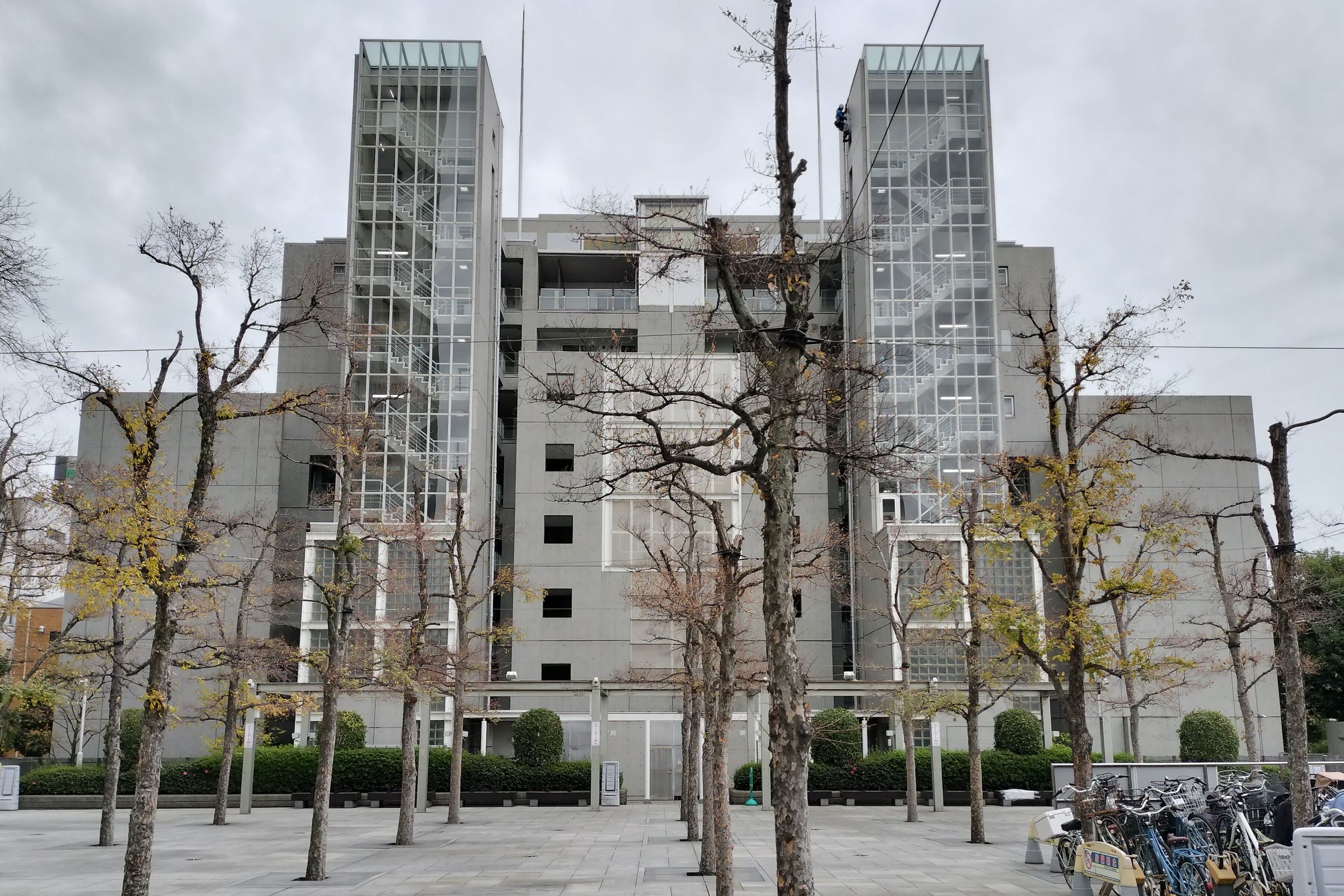
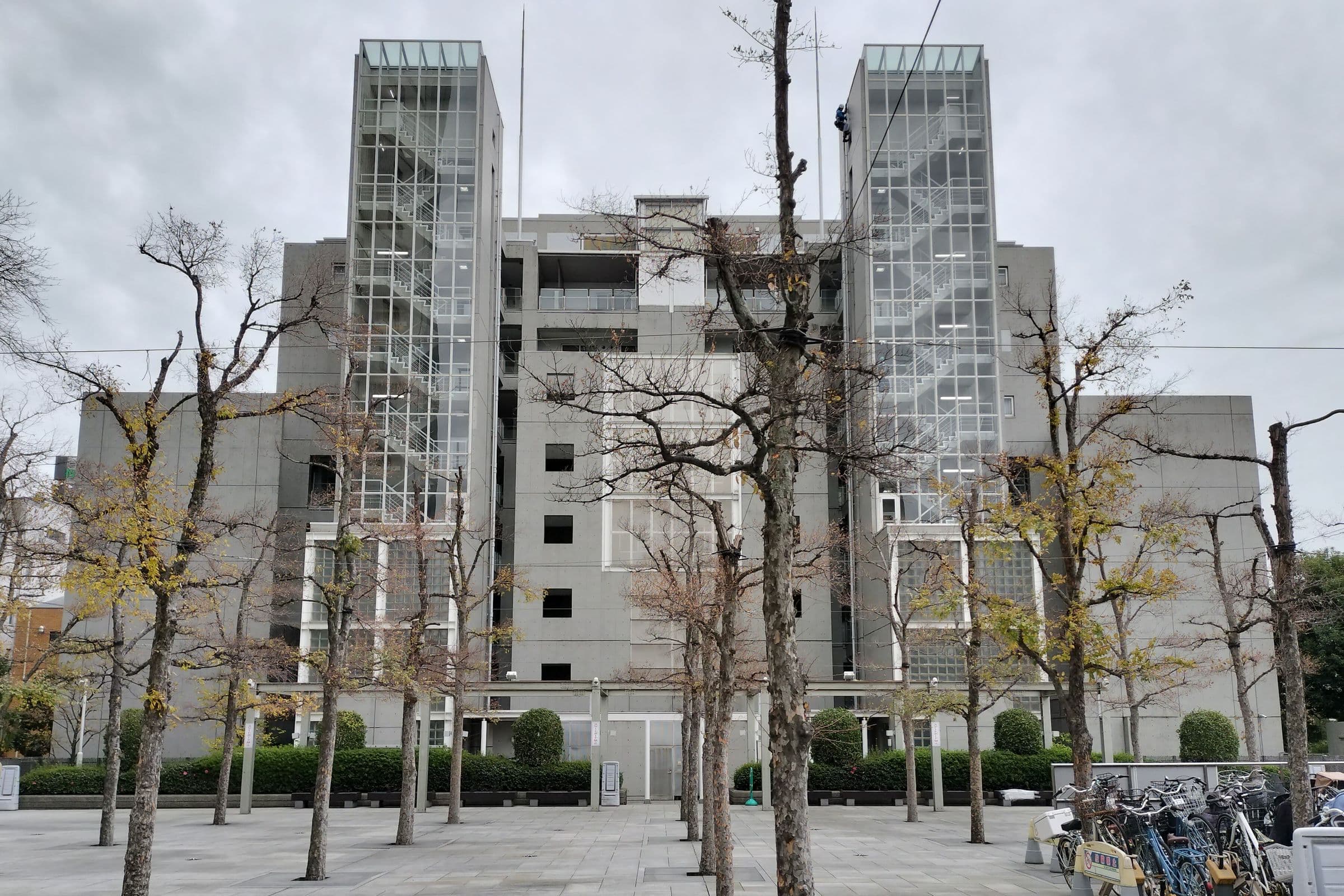
Figure 1 | Residence Nakano-sakaue, photographed on December 5, 2023. Photo: 鋸香具師 / Wikimedia Commons, CC0, unmodified. An illustration of multifamily housing.
A change in tax valuation does not increase rental income
For owners seeking long-term rental income, lettability and maintenance costs still determine operating performance. A change in tax valuation mainly changes the calculation used when assets are transferred; it does not simultaneously increase the rent arriving in the owner’s bank account.
The effect is more direct for buyers who accepted a lower operating return in the expectation that tax savings would make up the difference. If that benefit shrinks without a corresponding adjustment in purchase price, the overall investment may become less attractive. Sellers also need to explain leases and property condition rather than emphasize only the valuation discount available under previous assumptions.
This mechanism does not establish that market prices have already fallen. The final guidance and any changes to buyers’ offers will need to be assessed against subsequent transaction evidence. Our earlier analysis of Tokyo investment-condominium and whole-building prices examined the different price measures used for different asset classes; tax analysis likewise needs to address the specific property.
Fractional real estate products are treated separately in the draft. This article’s discussion of directly held rental buildings should not be applied wholesale to those products. Holding property through a company and inheriting its shares also raises separate share-valuation questions; conclusions for direct personal ownership cannot simply be transferred to that structure.
Use Nakano market samples to assess operations separately
To illustrate the range of market evidence used in rental-housing underwriting in Greater Tokyo, we selected samples within a 15-minute walk of Nakano Station in Tokyo. They show how rents and acquisition yields should be checked separately, not that Nakano would be more affected by the proposal.
Urbalytics recorded 536 residential rental listings for units of 20–40 m². Median base rent was ¥125,000 per month, with a lower quartile of ¥90,000 and an upper quartile of ¥148,250. This distribution can help owners identify comparable asking rents within the same size band, then narrow the comparison by age and equipment. It does not establish that their own unit can achieve the median rent.
A separate sample of whole-building listings and price revisions contained 40 records after deduplication. Median gross asking yield was 4.45%, with a lower quartile of 4.07% and an upper quartile of 5.28%. These figures prompt further checks on whether advertised annual income assumes full occupancy and how much remains after operating costs. They are not appraisals of normal transaction value for tax purposes.
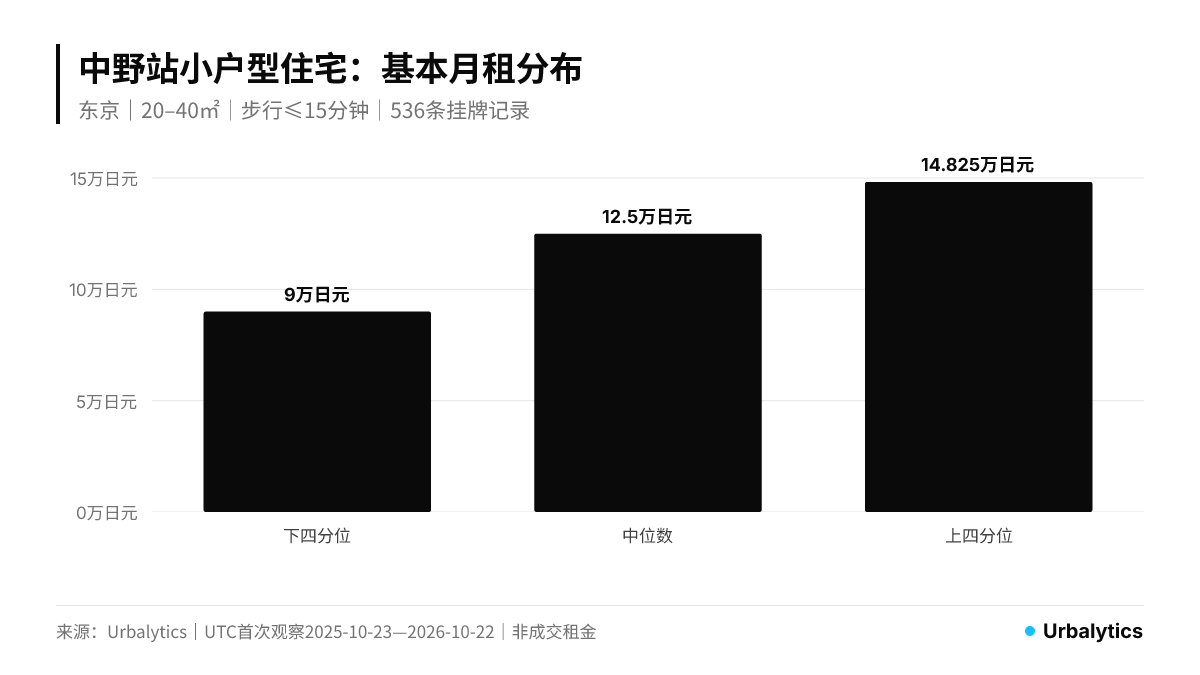
Panel A | Base monthly rent (¥10,000 per month): lower quartile 9, median 12.5, upper quartile 14.825. Residential units of 20–40 m² within a 15-minute walk of Nakano Station, Tokyo; n=536. Observation window: 2025-10-23 to 2026-10-22 (UTC).
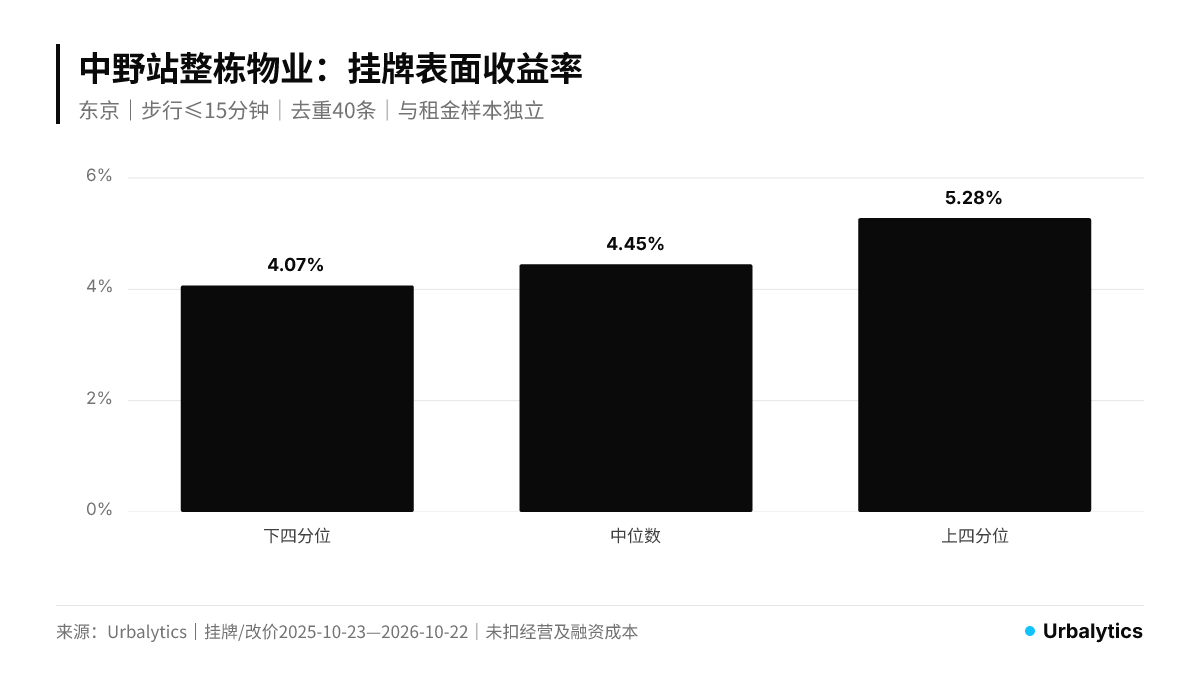
Panel B | Whole-building gross asking yield (%): lower quartile 4.07, median 4.45, upper quartile 5.28. Within a 15-minute walk of the same station; n=40 after deduplication, over the same window. Before operating and financing costs.
The two samples are independent. Multiplying unit rents by an assumed number of units, then combining that result with whole-building prices from a different sample, would not create a valid “representative rental building.” Actual acquisition analysis must return to the target property’s leases, vacancies and expenses. For area context, see the Nakano Ward whole-building market report and the Tokyo market report.
Methodology: queried on October 22, 2026, with the location restricted to Tokyo. Rent figures use currently stored base asking rents for residential listings first observed between 2025-10-23 and 2026-10-22 (UTC), for units of 20–40 m² within a 15-minute walk. The scan limit was not reached. Management fees and other charges are excluded; these are not agreed rents. The whole-building sample uses properties with listing or price-revision records in the same window, excludes completed-sale records and private valuations, and merges duplicates appearing under multiple stations. Gross yield is advertised annual income divided by asking price, before operating and financing costs. This cross-sectional distribution does not measure price changes before and after the policy.
Start with the tax assumptions in the acquisition plan
Families that already own rental buildings can organize the delivery dates and land/building price allocations for each acquisition, then ask their tax adviser whether the draft applies and whether any exceptions are relevant. If the original plan contains an inheritance-tax estimate, identify which version of the rules it uses rather than retain only an “expected tax saving.”
Buyers considering an acquisition should first check whether existing leases support their offer without relying on an uncertain tax benefit. Renovation plans also need their own appraisal, so that future rent increases and previously assumed tax savings are not both counted as certain gains.
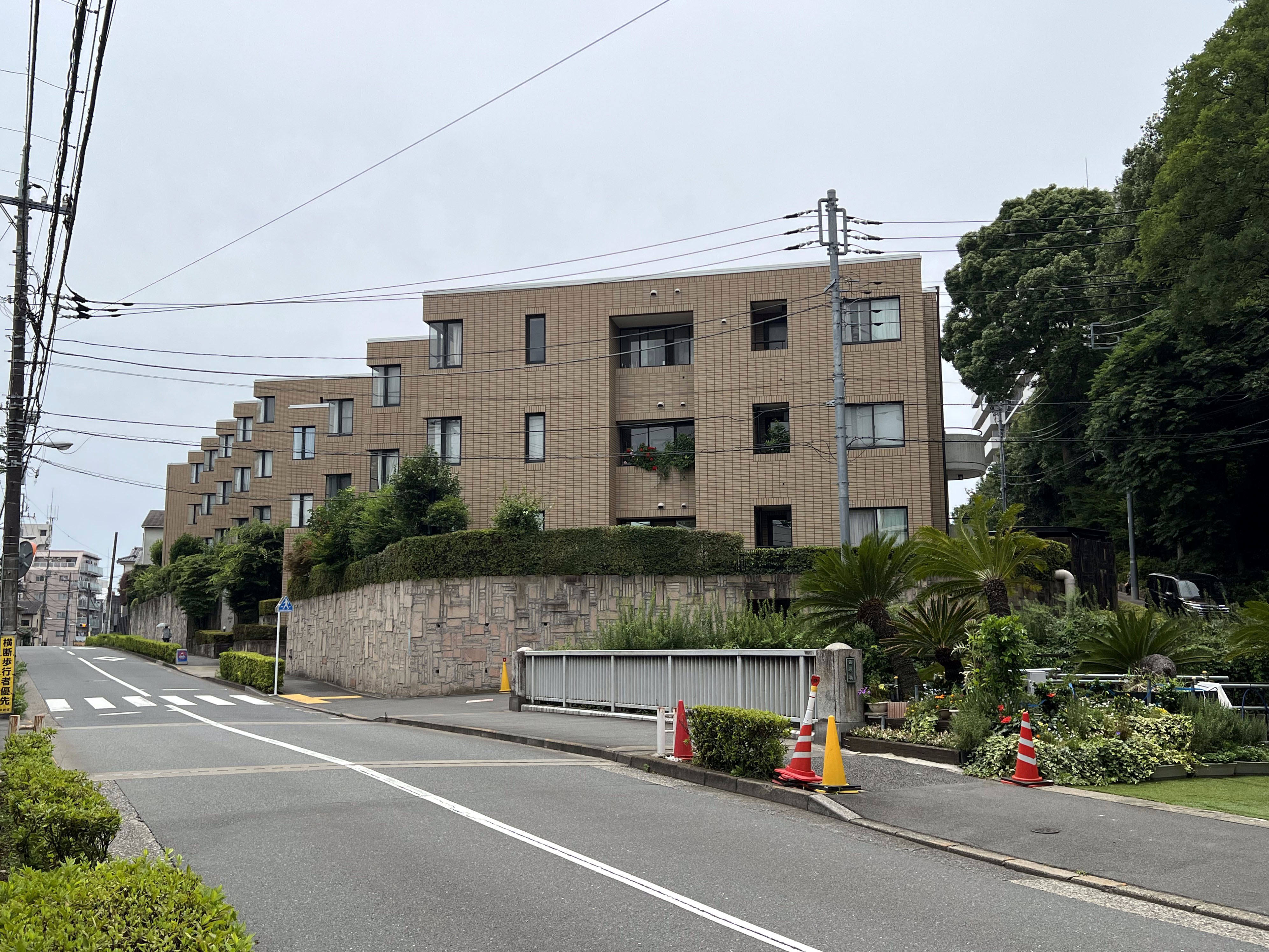
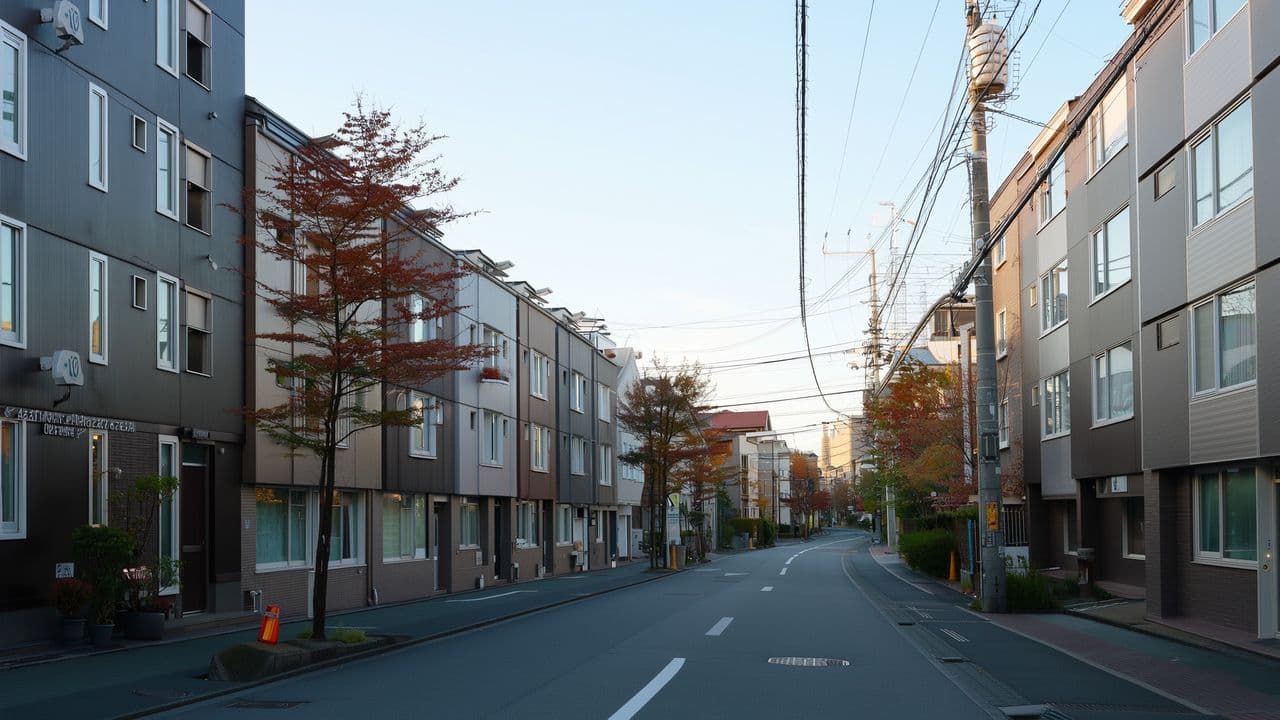
Figure 2 | Belte Nakano Egota, photographed on June 18, 2023. Photo: Asanagi / Wikimedia Commons, CC0, unmodified. This is not a property in the statistical sample or an individual tax case.
The next documents to watch are the National Tax Agency’s final guidance and transitional arrangements. Once finalized, use the same property information to update the tax calculation and compare it line by line with the original acquisition plan. If the change is material to the offer price, record the revised reasoning before delivery.
Cover and body photo 1: Residence Nakano-sakaue, December 5, 2023; 鋸香具師 / Wikimedia Commons, CC0, unmodified. Body photo 2: Belte Nakano Egota, June 18, 2023; Asanagi / Wikimedia Commons, CC0. The photographs illustrate multifamily housing in Tokyo; they do not identify properties in the statistical samples or individual cases to which the draft applies.
Tags
#JapanRentalProperty #InheritanceValuation #InheritanceTax #RentalRealEstate #FiveYearRule #NationalTaxAgency #TokyoPropertyInvestment #Nakano #WholeBuildingInvestment #RentalMarket #GrossYield #Urbalytics
References
Kenbiya, October 22, 2026: report on the draft rental-property valuation guidance.
National Tax Agency / e-Gov, September 18, 2026: case 410080055, summary, and full draft.
Urbalytics: Nakano Ward whole-building market report, September 2026 monthly page. The separate station-area queries used in this article are defined in the methodology above.
Wikimedia Commons: Residence Nakano-sakaue photograph and license; Belte Nakano Egota photograph and license.
Copyright: This article is original content by the author. Please do not reproduce, copy, or quote without permission. For usage requests, please contact the author or this site.