Words: 1593 | Estimated Reading Time: 8 minutes | Views: 15
Some Japanese banks do lend to non-residents, but the JPY 10 million annual income line keeps most people from even picking up the phone.
An interview with a banker cracked open a door we usually can’t see
On October 6, Weekly Economist Online published an interview with Tokyo Star Bank president Takeshi Ito. The protagonists are Taiwanese clients and TSMC Kumamoto expatriates—seemingly unrelated to most Chinese-speaking readers looking to buy property.
But one line is worth reading twice: as early as 2014 the bank developed a real estate loan called "Tokyo Shofukusei," under which "non-residents may, subject to prescribed screening, use financing needed to purchase real estate in Japan."
For readers who have long asked on social media whether they can borrow without being in Japan, this is one of the few explicit answers from a bank chief. In the same interview, Ito also spelled out the hard part: for foreign nationals with no address or actual residence in Japan, even opening a basic bank account is difficult under the Foreign Exchange and Foreign Trade Act.
This point is often glossed over by agents. Under anti-money-laundering rules, strict KYC isn’t banks being difficult—it’s the system’s first gate for remote owners. Borrowing is only the second gate beyond it.
Tokyo Star’s ability to do this isn’t because it is aggressive; it’s because since 2014 it has been a subsidiary of Taiwan’s CTBC Bank. The parent’s client relationships, Chinese-speaking staff, and dedicated hotlines for Taiwan and Hong Kong form the entire infrastructure behind this product.
"Tokyo Shofukusei" itemized: Taiwan JPY 10m, Hong Kong JPY 15m
The bank’s website states the conditions plainly, leaving virtually no ambiguity—unusual for Japanese financial product pages.
The version for Taiwan residents requires: holding a Republic of China (Taiwan) passport, residing in Taiwan, being a Taiwan tax resident and not a resident of any other country or region, and submitting publicly verifiable income documents. Applicants must be at least 20 at application and no older than 75 at final repayment.
The real dividing line is in the income row: the prior year’s official income certificate must show annual income of at least JPY 10 million, or net assets of at least JPY 30 million. The net-asset formula is specified: financial assets in Japan and Taiwan plus real estate held in Japan, minus housing-related debt, converted to JPY at the application-date exchange rate.
The Hong Kong version sets a higher bar: hold a Hong Kong ID (PIC or IC), have primary income sourced in Hong Kong, the maximum age at final repayment tightened to 65, and the threshold raised to annual income of JPY 15 million or net assets of JPY 45 million. The gap broadly reflects the bank’s different assessments of how verifiable income and assets are in the two markets.
The rest of the terms aren’t friendly to remote holders:
First, you must appear in person at Tokyo Star Bank’s head-office counter to sign. Applications can be mailed or emailed as PDFs, but the last step still requires a trip to Tokyo—a hard cost for buyers who want to transact remotely.
Second, if the purpose is investment, rent must be remitted into the bank’s designated repayment account—binding rental cash flows to the same bank. Changing the property manager or bank later will require renegotiation.
The loan term is 1–25 years, amounts start from JPY 20 million, and eligible collateral includes whole or sectional-title apartments, entire apartment buildings, single commercial buildings or sectional-title retail/office units, and detached houses—broader coverage than most expect.
As for the rate, the website doesn’t publish it and lists only a Chinese-language hotline: the rate is undisclosed—you have to call. That fact itself is information: pricing is negotiated case by case, not posted.

Residents in Japan take another path: you can still get a home loan without permanent residency
Asking whether "foreigners can borrow in Japan" conflates two very different groups. The previous section covered people overseas buying investment properties; foreigners already living in Japan and buying a primary residence go through another channel—far more lenient.
The same bank’s "Star Home Loan (for applicants without permanent residency)" draws the line here: as a regular employee, have worked in Japan continuously for 1+ years with pre-tax annual income of JPY 4 million or more; or annual income of JPY 3 million or more, be a regular employee and under 40 (subject to guarantee/underwriting assessment and other conditions). Company directors and the self-employed must have operated in Japan for at least three fiscal periods.
The rate is the number to watch on this channel: with payroll to a designated account and a full-term 1.10% discount, the floating rate is 2.400%–3.500% p.a. (as of October 1, 2026). No guarantee fee, zero prepayment fee, term up to 35 years, amount JPY 5 million to JPY 100 million.
The trade-off is on the same page: on drawdown you pay a handling fee of 2.2%–3.3% (incl. tax) of the loan amount, plus registration fees and stamp duty; group credit life insurance may add up to 0.3% p.a. depending on the plan. If you have a spouse, the spouse must be a joint and several co-borrower or joint guarantor.
Add that up: on a JPY 50 million loan, you’ll pay JPY 1.1–1.65 million in fees upfront—costs not reflected in the interest rate but which materially shift early-years holding costs.
Note the final remark: if you obtain permanent residency during repayment and notify the bank, after review your rate may be lowered. In other words, a change in status is an opportunity to negotiate a rate cut—many people forget after getting PR.
3.5% rate versus 4.4% gross yield: where does the math break even?
Put financing terms and asset yields on the same chart and you’ll see "can borrow" and "worth borrowing" are different questions.
Urbalytics compiled listings of whole-building income properties from July 2025 to October 2026 (gross yield = advertised annual income ÷ asking price; duplicates merged, outliers removed): median 4.65% around Ikebukuro (88 buildings), 4.44% around Kinshicho (42), 5.03% around Kamata (61), and 6.09% around Kawasaki (60).
We use medians rather than averages. Ikebukuro’s average is lifted to 5.24% by a few high-yield listings and doesn’t represent a typical asset—this statistical trap is common in broker materials.
Taking the upper end 3.500% from the home-loan floating-rate band in the prior section as an optimistic reference, Ikebukuro’s spread is only about 1.15 percentage points; Kinshicho is narrower at about 0.94 points. Kamata is about 1.53 points, while Kawasaki offers roughly 2.59 points.
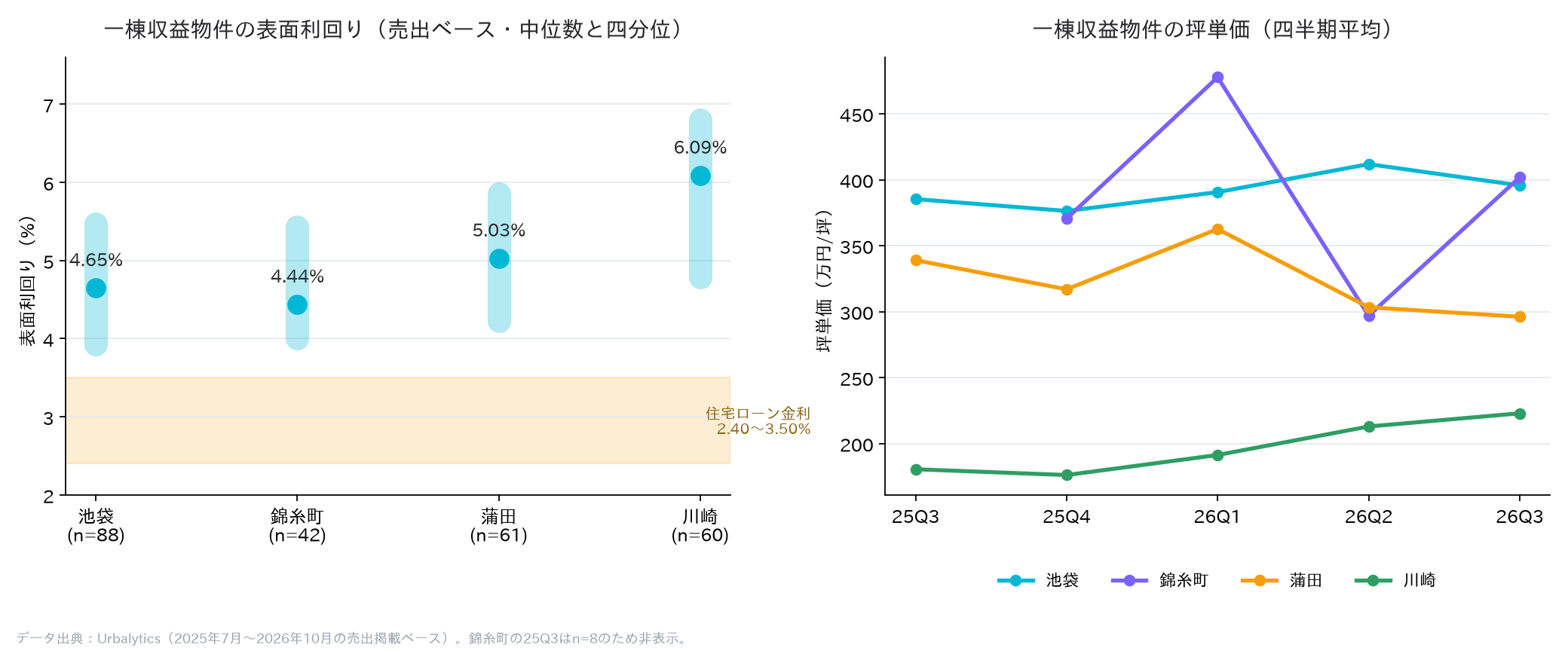
Urbalytics Insight What this comparison really shows is that in core station areas like Ikebukuro and Kinshicho, the spread between advertised gross yield and borrowing cost is down to roughly one percentage point. After fixed-asset and city-planning taxes, management fees, and vacancy, leverage delivers little to no excess return. Urbalytics’ station-area whole-building yield distribution tool lets you check this spread by station—instead of deciding off the phrase "central Tokyo."
Risk warning The above spreads use the upper bound of an owner-occupied home-loan rate as a best-case floor. "Tokyo Shofukusei" is an investment loan with undisclosed pricing, and investment financing is typically more expensive; add the 2.2%–3.3% arrangement fee and FX volatility, and the actual spread may be even narrower—or negative. Also, these yields are based on asking prices, not achieved prices.
Conclusion: decide which bucket you’re in before booking viewings
The value of this news isn’t that "Japan has loosened"—the terms have been there since 2014. Its value is turning a sheet of conditions once shared only by brokers into a public checklist you can verify line by line.
For readers overseas, the practical move is to first test yourself against the income and net-asset lines, and then factor the trip to the Tokyo head office into your costs. If you can’t clear either line, paying cash—or applying via a family member already residing in Japan—will often save more time than searching for "a bank willing to lend."
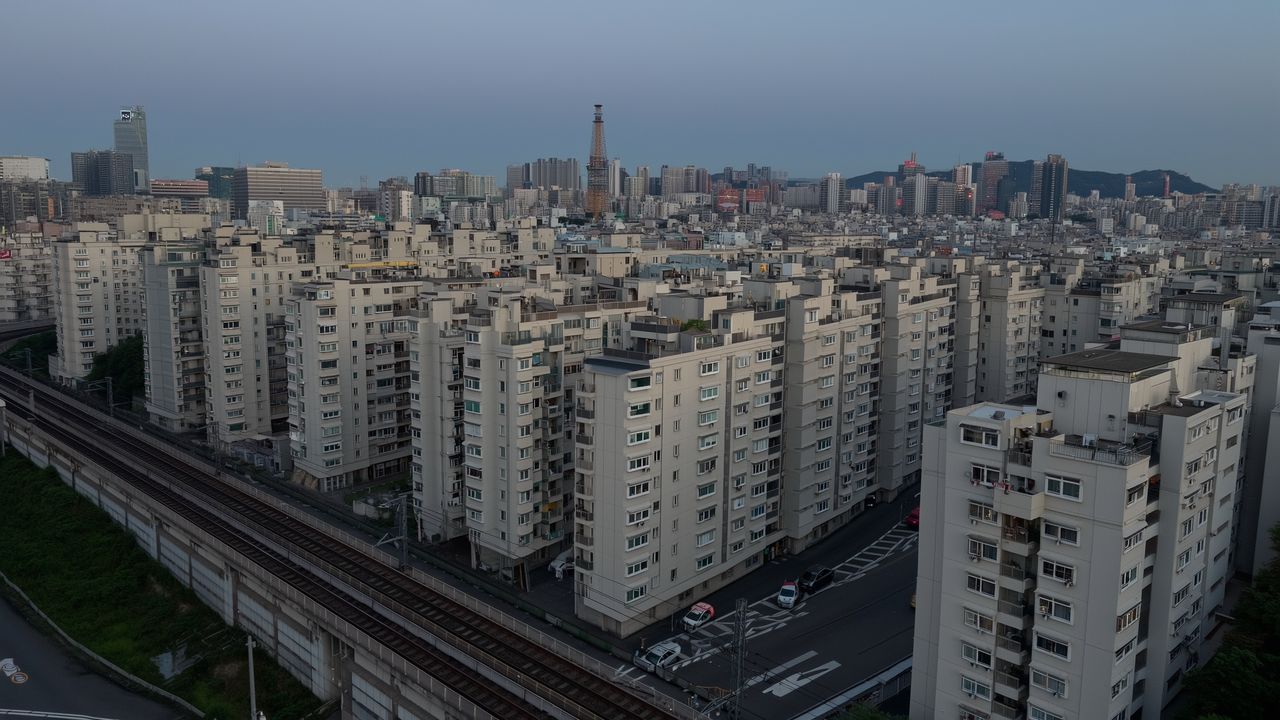
For readers already working in Japan, the picture is far brighter: one year of continuous employment and JPY 4 million in income is within reach for many, and after you obtain permanent residency you still have a chance to negotiate a lower rate.
Note that this article unpacks only one bank’s products. Different institutions treat non-residents and non-PR applicants very differently, and conditions will move with the rate environment—don’t treat these numbers as market-wide rules.
As for where to buy—that’s a separate question. In a market where the spread has been squeezed to about one percentage point, choosing the wrong station area costs more than choosing the wrong bank. Urbalytics’ station-level yield and price-per-tsubo data are designed to remove the guesswork from that step.
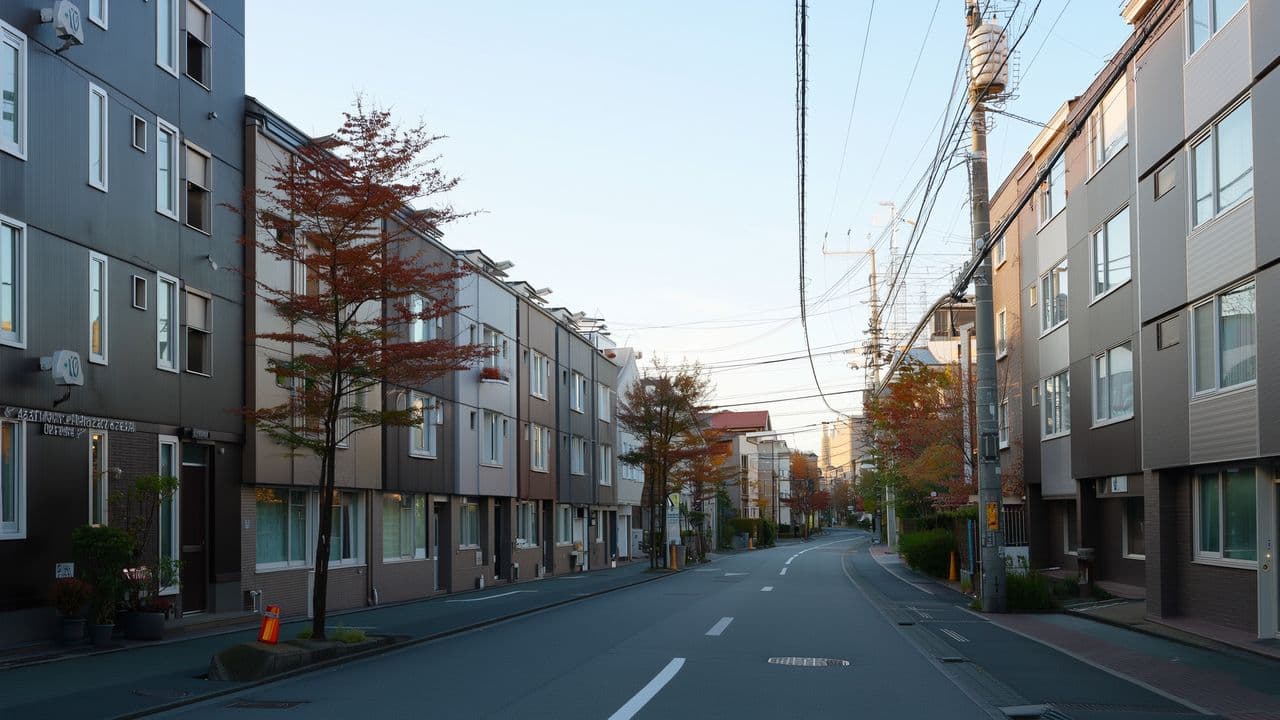
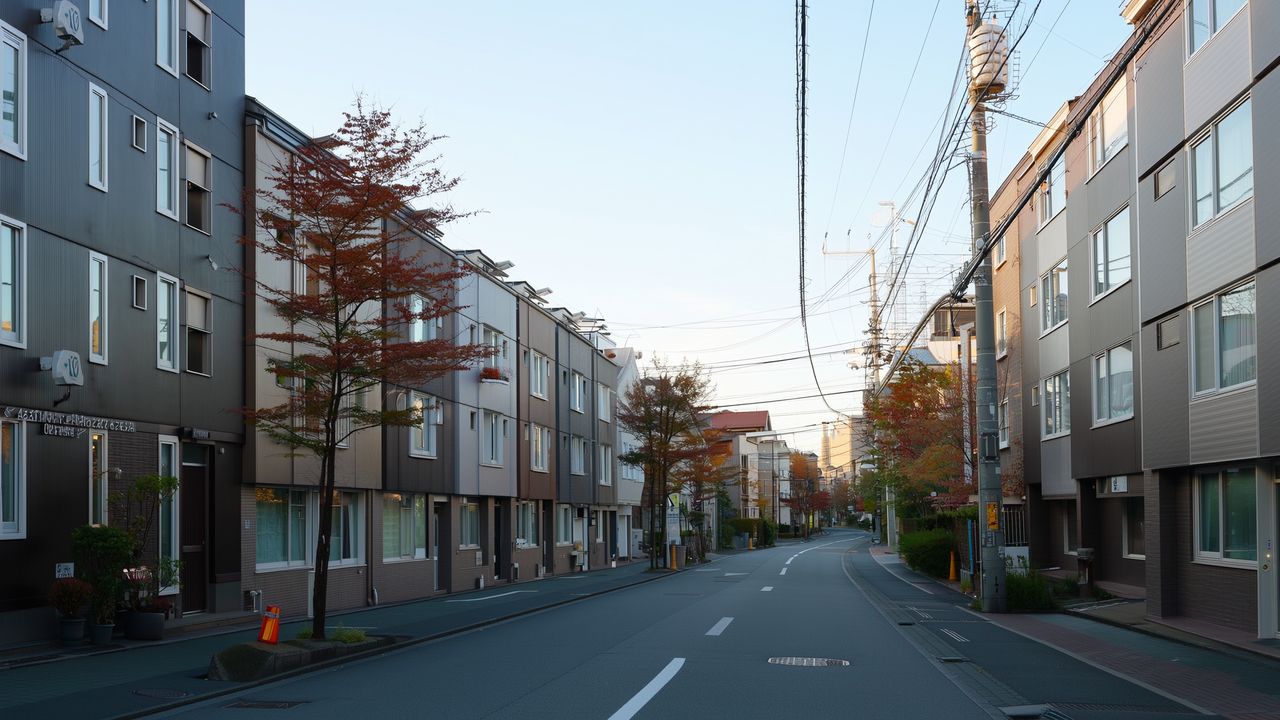
※ The concept images in this article were generated by AI.
#JapanRealEstate #NonResidentLoans #ForeignHomeLoans #TokyoStarBank #TokyoShofukusei #PermanentResidency #Mortgage #WholeBuildingIncome #GrossYield #Ikebukuro #Kinshicho #Kawasaki #TokyoProperty #JapanMortgage #Urbalytics
References
- Sunday Mainichi × Weekly Economist Online, 2026, "Interview: 'Strengthening services for Taiwanese; supporting TSMC Kumamoto expatriates and their families' — Takeshi Ito, President, Tokyo Star Bank", https://news.yahoo.co.jp/articles/ff3dd22bc8686ca7f0db91c26f725376fbd69fdb
- Tokyo Star Bank, 2026, "Tokyo Shofukusei" Star Real Estate Investment Loan (For Non-Residents of Japan), https://www.tokyostarbank.co.jp/foreign/products/loan/property/
- Tokyo Star Bank, 2026, Star Home Loan (For Applicants Without Permanent Residency), https://www.tokyostarbank.co.jp/foreign/products/loan/homeloan_star/
- Urbalytics, 2026, Whole-Building Income Properties Gross Yield Statistics (Ikebukuro, Kinshicho, Kamata, Kawasaki; July 2025–October 2026), https://www.urbalytics.jp/market
Copyright: This article is original content by the author. Please do not reproduce, copy, or quote without permission. For usage requests, please contact the author or this site.