Words: 1804 | Estimated Reading Time: 10 minutes | Views: 119
The same management fee plus repair reserve fund takes just 8.5% of rent in Nakano, but nearly one-fifth in Omiya and Funabashi; holding costs are reshuffling how resale condos are valued.
In recent years, when judging whether a Tokyo resale condo is worth buying, investors mostly looked at distance to the station, building age, floor area, and developer brand. But a figure often tucked onto the last page of the purchase contract is quietly becoming part of the pricing equation.
On October 2, 2026, Kenbiya ran an analysis titled “Condo prices won’t fall,” arguing that the coming market may not broadly decline; instead, assets will be screened by “how much they cost to hold.” Building on that piece, we pulled Tokyo Kantei’s original releases and used the Urbalytics platform to fetch rents for six stations across Greater Tokyo to answer a more concrete question: with the same holding cost, how much does the burden differ across rental condos in different areas?
I. A turning point has appeared, but it’s not a “broad-based decline”
First, the big picture. According to Tokyo Kantei’s September 24 release, the average asking price in August 2026 for a 70 m² used condo in Tokyo’s 23 wards was ¥126.77 million, down 0.4% m/m—its third straight monthly drop. Tokyo Metropolis overall was ¥112.74 million, edging down 0.2% m/m, the first decline in 28 months.
But in the same dataset, Greater Tokyo as a whole rose 0.8% m/m to ¥76.06 million, up for 25 consecutive months. The drivers were the three neighboring prefectures: Saitama rose 1.4% m/m to ¥33.29 million and Kanagawa rose 0.7% to ¥44.00 million, with both up more than 10% y/y.
In other words, buyers are starting to balk at core-area prices, while the suburbs still absorb displaced demand. New-builds show similar signals: citing Tokyo Kantei, Kenbiya notes Greater Tokyo’s new-condo price per tsubo fell from ¥5.021 million in Q1 2026 to ¥4.813 million in Q2, down 4.1%.
However, new-build prices have limited room to fall. With materials, labor, and energy costs not retreating, developers are more likely to shrink unit sizes, shift supply to the suburbs, and pace launches to sustain unit prices rather than cutting list prices. With new-build prices propped up by costs, the resale market will keep absorbing “can’t afford new” demand—the question is which types of resales that demand will chase.
II. ¥32,000 per month: rising slower than you think—and more stubborn than you think
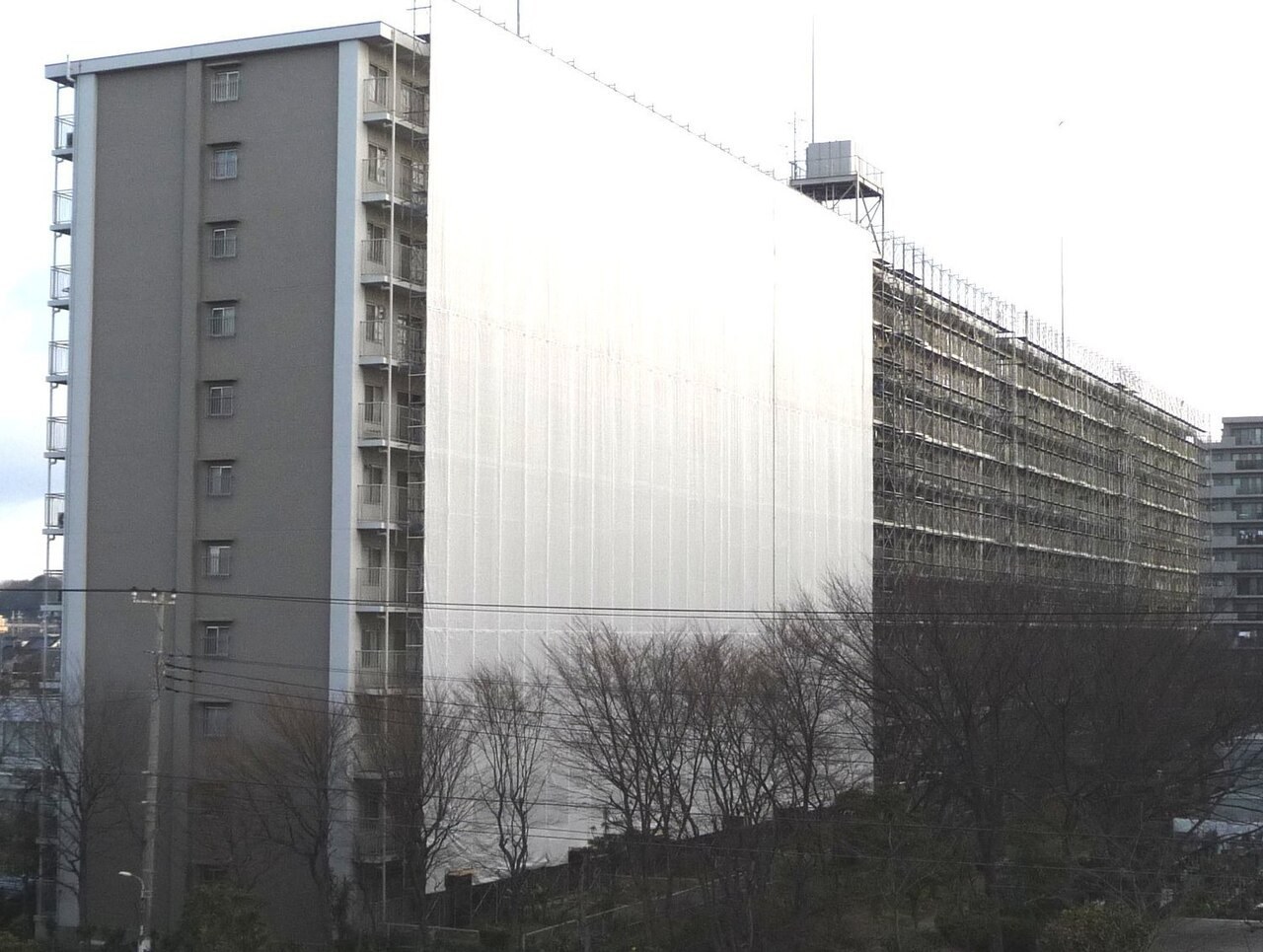
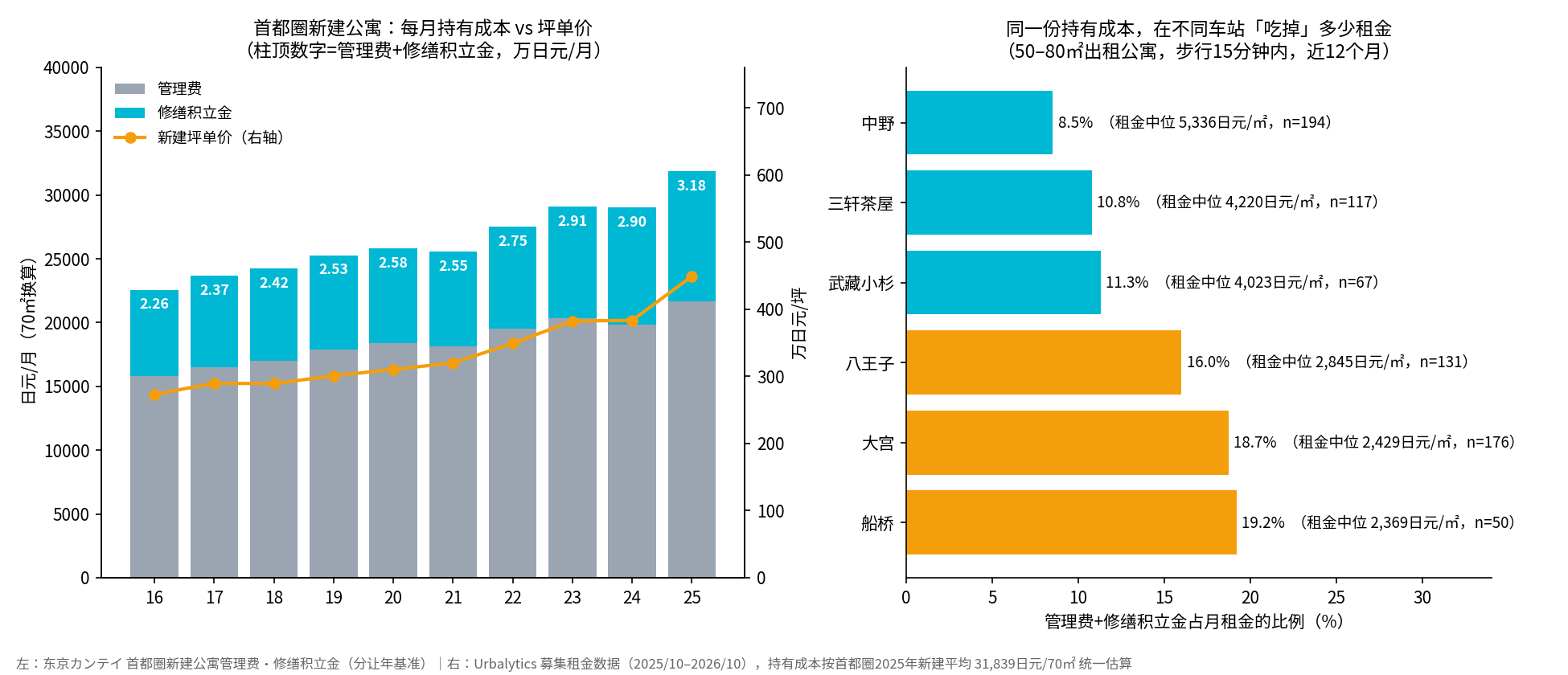
Tokyo Kantei’s statistics show that for a newly built condo in Greater Tokyo (70 m² basis) in 2025, the monthly management fee averaged ¥21,691 and the repair reserve fund (修繕積立金) averaged ¥10,148, for a total of ¥31,839—about ¥380,000 per year—up roughly 41% from ¥22,574 in 2016.
Notably, management-fee growth has lagged home-price growth. Using 2000=100, the 2025 index for management fees is 179.5 and for the repair reserve 193.3, while the per-tsubo price index has reached 249.9. Another Tokyo Kantei report on July 30 also notes the per-m² management fee in Greater Tokyo rose from ¥247.1 in 2010 to ¥310.4 in 2025, a 25.6% increase—well below home-price gains over the same period.
This means holding costs have been relatively “suppressed” versus prices over the past decade-plus. But that scissors gap is narrowing: tracking condos completed in 2010, Tokyo Kantei finds that in Tokyo, among properties sold by major developers, in the last five years 11.8% have seen per-m² management fees rise more than 10% from completion, and 15.3% have risen more than 5%.
Pressure is greater on the repair side. According to data cited by Kenbiya, the one-time initial repair reserve contribution (修繕積立基金) paid when buying a new-build reached ¥879,324 in 2025, up for 11 straight years. For 15-year-old resale condos, the combined monthly management fee plus repair reserve averages ¥34,509—higher than for new-builds—with the reserve alone at ¥17,180.
III. Urbalytics data: the same cost weighs more than twice as much depending on the station
For owner-occupiers, the management fee is a living expense; for rental investors, it’s a fixed cost that comes straight out of rent. To make this clear, we used Urbalytics to compute the 12‑month median monthly rent per m² for 50–80 m² rental condos within a 15‑minute walk of six stations.
The results: Nakano ¥5,336 (n=194); Sangenjaya (三軒茶屋) ¥4,220 (n=117); Musashi-Kosugi (武蔵小杉) ¥4,023 (n=67); Hachioji ¥2,845 (n=131); Omiya (大宮) ¥2,429 (n=176); Funabashi (船橋) ¥2,369 (n=50).
Applying the Greater Tokyo new-build average holding cost—about ¥455 per m² per month—uniformly to these six stations, the share of rent taken by management fees plus the repair reserve is just 8.5% in Nakano, 10.8% in Sangenjaya, and 11.3% in Musashi-Kosugi; it rises to 16.0% in Hachioji, and to 18.7% and 19.2% in Omiya and Funabashi, respectively. Using the 15-year-old cost level, Omiya and Funabashi exceed 20%.
On yields, the difference is even clearer. A condo with a 6% gross yield that loses 20% of rent to holding costs nets roughly 4.8%; the same absolute costs at a high-rent, core-area station take less than 10% of rent, so even a 4% gross yield retains about 3.66%.
Urbalytics Insight Management fees and repair reserves vary little across areas, but rents can differ by over 2x. The same “holding cost” therefore erodes suburban rental returns at roughly twice the rate it does in the urban core.
Note that the above uses Greater Tokyo averages. Actual management fees vary by property scale, amenities, and management company; suburban assets also tend to have slightly lower fee rates per m².
More granular area data are available in the Nakano Ward resale condo market report and the Saitama City Omiya Ward resale condo market report.
IV. The real dividing line: the owners’ association “ledger”
If rent levels determine the relative weight of holding costs, the trajectory of those costs is determined by the finances of each building’s owners’ association (管理組合). Kenbiya calls this the “fifth pricing factor” after distance to station, building age, size, and brand.
The logic is straightforward. Many long-term repair plans (長期修繕計画) drawn up a decade ago were costed at then-prevailing construction prices; MLIT’s reference range for major-repair (大規模修繕) work is ¥1–2.5 million per unit, while materials and labor are still rising. When reserves fall short, an association has only three options:
First, raise the monthly repair reserve contribution. This directly lifts holding costs—permanently shaving off rental income for landlords.
Second, narrow the scope of work. That saves money on paper but lowers maintenance standards, which ultimately shows up in leasing competitiveness and resale price.
Third, levy a one-time special assessment on owners. This is especially unfriendly to overseas investors holding remotely, often surfacing as a sudden cash outlay years after purchase.
So a low reserve level isn’t a virtue in itself. Buildings that keep reserves artificially low—kicking the can down the road—may look cheap to hold today but are likely to face steep hikes or special assessments later. By contrast, buildings that steadily, planfully increase reserves tend to carry less future uncertainty.
Tower condos feel this pressure more acutely; we analyzed this in The repair-reserve exit problem of Greater Tokyo tower condos.
Tokyo Kantei also notes another trend: some 2010‑vintage condos have cut per‑m² management fees by about 30% by switching management companies. This shows management costs aren’t entirely fixed, but the service trims that follow are something investors need to vet before buying.
Risk note Kenbiya’s example is clear: two resale condos priced at ¥50 million—one with ¥25,000 per month in holding costs, the other ¥45,000—diverge by ¥4.8 million over 20 years. If the latter also faces planned reserve hikes, the true burden gap only widens.
V. Takeaway for investors: shift from “can I buy it” to “can I carry it”
Taken together, the base case for the next few years is unlikely to be a condo price collapse, but rather high new-build pricing and a polarized resale market. Buildings close to stations, well managed, with pragmatic repair plans will keep attracting demand spilling over from the new-build market; older buildings with underfunded reserves and burdens like mechanical parking systems or costly equipment may need to discount to find buyers.
Interest rates add another layer. Kenbiya reports Japan’s 10-year JGB yield has topped 3%; per Diamond Real Estate Research Institute, variable, 10-year fixed, and 35-year fixed mortgage rates at major banks all rose in October, with Flat 35 (purchase type) at 3.830%. For leveraged investors, with prices, rates, and holding costs all up, the cushion in net returns is thinning.
For investors assessing Greater Tokyo resale condos, we recommend putting the following three items on the same sheet as the asking price:
First, from the Important Matters Investigation Report (重要事項調査報告書): the repair reserve balance, delinquency status, and recent increase history.
Second, the year the long-term repair plan was formulated and the timing of the next major overhaul; the older the plan, the more you should assume higher costs.
Third, the station’s median rent; use it to compute holding costs as a share of rent. The higher that ratio, the more “illusory” the gross yield.
We have previously analyzed Tokyo’s policy signals to curb condo speculation and record-high studio rents in the 23 wards.
Those covered the buy side and the rent side; this piece fills in the holding side. Only all three together give the true return of a resale condo.
If you want to quickly compare rental levels and yields by station, you can filter by station and size band on the Urbalytics platform. Run the “can I afford to hold it” math first, then talk price.
Tags
#Japan Real Estate #Tokyo Resale Condos #Management Fee #Repair Reserve Fund #Long-Term Repair Plan #Holding Costs #Greater Tokyo Condos #Rental Returns #Gross Yield #Nakano #Omiya #Funabashi #Tokyo Kantei #Japan Property Investment #Urbalytics
References
- Kenbiya, 2026, “Condo prices won’t fall—In an era when asset value is selected by ‘how much it costs to keep holding,’” https://www.kenbiya.com/ar/ns/buy_sell/property_choose/10570.html
- Tokyo Kantei, 2026, “Three Major Metropolitan Areas/Major Cities: Monthly price trends for 70 m² used condos, August 2026,” https://www.kantei.ne.jp/report/70m2/9447/
- Tokyo Kantei, 2026, “Kantei eye 127: Greater Tokyo—Ranking of management companies for new/used condos; Changes in condominium management fees,” https://www.kantei.ne.jp/report/kantei-eye-special/9232/
- Tokyo Kantei, 2026, “Changes in condominium management fees in Greater Tokyo,” https://www.kantei.ne.jp/wp-content/uploads/127TR_kanrihi.pdf
- Diamond Real Estate Research Institute (via Yahoo! News), 2026, “How did mortgage rates move in October?” https://news.yahoo.co.jp/articles/04909539f582491c57710f97274f39ffbed32ad9
- Kenbiya, 2026, “The J-REIT market is slumping—is this the buying opportunity? With Japan’s 10-year yield above 3%, considering the future of J-REITs,” https://www.kenbiya.com/ar/ns/jiji/reit/10580.html
- Wikimedia Commons, “Condominium in maintenance.jpg” (CC BY-SA 3.0) / “Central Suite Omiya-Sakuragicho.jpg” (CC BY-SA 4.0) / “Musashi-Kosugi tower blocks, Kawasaki” (CC BY-SA 3.0), https://commons.wikimedia.org/
Copyright: This article is original content by the author. Please do not reproduce, copy, or quote without permission. For usage requests, please contact the author or this site.