Words: 1544 | Estimated Reading Time: 8 minutes | Views: 74
Tokyo Kantei's resale price data for more than ten thousand condominium buildings show that properties with 5-star and 4-star management ratings rose much faster than unregistered properties. But tenants do not pay extra for stars: that premium ultimately feeds into the purchase price and gross yield.
Prices per tsubo for 5-star condos nearly double in five years
On November 21, 2026, Kenbiya republished a Tokyo Kantei study of condominiums across Japan rated under the Condominium Management Quality Evaluation System, referred to here as the management rating system, covering 10,052 buildings. The study compared resale price trends per tsubo, a Japanese unit of floor area, for these properties and unregistered condominiums. Prices came from resale condominium records registered with Tokyo Kantei, covering 2020 through April 2026.
The results for Tokyo's 23 wards are particularly clear. With 2020 set to 100, the price-per-tsubo index for 2025 for 5-star condominiums was 199.9, compared with the 4-star index of 169.2 and the unregistered-property index of 160.9. By contrast, 3-star properties trailed unregistered properties; the report did not give a specific index value for the 3-star group. Yokohama, Sendai, Sapporo, Hiroshima and Fukuoka showed the same ranking: 5 stars > 4 stars > unregistered > 3 stars.
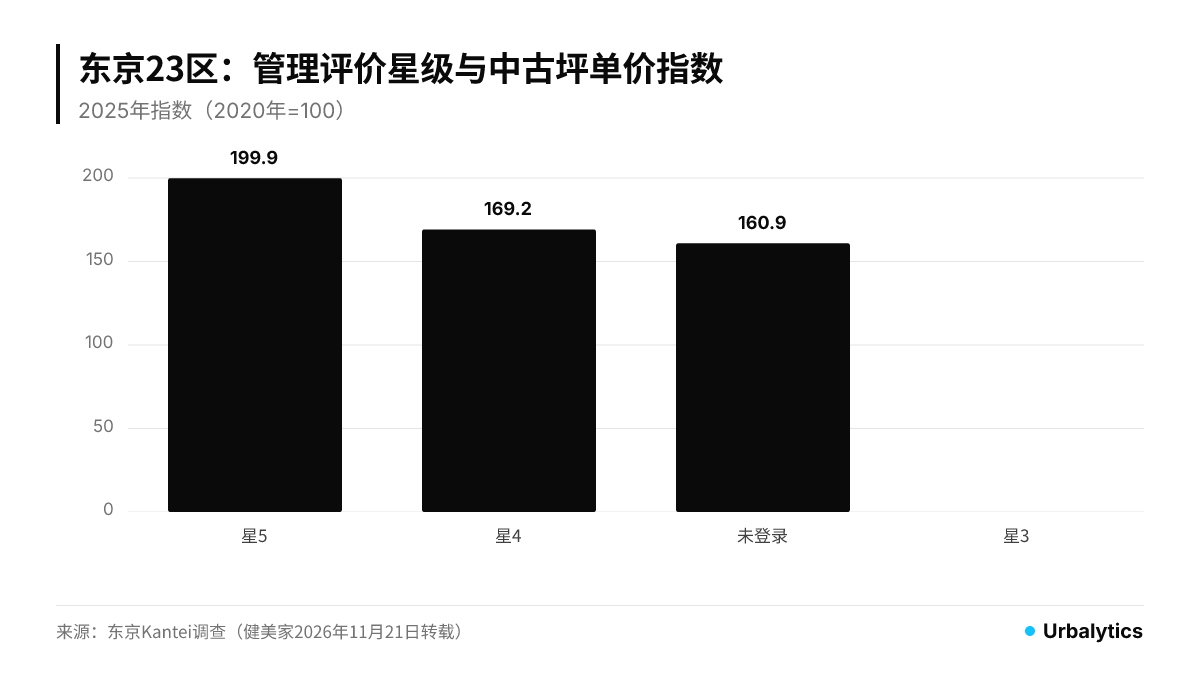
Using the same 2020 baseline, the indexed price level for 5-star condominiums was approximately 24% higher than for unregistered properties (199.9 ÷ 160.9). This is a difference between indices, not a before-and-after comparison of the same building, but it is large enough to affect valuations.
Do ratings drive prices, or do better buildings appreciate faster anyway?
This is the central question to ask when reading the report. Well-managed condominiums often also have better locations, stronger developer brands and greater scale. A star rating may simply label those existing advantages.
Tokyo Kantei ran an additional test: it examined only condominiums in the 23 wards registered in 2023, setting the registration year to 100, and tracking the two years before and after registration. In the pre-registration years, 2021 and 2022, price trends were almost identical across properties that later received different ratings. The gap emerged from 2024 onward, particularly in 2025. The report therefore attributed the additional appreciation of 5-star and 4-star properties to obtaining the ratings themselves.
This approach is more persuasive than a simple cross-sectional comparison, but it still has two limitations. First, it covers only one registration cohort and two years of subsequent observations. Tokyo resale price growth also accelerated in 2025, so the possibility that buyers favored stronger properties in a rising market cannot be fully ruled out. Second, the report says 5-star and 4-star properties “can set higher asking prices,” suggesting that its price measure is closer to sellers' asking prices than transaction prices. The more cautious interpretation is that ratings have become a pricing signal for buyers and sellers; how much of that premium is realized depends on actual transactions.
What the ratings measure
According to the Condominium Management Companies Association, which operates the system, properties are inspected and registered by qualified condominium management operations supervisors or condominium management consultants who have completed designated training. Scores cover 5 categories and 30 items, with a maximum of 100 points: management organization, 20 points; building and equipment, 20 points; owners' association finances, 40 points; earthquake resistance, 10 points; and living environment, 10 points. Registration costs ¥5,500, including tax, with additional fees for engaging an assessor or management company.
Finances account for four-tenths of the total score, so ratings largely reflect whether repair reserves are adequate and long-term repair plans are credible. Association materials show an average financial score of 37.6 points for 5-star properties, versus just 20.2 for 3-star properties. The underperformance of 3-star buildings relative to unregistered properties may indicate that the market sees “registered, but only 3 stars” as a sign of financial weakness rather than a neutral result.
At the end of March 2026, registrations totaled 11,801 registrations, including 4,038 with 5 stars and 5,020 with 4 stars. Tokyo Kantei also notes that many unregistered condominiums are well managed but have not yet applied, while tower condominiums have a relatively low registration rate. This partly explains why the unregistered group sits between the 4-star and 3-star groups.
Tenants do not pay for stars
For investors who own individual condominium units to rent out, the key question is whether a management rating can command higher rent.
Using Urbalytics rental listings, we examined asking rents for residential condominiums of 40–80 m² within 8 km of Tokyo Station, excluding management fees and first observed between November 2025 and November 2026. Median asking rents per square meter, grouped by construction year, were as follows: built in 1990 or earlier, ¥3,615/m² (2,508 listings); built in 1991–2005, ¥4,456 (3,770 listings); built in 2006–2015, ¥4,725 (4,625 listings); and built from 2016 onward, ¥5,257/m² (4,176 listings).
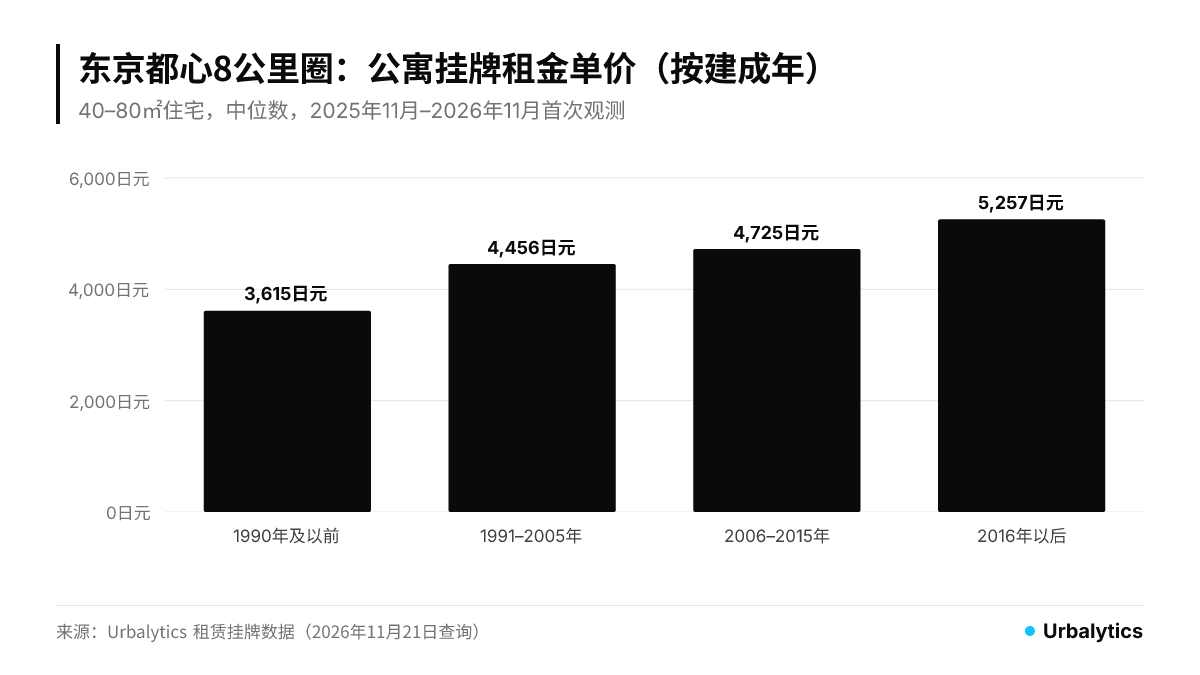
Rents are differentiated mainly by building age and location. Tenants focus on the unit, its equipment and their commute; few check the building's repair reserve balance. Our data do not include management ratings, so we cannot directly compare rents across similarly aged buildings with different ratings. Still, given how tenants make decisions, the effect of stars on monthly rent is unlikely to match the gap in the price indices.
The arithmetic is straightforward: if rent is unchanged but a 5-star condominium costs about 24% more, gross yield falls to roughly four-fifths of its original level. A property yielding 4.5% would instead yield approximately 3.6%.
How investors can use these findings
Buying 5-star or 4-star properties: you are paying for the exit. The premium buys better resale liquidity and lower repair risk, not higher cash flow. It suits buyers with long holding periods who prioritize exit prices and lenders' valuations. Yield-focused buyers must accept a lower gross yield and check that the purchase price does not already price in future appreciation.
Unregistered condominiums: check the documents before negotiating the price. Unregistered does not mean poorly managed. Obtain the long-term repair plan, repair reserve balance and financial statements. If these are sound, there may be an opportunity to buy at an unregistered-property price and benefit from repricing if the owners' association later applies for a rating. Conversely, an unregistered building with incomplete documentation should be valued for the risks associated with a 3-star rating or worse.
3-star condominiums: treat the rating as a health check. A 3-star rating is itself a signal the market discounts. Before buying, examine where points were lost, especially in the financial category. If reserves are materially inadequate, future special assessments or sharp increases in contributions will directly erode already modest rental returns.
For existing owners: If your building is well managed but unregistered, consider encouraging the owners' association to apply. The cost is the ¥5,500 registration fee plus assessor fees, while Tokyo Kantei's interpretation suggests the return comes through the resale price. For individual-unit investors, this may be one of the few ways to improve an exit price without renovating.
Data definitions and limitations
Tokyo Kantei data: the sample comprises 10,052 rated condominium buildings registered with Tokyo Kantei that had price records during the study period, including 3,349 rated 5 stars, 4,275 rated 4 stars and 2,055 rated 3 stars. The analysis used 613,468 records for rated properties and 6,000,504 for unregistered properties, covering 2020 through April 2026. Properties rated 2 stars or below were excluded because of insufficient samples. These are price-per-tsubo indices. This article draws on the release republished by Kenbiya; Tokyo Kantei's original release page was not obtained. The 24% figure was calculated for this article from the two indices.
Urbalytics data: asking rents for residential condominium listings of 40–80 m² within an 8 km radius of Tokyo Station, filtered by first observation date in UTC. These are asking rents, not achieved rents. The 2006–2015 and 2016-onward construction cohorts reached the single-scan limit, so the sample is not exhaustive. Observations for the 2016-onward cohort are concentrated from September 2026 onward. These data illustrate only how rents vary by building age, not the relationship between ratings and rents. This article does not cover whole-building income properties or use whole-building yield statistics.
For the latest changes in Tokyo condominium prices, see Urbalytics Tokyo Market Data. Related reading: Greater Tokyo New Condominium Contract Rate for October; What Changed One Year After the Tax on Short-Term Condominium Resales.
Tags
Condominium Management Quality Evaluation System, management ratings, star ratings, Tokyo Kantei, resale condominiums, price per tsubo, Tokyo's 23 wards, individual condominium investment, repair reserves, long-term repair plans, gross yield, exit strategy, Urbalytics
References
Kenbiya, “Clear Link Between Condominium Management Ratings and Resale Prices: A Nationwide Study of 10,052 Rated Buildings,” November 21, 2026 (release issued by Tokyo Kantei Co., Ltd.). https://www.kenbiya.com/ar/ns/research/r_other/10720.html
Condominium Management Companies Association, “Condominium Management Quality Evaluation System” brochure, November 2025. https://www.kanrikyo.or.jp/evaluation/file/pamphlet_202511.pdf
Condominium Management Companies Association, press release, April 14, 2026. https://www.kanrikyo.or.jp/news/data/20260414presschousa.pdf
Urbalytics rental listings data (rent_stats), queried on November 21, 2026.
Copyright: This article is original content by the author. Please do not reproduce, copy, or quote without permission. For usage requests, please contact the author or this site.