Words: 1183 | Estimated Reading Time: 6 minutes | Views: 35
In September, Greater Tokyo resale condominium transactions fell year on year by 22.7%, while transaction prices declined by just 4.5%. Bayfront tower sellers are waiting, while buyers calculate mortgage payments. Investors should first establish who is under pressure to sell and how much support rents can provide.
Author: Chen | Review: Luo Xingkai | Data as of October 31, 2026
What Has Changed: Sales Fall Before Prices
On October 31, Shueisha Online published a report on bayfront condominium towers whose central question was why prices were not falling despite weak sales. Citing East Japan Real Estate Information Network Systems (REINS) data for September, it reported that Greater Tokyo resale condominium transactions fell 22.7% year on year, the sixth consecutive monthly decline. Transactions in Tokyo's ward area fell 30.6%, while declines in surrounding prefectures ranged from 7% to 19%. Transaction prices per square meter in the ward area fell just 0.9% year on year, while asking prices remained high. The widening gap between asking and transaction prices—described as an open crocodile's mouth—persisted.
I could not access the REINS website directly for this article, so I cross-checked the Greater Tokyo figures against a page reproducing its monthly report: 3,457 transactions, down 22.7% year on year; transaction prices down 4.5%; and transaction prices per tsubo, a Japanese unit of floor area, down 4.8%. Inventory rose year on year for the seventh consecutive month, increasing 15.1%. The ward-area figures of 30.6% and 0.9% could only be found in the report cited above; I could not trace them to the original tables. They are treated below as figures relayed by that report.
Reading the Data: Transactions and Listings Are Not Interchangeable
A Kyodo News report dated October 22, citing Tokyo Kantei, put the average resale condominium price in September across Tokyo's 23 wards, standardized to 70 m², at JPY 126.29 million. That was down 0.4% month on month, the fourth consecutive monthly decline. In the central 6 wards, the average was JPY 177.86 million, down 1.6% for a fifth consecutive monthly decline. These figures use a different basis from REINS. The monthly change of -0.4% cannot be compared directly with the annual change of -4.5%. Together, they support only a narrower conclusion: prices are softening, but far less sharply than transaction volumes are contracting.
Why Sales Are Falling While Prices Hold
The report offers two explanations. First, owners who bought homes for their own use in recent years have unrealized gains of several tens of millions of yen. Most are unwilling to cut prices unless divorce, a job transfer or a move forces their hand. Second, buy-renovate-resell operators generally rely on project loans lasting from half a year to a year. If a property does not sell, they face refinancing at higher rates or demands for repayment, prompting price cuts to limit losses. Some bayfront listings reportedly saw repeated cuts over several months, totaling several tens of millions of yen. This latter explanation rests on testimony from a single broker and the reporter, without broader statistical support. It remains a proposed mechanism to monitor.
The constraint on buyers is easier to quantify. Using the interest-rate assumptions cited in the report—a 35-year loan with level principal-and-interest payments—borrowing JPY 100 million at an annual rate rising from 0.5% to 1.25% increases the monthly payment from roughly JPY 259,600 to JPY 294,100, a rise of about JPY 34,500. These are the author's calculations, excluding bonus-linked repayments and variable-rate resets. Prices have barely changed, but monthly payments have risen substantially: that is the arithmetic behind sales slowing almost to a standstill.
Rental Support: Asking Rent per Square Meter Around Three Stations
Rent provides another anchor for investors. I sampled residential asking rents around Toyosu, Kachidoki and Tsukishima stations over the latest 12 months, based on first observation dates beginning in November 2025. The sample covers homes of 40–80 m² and base rent only. Median asking rents per square meter were JPY 4,480 in Toyosu, from 243 observations; JPY 4,820 in Kachidoki, from 446 observations; and JPY 5,440 in Tsukishima, from 448 observations.
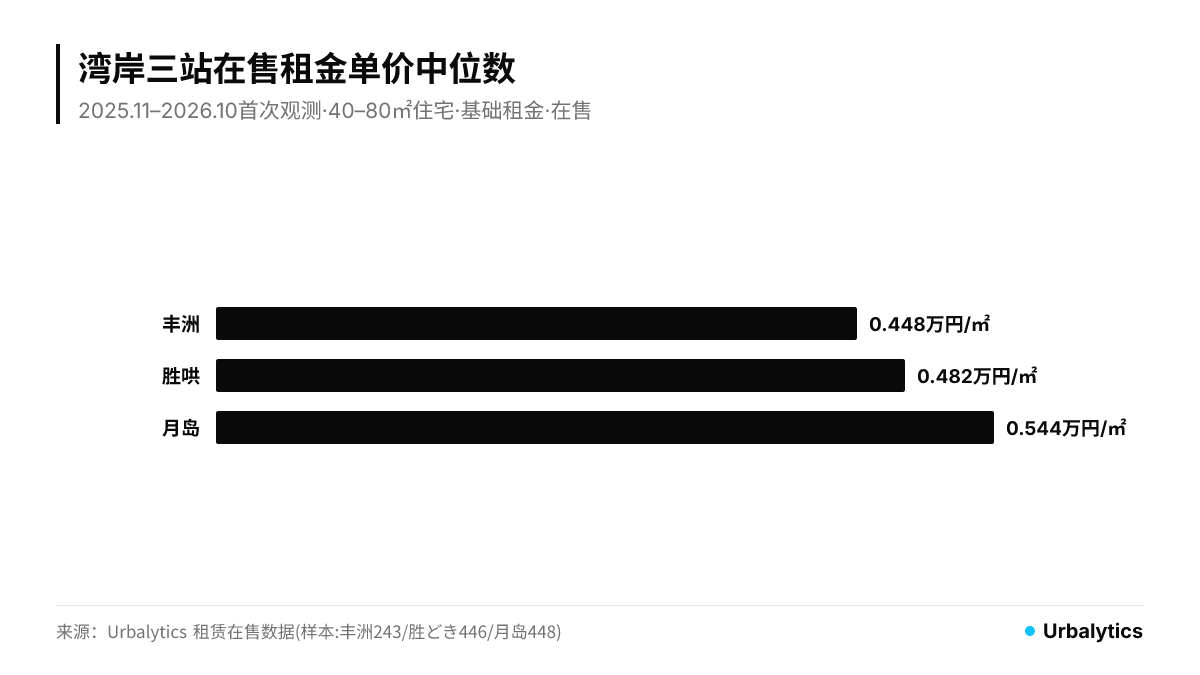
The platform's quarterly asking-rent trends, which reflect the mix of listed properties, also offer no support for a parallel fall in rents. Cumulative changes were +2.65% in Toyosu, 0% in Kachidoki and +4.76% in Tsukishima. These figures reflect different listing mixes over time, not rent increases for the same homes, and they are not achieved rents. Listings grouped under Kachidoki station also include properties farther away on foot in Harumi, making that catchment relatively broad. The conclusion is limited: asking rents have not yet fallen in step with transaction volumes and can still serve as a reference floor for underwriting.
What Investors Should Consider
First, there is no need to wait for market-wide price cuts. When volumes fall but prices hold, reductions tend to concentrate among sellers facing financing deadlines, rather than across all owners. Property registry records, available online for JPY 330 per copy, show when the seller acquired the property and identify the mortgage lender. The renewal count in a real-estate business license number may also offer a rough indication of an operator's capital base. These are screening methods mentioned in the report and available to investors now.
Second, use asking rent per square meter for conservative underwriting. Multiplying Kachidoki's median of JPY 4,820 per m² by 70 m² gives approximately JPY 337,000 per month. This is an asking-rent figure and needs a downward allowance for vacancy and potential rent reductions. The additional monthly mortgage payment of roughly JPY 34,500 discussed above already amounts to about a tenth of that rent. Before deciding whether a discount on a bayfront tower condominium is sufficient, calculate how much rent the increase in mortgage payments would absorb.
Third, watch the REINS data for October and how quickly individual operators sell through their inventory. If widespread price cuts begin while transaction volumes continue to shrink, that would indicate that sellers' capacity to hold firm has been exhausted. If neither volumes nor prices move, it would suggest the market is temporarily frozen. For context, see our earlier analyses: Tracking Tokyo Condominium Price Reductions (October), and Chiyoda Ward's Specific Requirements for Resales.
Tags: bayfront condominium towers, Tokyo resale condominiums, transaction volumes, East Japan Real Estate Information Network Systems, REINS, buy-renovate-resell operators, Tokyo Kantei, Toyosu, Kachidoki, Tsukishima, rent per square meter, mortgage rates, Tokyo ward area, investment assessment
References
Shueisha Online (distributed by Yahoo! News), “Why Aren't Prices Falling Even Though Bayfront Tower Condominiums Aren't Selling?” October 31, 2026:https://news.yahoo.co.jp/articles/0dcc232a768367e24ce2d9ef670acae404b63fda
R-bay, “Greater Tokyo Resale Condominiums: September” (reproduction of the East Japan REINS monthly report), October 13, 2026:https://www.rbayakyu.jp/rbay-kodawari/item/8885-9
Kyodo News (Kumamoto Nichinichi Shimbun), “Resale Condominium Prices in Tokyo's 23 Wards Fall for 4 Consecutive Months in September,” October 22, 2026:https://kumanichi.com/articles/2049317
Urbalytics rental listing data (rent_stats; first observed 2025/11–2026/10; 40–80 m²; base rent). Example building:THE TOKYO TOWERS MIDTOWER
Copyright: This article is original content by the author. Please do not reproduce, copy, or quote without permission. For usage requests, please contact the author or this site.