Words: 764 | Estimated Reading Time: 4 minutes | Views: 29
Units under 40 sqm cut least; the newer and larger, the more likely to cut
Tokyo Condo Market Watch (東京マンション相場ウォッチ) tracks Tokyo's resale condominium market at regular intervals using Urbalytics listing data.
As of mid-October 2026, 45.6% of resale condos on the market in Tokyo's 23 wards had cut their asking price in the previous three months, up 1.3 points from 44.3% in our last count (around October 14). Last time we looked at where cuts are happening; this time we look at which kinds of units are cutting first: towers or not, new or old, large or small.
The "price-cut share" is defined as before: the share of resale condos with a listing record in the last three months whose asking price fell below its previous record. It counts how many listings were cut, not how far market prices have fallen.
Towers are 14 points above other buildings
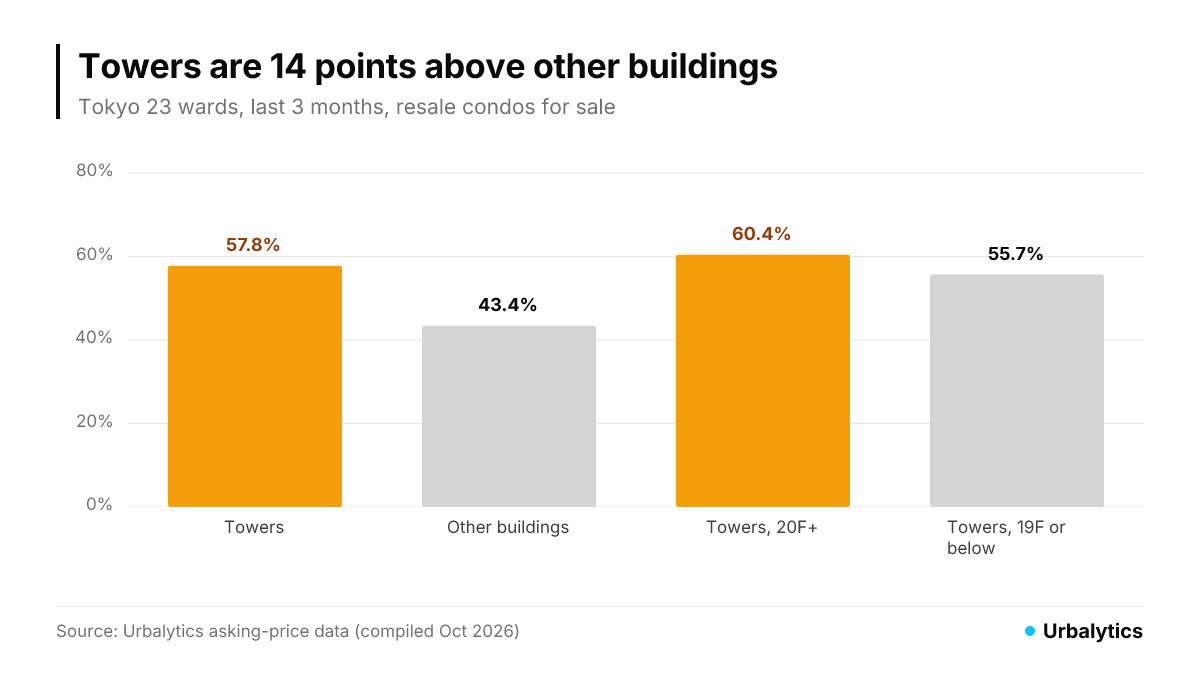
Of 4,918 tower-condo listings, 57.8% had cut their price; the 26,981 other listings stood at 43.4%, a 14-point gap. The median cut was also larger in towers, 5.6% against 4.6%: about 5.6 million yen versus 4.6 million yen on a 100-million-yen unit.
Within towers, higher floors cut more: 60.4% of units on the 20th floor or above, against 55.7% on the 19th floor or below. Higher floors carry higher asking prices per square meter and are cutting more. In this article, a "tower" is a building whose listing records include a unit on the 20th floor or above.
The newer the building, the more likely it is to cut
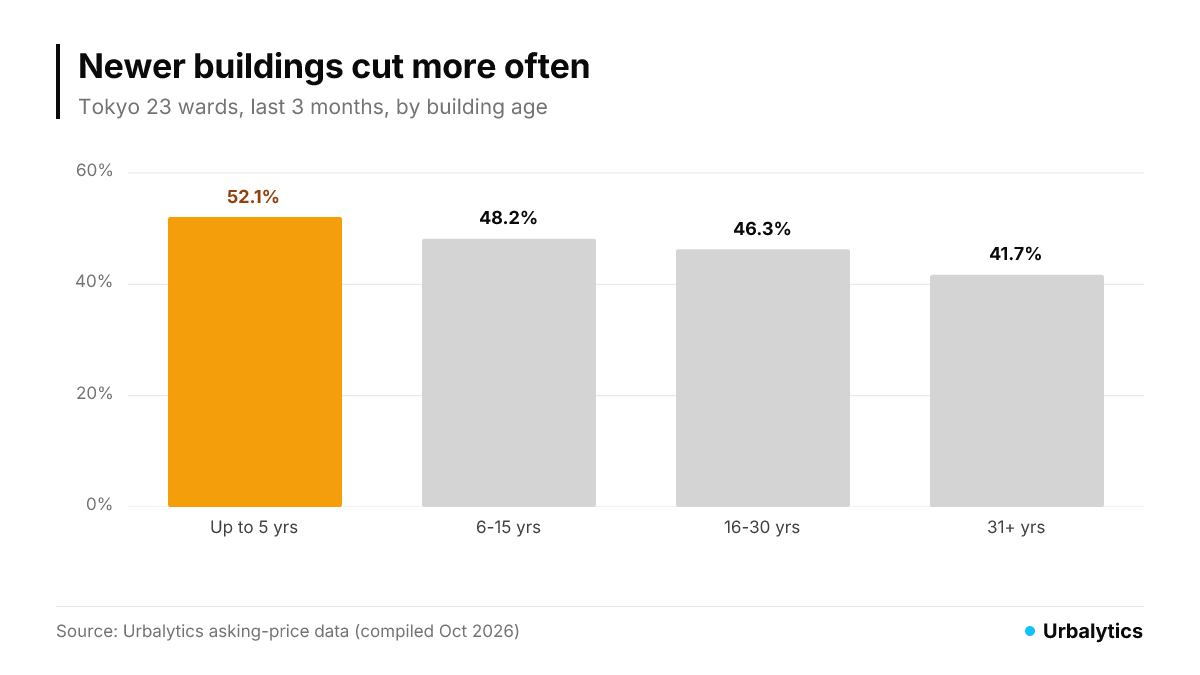
By building age: 52.1% for buildings up to 5 years old (completed 2021 or later, median cut 5.3%), 48.2% for 6 to 15 years, 46.3% for 16 to 30 years, and 41.7% for 31 years or more (completed 1995 or earlier). Newer buildings cut more, with the youngest group 10 points above the oldest. Newer units were priced at the high levels of the past two or three years, so difficulty selling shows up more readily once they are listed. This is an inference from the data.
Among towers alone, 60.6% of units in 6- to 15-year-old towers had cut, the highest of any group.
Larger units cut more; units under 40 sqm are the most stable
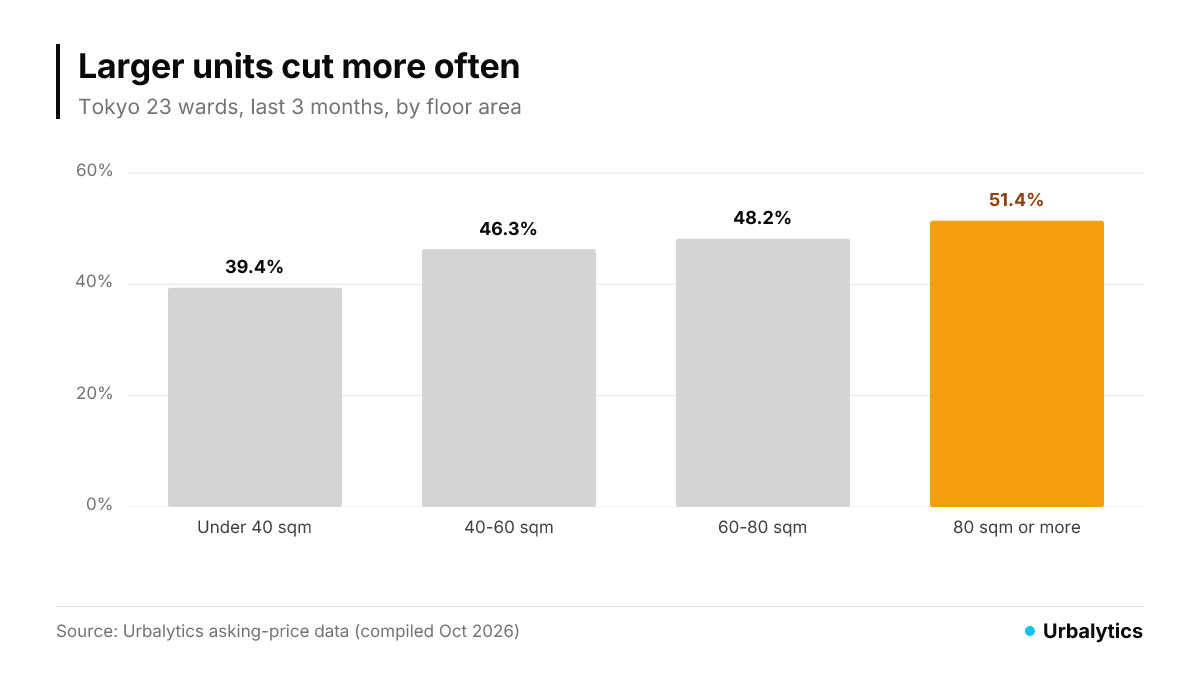
By floor area: 39.4% under 40 square meters, 46.3% at 40 to 60, 48.2% at 60 to 80, and 51.4% at 80 or more, a 12-point spread from smallest to largest. Units under 40 square meters are mostly for single occupants or for rent; rental demand is steady and most buyers are investors looking at yield, so their asking prices did not rise as much as owner-occupier units and there is less pressure to cut. This is also an inference; yields are covered later in the series.
When small units do cut, though, the median cut is 5.1%, the same as for units of 80 square meters or more.
What this means for buyers and sellers
Buyers: For towers, buildings up to 15 years old and units of 80 square meters or more, more than half of listings cut within three months, by 5% to 6% at a time. The longer such a unit has been listed, the more room there is to negotiate.
Sellers: Listing a high-floor tower unit or a newer unit at sale prices from two or three years ago is likely to require a cut. Units under 40 square meters face the least pressure, but cuts there are still around 5%.
Log in to Urbalytics to see more condo price history and transaction records
Methodology
Resale condominiums in Tokyo's 23 wards: 32,035 units with a listing record in the 90 days to around October 19, 2026. Price cut = any asking price in those 90 days below the previous record. Cut size = the median of each listing's largest cut within the 90 days. Tower = a building whose highest listed unit is on the 20th floor or above (estimated from listing data, not registered floor counts). Building age from completion year; floor area is private floor area. All figures are asking prices, not transaction prices. Data: Urbalytics asking-price data, compiled October 2026.
Tags: Tokyo tower condos, price cuts, new-build condos, Tokyo resale condos, Tokyo 23 wards, unit size, studio investment, Tokyo condo market, buying property in Japan, Urbalytics
Cover image: AI-generated illustration (Higgsfield)
Copyright: This article is original content by the author. Please do not reproduce, copy, or quote without permission. For usage requests, please contact the author or this site.