Words: 1520 | Estimated Reading Time: 8 minutes | Views: 369
One stop apart, a 22% rent gap: Wako-shi North Exit reaches construction-prep stage; the spread remains where it was
Wako-shi Station is the only Tokyo Metro station located in Saitama Prefecture; the Yurakucho and Fukutoshin Lines terminate here and inter-run onto the Tobu Tojo Line. One stop south is Narimasu in Tokyo’s Itabashi Ward. Since August 2026, the North Exit redevelopment has posted three developments in quick succession: a call for a preferred contractor under an ECI scheme, consultation on the land readjustment replotting plan, and budget allocation for a temporary bus stop.
For investors, the question is not 'Will redevelopment create a premium?' but 'Which lever is moving this time, and historically how much price response does that lever produce?' We first clarify the project phase, then use our in-house asking rent and sale data to test where today’s spread stands.
This announcement advances the phase, not the schedule
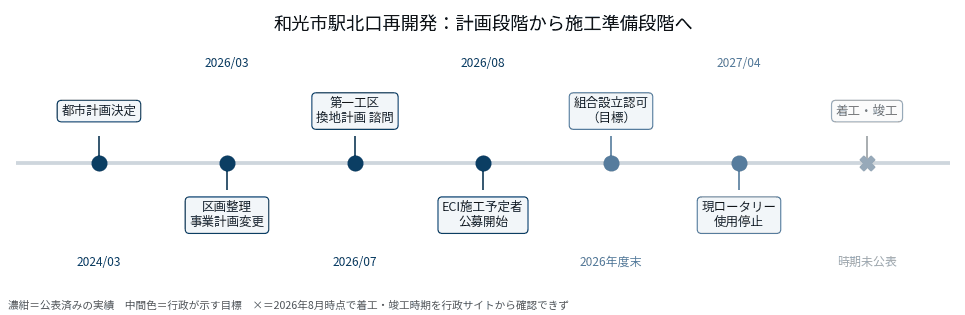
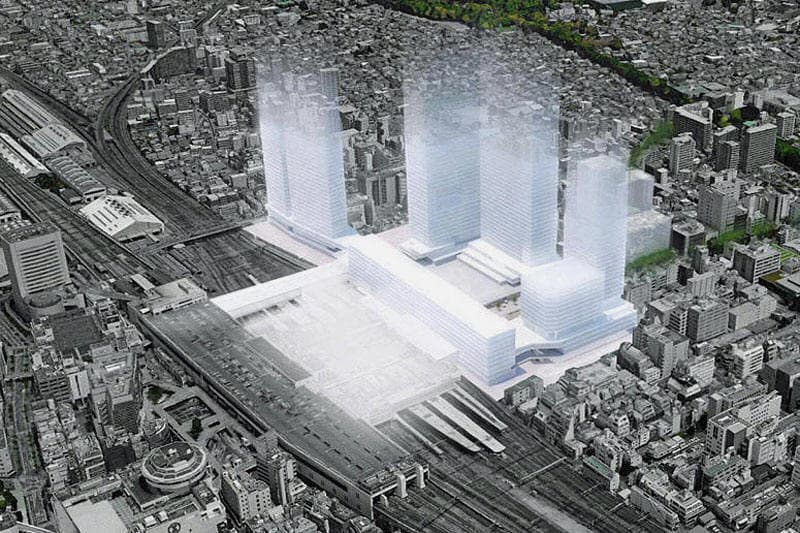
The Urban Planning decision for the North Exit redevelopment was finalized in March 2024. For the next two and a half years, progress remained at the regulatory level. On August 6, 2026, the Wako-shi Station North Exit District Urban Redevelopment Preparatory Association launched a public call for a preferred contractor under an ECI (Early Contractor Involvement) scheme. Under ECI, the contractor participates during design to provide technical support; in this case, the contractor will contribute technical input to the implementation design and discuss the construction plan. In other words, the question of 'who will build' has entered a substantive process. Kenbiya’s September 14, 2026 article summarizes this sequence of moves.
Running in parallel is the consolidation of land rights. In March 2026, Wako City executed the third revision of the Land Readjustment Project plan, including updates to the project period and financing plan; in May, changes to the replotting design standards and replotting plan were deliberated by the Land Readjustment Council; on July 24, the replotting plan for Work Area 1, which includes the redevelopment zone, was submitted for consultation. Replotting reallocates fragmented holdings among multiple rightsholders into parcels with shapes and titles suitable for redevelopment. This step never appears in the final renderings, but without it construction cannot begin.
The city has simultaneously increased its budget. For FY2026, the special account for the Wako-shi Station North Exit Land Readjustment Project totals about JPY 1.84637 billion, up roughly 24% year over year. Of this, JPY 41.8 million is allocated to install two temporary bus stops (boarding/alighting) on a new 15-meter-wide road created by the readjustment. The existing North Exit bus rotary is slated to be taken out of service from April 2027, and the temporary bus stops are expected to operate for roughly four years. The city aims to secure approval for the project plan and the establishment of the association by the end of FY2026, and, once approved, to start by demolishing the current station-front rotary area in FY2027. These facts and budget figures are drawn from Wako City’s public materials.
Note the gap: as of August 2026, the administrative websites do not specify the groundbreaking and completion timing for the redevelopment facilities themselves. The sequence that was once public—association establishment, rights conversion, groundbreaking, completion—now has clear markers only for the first half. The accurate framing is that the project has moved from 'planning' into 'construction preparation,' not that the 'schedule has been fixed.'
The 22% rent-per-sqm gap between Wako-shi and Narimasu is not driven by unit-size mix
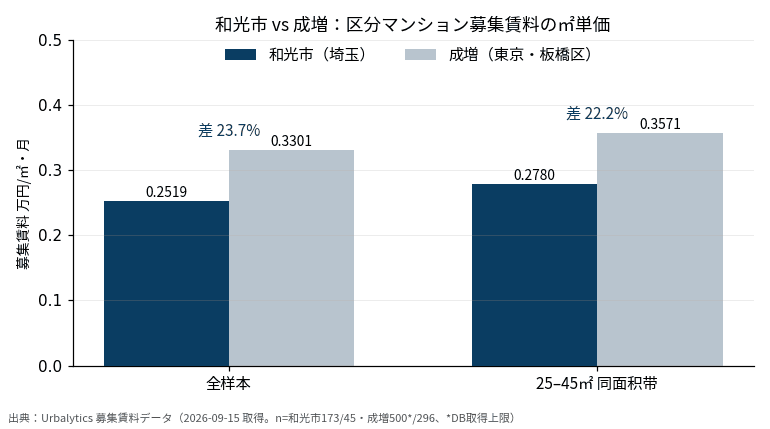
Rents are the earliest place to see whether redevelopment has priced in. Urbalytics’ asking-rent data (retrieved September 15, 2026) show average rent for condominium units around Wako-shi Station at JPY 2,519 per sqm per month (n=173), versus JPY 3,301 one stop away in Narimasu (n=500, at our database retrieval cap), a 23.7% gap.
However, this gap alone doesn’t justify a conclusion. The average unit size in the Wako-shi sample is 46.6 sqm, versus just 32.7 sqm in Narimasu, and smaller units naturally command higher rent per sqm—different size mixes can make a location effect look like a size effect. Re-sampling both sides within the same 25–45 sqm band yields: Wako-shi JPY 2,780 per sqm per month (n=45) vs. Narimasu JPY 3,571 (n=296), a 22.2% gap.
At 23.7% before controlling and 22.2% after, the two are close. This indicates the spread is driven mainly by true station-to-station pricing, not unit-size mix. In other words, on the rent side, Wako-shi’s discount to Narimasu has largely stayed put over the two and a half years since the Urban Planning decision.
A note on definitions: all figures above are asking rents (listings), not achieved rents. The two differ, and the gap widens when vacancy is high. Asking rents reflect landlord pricing intent; to estimate realized income, apply a further discount. We used the same comparative method in our piece on brand-line premiums, which analyzed a 'same 30-minute-to-Shinjuku, JPY 30 million price gap' structure.
Whole-building median gross yield 6.1%, but the price-trend line is unusable
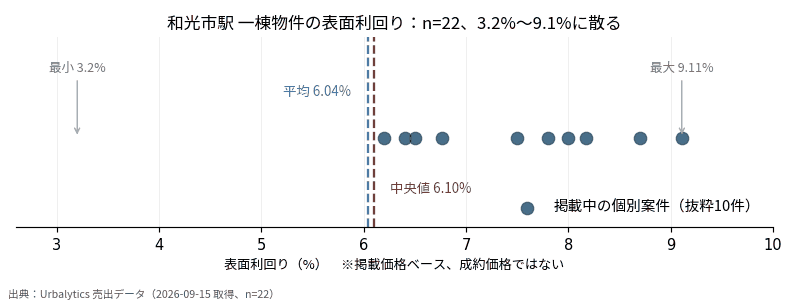
On the for-sale side, we have 22 whole-building listings around Wako-shi Station, with an average gross yield of 6.04%, a median of 6.10%, a low of 3.2%, and a high of 9.11%. Gross yield equals annual income divided by price, before deducting management, repairs, and vacancy loss. A 6.1% median is a reasonable pricing benchmark for the station at this stage.
What we cannot use is the price trend. In the same dataset, quarterly tsubo prices rise from JPY 1.0936 million in Q3 2025 to JPY 1.5068 million in Q3 2026, a +37.78% change. But the corresponding sample counts are 2, 2, 8, 10, and 4. When the sample jumps from 2 to 10, you are essentially pricing a different basket; the difference reflects composition, not the same assets moving. We therefore do not cite this increase, and we recommend that whenever you see an area trend derived from single-digit samples, first ask for the sample size.
This is a common pitfall with such data: an average can blend two distinct markets into one. Our Yokohama Tsurumi West Exit piece tackles the flip side of the same issue—public investment amounts and yield levels may both be clear, yet there is no direct conversion between them.
Three possible reasons the discount hasn’t budged
1) It’s still early in the cycle. The association is not yet established; groundbreaking and completion are unannounced; the market is waiting for certainty. Under this view, price action will lag until approval of association establishment (targeted for end-FY2026) and a public groundbreaking date.
2) Thin liquidity. Within the 25–45 sqm band, Wako-shi has 45 samples vs. 296 in Narimasu. Sparse samples imply slower price discovery and larger noise from each trade. The apparent stasis may simply reflect insufficient transactions to move the statistics.
3) The market has judged the redevelopment insufficient to change the station’s positioning. The plan centers on low-rise retail and public facilities plus high-rise residential—a station-front refresh, not new rail capacity or a new employment hub. If so, the discount should not converge.
These three narratives imply very different actions, and current data cannot distinguish among them. A testable approach is to mark the two milestones—association establishment approval and groundbreaking announcement—then re-sample asking rents and for-sale gross yields within the same size band before and after each date to see whether the spread narrows. This calls for continuous observation, not a one-off judgment.
For investors considering entry now, two points are clear. First, from April 2027 the station-front rotary will be replaced by temporary bus stops for roughly four years. During this period, pedestrian flows and retail conditions at the front of the station will deteriorate—a negative for existing rental assets—and the timing is already fixed. Second, the 6.1% median yield reflects today’s station-front conditions, not post-completion—bidding as if the future premium were already realized is effectively prepaying for an outcome that has not happened. For comparables across Saitama, see the Saitama market data page and our prior analysis of Saitama’s tri-core reordering.
Data notes
Asking rent and whole-building for-sale yield data are from the Urbalytics database, retrieved September 15, 2026.
Asking rent refers to list prices, not contracted rents; whole-building yield is gross yield, based on listing prices rather than contracted prices.
Station-by-station comparisons are limited to 25–45 sqm condominium units to control for size-structure differences. Narimasu’s full-sample query hit the 500-record retrieval cap; the actual count is higher.
Commute times and origin-run frequencies are from a 2019 article; schedules may have changed since and are for positioning reference only.
Tags
Wako City / Wako-shi Station / Saitama Prefecture / Tobu Tojo Line / Tokyo Metro Fukutoshin Line / Yurakucho Line / urban redevelopment / land readjustment / replotting / ECI method / gross yield / asking rent / Greater Tokyo commuter belt / whole-building investment / station-front redevelopment
References
Kenbiya, 'Saitama: Wako-shi Station North Exit redevelopment moves into construction-prep stage,' September 14, 2026: https://www.kenbiya.com/ar/ns/region/shutoken/10483.html
Wako City official website (public materials on budget, replotting, and basic station-plaza design): https://www.city.wako.lg.jp/
Toyo Keizai Online, 'The surprising convenience of Wako’s access to the city center' (origin runs and travel times as of 2019): https://toyokeizai.net/articles/-/286171
Urbalytics asking-rent and whole-building for-sale datasets (retrieved September 15, 2026)
Copyright: This article is original content by the author. Please do not reproduce, copy, or quote without permission. For usage requests, please contact the author or this site.
Photos in this article: Saitama Prefectural Wako Jurin Park Ebiebi2/CC BY-SA 4.0(トリミング) Wikimedia Commons·Wakoshi station SEIBU LINER/CC BY-SA 4.0(トリミング) Wikimedia Commons·Itabashi-at-nakajuku Missmikage/CC BY-SA 3.0(トリミング) Wikimedia Commons·Narimasu station SEIBU LINER/CC BY-SA 4.0(トリミング) Wikimedia Commons·NarimasuSkipVillage Missmikage/CC BY-SA 3.0(トリミング) Wikimedia Commons