Words: 1565 | Estimated Reading Time: 8 minutes | Views: 74
The Bank of Japan has lifted the policy rate to 1.25%, but monthly payments on variable-rate mortgages will not actually move until early 2027 — that roughly half-year lag is your actionable window.
At midday on September 18, 2026, the Bank of Japan, at its two-day Monetary Policy Meeting, raised the policy rate from 1.00% to 1.25%. The vote was 7 in favor and 2 against. This is the highest level in roughly 31 years, since 1995.
For most people who own property in Japan or are considering a purchase, the real question is not “did rates rise,” but “when and through what path will this 25 basis points show up on my monthly bill.” The answer is more complex — and slower — than you might think.

Why this hike came faster than markets expected
To understand the weight of this decision, look at the cadence first. After exiting negative rates in March 2024, the BOJ had been hiking roughly “once every half year.” This time, only three months have passed since the June 2026 meeting — the shortest hiking interval since the exit from negative rates.
The reason for the sudden acceleration is broadly consistent across media: higher crude prices, combined with a weaker yen, have raised the risk of upside inflation. The BOJ chose to move early rather than wait to repair the damage after the inflation data fully deteriorate.
Note the split vote. It was 7–2, with the two dissents coming from Policy Board members appointed by Prime Minister Takaichi. This suggests the political cost of further hikes is rising, and each subsequent decision could be tougher than this one.
After the announcement, the yen briefly traded in the high ¥156 per USD. In other words, markets did not read this as a “stronger yen ahead” signal, but as the BOJ merely catching up. For buyers using foreign-currency assets to acquire Japanese properties, the FX leg remains unsteady.
Three gates stand between the policy rate and your bill
This is the part most often misread. A higher policy rate does not mean your mortgage rate adjusts that same day — there are at least three independent dates in between.
According to CPA Taro Sennichi’s summary in Diamond Real Estate Research Institute, the three gates are:
First, the day each bank changes its “base rate.” Banks set this on their own schedules — some monthly, some semiannually — and they do not move in sync.
Second, the day your individual “borrowed rate” under contract is reviewed. Even within the same bank, new loans and existing loans often follow different timetables.
Third, the day the changed rate actually flows through to your repayment amount. This one is the slowest and most likely to create the illusion of “no impact.”
The result of these three gates is that full alignment across banks takes about half a year. At banks with two rate reviews per year, if you miss the review date, the reflection may be delayed until as late as April–May 2027. As for the June 2026 hike (to 1.00%), by the same estimate it will actually affect repayment amounts around January 2027.
Risk note What’s even easier to misunderstand is the “five-year rule.” Under equal principal-and-interest amortization, even if rates rise, your monthly installment is frozen for five years; in the sixth year it is recalculated, capped at 1.25 times the original amount. But what’s frozen is the bill amount, not the debt itself — the interest share rises and principal amortization slows. An unchanged payment does not mean a hike hasn’t affected you. Also note: PayPay Bank, Sony Bank, and SBI Shinsei Bank do not apply the five-year rule.
Once rates align, league tables will flip
The rate tables you see today are really a blended snapshot with uneven pass-through. Some banks have already incorporated the previous hike; others have not. Side-by-side comparisons are of limited use.
As of September 2026, applicable rates show Resona Bank at 0.950% (lowest), SBI Shinsei Bank at 1.080%, and MUFG Bank at 1.195%. But SBI Shinsei has already announced it will raise the base rate on variable loans by 0.35 percentage points from October 1, which is not reflected in September’s figures.
If you fully reflect the impact of a 1.25% policy rate (assuming no extra markup beyond the BOJ hike and no change in discount margins), the same estimate reorders the list to: MUFG 1.445%, Resona 1.450%, swapping their positions; PayPay Bank 1.580%; and docomo SMTB Net Bank 1.750%.
The gaps are small — too small to be the sole basis for choice. What you should evaluate alongside are group credit life insurance coverage, processing fees, and the actual discount terms the bank offers you at underwriting — the headline rate is the starting line, not the finish.
The fixed-rate side is moving much faster. In September 2026, Flat 35 (loan term 21+ years, 10%+ down payment, with credit life) stood at 3.460%. Based on the Japan Housing Finance Agency’s 233rd JHF bond issued on September 16 with a coupon of 3.650%, October’s Flat 35 is projected to rise to 3.640%. Over the same period, the 10-year JGB yield hovered around 2.996%.
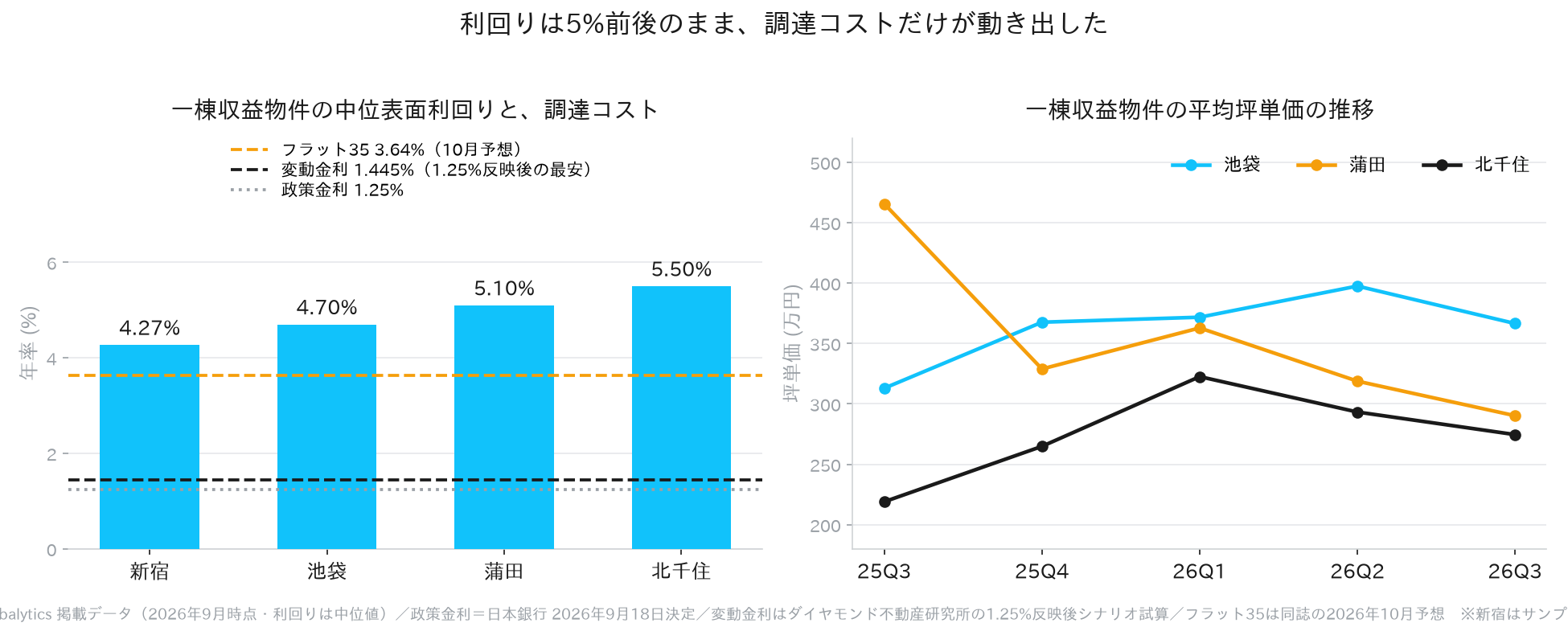
Urbalytics Insight Shift the lens from owner-occupied homes to income properties and the picture clarifies. Urbalytics data show median gross yields for whole-building assets within major Tokyo station areas at roughly 4.27% in Shinjuku, 4.70% in Ikebukuro, 5.10% in Kamata, and 5.50% in Kitasenju. Over the same period, per-tsubo prices rose about 17% in Ikebukuro and about 25% in Kitasenju over the past year, while Kamata has trended lower since Q3 2025. In short, yields have been broadly flat; it’s the cost of capital that’s moving.
What this hike means for different people
The same 25 basis points mean very different things depending on your holding structure.
For owner-occupiers already on variable rates, your bill will likely stay put in the short term, but your debt mix is quietly shifting. The practical task is not to panic-switch to fixed, but to calculate two numbers: your monthly payment once the 1.25% policy rate is fully passed through, and your payment if the policy rate reaches 2.0%. You can get the latter by adding 0.75 percentage points to the 1.25% scenario.
For those weighing variable versus fixed, the problem is often framed the wrong way. Using MUFG Bank’s September 1, 2026 figures as an example, the spread between variable at 1.195% and 10-year fixed at 3.63% is 243.5 basis points. Choosing variable is effectively a bet that the average rate over the next decade will not exceed today’s by more than 2.4 percentage points — the question isn’t “will it rise,” but “will it rise that much.”
The Japan Housing Finance Agency’s user survey (January 2026; 1,237 loans originated April–September 2025) shows 75.0% chose variable, while 73.7% expect rates to rise over the next year. Seen together this looks contradictory, but against a 243.5 bps pricing gap, it is a defensible choice.
For investors holding income properties, pressure comes from both sides. Rents adjust far more slowly than interest rates — on Urbalytics, rental mansions in Ikebukuro (Q3 2026; n=496) show a median unit rent of about 0.450万円/㎡ (≈¥4,500/m²) and an average monthly rent of ¥158,500. Those numbers will not be repriced by a single hike. The rise in funding cost is immediate, and the squeezed spread comes out of owners’ cash flow first.
What to track over the next six months
In the near term, the most important things to watch are not the policy rate itself, but each bank’s moves on the “base rate” and on “discount margins.” They work very differently:
A higher base rate hits both existing borrowers and new borrowers.
Narrower discounts affect only new signings; existing contracts are not impacted.
For example, in the same estimate, between March 2024 and the scenario with a 1.25% policy rate, docomo SMTB Net Bank’s base rate rose by 125 bps, while its applicable rate rose by 170.2 bps — the 45.2 bps difference reflects tighter discounts. Conversely, AEON Bank’s base rate rose by 135 bps, while the applicable rate rose by only 119 bps, indicating it is widening new-customer discounts to gain share.
As for the next hike, market views are not yet converged. In Bloomberg’s survey, 58% expect January 2027 and 35% expect December 2026. Either way, the probability of another move within six months is not low.
For those planning to act within this window, a pragmatic approach is to treat “today’s rates” as reference, use “post-alignment rates” as your budgeting base case, and back into affordable prices using actual gross yields and rent levels on income properties. Urbalytics’ area-level yield and rent data are built for exactly this reverse-engineering step.
#JapanRealEstate #JapanRateHike #BankOfJapan #PolicyRate #HomeLoans #VariableRate #FixedRate #Flat35 #TokyoProperty #IncomeProperty #GrossYield #WholeBuilding #TokyoInvestment #MortgageRates #Urbalytics
※ The images in this article are AI-generated conceptual images, not real photographs.
References
- 日本銀行「金融政策決定会合」2026年9月18日決定 — https://www.boj.or.jp/mopo/mpmdeci/index.htm
- 時事通信「日銀、1.25%に利上げ=決定会合、物価高でペース加速」2026年9月18日 — https://www.jiji.com/
- Bloomberg「日銀が政策金利1.25%に引き上げ決定、賛成7・反対2-ペース加速」2026年9月18日 — https://www.bloomberg.co.jp/
- 共同通信「日銀利上げ、1.25%に ペース最短3カ月に加速」2026年9月18日 — https://nordot.app/
- ダイヤモンド不動産研究所「日銀の追加利上げ+0.25%で住宅ローン変動金利はどうなる? 12銀行の金利動向から本当にお得な金利を試算!」2026年9月18日 — https://diamond.jp/articles/-/realestate
- ダイヤモンド不動産研究所「10月のフラット35金利はさらに上昇で3.5%超えか?! 住宅ローン金利(変動・10年固定)を予想!」2026年9月18日 — https://diamond.jp/articles/-/realestate
- 住宅金融支援機構「フラット35 金利情報」2026年9月 — https://www.flat35.com/
- 住宅金融支援機構「住宅ローン利用者の実態調査」2026年2月20日公表 — https://www.jhf.go.jp/
- 三菱UFJ銀行「住宅ローン金利」2026年9月1日現在 — https://www.bk.mufg.jp/kariru/jutaku/
- 財務省「国債金利情報」2026年9月 — https://www.mof.go.jp/jgbs/reference/interest_rate/
- Urbalytics 掲載データ(一棟収益物件の表面利回り・坪単価・賃料統計、2026年9月18日取得) — https://www.urbalytics.jp/
Copyright: This article is original content by the author. Please do not reproduce, copy, or quote without permission. For usage requests, please contact the author or this site.