Words: 1630 | Estimated Reading Time: 9 minutes | Views: 1359
When a developer that ranks only 19th nationwide by units supplied can deliver a JPY 2.5 billion-per-unit residence in Minami-Aoyama, the competitive logic in central Tokyo has shifted decisively from 'how many units you sell' to 'which site you control'.
In Japan’s real estate industry, one ranking is rolled out almost every year—the league table of condominium supply by seller (供給戸数). On July 31, 2026, a Toyo Keizai article upended what that table signifies: a company ranked only 19th nationwide is building a tower in Tokyo’s Minami-Aoyama with a top unit priced at JPY 2.5 billion. For cross-border investors who have long gauged Japanese developers by 'scale,' this demands a recalibration.
Find properties in 東京都港区
Individual listings, price-change history, closed transactions and AI valuations are available on a free account.
A JPY 2.5 billion-per-unit tower, sited directly atop Nogizaka Station’s subway exit
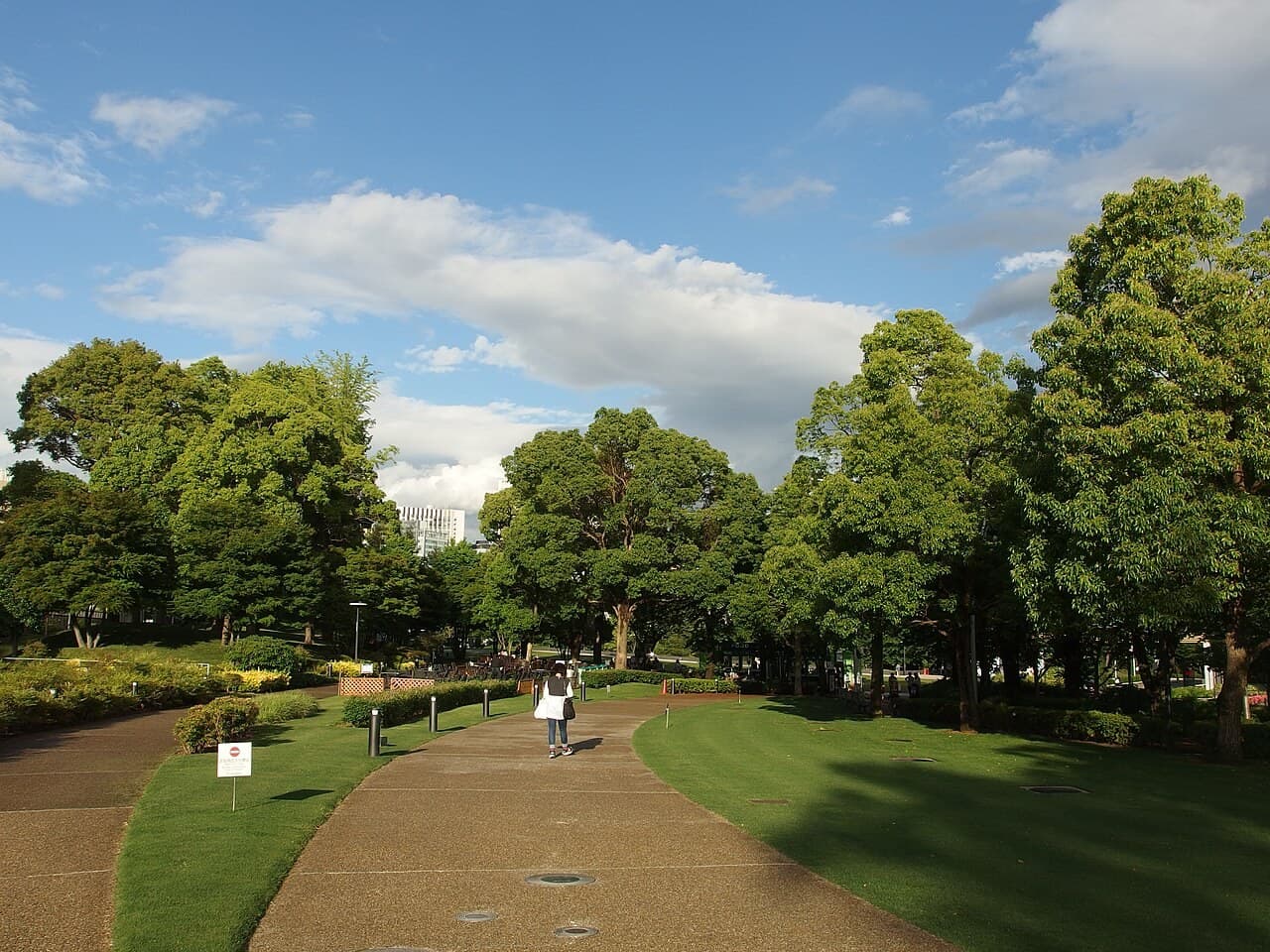
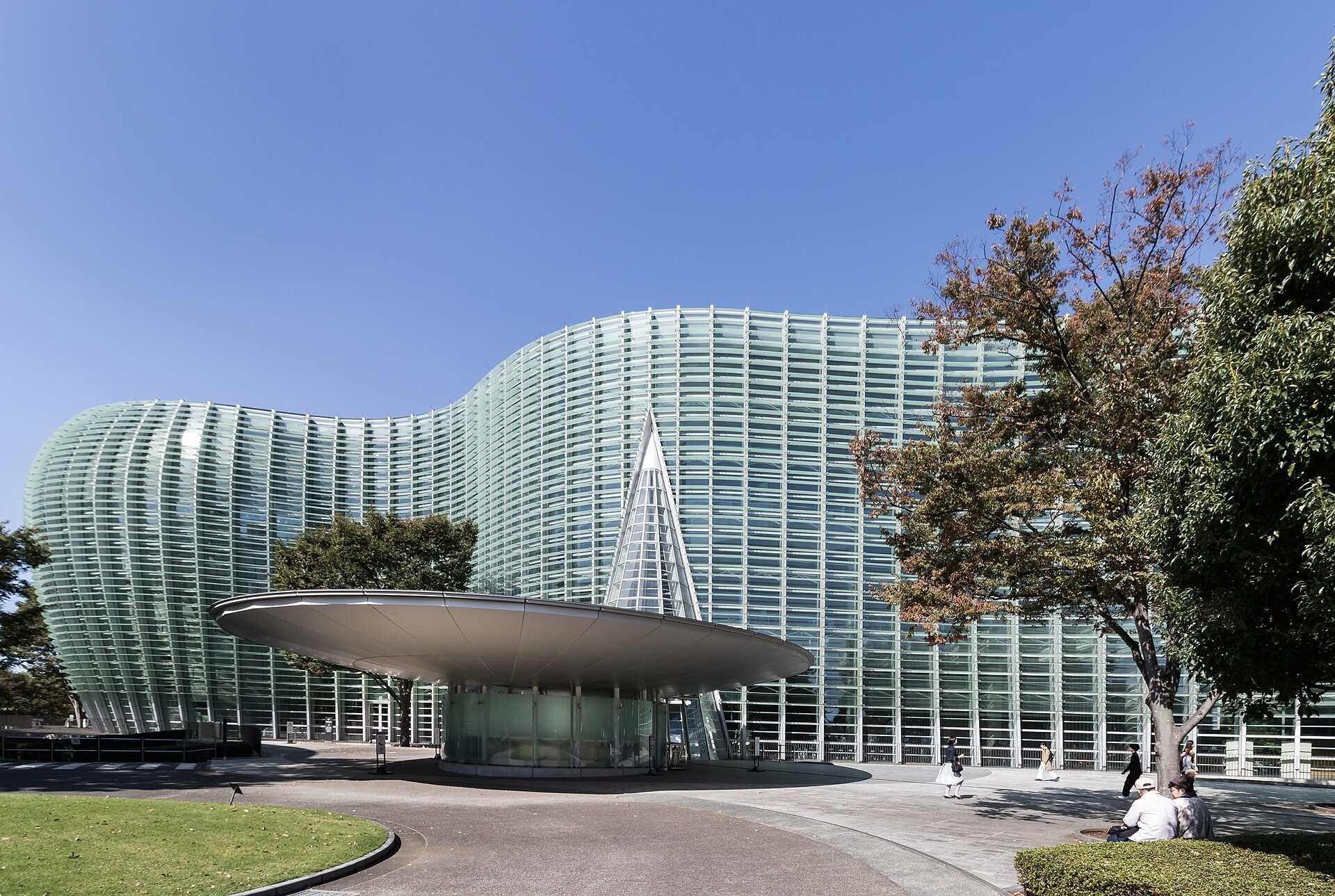
The project is "Brillia Tower Nogizaka," 27 stories, scheduled for January 2028 completion, developed by integrated real estate developer (総合不動産デベロッパー) Tokyo Tatemono. What matters most is not the height but the location: the building connects directly to the underground concourse of Tokyo Metro’s Chiyoda Line Nogizaka Station, and is encircled by Tokyo Midtown (東京ミッドタウン), the National Art Center, Tokyo (国立新美術館), and Aoyama Park.
What truly turns heads is the pricing. According to Toyo Keizai, the top unit is a 176 m² 3LDK listed at JPY 2.5 billion. Converted into Japan’s customary tsubo basis, that is roughly JPY 47 million per tsubo—beyond 'expensive,' it is effectively a public pricing experiment on what scarcity in prime central locations is worth.
For cross-border buyers, the significance is not owner-occupancy but the anchor it sets for the area’s price ceiling. Once the JPY 2.5 billion level is absorbed in Minami-Aoyama, the valuation reference for existing towers in the same station area will shift upward.
A 'Major Seven' ranked 19th by units: a post-Lehman pivot
In Japan’s condominium sector, the 'Major Seven' refers to seven leading for-sale condo developers such as Sumitomo Realty & Development and Nomura Real Estate; Tokyo Tatemono is among them. Yet in the Real Estate Economic Institute’s 2025 seller ranking by units supplied, Tokyo Tatemono delivered 1,054 units, placing 19th nationwide—the smallest among the seven.
How wide is the gap? Leader Open House Group (オープンハウスグループ) supplied 6,597 units; No. 2 Nomura Real Estate, 3,190—both more than triple Tokyo Tatemono’s tally. By the industry’s old narrative, that would all but spell 'falling behind'.
But Hideshi Akita, Managing Executive Officer and Head of the Housing Business at Tokyo Tatemono, offers a different logic: the company is not fixated on unit count. The report notes that Tokyo Tatemono once pursued volume, but the 2008 Lehman Shock (リーマンショック) marked a turning point.
The logic is simple: when a unit target leads, you end up bidding on sites that are farther from stations or have flaws; project economics tighten, and if you cut quality to save costs, you damage the Brillia (ブリリア) brand built over years. In other words, stepping away from scale is not a defensive retreat but an active concentration of resources on a few sites that can sustain brand premium.
Urbalytics on Nogizaka: rents are holding firm while whole-building pricing retreats
If a prime-location residence can fetch JPY 2.5 billion, are leasing and yield dynamics equally strong? We cross-checked with in-house data from the Urbalytics platform; the result is more nuanced than expected.
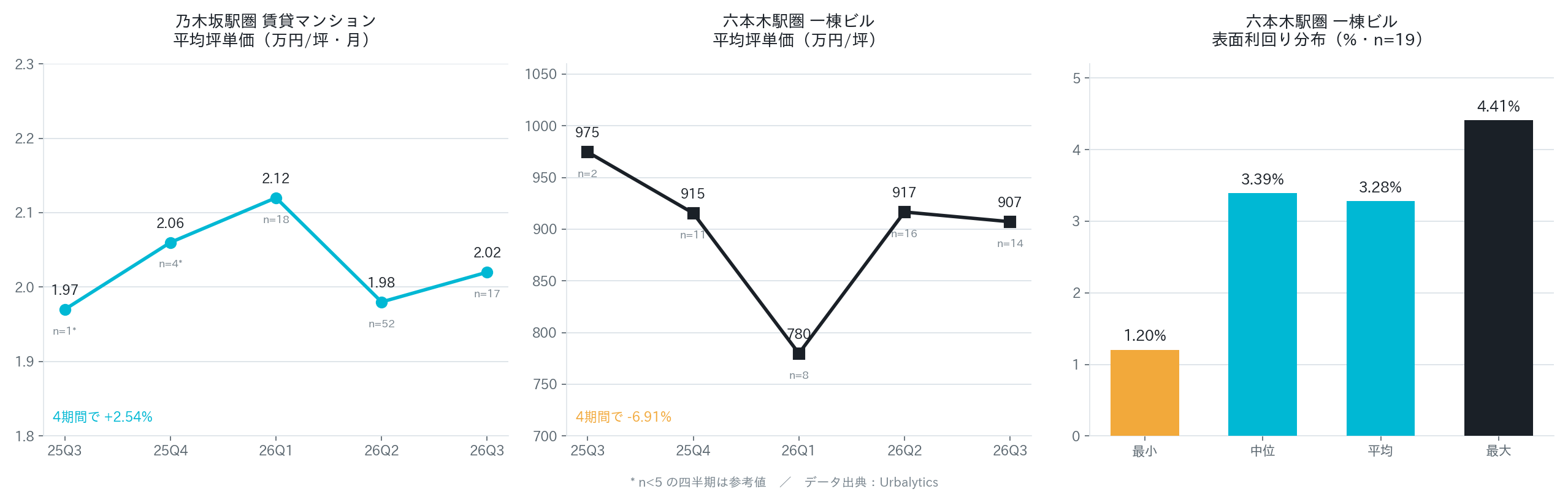
Start with rents. Urbalytics tracks 93 rental apartment samples in the Nogizaka station area: average monthly rent JPY 344,000; average size 51.95 m²; implied average unit rent about JPY 20,200 per tsubo per month. From Q3 2025 to Q3 2026 this metric rose a cumulative +2.54%, peaking at JPY 21,200 in Q1 2026 before a mild pullback—broadly a 'sideways at elevated levels with a slight uptrend' profile, indicating demand in ultra-prime areas has not been priced out.
Urbalytics Insight In-house Urbalytics data also flags a subtle divergence: while Nogizaka’s rental unit rent per tsubo rose +2.54% over four quarters, whole-building average price per tsubo in adjacent Roppongi fell -6.91% over the same period. Within Minato’s core, the leasing market and the asset-trade market are moving in opposite directions—precisely where investors who read only deal headlines, not internal comps and active listings, are prone to missteps.
Now the yield side. In Roppongi’s station area, there are 19 whole-building samples: gross yield (表面利回り) median 3.39%, average 3.28%, ranging from 1.20% to 4.41%, with an average total price around JPY 1.53 billion. A sub-3.4% median says these assets are priced less on cash flow and more on land scarcity and capital preservation expectations.
The trajectory bears watching: Roppongi whole-building average price per tsubo fell from JPY 9.75 million/tsubo in Q3 2025 to JPY 7.80 million in Q1 2026, then recovered to JPY 9.07 million in Q3 2026—still a -6.91% four-quarter decline. While residential price ceilings are being reset higher, commercial whole-building pricing has actually eased—funding sources and financing terms differ, so one cannot be substituted for the other.
From Nogizaka to Yaesu: the company’s other leg
To understand the conviction behind Tokyo Tatemono’s 'not chasing unit count,' shift the lens from housing to redevelopment (再開発). As the same reporter previously noted, Tokyo Tatemono’s largest redevelopment, "TOFROM YAESU" (トフロム ヤエス), completed the entire district in 2026.
The scale is straightforward: the 51-story TOFROM YAESU TOWER was completed at end-February, and the 10-story THE FRONT in July; together they provide roughly 237,000 m² of gross floor area. Total project cost is about JPY 240 billion per Tokyo Metropolitan Government materials. Beyond offices and conference facilities, the complex includes a theater for roughly 800 people, medical facilities of Nippon Medical School, and a bus terminal operated by Keio Dentetsu Bus.
More crucial is the cadence of capital: Tokyo Tatemono plans to invest about JPY 173 billion across 2025–26 into large-scale redevelopments including TOFROM, and will relocate its headquarters into TOFROM this autumn. President Katsuhito Ozawa noted in an interview that since the Edo period Yaesu has been a quarter of merchants and artisans, its blocks finely grained; this redevelopment intentionally preserves that 'streets are made by walking' human scale—from an investment lens, curating neighborhood character is the soft asset that allows office and retail rents to outperform over time.
One hand on prime residential land, the other on Tokyo Station–front redevelopment—together these two legs explain why a company ranked 19th by units dares to set a JPY 2.5 billion sticker for a single residence.
Three takeaways for cross-border investors
Strip the news down: what’s portable is not 'Tokyo Tatemono is great,' but a few judgments you can apply directly to selection.
First, recalibrate how you evaluate developers: in prime central areas, unit supply has clearly decoupled from product strength. Screening partners or resale exits by unit rankings will systematically miss boutique players with higher brand premiums.
Of course, opportunity comes with risks:
1) Price discovery for ultra-high-ticket units depends heavily on affluent demand and liquidity. At the JPY 2.5 billion level the secondary buyer pool is extremely thin; if global HNW capital sentiment shifts, exit timelines can lengthen materially.
2) The Toyo Keizai pieces cited are paywalled; the accessible excerpts do not cover the Kansai and Kyushu outlooks referenced. If you intend to extrapolate to regional markets, go back to the originals and the developer’s IR materials—do not transplant central-city conclusions to the provinces.
3) In the Urbalytics samples, Nogizaka rental data in Q3 and Q4 2025 comprise only 1 and 4 cases, respectively, and are for reference; base trend judgments primarily on the more robust 2026 quarters to avoid small-sample noise.
Conclusion: Pricing power in prime locations is concentrating among a few players
In 2026, central Tokyo is undergoing a quiet transfer of power: winners are no longer those who sell the most, but those who defend brand and economics at scarce sites. With a JPY 2.5 billion-per-unit tower and a JPY 240 billion district, Tokyo Tatemono has made that shift explicit.
Urbalytics data reminds us this is not a universal upswing—rental and whole-building sales are already diverging. Conflating the two is risky. If you need to verify where a station area’s rent levels and whole-building yields are heading before deploying capital, Urbalytics’ area datasets and comp queries can answer in minutes.
#TokyoTatemono #Brillia #Nogizaka #MinamiAoyama #MinatoWardInvestment #CentralTokyo #TowerCondominium #TowerMansion #PrimeLocation #TOFROMYaesu #YaesuRedevelopment #GrossYield #GreaterTokyoRealEstate #JapanRealEstateInvestment #Urbalytics
References
- Toyo Keizai Online, 2026, 'Tokyo Tatemono’s Brillia eschews unit counts to focus on prime sites… in Tokyo, a single unit lists at JPY 2.5 billion; headroom remains in Kansai and Kyushu' (series: Condominium Disruption—Soaring Prices Drive Survival of the Fittest), https://toyokeizai.net/articles/-/953004?display=b ※ Paid-members-only article (public portion quoted)
- Toyo Keizai Online, 2026, 'Total project cost of Tokyo Station-front redevelopment TOFROM YAESU is about JPY 240 billion… its success will also sway Tokyo Tatemono’s corporate value', https://toyokeizai.net/articles/-/945591?display=b ※ Paid-members-only article (public portion quoted)
- Toyo Keizai Online, 2026, 'Interview: Tokyo Tatemono President Ozawa on expectations for TOFROM YAESU and signals from Brillia Tower Nogizaka', https://toyokeizai.net/articles/-/945350?display=b ※ Paid-members-only article (public portion quoted)
- Real Estate Economic Institute, 2025, Condominium supply by seller ranking (values as cited by Toyo Keizai reporting), https://www.fudousankeizai.co.jp/
- Tokyo Metropolitan Government, Bureau of Urban Development, Yaesu 1-chome East District Type-1 Urban Redevelopment Project materials (source for the approx. JPY 240 billion total project cost as cited by Toyo Keizai), https://www.toshiseibi.metro.tokyo.lg.jp/
- Tokyo Tatemono Co., Ltd., Corporate information and IR materials (Brillia brand / large-scale redevelopment investment plans), https://www.tatemono.com/
- Urbalytics in-house data, 2026-07, Nogizaka station area rental apartment rent statistics (n=93) / Roppongi station area whole-building gross yield statistics (n=19), https://www.urbalytics.jp/
Copyright: This article is original content by the author. Please do not reproduce, copy, or quote without permission. For usage requests, please contact the author or this site.
Photos in this article: 20110405-TokyoTower-Sakura 東京太郎/CC BY-SA 3.0(トリミング) Wikimedia Commons·Nogizaka Station - 2022 June 26 various 16 13 57 456 Nesnad/CC BY 4.0(トリミング) Wikimedia Commons·Roppongi-STA Entrance MaedaAkihiko/CC BY-SA 4.0(トリミング) Wikimedia Commons·Tokyo-STA Marunouchi-Entrance 2 MaedaAkihiko/CC BY-SA 4.0(トリミング) Wikimedia Commons