Words: 2337 | Estimated Reading Time: 12 minutes | Views: 5449
Tateishi in Tokyo’s Katsushika Ward is undergoing a profound urban renewal. Once known as a downtown area steeped in Showa-era nostalgia and a nightlife strip famous for “getting drunk for 1,000 yen,” the neighborhood has become a focal point for investors due to a large-scale redevelopment plan around the station. Here, the human-scale charm of traditional alleys intersects with the silhouette of new high-rises, and the investment value of an old district is being redefined.
Regional History and Development Context
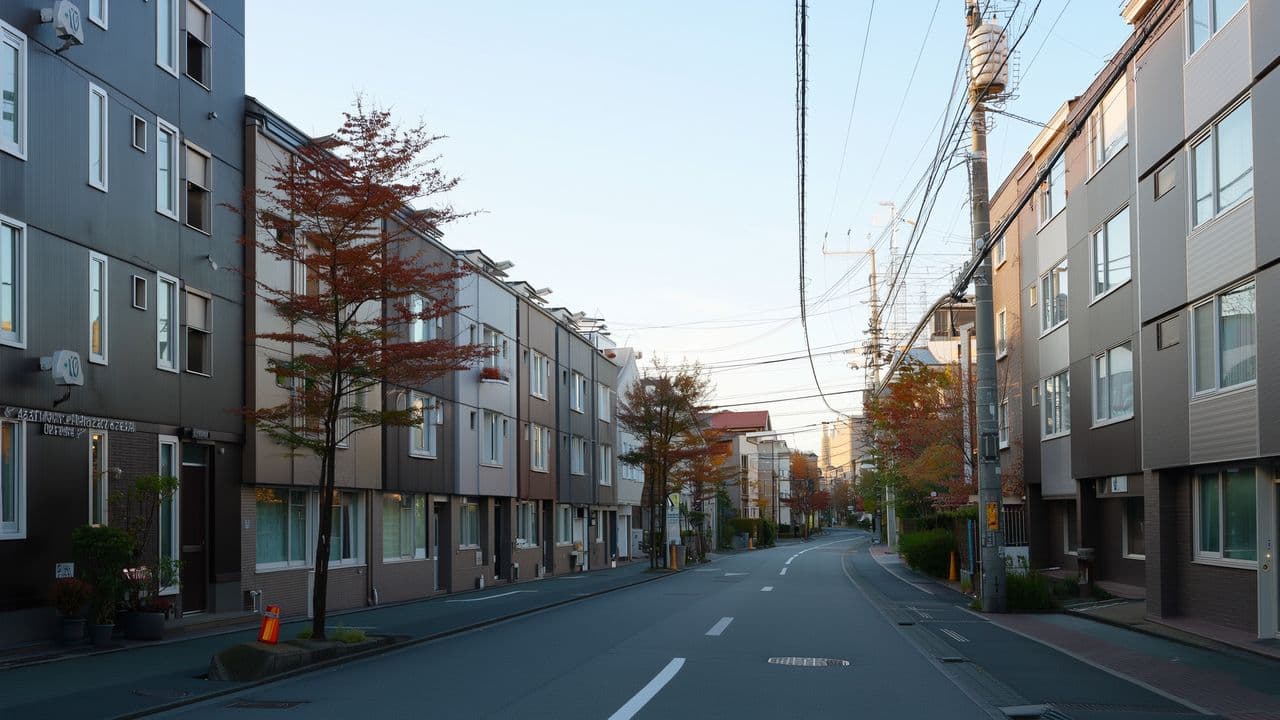
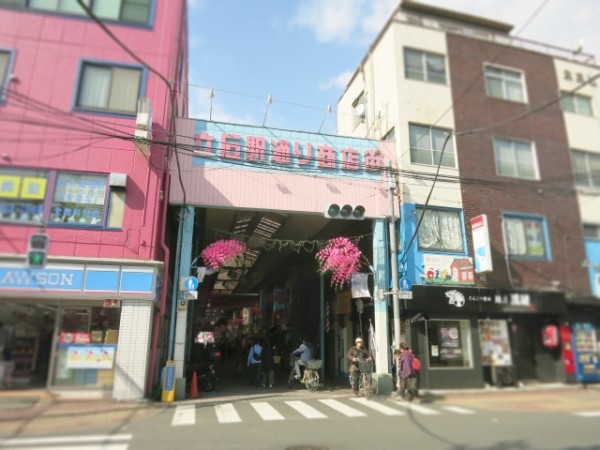
Tateishi sits at the heart of Katsushika Ward and has long preserved the strong street-level atmosphere of the Showa era. Narrow alleys are lined with long-established izakaya and shopping streets, notably the Tateishi Station-dori Shopping Street and the Tateishi Nakamise Shopping Street, which attract visitors seeking a nostalgic experience. The area is affectionately known as a "senbero" district—places where you can get drinks for around 1,000 yen—making it a symbol of Tokyo’s shitamachi (old downtown) culture. At the same time, Tateishi houses many public facilities, including the former ward office and a cultural hall, reinforcing its civic and cultural character.
However, Tateishi’s historical fabric has created urban planning bottlenecks. Around the station a bustling market centered on shopping streets developed, but the neighborhood’s roads are generally narrow, wooden buildings are densely clustered, and disaster resilience is a concern—making livability improvements urgently needed. Local government and the community recognized these issues as early as the 1990s: in 1996 the "Tateishi Station North Exit Area Redevelopment Study Group" was established, and in 2007 a redevelopment preparation organization was formed to start shaping renewal concepts. After years of planning, the project received a city planning decision in 2017, the redevelopment association was officially approved in 2021, and following the completion of the rights-exchange plan in 2023, the long-held vision finally moved into the construction phase.
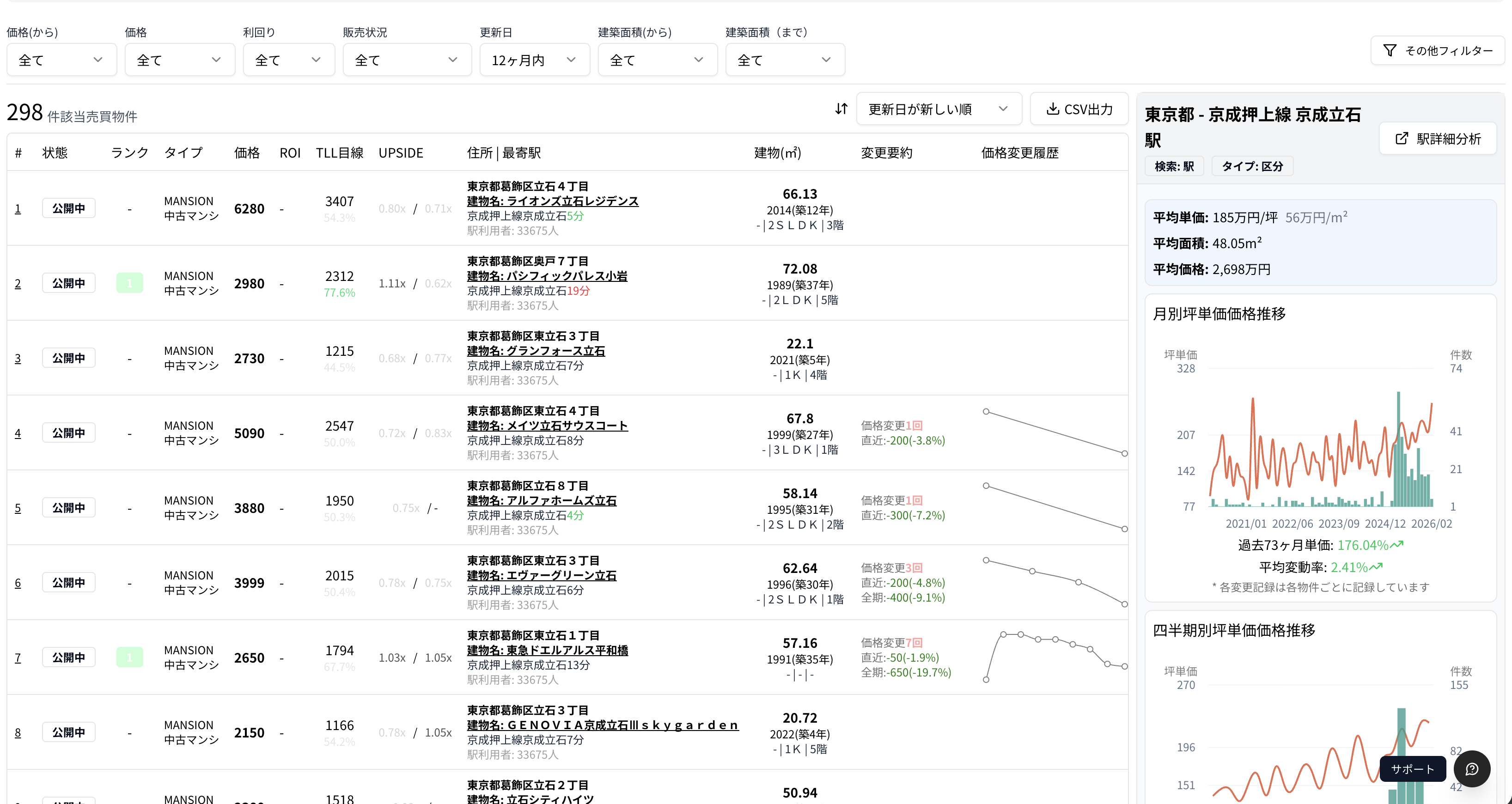
Find properties in 東京都葛飾区
Individual listings, price-change history, closed transactions and AI valuations are available on a free account.
Population, Land Prices and Rental Demand Trends
From a data perspective, population and real estate indicators in the Tateishi area reflect the changes underway in this older district. Katsushika Ward currently has a population of about 470,000, ranking ninth among Tokyo’s 23 special wards, with approximately 253,000 households—also ninth. Notably, the number of households in the ward has been increasing in recent years while total population has remained largely flat, indicating a rise in many smaller households—mainly single residents and small families moving in. Between 2019 and 2024, the total population increased by only about 5,500, but the number of households rose by roughly 16,000, causing the average household size to fall from 1.96 to 1.86 persons. This shows that more single young people and small families are choosing to settle in Katsushika, and transport-accessible neighborhoods like Tateishi are increasingly attractive to younger renters. The trend toward single-person households supports steady rental demand—young professionals tend to prefer renting near stations for convenience and safety rather than buying detached homes in distant suburbs, keeping rental apartments around Tateishi at high occupancy rates. With further redevelopment and rising area attractiveness, this rental demand is expected to strengthen.
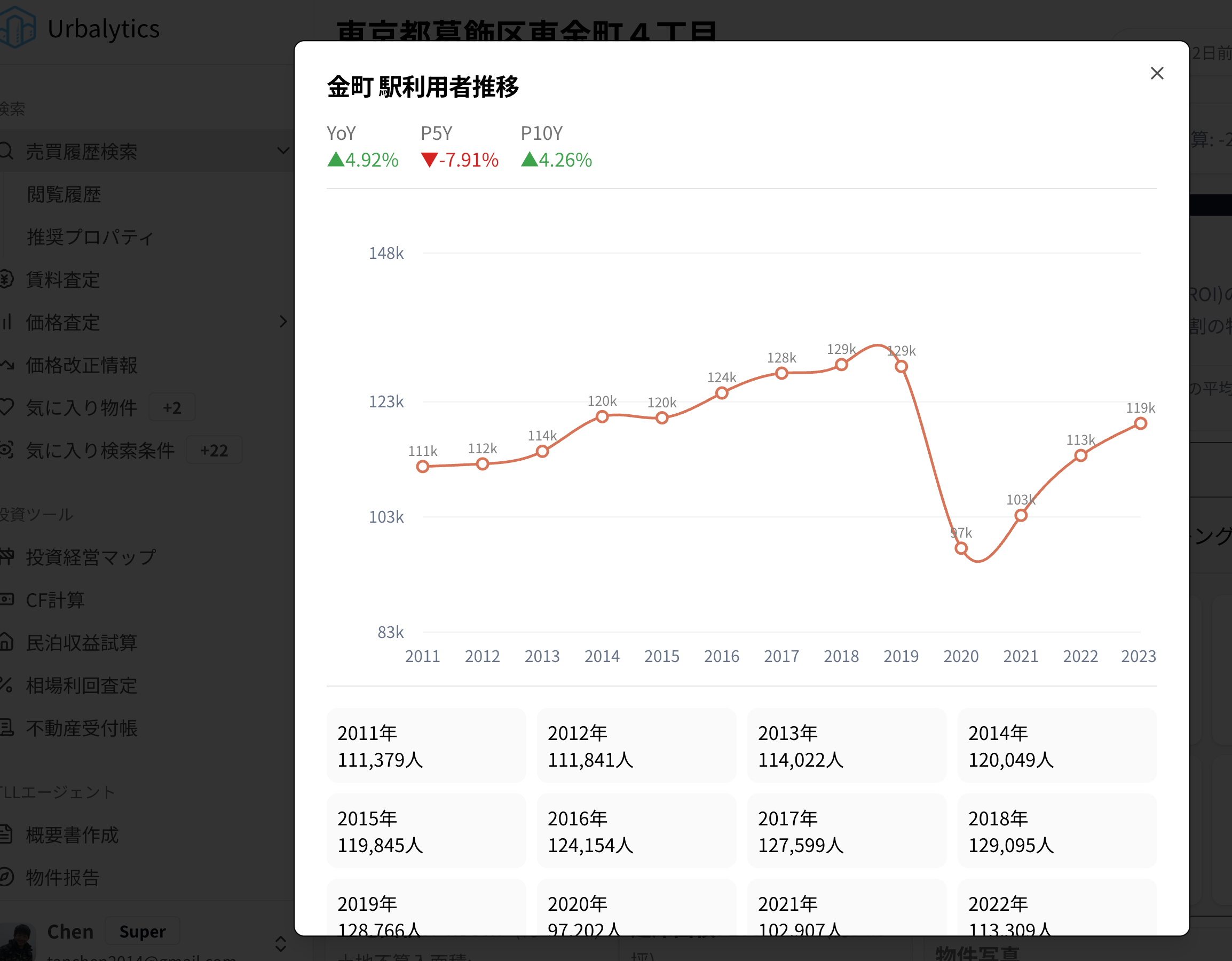
In terms of real estate prices, Tateishi’s recent land price trends also confirm market optimism about the area’s prospects. Official data show that the average published residential land price in Katsushika Ward rose by about 6.3% year-on-year in 2025, with particularly notable increases around Tateishi. For example, the standard land plot in Tateishi 5-chome had a published price around JPY 392,000/m² in 2025, up nearly 7% from 2024 and almost 13% since 2023. Over the past decade (2015–2025), a benchmark site in Tateishi saw a cumulative price increase of about 35%. Stretching the timeline further back, land prices in Tateishi have risen nearly 60% since 2012, well above the surrounding ward average increase of roughly 38%, demonstrating strong asset appreciation potential. These figures show that previously undervalued Tateishi is rapidly entering investors’ radars. Capital is flowing into the local real estate market, driving prices up. The nearby Kanamachi redevelopment case also adds confidence for Tateishi’s future: after new high-rise apartments and environmental improvements were introduced around Kanamachi Station, population has posted net growth since 2021, with year-on-year increases exceeding 2% in 2023 and 2024—the largest gains in the past decade—indicating that urban renewal can bring both foot traffic and value. Tateishi is expected to see similar population and demand increases once major projects are completed.
Details of the Tateishi Station Front Redevelopment
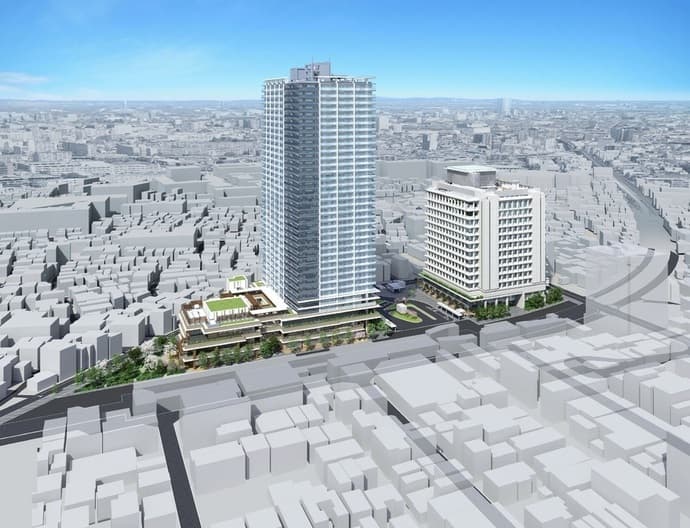
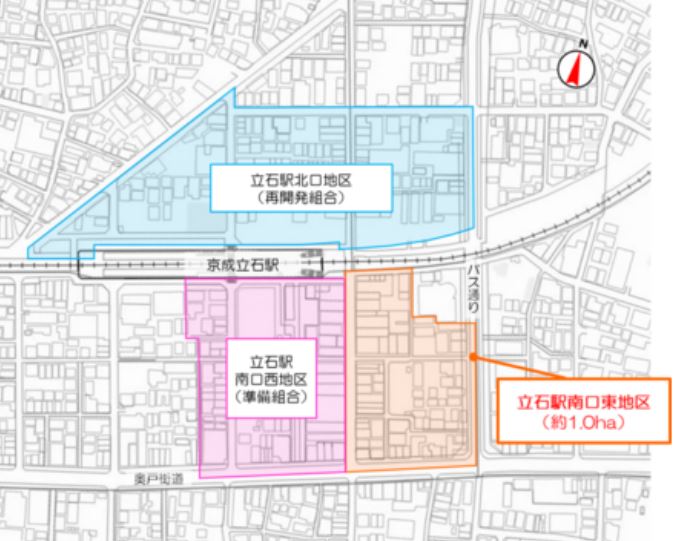
The turning point for Tateishi’s transformation is the full-scale launch of the Keisei Tateishi Station North Exit Type I Urban Area Redevelopment Project. On November 1, 2025, this long-prepared large-scale project officially broke ground. The development area adjoins the north side of Keisei Tateishi Station, covering about 2.2 hectares, and aims to create a modern stationfront hub integrating residential, commercial and administrative uses. The site is divided into east and west blocks by a newly created North Exit Transportation Plaza. The plaza covers about 3,410 square meters and will serve as a station bus terminal and public event space, significantly improving passenger flow and circulation.
In the West Block, a super high-rise residential tower of 36 floors above ground and 2 basement levels is planned, with a building height of approximately 125 meters. The tower will offer about 710 high-quality residential units and include retail at its podium, injecting new residents and consumer activity into the area. The East Block will house a mixed-use building of 13 stories above ground (planned as 14 administrative floors) and 3 basement levels, about 75 meters high, which will accommodate the new Katsushika Ward office (new government building) along with shops and public facilities. The ward office’s relocation to Tateishi will consolidate the area’s role as an administrative center, bringing a steady flow of office workers and citizens conducting official business, thereby generating continuous daytime activity.
The north-exit redevelopment is being coordinated with rail infrastructure upgrades. The Tokyo Metropolitan Government is simultaneously implementing the Keisei Oshiage Line (Shiki–Aoto section) grade separation project, elevating the line between these stations to eliminate level crossings and improve commute efficiency and safety. Historically, Keisei Tateishi Station has only been served by local trains while express services pass through, but it is only an 8-minute ride to Oshiage Station, where transfers provide through access to the Asakusa Line and seamless connections to central business districts such as Nihonbashi and Shinbashi. Through the Asakusa Line and direct Kanto-area connections, Haneda Airport can be reached in one ride via the Keikyu through service, and Narita Airport is accessible via the Keisei network. With the planned rail elevation and station improvements, this "hidden downtown transit hub" can truly leverage its locational strengths—Tateishi has the potential to rise from an unremarkable small station to an important node in Tokyo’s eastern subcenter. The stationfront buildings, modern elevated station and transportation plaza will integrate to provide a solid infrastructure foundation for the area’s development. In addition to Katsushika Ward and the redevelopment association, strong private partners have joined the project: Tokyo Tatemono Co., Ltd., Asahi Kasei Homes Corporation and the Capital Region Noncombustible Building Corporation are among the participating members advancing construction. The works are contracted to a joint venture led by Kajima Corporation and Sumitomo Mitsui Construction Co., Ltd., with completion targeted for fiscal 2029. From planning to capital and policy implementation, multiple stakeholders have converged in Tateishi to drive this transformative change.
Notably, the station upgrade is not limited to the north side. On the south side of the station, the government is also planning two redevelopment projects, signaling an ambition for comprehensive enhancement: the "Tateishi Station South Exit West Area Type I Urban Area Redevelopment" (about 1.3 ha) and the "Tateishi Station South Exit East Area Redevelopment" (about 1.0 ha), currently being advanced with participation from developers including Nomura Real Estate. According to released plans, the south-exit west area will include a roughly 125-meter-high, 34-story residential tower (~700 units), while the south-exit east area plans a roughly 120-meter-high, 32-story residential building (~440 units) plus supporting commercial facilities. Once these two high-rise apartments are completed, the cumulative new supply on the north and south sides of Keisei Tateishi Station will exceed 1,800 residential units, reshaping the skyline with several towers. These projects are mutually reinforcing, forming a coordinated development pattern across the north 2.2 ha + south-west 1.3 ha + south-east 1.0 ha sites. Tateishi’s entire stationfront area is undergoing an unprecedented scale expansion and functional upgrade. The neighborhood’s strong shitamachi character will soon be complemented by a new high-rise appearance, creating a distinctive urban landscape where old and new coexist.
Impact of Redevelopment on the Area’s Future Investment Value
Such sweeping urban renewal will profoundly change Tateishi’s investment profile. First, the most immediate effect will be an upgrade in regional positioning—Tateishi will transform from a popular low-cost izakaya street into an important comprehensive node within Katsushika Ward. The arrival of the new ward office will make Tateishi an administrative center; the large-scale residential and commercial properties will attract many new residents and businesses, boosting local consumption and employment. The influx of people and industries will unquestionably increase the attractiveness and value of real estate in the area. For property investors, Tateishi is evolving from a relatively niche downtown community into a new investment hotspot that can rival other eastern Tokyo subcenters. Areas previously avoided for being old and disordered are now gaining new vitality and order from reconstruction, signaling a revaluation of property assets.
Second, upgraded infrastructure and public environment will underpin long-term value. Rail grade separation eliminates long-standing level crossing congestion and safety risks, while the transportation plaza improves bus connections and the quality of public space. These changes significantly enhance Tateishi’s convenience and livability, attractive to both renters and buyers. Especially for commuters and students who rely on public transport, Tateishi’s transport advantages will become more prominent after the upgrades, drawing more cross-district workers to settle here and expanding housing demand. In addition, new plazas, parks and other amenities will enrich community life, and improved retail will create a one-stop living environment for residents—adding further value premium to real estate.
Third, the large increase in residential supply itself will create structural market opportunities. Around two thousand new apartment units will come to market within a few years. In the short term this may create a supply peak, but in the medium to long term these high-quality units will attract many young families and first-time buyers, helping to optimize Tateishi’s population structure and raise spending levels. As new residents move in, existing shopping streets could be revitalized and upgraded to complement the new commercial offerings—integration of old and new will become a key selling point for Tateishi. For long-term buy-and-hold investors, entering before the new community reaches maturity is an opportunity to catch the early upswing. The upward trend in land prices is already visible, and after redevelopment completes, there remains upside for rents and sale prices.
Of course, opportunities come with challenges. Cultural impact and transitional pains are issues Tateishi must confront during the transformation. The rise of high-rise towers and an influx of people may erode some of the nostalgic atmosphere and community ties that define the old shopping streets. This shift may disappoint nostalgia-seeking visitors and create a sense of loss among some long-term residents. From an investment perspective, the fading of traditional charm will take time to be replaced by new urban appeal. During construction, nearby businesses will inevitably be affected, and some long-standing shops may be unable to survive until rebirth, causing short-term disruption to the commercial environment and rental income. Additionally, a concentrated release of new housing stock requires sufficient market absorption; if sales or occupancy lag expectations, there could be temporary inventory pressure or a longer leasing period, affecting investment return timing. Nevertheless, given Tokyo’s robust housing demand and Tateishi’s comparatively low base prices, these risks are relatively controllable: the area’s status as a "value pocket" is disappearing as redevelopment progresses, and future price and rent levels are likely to converge toward eastern Tokyo averages, increasing the certainty of capital preservation and appreciation.
Overall, the redevelopment’s benefits for Tateishi are comprehensive and far-reaching. Upgraded urban functions, inflows of people and capital will refresh the area inside and out. For investors seeking value discovery, Tateishi offers a distinct dual appeal: it retains the warm, human-scale atmosphere unique to Tokyo’s shitamachi while introducing modern urban vitality and convenience. This combination helps Tateishi stand out among Tokyo investment options. As projects are completed, Tateishi’s investment value will likely be reappraised further—what was once an overlooked corner could become a highly sought-after growth stock. Capturing this urban renewal window requires both confidence in the area’s future and patience for phased deployment. For long-term-minded investors, today’s Katsushika Tateishi stands at the intersection of "nostalgic charm" and "modern opportunity," offering promising returns.
Conclusion
Seasoned by a century of change, Tateishi is stepping out of its past shadow and onto a new stage. From a Showa-era working-class neighborhood to a vibrant new cityscape of high-rises, its transformation provides a vivid case study of Tokyo’s urban renewal. For investors, Tateishi’s story illustrates the full process of rediscovering urban potential: advantageous transport location, shifting population structure, and policy support converge here to create a rare investment opportunity. While risks should be managed, overall Tateishi’s investment positioning is steadily rising—from a once overlooked shitamachi to a now highly watched area of value. Looking ahead, as redevelopment projects are completed and area value is realized, a "New Tateishi" will rise in eastern Tokyo, offering abundant returns and possibilities to those who commit and invest in the area.
Sources
[Source: Tokyo Shimbun, 2025, https://adv.tokyo-np.co.jp/prtimes/article85687/】
[Source: Traffic News, 2025, https://trafficnews.jp/post/602913】
[Source: Diamond Real Estate Research Institute, 2025, https://diamond-fudosan.jp/ud/realestate_price_land_2024/url/東京都葛飾区立石】
#Tokyo #Katsushika #Tateishi #UrbanRenewal #StationfrontRedevelopment #RealEstateInvestment #DemographicTrends #LandPrices #RentalMarket #DowntownCulture #PublicInfrastructure #UrbanPlanning #HighRiseApartments #AreaValue #InvestmentOpportunity
Copyright: This article is original content by the author. Please do not reproduce, copy, or quote without permission. For usage requests, please contact the author or this site.
Photos in this article: Shibamata Taishakuten March 11 2021 various 20 44 16 882 Nesnad/CC BY 4.0(トリミング) Wikimedia Commons·Keisei-railway-KS49-Keisei-tateishi-station-entrance-20170104-151 LERK/CC BY-SA 4.0(トリミング) Wikimedia Commons·Tateishi 2 Geospatial Information Authority of Japan/Attribution(トリミング) Wikimedia Commons·Kanamachi-Sta-S Nyao148/CC BY-SA 3.0(トリミング) Wikimedia Commons