Words: 1821 | Estimated Reading Time: 10 minutes | Views: 1732
On July 15, the Japan Tourism Agency issued a technical advisory that turned minpaku from an expanding industry into a regulated exception—and HARUMI FLAG happens to be the most glaring case study of this pivot.
On August 4, 2026, Japanese media again turned their cameras on Harumi in Tokyo’s Chuo City. This time, the headline wasn’t about prices, but about “illegal minpaku targeting Chinese customers.” Just three weeks earlier, the Tourism Agency had released a notice that could rewrite the industry’s underlying logic. These may look like two separate stories; in reality, they are two ends of the same one.
Find properties in 東京都中央区
Individual listings, price-change history, closed transactions and AI valuations are available on a free account.
A 5,632-unit sample exposes structural flaws in cross-border ownership
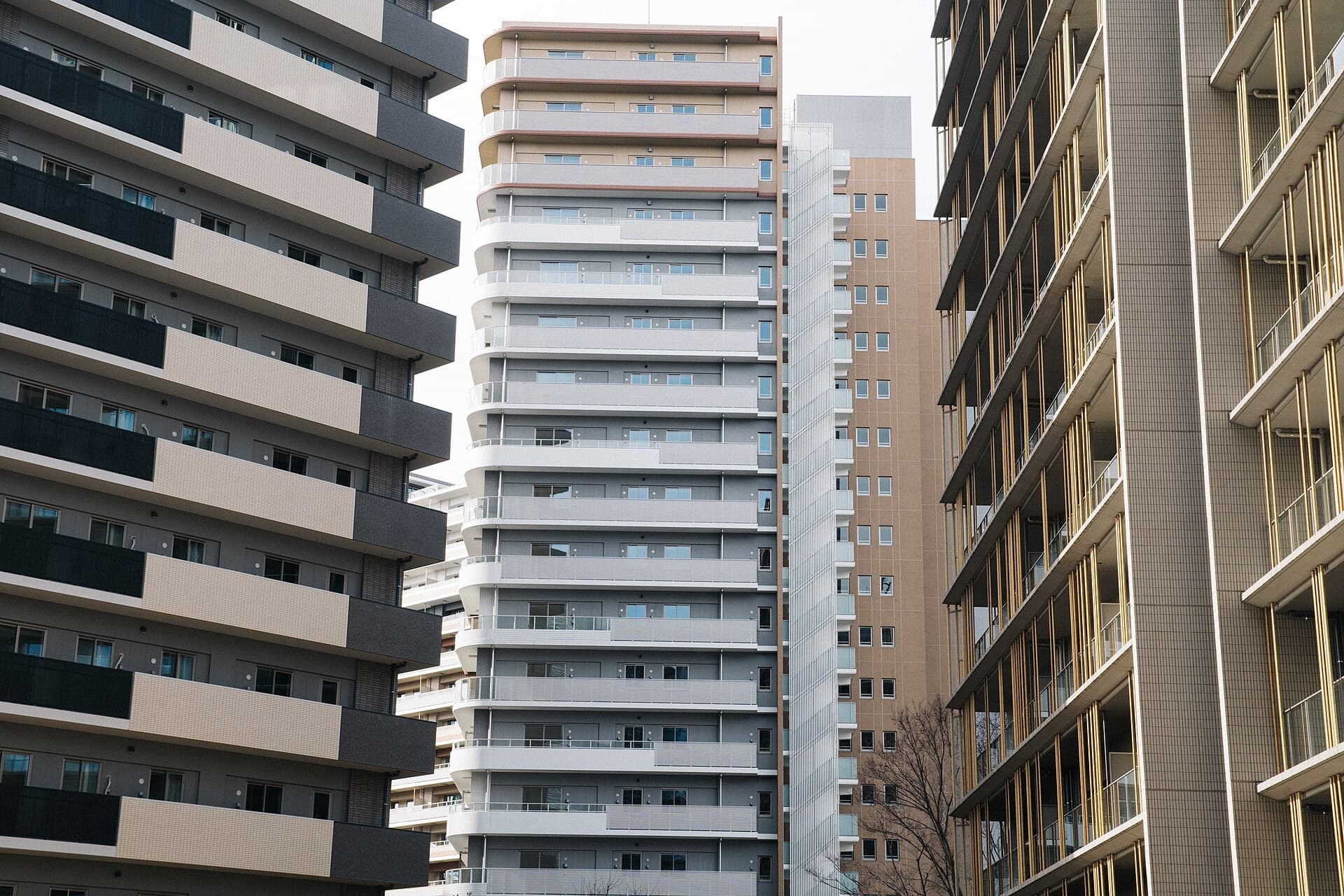
HARUMI FLAG is a new district redeveloped from the former Olympic and Paralympic Village site, with for-sale and rental condominiums, retail, schools, and parks. With a total of 5,632 units (4,145 for-sale), it is among the largest condominium projects in Japan—making it a natural benchmark for the resale condo market.
The price trajectory shows how capital flowed in. When sales began in 2019, the price per tsubo was about 3 million yen, with most units priced in the 60-million-yen range—“cheap,” which triggered lottery frenzies. By the time residents moved in around 2024, as Greater Tokyo condo prices surged broadly, the price per tsubo jumped to around 6 million yen, with some sellers even asking as high as 10 million yen per tsubo.
Today, the price per tsubo is moving sideways near 6 million yen, and many now see the market as topping out. From June 2025 to March 2026, the median closing price per tsubo was roughly 6.2 million yen, while listing prices generally ranged from 7.2 to 9.9 million yen—implying a 10–20% gap between listings and closings, a classic sign that seller expectations have outpaced buyers’ wallets.
The problem lies in the ownership structure. Real estate journalist Junji Sakaki, supervising author of “Gap Map of Used Condominiums in Tokyo’s 23 Wards,” notes that among Chinese-affiliated buyers “many appear to be holding purely as investments,” with some operating minpaku, food service, and even unlicensed adult entertainment businesses for Chinese visitors—fueling ongoing disputes with residents. His view is that the project harbors a notably hard-to-resolve structural problem.
Why the police can’t fix it: the wall of insufficient evidence
In theory, unlicensed ride services and unlicensed adult entertainment are illegal, so stricter policing should solve the problem. In practice, it doesn’t work that way.
Sakaki explains the enforcement challenge: white-plate taxi drivers claim “I’m just giving a friend a ride.” Even if money changes hands, “they gave me a gift; I chipped in for gas” can stall the evidentiary chain. The same goes for unlicensed adult entertainment—“just visiting a friend” is hard to disprove without strong counterevidence.
The cross-border setup is the killer: both operators and customers are Chinese, the coordinator sits in China, and guests fly home in a few days. When your evidence evaporates within days, the threshold to bring a case to prosecution under current law becomes prohibitively high.
The takeaway for investors matters more than the headlines: outsourcing compliance risk to “enforcement difficulty” has never been a sustainable business model. Hard-to-enforce only means a lower penalty probability today; it does not change the illegality of the behavior, nor does it prevent a legislative response—and that response has arrived.
The Tourism Agency’s July 15 technical advisory: from “expansion” to “control”
On July 15, 2026, the Japan Tourism Agency, the Ministry of Land, Infrastructure, Transport and Tourism, and the Ministry of Health, Labour and Welfare jointly issued a notice to local governments titled “On Zero-Day Regulation, etc. for Notified Dwellings under the Private Lodging Business Act (Technical Advisory).”
“Zero-day regulation” is a striking term: it means municipalities may, by ordinance, reduce allowable operating days for minpaku to effectively zero. The national government had previously been cautious about such moves, viewing them as contrary to the intent of the Private Lodging Business Act. This notice effectively recognizes that municipalities have wide latitude to tighten minpaku rules substantially.
To be clear, this is not a nationwide abolition of minpaku. The Act has always allowed municipalities to impose restrictions by ordinance—for example, designating zones and periods around schools or quiet residential streets. The real change is the national stance on the extreme measure of “effective zero,” shifting from disapproval to acceptance.
Also introduced is mandatory ICT-based monitoring: municipalities can compel noise meters, security cameras, and video-data retention at their discretion. Combined with the existing cap of 180 operating days per year, the operating cost structure for minpaku has been pushed up a notch.
The backdrop is no mystery. A weak yen drove an inbound tourism surge; noise and garbage disputes became frequent; unreachable operators kept popping up. The Tourism Agency’s notice signals that minpaku has moved from “increasing supply” to “being managed.”
Rents didn’t rise while prices are peaking: the temperature gap in Urbalytics data
Headlines alone might suggest “robust demand” in Harumi. The rental data tell a different story.
Urbalytics shows rent per tsubo for rental condos in the Kachidoki station catchment fell from 18,700 yen/tsubo in 2025 Q3 to 17,700 yen/tsubo in 2026 Q3—a cumulative 5.35% decline. Sample size peaked at 247 in 2026 Q2, indicating this is not a small-sample artifact but rents failing to keep up with the price narrative.
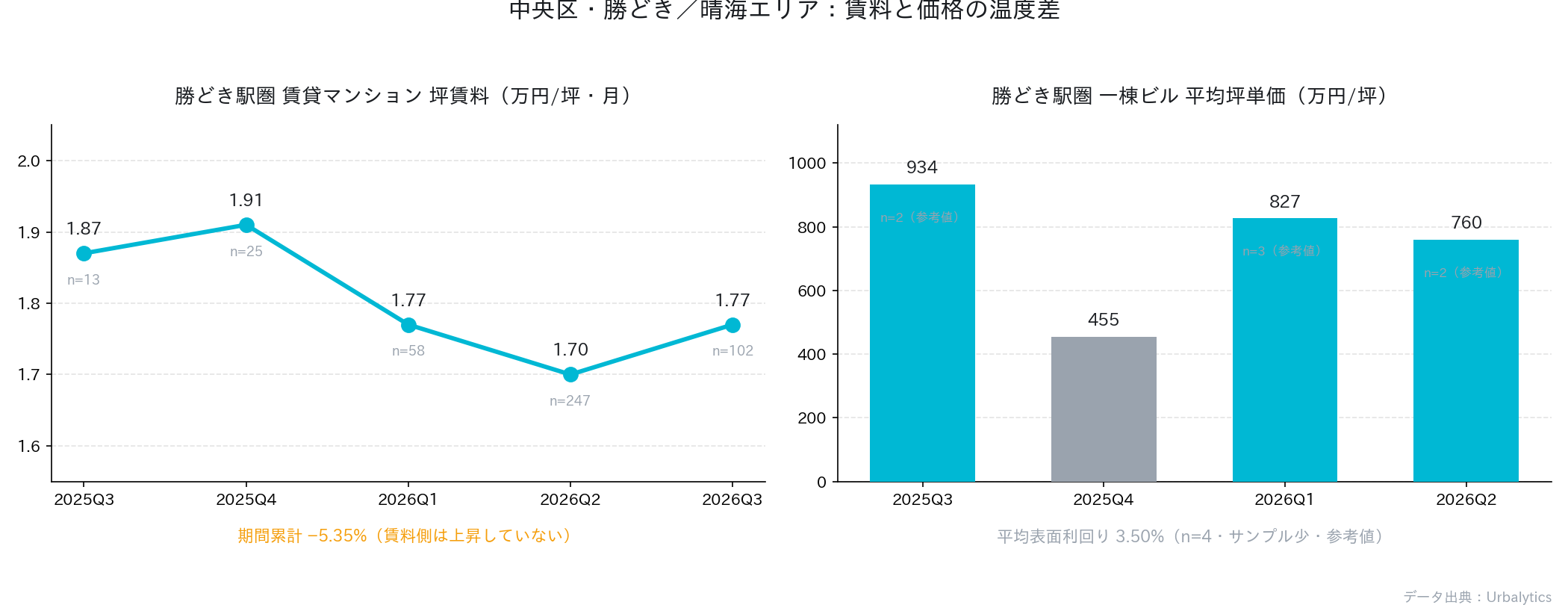
A whole-building sample in the same catchment offers another signal: average gross yield about 3.50% (median 3.50%), with an average closing price of 718 million yen; average price per tsubo fell roughly 18.62% from 2025 Q3 to 2026 Q2. Note: the whole-building sample is small (n=4 total; n=2–3 per quarter) and should be treated as reference, not a definitive trend.
Urbalytics Insight The value of Urbalytics’ internal data emerges at these points of contradiction: news tells you “where something went wrong,” but only by overlaying rent statistics, closing prices per tsubo, and gross yields in the same station catchment can you judge whether the problem is overheated demand or a spent premium. In Kachidoki–Harumi today, prices are flat, rents are soft, and yields are compressed near 3.5%—not a structure that a “high-yield minpaku” story can sustain.
Put differently, part of the premium supporting Harumi in recent years was predicated on short-term lets with high nightly rates operating outside or at the edge of the law. Once zero-day regulation closes that path, what remains is a conventional rental return around 3.5%—insufficient to justify an acquisition cost of 6 million yen per tsubo.
Three owner profiles are diverging
Policy shock is never evenly distributed. The same asset, in different zones and held by different owners, can yield opposite conclusions.
For investors, identify your category now:
First, holders in quiet residential streets such as the Category I Exclusively Low-Rise Residential Zone are in the most passive position. The Building Standards Act imposes the strictest use limits there, and lodging facilities are generally not permitted—meaning obtaining a Hotel Business Act license as a fallback is difficult. These assets are also the most likely targets of municipal ordinances, effectively leaving only conventional long-term leasing.
Second, holders in Commercial Zones or Category I Residential Zones still have options. The Building Standards Act allows lodging in these zones, so you can consider applying for a Simple Lodging or Ryokan/Hotel license under the Hotel Business Act. Once licensed, minpaku’s 180-day limit no longer applies and you can operate year-round.
Third, investors holding individual condo units face an extra gate: the building’s management bylaws. Noise, improper trash disposal, and disturbances in common and private areas are perennial flashpoints. After the Tourism Agency’s policy shift, more condo associations are likely to initiate bylaw amendments.
Risk alert “Switching from minpaku to a hotel license” is not a light lift. Hotel licensing demands far stricter compliance on zoning, the Building Standards Act, and the Fire Service Act, plus requirements for management setup, room size, lighting/ventilation, evacuation routes, and neighborhood notices. Converting a residential building to a lodging facility may trigger a change-of-use under the Building Standards Act and additional fire equipment; property insurance may also need to switch to commercial-use coverage. Treating the switch as “just some paperwork” is the easiest fatal error in this cycle.
Notably, Tokyo’s Sumida, Ota, and Toshima Wards have already been tightening minpaku rules—Toshima (home to Ikebukuro) plans to strengthen regulations from year-end. According to the Toshima Public Health Center, hotel license applications “appear to be rising markedly, perhaps to beat the deadline.” That is a high-signal leading indicator: the market is voting with its feet.
Conclusion: As the arbitrage window closes, the only road back is compliance
Viewed together, resident disputes at HARUMI FLAG and the Tourism Agency’s technical advisory reveal a clear causal chain: cross-border capital found high-yield seams in the system; once externalities crossed a threshold, the system self-repaired—and the repairs are often stricter than the original rules.
The next steps are easy to forecast. The bite of zero-day regulation depends on how fast municipalities amend ordinances. From H2 2026 into 2027, expect a wave of changes across Tokyo and the three neighboring prefectures in tourist hotspots and dense residential areas. Meanwhile, ICT mandates will squeeze out small individual operators, and the sector will consolidate toward corporates with Hotel Business Act licenses and operating capacity.
For owners, this is not a time to wait and see, but to do three concrete things: check whether your municipality is moving on ordinance changes; assess the true feasibility and cost of obtaining a hotel license; and revalue your asset using conventional rental yields—if a 3.5% gross yield doesn’t pencil out, the problem was never policy; it was your entry price.
In a policy-driven repricing cycle, judgment quality depends on data granularity. With Urbalytics’ rent statistics, transaction history, and yield distributions, investors can size the true floor return on their assets before new ordinances take effect.
#TokyoRealEstate #ChuoCity #HARUMIFLAG #Minpaku #ZeroDayRegulation #JapanTourismAgency #PrivateLodgingBusinessAct #HotelBusinessLicense #Kachidoki #CrossBorderInvestment #Yield #JapanPropertyInvestment #PolicyRisk #GreaterTokyoCondo #Urbalytics
References
- Japan Tourism Agency, 2026, “Issued a notice to local governments regarding minpaku — ‘On Zero-Day Regulation, etc. for Notified Dwellings under the Private Lodging Business Act (Technical Advisory)’,” https://www.mlit.go.jp/kankocho/news06_00067.html
- Money Post WEB (Yahoo! News), 2026, “With ‘illegal minpaku business targeting Chinese’ making headlines: What’s next for Japan’s largest 5,632-unit ‘HARUMI FLAG’? Why a real estate journalist believes ‘complete resolution is difficult’,” https://news.yahoo.co.jp/articles/751e7caec7999266ceb9f10635edcafa2b1c041b
- Kenbiya, 2026, “Is minpaku effectively banned? What did the Tourism Agency notify municipalities? Where does minpaku go from here? A look at current conditions,” https://www.kenbiya.com/ar/ns/for_rent/minpaku/10375.html
- Travel Voice, 2026, “The Tourism Agency’s two new minpaku rules: ‘Zero-Day Regulation’ and ‘Mandatory ICT Management.’ Municipalities’ scope of action expands,” https://www.travelvoice.jp/20260715-160180
- Kankokeizai Shimbun, 2026, “Zero-day regulation now possible for minpaku to curb local externalities: Tourism Agency notifies municipalities,” https://www.kankokeizai.com/2607270630kks/
- Urbalytics, 2026, Kachidoki Station area rent statistics and whole-building yield statistics (rent_stats / building_cap_rate_stats, 2025Q3–2026Q3), https://www.urbalytics.jp
Copyright: This article is original content by the author. Please do not reproduce, copy, or quote without permission. For usage requests, please contact the author or this site.
Photos in this article: Ginza-WAKO at night Kakidai/CC BY-SA 4.0(トリミング) Wikimedia Commons·A1 entrance of Kachidoki Station on the Toei Ōedo Line, Tokyo, Japan - 20090 た! ./CC BY-SA 3.0(トリミング) Wikimedia Commons·Tokyo Skytree 2 Kakidai/CC BY-SA 3.0(トリミング) Wikimedia Commons·Sunshine 60 1 Ikebukuro Tokyo 21 May 2 Morio/CC BY-SA 3.0(トリミング) Wikimedia Commons