Words: 1513 | Estimated Reading Time: 8 minutes | Views: 31
A local-only station with fewer than 10,000 daily passengers has surged to No. 6 in the Greater Tokyo rankings, yet per-tsubo rents have already caught up with Shimokitazawa while whole-building gross yields have been squeezed to just over 4%.
1. The small station that was passed by for four centuries
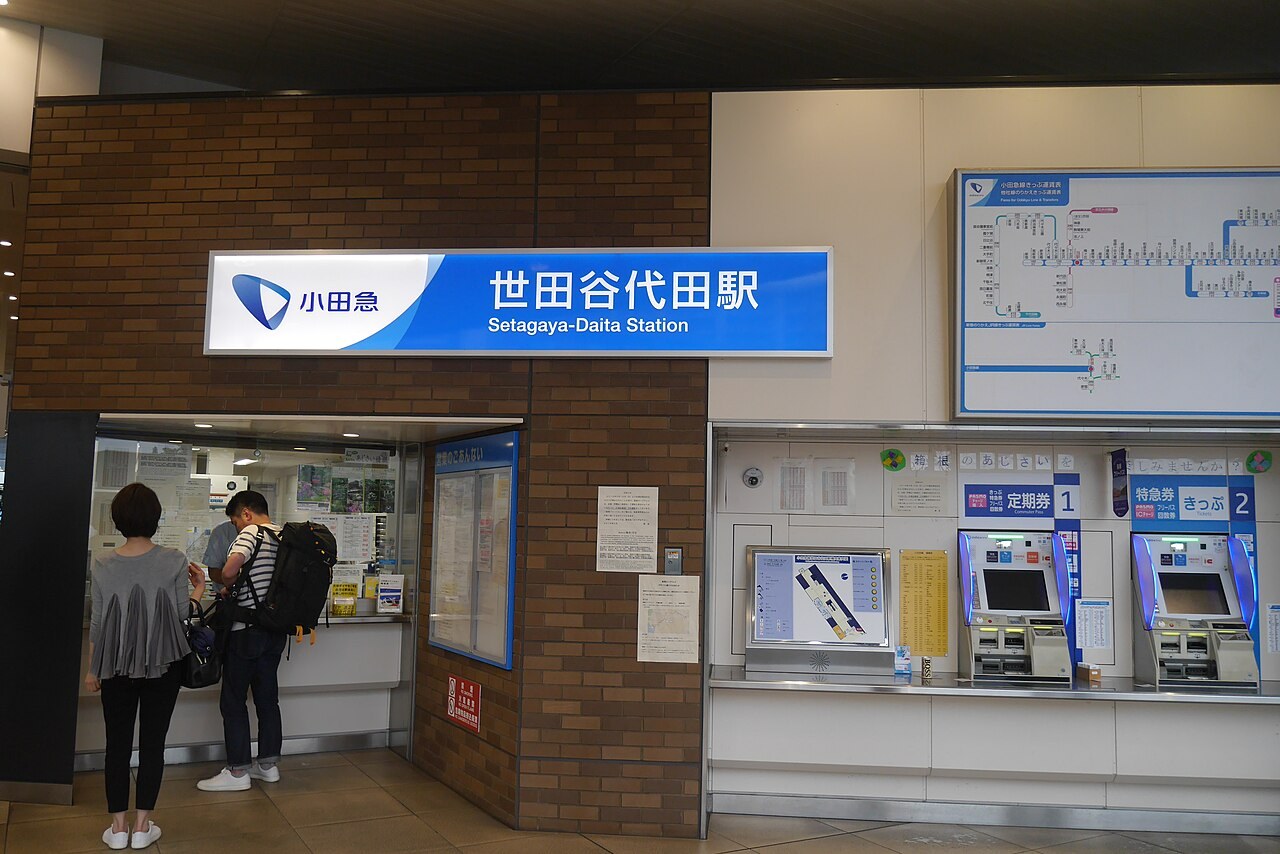
On September 1, 2026, SUUMO Research Center under Recruit released the SUUMO Livability Rankings 2026 (Greater Tokyo). Setagaya-Daita Station on the Odakyu Odawara Line (Setagaya City, Tokyo) jumped to 6th overall in the metropolitan area. In the previous 2024 survey it was 177th—an ascent of 171 places in two years.
The sample size is far from small: 251,356 valid responses, covering 1,043 stations with 30 or more respondents each. Setagaya-Daita scored an average of 85.16 with a deviation score of 72.03, ranking 5th within Tokyo Metropolis, just behind the Sendagaya and Akasaka tier.
Its standing within the ward is even more telling. This time Setagaya-Daita outranked Shimokitazawa (90th) and Sangenjaya (141st) to become No. 1 in Setagaya Ward. For anyone familiar with Tokyo, that feels counterintuitive—Shimokitazawa is one of Japan’s best-known subculture districts, and Sangenjaya has long dominated the “streets you want to live in” lists.
Setagaya-Daita’s roots run deep. After the Odawara Campaign ended in 1590, a group known as the “Daita Seven” returned to farm and opened Enjō-in Temple and Daita Hachimangū. The name “Daita” itself comes from the Daidarabocchi giant legend about footprints forming hollows; folklorist Yanagita Kunio examined it in his 1927 work “Daidara-bō no Ashiato.”
Yet in the railway era, this station—just 5.6 km from Shinjuku—was long served only by local trains, a quintessential node that was “passed by.” Its turnaround began precisely when the railway ceded the surface.
2. Rents have caught up with Shimokitazawa, but yields are heading lower
Rankings capture “want to live,” while investors must ask how much of that desire is already priced in. That is where internal data can answer.
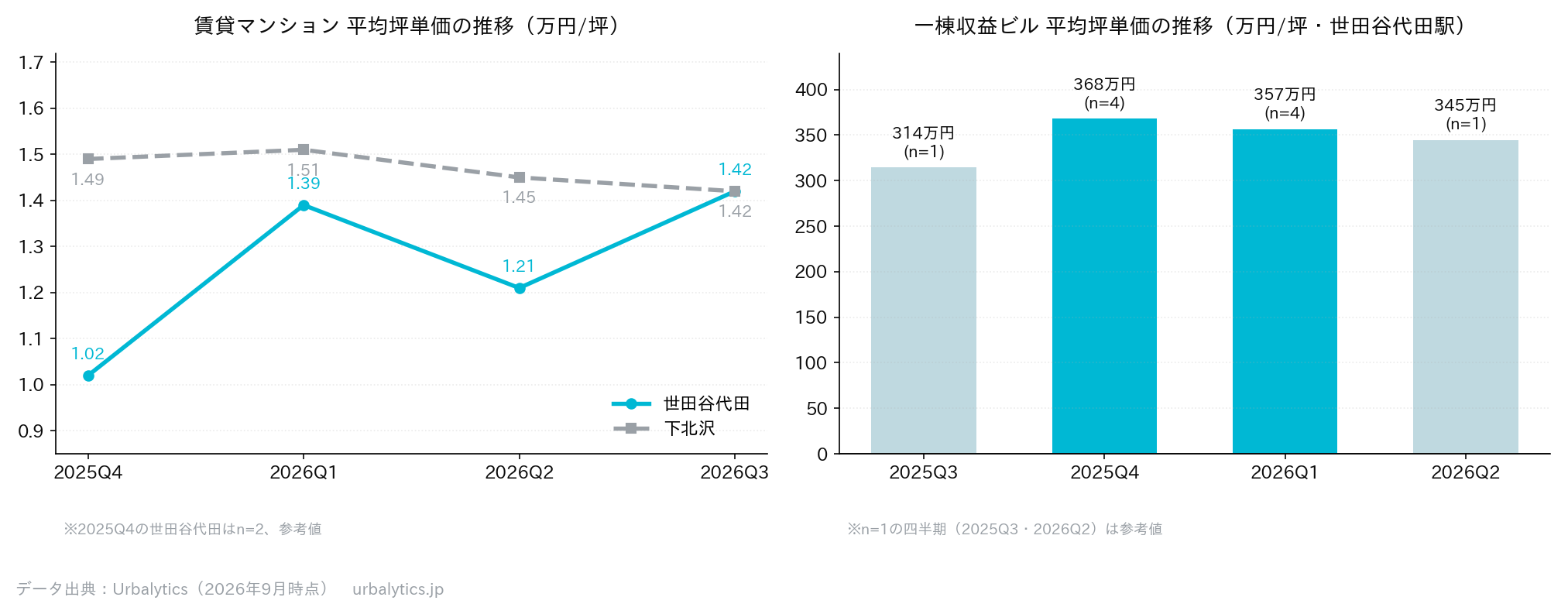
Urbalytics data show 91 rental apartment (賃貸マンション) samples around Setagaya-Daita, with an average monthly rent of ¥156,400 on an average 36.60 m². The average per-tsubo rent reached ¥14,200 in 2026 Q3. From 2025 Q4, that curve has cumulatively risen 39.22%.
The real signal lies in the control group. Over the same period, 356 samples around Shimokitazawa saw average per-tsubo rent slip from ¥14,900 in 2025 Q4 to ¥14,200 in 2026 Q3, a 4.70% decline. In other words, the two stations’ per-tsubo rents converged in 2026 Q3—one catching up, the other easing.
Urbalytics Insight The value of Urbalytics’ internal data is that it captures actual listings and transactions rather than survey “desire.” With only 91 samples at Setagaya-Daita—and just n=2 in 2025 Q4 as a reference—the series is volatile; but the fact it converged in the same quarter to the same per-tsubo level as Shimokitazawa’s 356-sample dataset makes that crossover point more informative than any single-station growth figure.
The whole-building income side is much cooler. Eleven samples in the station area show an average gross cap rate (表面利回り) of 4.56% with a median of just 4.19%, ranging from 3.15% to 8.00%. The average closing price is ¥271.38 million, for average annual income of ¥11.54 million. Over the same window, whole-building per-tsubo prices rose from ¥3.1434 million to ¥3.4462 million, a cumulative +9.63%.
Overlaying the two sets of numbers yields a clear conclusion: rent growth is lagging asset-price growth. Livability premia first get capitalized into land and sale prices, then seep into rents. Official land data corroborate this—2025 posted prices for residential land around Daita were already in the ¥797,000–¥887,000 per m² range.
3. Burying the railway to unlock 27,500 m²
The transformation stems from the continuous grade separation and quadruple-tracking project (連続立体交差化・複々線化事業) between Yoyogi-Uehara and Noborito. Launched in 1994, the Higashi-Kitazawa–Setagaya-Daita segment was initially planned as elevated, but was switched to underground due to structural constraints at the Shimokitazawa crossing with the Keio Inokashira Line, high land-acquisition costs along the Shimokitazawa shopping street, and resident demands for a station plaza.
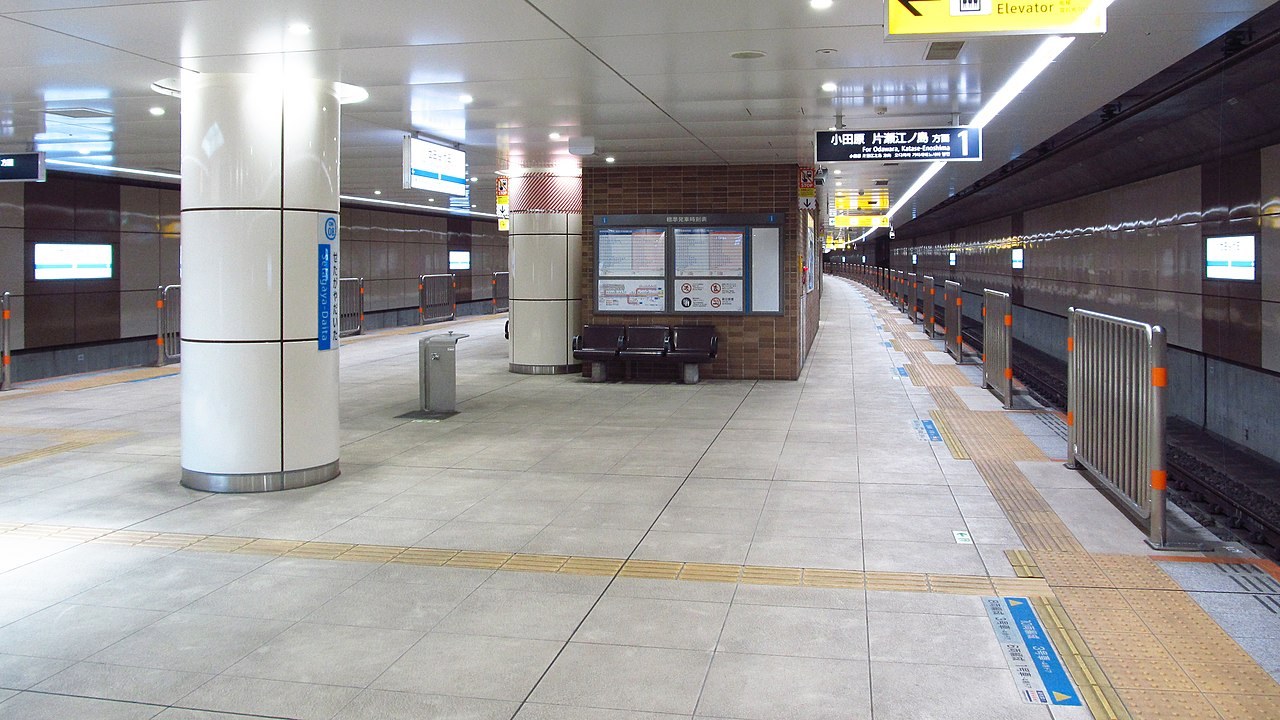
Milestones were hard won. Work on the segment started in 2004; a temporary bridge station opened in 2006. In 2013, together with Higashi-Kitazawa and Shimokitazawa, it moved underground, with all nine level crossings removed. Immediately after, a temporary platform was even needed on the express line on the third basement level, forcing passengers to climb 106 temporary steps.
The ticket gates returned to the surface in 2015; the surface station building was completed in 2017. In March 2018, the local (slow) line platform on the second basement level opened, completing quadruple-tracking; through-services to the Chiyoda Line began stopping here. The overall project wrapped in 2019. Capacity effects were immediate: peak-hour congestion on the most crowded section (Setagaya-Daita → Shimokitazawa) fell from 192%–194% in FY2016–2017 to 151%.
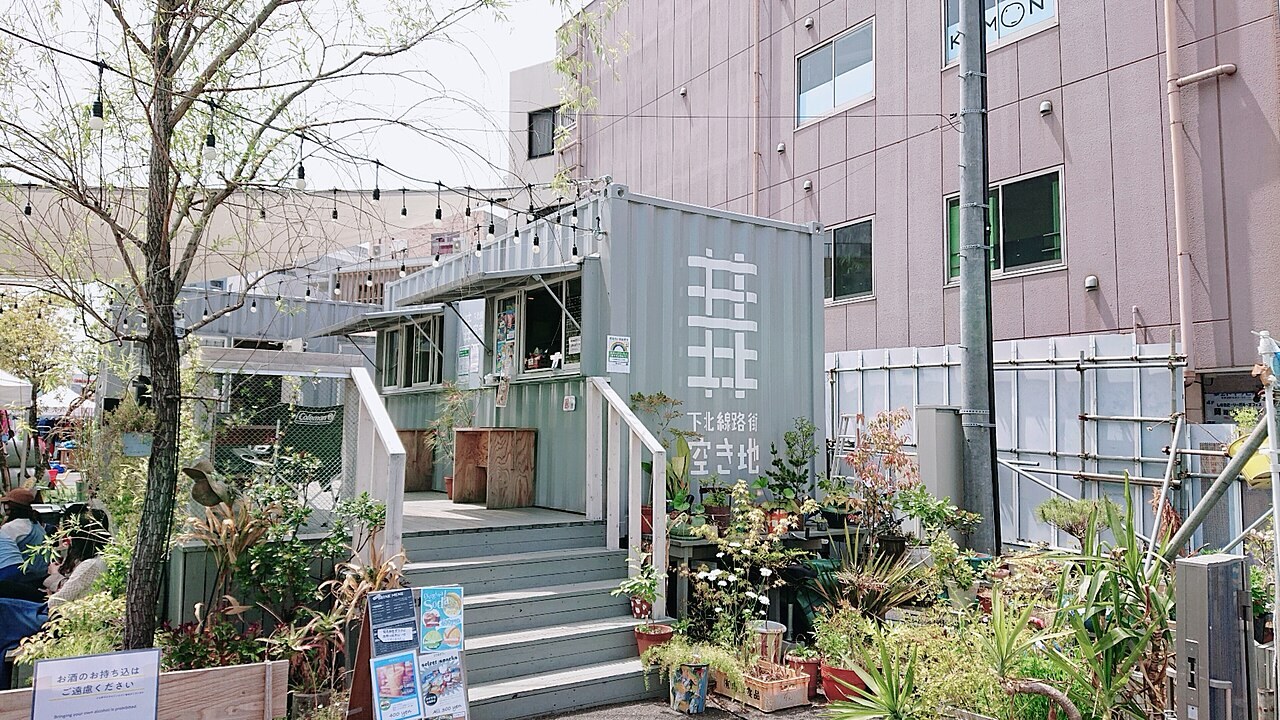
The true upside is on the surface. Roughly 1.7 km and about 27,500 m² of former right-of-way between Yoyogi-Uehara and Setagaya-Daita was converted into “Shimokita Line Street,” fully opened in 2022: the pedestrian retail street BONUS TRACK, the ryokan “Yuen Bettei Daita” drawing Hakone hot-spring water, coworking spaces, and the Tokyo University of Agriculture Open College line the corridor.
The ranking criteria shifted accordingly. Setagaya-Daita’s highest scores were not for transport but for “developing an attachment to the character of the neighborhood” (deviation 65.74), followed by “attractive library facilities” (65.08), “a sense that living here adds value to life” (64.41), and “facilities for quiet work” (64.37). Transport (64.35) ranked only fifth.
4. How did a 9,582-passenger small station place 6th?
In FY2024, Setagaya-Daita handled a daily average of 9,582 entries/exits, ranking 63rd of 70 stations on the Odakyu network. There is an obvious gap between station scale and a No. 6 metropolitan ranking.
That gap is precisely the part most valuable for investment judgment: footfall is no longer a single proxy for area quality. Modest flows avoid mega-hub congestion and over-commercialization, allowing “slow infrastructure” such as low-rise storefronts, libraries, and coworking spaces to take root.
The same pattern repeats along the Odakyu. In this ranking, Sangubashi (5th), Higashi-Kitazawa (27th), and Yoyogi-Uehara (29th) are all primarily local stops with generous pedestrian realms. Staying (滞在性) is displacing throughput (通過性) as a new source of value along the line.
Cultural layering adds resilience. The 2022 TV drama “silent” used the Setagaya-Daita station plaza and nearby cafés as main locations. In the broadcast month (November), non-commuter ridership at the station rose 22.7% versus September. Odakyu later distributed filming-location maps network-wide. A neighborhood of about 23,000 people thus entered the national conversation.
With Urbalytics’ area-comparison tools, investors can decompose this kind of “narrative-driven appreciation” back into verifiable quantities: whether per-tsubo rents are keeping pace, where whole-building cap rates are being compressed to, and which per-tsubo price percentiles nearby comps occupy.
Conclusion: Livability is not the same as yield
Setagaya-Daita’s leap is a model of public–private collaboration: Odakyu ceded surface space; the Tokyo Metropolitan Government and Setagaya Ward delivered supporting works; history and culture then grew organically. For urban planners, it shows that trillion-yen-grade grade-separation projects pay off beyond shaving minutes off commutes.
For investors, weigh both opportunity and risk:
First, the opportunity lies in structural scarcity. Few stations can repurpose former right-of-way; undergrounding demands massive capital and more than two decades. This kind of “surface-space dividend” cannot be replicated easily and thus offers a durable moat.
Second, the risk is that prices have already moved. A median whole-building cap rate of just 4.19% implies the livability narrative is well priced; meanwhile, rent-side upside still contains small-sample noise, with the 2025 Q4 n=2 datapoint especially unfit to read as a trend.
Third, the risk also lies in the durability of the rating itself. Even the source acknowledges it is unclear whether this jump is a one-off media effect or the result of surface space embedding into daily life. If it is the former, rents will be the first to feel pressure as heat fades.
Risk warning Infrastructure upgrades and commercial clustering can raise rents and crowd out original residents (gentrification). Setagaya-Daita currently balances new and old with a low-rise, chain-free retail mix and historic sites such as Daita Hachimangū, but this balance is not institutionally guaranteed. If commercialization accelerates, “quietness” as a core selling point may be eroded by its own success.
For cross-border investors, the right approach is not to chase rankings, but to treat them as demand-side leading indicators and then use transaction and rent data to infer whether prices are already overextended. To verify a station area’s per-tsubo rent and whole-building cap-rate percentiles, Urbalytics can pull the sample details directly.
#SetagayaDaita #Shimokitazawa #SetagayaCity #OdakyuLine #TokyoRealEstate #住み続けたい街ランキング #ShimokitaLineStreet #QuadrupleTracking #WholeBuildingIncome #GrossYield #TokyoRentalMarket #JapanRealEstateInvestment #AreaAnalysis #Urbalytics #Tokyo23Wards
References
- Merkmal(小西マリア),「なぜ「小田急線の各駅停車駅」が171ランクも爆上がりして6位になったのか?「住み続けたい」と評価された世田谷エリアの正体」, September 12, 2026, https://news.yahoo.co.jp/articles/19d3e845062dac58e04b67270e18cfc091588ede
- Recruit SUUMO Research Center,「SUUMO住み続けたい街ランキング2026 首都圏版」, September 1, 2026, https://www.recruit.co.jp/newsroom/
- Odakyu Electric Railway,「代々木上原〜登戸間 連続立体交差事業・複々線化事業」, https://www.odakyu.jp/
- Setagaya City,「下北沢駅周辺地区まちづくり」, https://www.city.setagaya.lg.jp/
- Ministry of Land, Infrastructure, Transport and Tourism (MLIT),「地価公示(2025年)」, https://www.land.mlit.go.jp/landPrice/
- Urbalytics internal platform data (rental apartment rent statistics; whole-building cap-rate statistics), September 2026, https://www.urbalytics.jp/