Words: 1571 | Estimated Reading Time: 8 minutes | Views: 179
The former Murakami fund group relaunched its bid at the exact same JPY 125,000 per unit as the failed previous round, betting on the gap between listed REIT discounts and private-market cap rates.
On September 25, 2026, TSE-listed Sankei Real Estate Investment Corporation (hereafter “Sankei RE”) announced it supports the tender offer (TOB) launched by City Index Fifth, an investment company affiliated with the former Murakami fund group, while leaving the decision to tender to unitholders.
The offer price is JPY 125,000 per unit, an 18.93% premium to the prior day’s close of JPY 105,100. The figure is not new: from January to May this year, Tosei and Singapore’s GIC offered the same JPY 125,000 in a TOB that ultimately failed due to insufficient tenders.
Same price, second knock. This time the buyer—and the math—have changed. For investors focused on Tokyo office and hotel assets, the question is less who wins and more how listed REITs are being repriced.
I. From Tosei to the former Murakami group: a nine‑month takeover saga
Timeline first. On January 6, 2026, Tosei and GIC, via two investment limited partnerships, announced a TOB plan; Sankei RE immediately expressed support and recommended tendering. Starting January 7, the former Murakami group steadily bought investment units in the secondary market.
The first TOB period was extended six times; by the May 18 deadline, tenders totaled 138,376 units, below the 247,563-unit minimum, and the offer failed. The former Murakami group already held about 26.12% then—becoming the blocking stake in the middle.
On August 4, the former Murakami group submitted an indication of interest, again at JPY 125,000. Sankei RE set up a special committee, asking the bidder to set a minimum tender threshold and raise price; the threshold was accepted, price unchanged. Both sides announced on September 25.
The TOB runs from September 28 to November 10, with a minimum of 118,732 units, no upper limit, and funding entirely from own capital without bank loans. If successful, the bidder plans to complete a squeeze-out (スクイーズアウト) and delist by end-February 2027.
II. Why now: the sponsor’s parent may change hands as the REIT trades at a discount
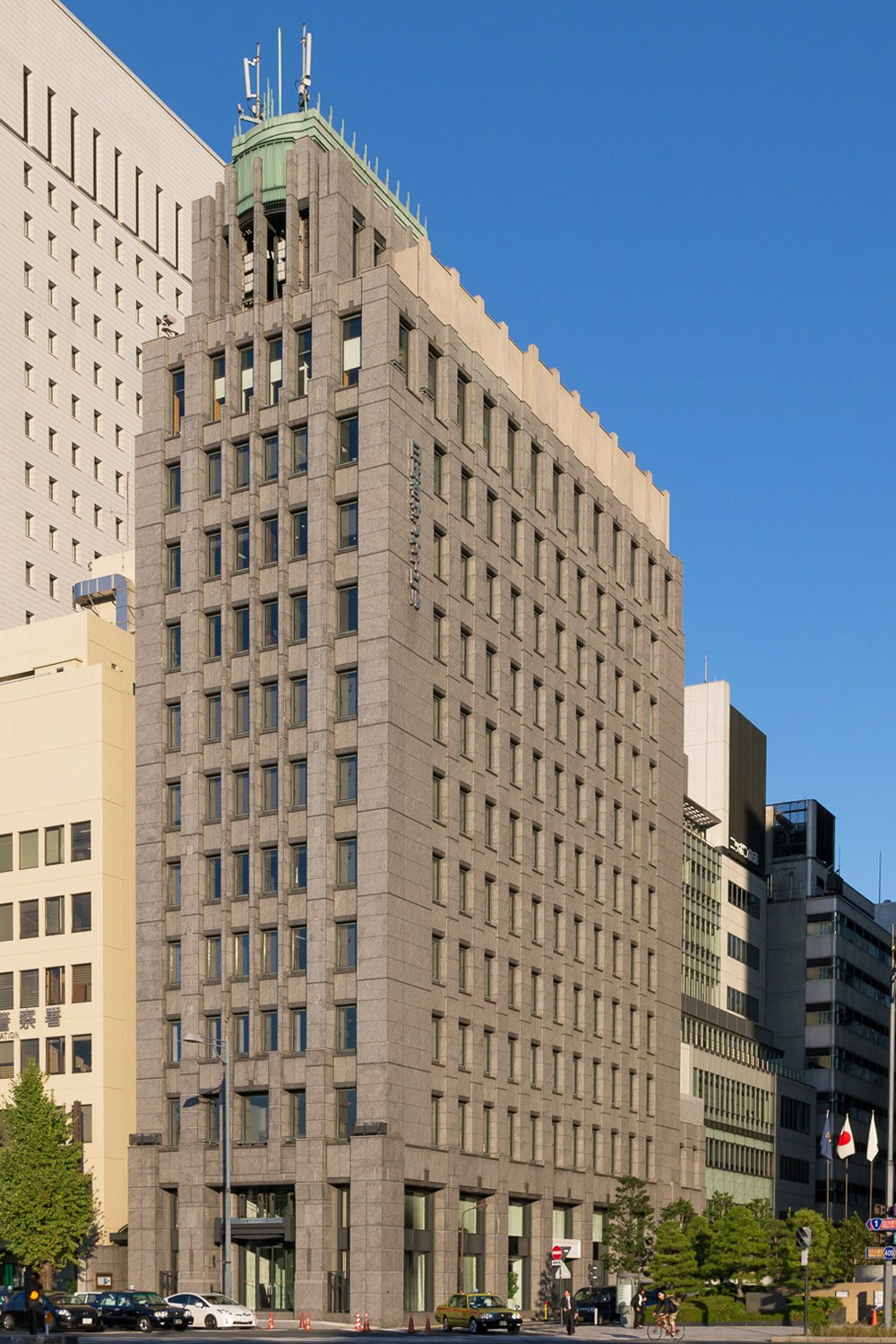
The starting point is not the REIT itself but its sponsor. Sankei RE’s sponsor is Sankei Building, whose parent is Fuji Media Holdings.
The former Murakami group began buying Fuji Media shares and engaging from January 2025. On February 3, 2026, Fuji Media announced it was studying “bringing in external capital” for its urban development and tourism businesses. Citing media reports, the TOB notice states Sankei Building has received acquisition interest exceeding JPY 1 trillion, with a buyer possibly to be decided within the year.
The group’s critique is straightforward: with the parent poised to change hands, the REIT supported Tosei’s plan without a competitive process. In their view, a new owner may value the REIT’s hotel assets; future asset buybacks or a reworked capital relationship could justify a higher price.
The market backdrop has also shifted. From the prior TOB announcement to the day before this one, the TSE REIT Index fell from 2,029.82 to 1,739.64, down about 14.3%; the 10Y JGB yield rose from 2.12% to 2.99%. Rising rates have compressed REITs’ relative appeal, pushing unit prices lower.
III. The 41% arithmetic: how this minimum threshold was set
The TOB’s most instructive element is its minimum condition. Passing a squeeze-out via unit consolidation requires two-thirds of votes cast at a unitholders’ meeting, but the bidder does not intend to buy up to two-thirds.
The bidder’s math has three steps:
First, actual voting participation at the last two unitholder meetings was about 69% and 71%. Most non-voters are retail unitholders, so the maximum participation is estimated at about 85%, implying the approval votes needed would be roughly 57% of all units.
Second, passive investors such as index funds are estimated to hold about 15.20%. They typically do not tender into TOBs but tend to vote in favor of squeeze-out resolutions.
Third, net of passive funds, the bidder would need to hold about 41% to pass the resolution; hence it set the post-TOB minimum holding at 45%, further deducting the 19.58% held by ATRA and Aya Nomura, who are not expected to tender.
Another red line is the conduit requirements (導管性要件). If the bidder tops 50% while the REIT remains listed, the REIT could lose tax-exempt treatment on distributions—imposing an additional tax burden on remaining unitholders. The 45% minimum is designed to avoid such “tender or be penalized” coercion.
IV. From the public market to the private market: Urbalytics data on the gap
On the same day, Sankei RE also announced an asset sale. The Fukuoka Green Building in Momochihama, Fukuoka—completed 30 years ago and 100% vacant after its sole tenant left—had previously booked a JPY 4.933 billion impairment and has now been sold for JPY 5.5 billion to an undisclosed Japanese buyer.
The price is above the appraisal value of JPY 4.91 billion and the book value of JPY 5.102 billion. Proceeds will be used to repay debt; LTV is expected to fall from 48.6% to 45.7%, and the distribution per unit forecast for the February 2027 period is raised from 1,093 yen to 2,071 yen.
The rub: a vacant, older office can clear the private market above appraised value, while the REIT’s own unit price trades below book NAV. Using current-period NAV per unit of JPY 114,099, the September 24 close implies a P/NAV of about 0.92x.
Using single-building income property listing data on the Urbalytics platform, we looked at station areas where Sankei RE’s Tokyo offices are located. Median listing cap rates are 3.83% in Hatchobori (n=18), 3.89% in Akasaka (n=12), and 4.13% in Kodemmacho near Nihonbashi-Honcho (n=18).
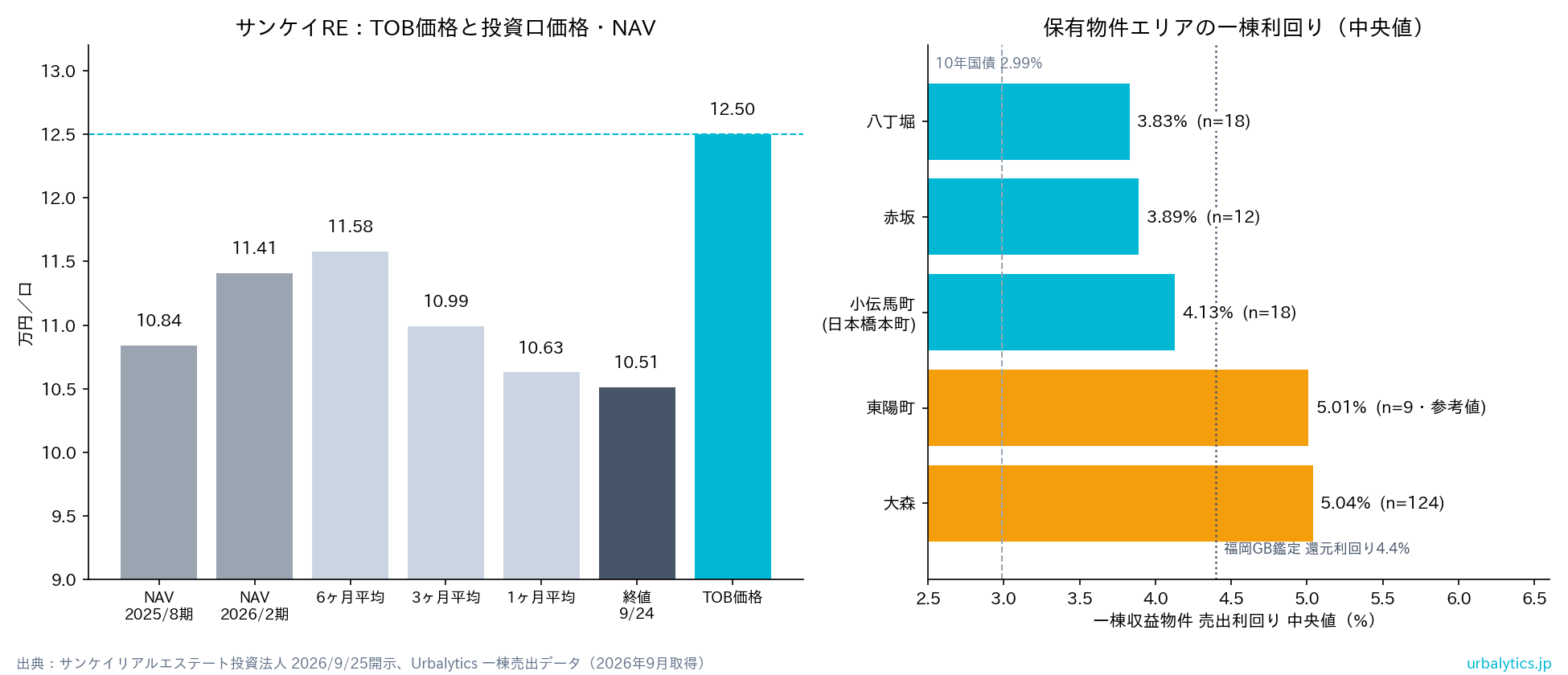
Urbalytics Insight Median listing cap rates in the three central areas are around 4%, below the Fukuoka building’s 4.4% appraisal cap rate. Private-market pricing has not fallen 14% the way the REIT index has.
Of course, these samples are mainly small to mid-size single buildings and not fully comparable to the REIT’s institutional-grade offices—better suited to gauging direction. In east Tokyo, Toyocho is 5.01% (n=9, ref only), and Omori in Ota Ward is 5.04% (n=124). Inter-area cap-rate spreads are also evident; see Urbalytics [Chuo Ward single-building income property market report](https://www.urbalytics.jp/market/area/tokyo/chuo-ku/building) for detailed distributions.
V. How investors should read this transaction
For remaining unitholders, this is a choice: JPY 125,000 is about 9.6% above current-period NAV, and third-party valuations by Mizuho Securities cap out below the offer price; but it is only 7.95% above the past six-month average, so investors who bought higher during the previous round may be unsatisfied.
More important is to understand the bidder’s plan post-control. The notice lists three options: merging with other listed REITs or private funds; selling assets one by one to third parties; and negotiating with Sankei Building’s new owner over the disposition of hotels and other assets.
This suggests the REIT’s “portfolio-level discount” could be realized piece by piece at “private-market prices.” For individual investors targeting single-building deals in Tokyo, such piecemeal disposals often bring a wave of institutional-grade supply and push transaction prices for central Tokyo offices and hotels toward more transparent ranges.
Risk warning The deal could still shift: a higher counter-TOB or failure of the unit consolidation resolution could delay the delisting timeline; further rate increases could also depress private-market sale prices.
In retrospect, this nine-month tug-of-war is fundamentally a pricing question in a rising-rate cycle: the public market has discounted REITs; the private market has not. Who captures the spread should become clear in the coming months.
Until then, rather than just watching TOB notices, use Urbalytics’ station-area cap rates and the [Minato Ward single-building income property market report](https://www.urbalytics.jp/market/area/tokyo/minato-ku/building) to benchmark what your assets are worth in the private market.
#SankeiREIT #FormerMurakamiFund #TenderOffer #TOB #JREIT #REITPrivatization #TokyoOffice #JapanHotelInvestment #NAVDiscount #ConduitRequirements #JapanRealEstateInvestment #TokyoSingleBuilding #CapRates #FujiMedia #Urbalytics
References
- Reuters (via Yahoo! News), “Sankei RE expresses support for TOB by former Murakami fund group”, 2026, https://news.yahoo.co.jp/articles/d11041d5a0cdb319199a4e068148d9b39c1d2289
- Sankei Real Estate Investment Corporation, “Notice regarding statement of support and neutral opinion on tendering for the tender offer by City Index Fifth Co., Ltd.”, 2026, https://www.s-reit.co.jp/file/news-d7c064fb3ac865a729940e8480530774a5e8122e.pdf
- Sankei Real Estate Investment Corporation, “Notice regarding commencement of tender offer by City Index Fifth Co., Ltd.”, 2026, https://www.s-reit.co.jp/file/news-ce1d222e1508ed7c78361561d57fef0f19efca97.pdf
- Sankei Real Estate Investment Corporation, “Notice regarding revisions to operating results and distribution forecasts for the fiscal periods ending August 2026 and February 2027”, 2026, https://www.s-reit.co.jp/file/news-6a3354103cae2a0221e786cc67adf84d22692040.pdf
- Sankei Real Estate Investment Corporation, “Notice regarding transfer of domestic real estate trust beneficiary interests (Fukuoka Green Building)”, 2026, https://www.s-reit.co.jp/file/news-0aeb3c9fc75e4c1825ee6e1d135df8b8a5448d19.pdf
- M&A Online, “Sankei Real Estate Investment Corporation (2972) to accept TOB by City Index Fifth and go private”, 2026, https://maonline.jp/news/20260925f
- Newsweek Japan (Reuters), “Tosei’s TOB for Sankei RE fails as tenders fall short of minimum threshold”, 2026, https://www.newsweekjapan.jp/articles/-/322885?display=b
- Nikkei Real Estate Market Information, “TOB for Sankei REIT fails; listing to continue”, 2026, https://nfm.nikkeibp.co.jp/atcl/news/21/00001/08195/
- Toyo Keizai Online, “Fuji Media vs the former Murakami group: the real estate tug-of-war continues”, 2026, https://toyokeizai.net/articles/-/933933?display=b
- Urbalytics Market Report, Chuo Ward, Single-building income properties, 2026, https://www.urbalytics.jp/market/area/tokyo/chuo-ku/building
- Urbalytics Market Report, Minato Ward, Single-building income properties, 2026, https://www.urbalytics.jp/market/area/tokyo/minato-ku/building
Copyright: This article is original content by the author. Please do not reproduce, copy, or quote without permission. For usage requests, please contact the author or this site.