Words: 1643 | Estimated Reading Time: 9 minutes | Views: 21
In Tokyo and the three neighboring prefectures, more than half of owners have already raised rents, but what truly widens the return gap isn’t location—it’s whether someone is actively monitoring rents.
Owners who have run entire-building rentals (ittō chintai) in Japan for twenty years have likely never discussed 'rent increases' as frequently as in the past two years. A survey of 1,000 whole-building owners across Tokyo and the three prefectures, released by Teikoku Real Estate on July 29, 2026, turned that sentiment into a clear number: 56.7% of owners actually raised rents over the last two years. A majority—within a market where rents have been sticky for three decades—is structural news in itself.
Yet after reading the survey line by line and cross-checking against Urbalytics internal data, we found something more investment-relevant than 'the rent-hike wave is here': the places where rents can be raised and the owners who actually captured those increases are not the same cohort.
Inflation has handed pricing power back to owners
To understand this round of rent increases, start with the macro base. In its July 2026 Outlook for Economic Activity and Prices, the Bank of Japan stated that core CPI (excluding fresh food) is expected, from the second half of FY2026, to stabilize at levels clearly above 2%. Once inflation becomes a fact rather than a policy target, rents—long-sticky nominal prices—are almost bound to be repriced.
This macro pressure is showing up as rare optimism on the owner side. In the survey, 64.6% of owners said they 'clearly feel rental demand is stable'—two out of every three. The direction of capital speaks louder: 26.1% plan to 'continue repairs and renovations', 8.9% are 'considering redevelopment', and 4.6% are 'considering additional acquisitions'—in total, nearly 40% of owners are in expansion or reinforcement mode.
Cross-border investors should take note. Rental operations in Japan have long been framed as a 'shrinking business': declining population, rising vacancies, rents that only go down. But this survey depicts Greater Tokyo as a market where owners are willing to keep investing.
From 73% to 44%: a rent-raising hierarchy within Greater Tokyo
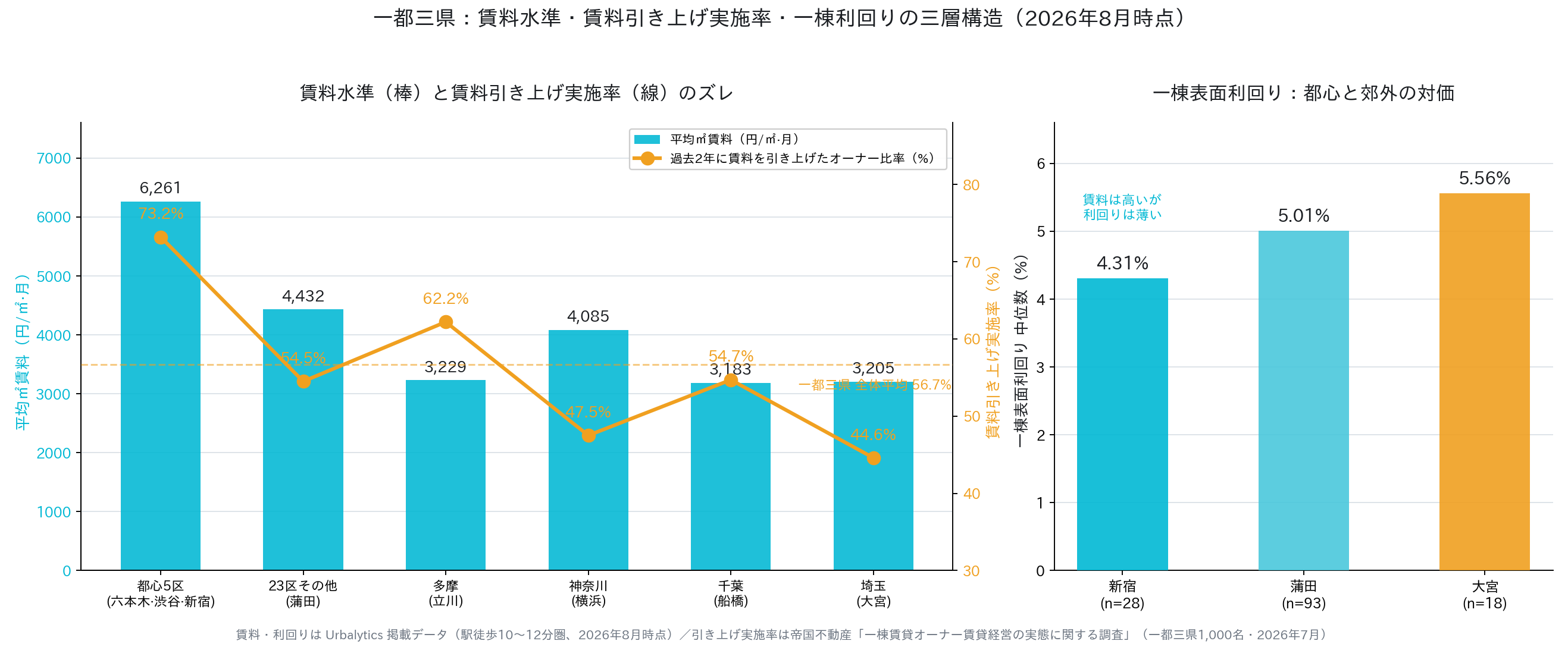
The real signal sits in the regional breakdown. In Tokyo’s Core 5 Wards (Chiyoda, Chuo, Minato, Shibuya, Shinjuku), the rent-hike implementation rate reached a high 73.2%, and within that, 23.2% of owners raised rents by more than 10% in one go—the highest 'large increase' share among all areas.
Moving outward, the gradient is clear: Tokyo’s municipalities/Tama area 62.2%, Chiba 54.7%, Tokyo’s 23 Wards (ex-Core 5) 54.5%, Kanagawa 47.5%, Saitama 44.6%. The head-to-tail spread is nearly 30 percentage points.
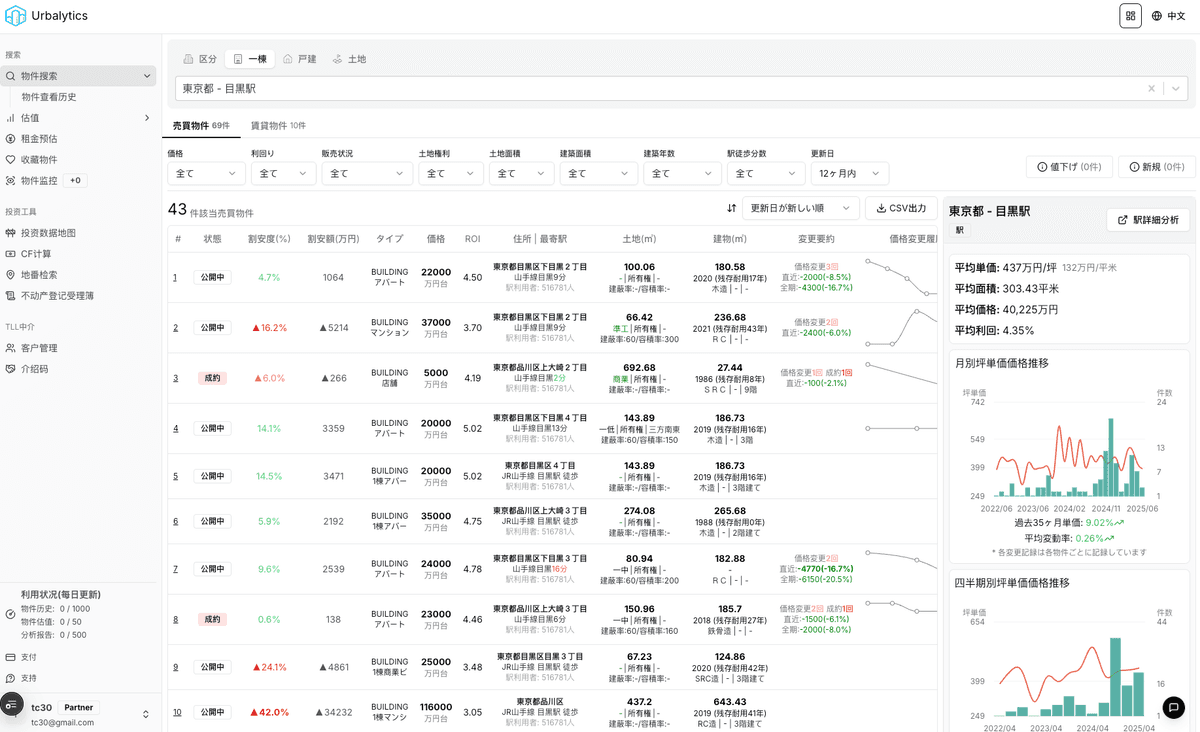
Overlaying this curve with actual asking-rent data on the Urbalytics platform yields an even more interesting picture. As of August 2026, average listed rent per sqm per month within a 10-minute walk of Roppongi Station is about ¥6,713/sqm·month, Shibuya ¥6,488, Shinjuku ¥5,582; by contrast, Omiya ¥3,205 and Funabashi ¥3,183—roughly half of the core. In general, higher rent levels align with higher implementation rates—which fits intuition.
But there is a notable divergence: the Tama area’s absolute rent level is not high (around Tachikawa Station it’s ~¥3,229/sqm·month, comparable to Omiya and Funabashi), yet its implementation rate reaches 62.2%, surpassing Chiba and the outer 23 Wards. Lower rent levels do not necessarily mean limited room to raise rents; conversely, submarkets where rents are already expensive do not automatically have headroom for the next round of increases. The market has long conflated these two ideas.
Urbalytics Insight The value of Urbalytics internal data lies precisely at these intersections: a survey tells you 'what share of owners raised rents', but only real listing and transaction samples can tell you 'whether there’s still a ceiling at this price point'. By juxtaposing the sqm price distribution in rent_stats with regional rent-hike intent, investors can distinguish where demand-driven genuine repricing is happening versus where rents are merely catching up from previously suppressed levels.
The real watershed: who is watching rents
If the regional stratification is the survey’s surface conclusion, the next set of numbers is its sharpest edge.
Among owners who actually raised rents (valid sample 563), the share reporting returns 'improved' was 32.1%, while 'deteriorated' was 18.1%. Among owners who answered 'not sure / left entirely to the manager' (valid sample 40), only 7.5% reported 'improved', while 'deteriorated' was 25.0%. In effect, owners who actively review rents were about 4.3x as likely to see improvement as those who let go; and on deterioration, the hands-off cohort’s probability was roughly 1.4x higher.
The surveyor specifically notes this gap is independent of the size of the rent hike—it’s not 'raise more, earn more'; it’s that 'watching rents as an ongoing practice' itself correlates with improved returns. This squares with another data point: the share answering 'I leave rent negotiations entirely to the property manager' is only 3.6% in the Core 5 Wards and 4.5% in the rest of the 23 Wards—the lowest across regions. The core’s high rent-hike rate likely reflects not only location, but also operating intensity.
Structurally, there’s another layer. Urbalytics data show median gross yield (hyōmen rimawari) for whole-building income assets is about 4.31% around Shinjuku Station, 5.01% around Kamata, and 5.56% around Omiya. Entry prices in the core have already discounted future rent growth, leaving investors with thin current yield; in the suburbs it’s the opposite—current yields are higher, but the certainty of rent increases is visibly lower.
Put differently, core assets deliver via rent growth; suburban assets deliver via current gross yield. This survey reveals that the former is not automatic—it depends on owners’ ongoing rent-management actions.

Risk note Note that the whole-building yields cited are medians from August 2026 listings; in the Omiya catchment there are only 18 samples and in Shinjuku 28—sample sizes are thin; treat as reference values. In addition, there is one anomalous listing price in the Shinjuku sample that would severely bias the arithmetic average, so we report medians throughout. Cross-border remote owners should pay special attention: headline listing yields and actual net yields are separated by vacancies, management fees, and reserve for repairs.
Fixed-term leases: 76.4% awareness, 58.7% intent to adopt—stuck between 'knowing' and 'using'
So why have more than 40% of owners still not raised rents? The survey points not to demand, but to contract form.
Asked 'Why weren’t you able to raise rents as intended?', the top answer was 'Because it’s an ordinary lease (futsu shakka keiyaku), it’s hard to ask for an increase at renewal', at 35.8%; next was 'Worried the tenant will move out, couldn’t make the call', at 30.0%. Japan’s ordinary lease grants strong tenant protections—landlords need 'just cause' to refuse renewal, which in practice is close to impossible. By contrast, a fixed-term lease (teiki shakka keiyaku) naturally terminates at the end of the agreed term; renewal happens only by mutual consent, creating a natural point for rent negotiations.
Owners are not unfamiliar with this tool: total awareness is 76.4% ('know well' 35.5% + 'know the outline' 40.9%), and total intent to adopt is 58.7%. But crossing the answers reveals two real frictions:
First, owners generally worry fixed-term leases will depress asking rents—26.8% believe rents would 'decline slightly' at lease-up and 12.2% 'decline significantly', totaling 39.0%, whereas only 8.8% think they 'make increases easier'. In other words, many view fixed-term leases as flexibility purchased with a rent discount, rather than as a pricing tool.
Second, the more someone is constrained by contract form, the keener they are to use it—among owners who cited 'ordinary lease' as an obstacle (n=358), intent to adopt reaches 77.9%; among those who cited 'fear of tenant move-outs' (n=300) it’s an even higher 82.0%, both well above the overall 58.7%.
Awareness and intent to adopt are almost linearly correlated: among owners who 'know well' about fixed-term leases, 78.3% are positive; among those who 'don’t know', that share falls to just 9.2%. This is a classic information-gap problem, not a yield problem.
Conclusion: this rent upswing will not be realized evenly
Taken together, these three layers of data show an uneven recovery in Greater Tokyo’s rental market in 2H 2026. Inflation provides a uniform macro rationale; regions provide differentiated ceilings; and owners’ operating actions determine how much of those ceilings get captured.
For long-term holders, this shifts the focus of due diligence. Location and building fundamentals remain necessary, but answers to 'Where do current rents sit within the submarket’s distribution?', 'Does the contract form create the next repricing window?', and 'Has anyone actually moved rents in the past two years?' may matter more for your five-year realized return than the headline gross yield figure.
Commenting on the survey, Teikoku Real Estate president Keiki Kimoto said that 'selection precision across submarkets' increasingly determines rental management outcomes. We would add: Submarket sets the ceiling; operations set the realization rate.
If you’re evaluating a whole-building income asset in Greater Tokyo, start with Urbalytics’ rent-vs.-yield comparison tool: place the asset’s current rent back into the actual distribution of its trade area—often, the headroom for increases hides in that percentile gap.
#TokyoRents #IttōChintai #Core5Wards #FixedTermLease #OrdinaryLease #GreaterTokyo #RentalOperations #GrossYield #JapanRealEstateInvestment #RentIncrease #TeikokuRealEstateSurvey #Urbalytics #IncomeProperty #AssetManagement #BOJInflation
References
- Kenbiya, '56.7% of owners raised rents; in Tokyo’s Core 5 Wards it exceeds 70% [What a 1,000-owner survey reveals about rental management]', August 26, 2026, https://www.kenbiya.com/ar/ns/research/chintai_market/10452.html
- Teikoku Real Estate Co., Ltd., 'Survey on the actual state of rental management among whole-building (ittō chintai) owners' (Greater Tokyo; valid responses: 1,000), released July 29, 2026
- Bank of Japan, 'Outlook for Economic Activity and Prices (July 2026)', 2026, https://www.boj.or.jp/mopo/outlook/
- Urbalytics, Rent statistics and whole-building yield statistics (10–12 minute walk zones, as of August 2026), https://www.urbalytics.jp/