Words: 1531 | Estimated Reading Time: 8 minutes | Views: 32
As most stations along the Yamanote Line have already been re-rated, Otsuka now has a clear anchor for reassessment for the first time thanks to the timetable for a 41-story redevelopment.
For many investors, Otsuka’s first impression is a “blink-and-you-miss-it” stop on the Yamanote Line. It lacks Shibuya’s buzz and Shinagawa’s scale, and has long been considered low-profile even within the loop.
In August 2026, Toshima Ward announced the urban redevelopment plan for the Otsuka Station South Exit area—a 41-story mixed-use tower to rise around Minami-Otsuka 3-49. This is a data point worth re-running the numbers for.
From the prewar “No. 1 high street of northern Tokyo” to a low-key Yamanote stop
Otsuka’s current understatement is really a historical mismatch. Before the war, it was the liveliest high street in northern Tokyo, lined with Shirakiya department store, yose vaudeville theaters, and fruit parlors.
It also hosted a geisha-entertainment quarter—sangyochi (licensed teahouse/restaurant/geisha district), which made Otsuka unique in northern Tokyo. Traces of teahouses where geisha could be called still remain near the South Exit today.
War changed its fate. The late Pacific War air raids on northern Tokyo turned the area from Ikebukuro to Otsuka to ashes—34,000 houses were completely burned and more than 160,000 people were affected, leaving swathes of scorched earth.
Postwar land readjustment led by the Reconstruction Agency reorganized blocks but left many contiguous row (rento-shiki) buildings. Large clusters of these older structures still remain around the South Exit.
The issue isn’t age so much as overly complex rights structures. A single building can involve multiple rights holders, stalling demolition/rebuild agreements for years. This is the most direct technical reason Otsuka has “stood still” on the Yamanote Line.
Meanwhile, the South Exit retains two practical deficits: insufficient temporary evacuation space in disasters, and the shopping street’s incomplete pedestrian–vehicle separation. Both are starting points for this round of redevelopment.
The station kept improving, but the data tell a different story
Purely at the station level, Otsuka has steadily improved over the past decade-plus. In 2009, the station building was rebuilt with a north–south free passage; in 2013, JR East’s station retail facility “atrevie Otsuka” opened.
In 2017 the South Exit plaza was renewed; in 2021, the ironowa hiro ba plaza opened at the North Exit, with surrounding road upgrades, wider sidewalks, and barrier-free access. Nighttime LED lighting has boosted footfall to the north side.
Transport connectivity is already strong: Otsuka is 11 minutes to Shinjuku, 14 to Ueno, 18 to Shibuya, and 21 to Tokyo Station—direct via the Yamanote Line—and within walking distance of Ikebukuro and Higashi-Ikebukuro.
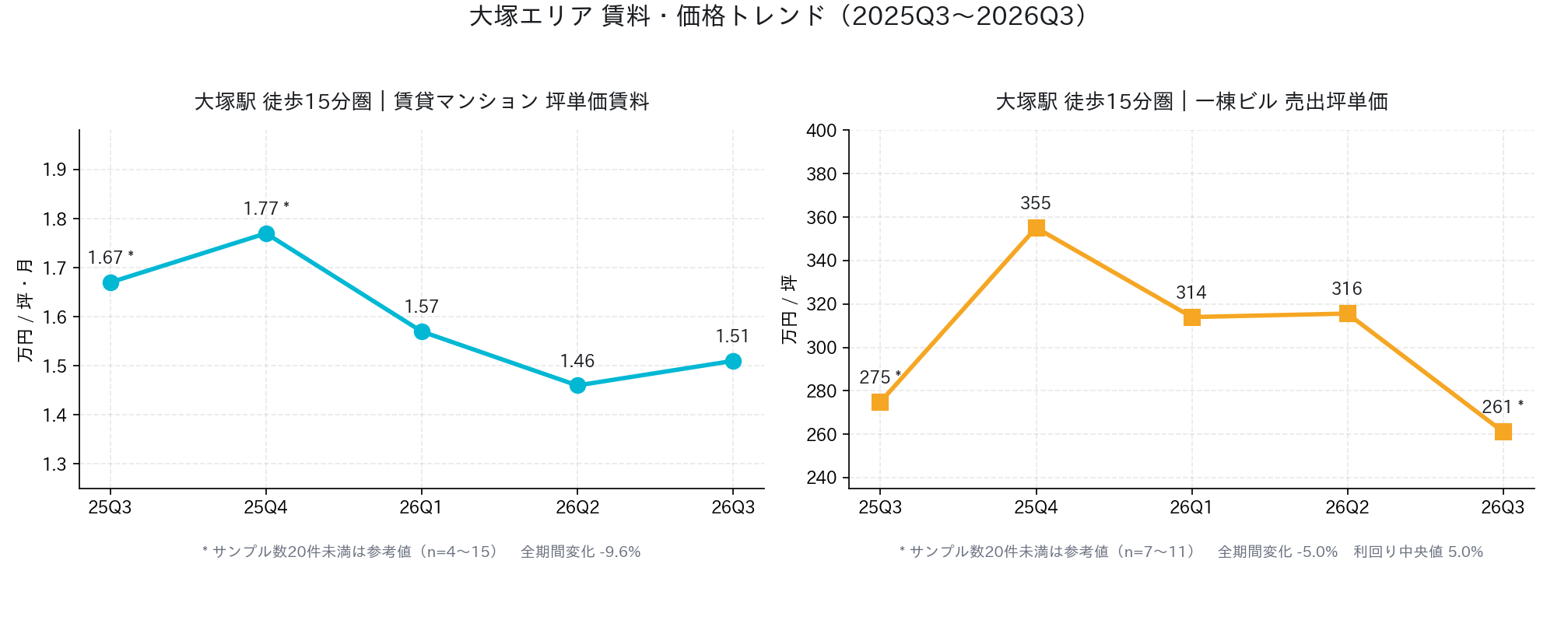
Zooming into rental and sales data, the picture is less linear. Urbalytics shows 499 rental apartment samples within a 15-minute walk of Otsuka Station, with average asking rent of JPY 142,100, average size of 31.76 sqm, and a rent per tsubo of about JPY 15,100.
From 2025 Q3 to 2026 Q3, that per-tsubo rent declined by roughly 9.6%. Note that the first two quarters had only 4 and 15 samples respectively, so they are merely indicative.
After 2026, samples rose above 200, and the JPY 14,600–15,100 per tsubo range is the credible current level. In other words, Otsuka’s rental side has not kept pace with broad market optimism on the Yamanote Line.
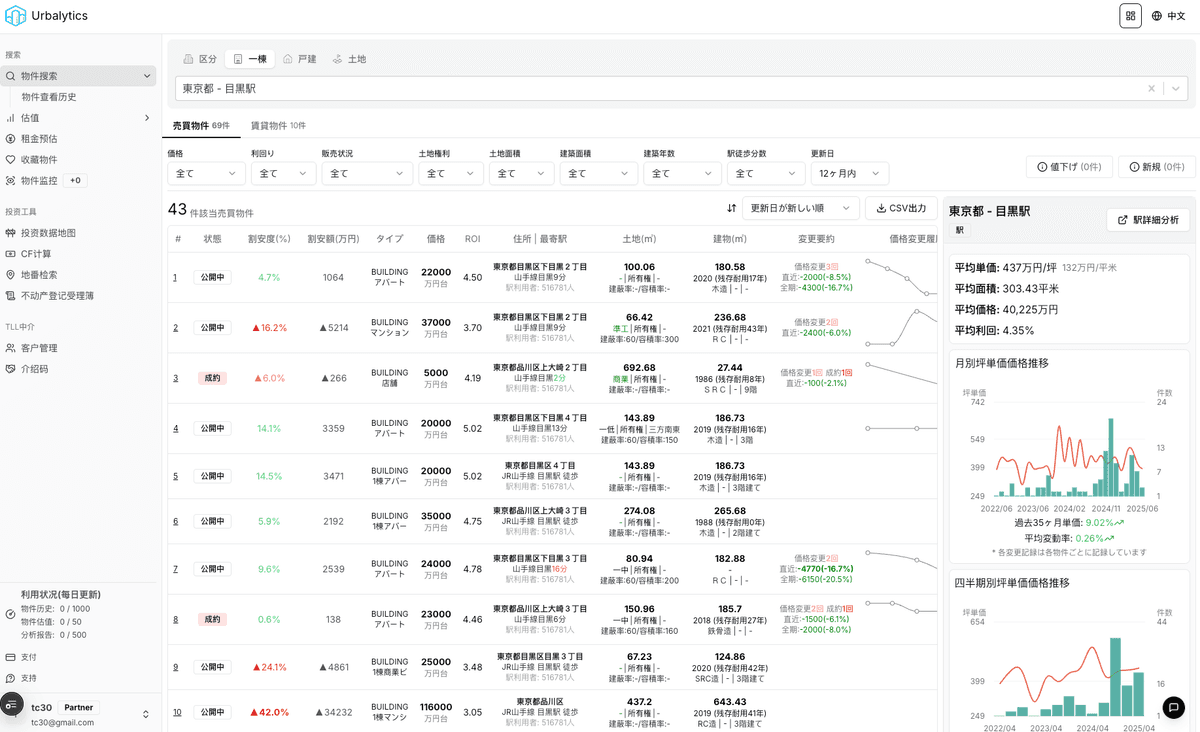
The whole-building side also bears watching. Across 61 for-sale samples, the median gross yield is 5.0%, with an average list price of JPY 241 million. Achieved price per tsubo fell from JPY 3.55 million in 2025 Q4 to around JPY 2.61 million recently.
This pullback needs proper context. The change over the full period is about -5.0%, paced more like “post-peak froth coming off” than a structural downtrend—2026 Q3 had only 11 samples, magnifying volatility.
For whole-building buyers, the real signal is the 5.0% median line: Otsuka is neither a core 3-ward market with yields compressed into the 3% range, nor has it slid to the northern periphery with 5.5%+ levels.
Urbalytics Insight The value of Urbalytics’ internal data lies in traceable sample definitions. Otsuka’s average yield once showed 13.27%, but breaking down samples revealed a single input anomaly (price JPY 140 million vs annual income JPY 669 million) skewing the mean. Excluding it, the 5.0% median is the true level—which is why we prioritize medians over averages for area assessments.
41 stories, 0.5 hectares, and two developers
What truly puts Otsuka on a re-rating path is the South Exit urban redevelopment. The “Otsuka Station South Exit Redevelopment Preparatory Association” is targeting FY2027 approval to establish the association, with multiple rightsholder-led briefings already held.
The plan is sizable. The redevelopment tower will rise 41 stories, with for-sale condominiums on the mid- to upper floors and shops, life-support functions, and public facilities below. The implementation area is about 0.5 hectares.
The zoning supports the height—the site is in a Commercial Zone with 80% building coverage and floor-area ratios of 500% and 700%. Inside the Yamanote Line, such FAR combinations are scarce.
The project partners speak to scale: Tokyo Tatemono and Sumitomo Realty & Development. Tokyo Tatemono has track record nearby with Hareza Ikebukuro (former ward office site) and Brillia Tower Ikebukuro; Sumitomo has recently been notable for aggressive expansion of rental holdings.
Toshima Ward’s place-making policy goes beyond plazas and pedestrian networks to explicitly preserve Tenso Shrine and the streetscape along the Toden Arakawa Line (Tokyo Sakura Tram). Tenso Shrine dates to the Kamakura period and is the general guardian of the old Sugamo village area.
The timeline gives investors a calculable window: demolition around 2029; completion in FY2032 or later. With six-plus years to physical delivery, this is precisely the gap between price expectations and actual supply.
The 41-story height has a supply-side meaning as well. Existing for-sale condos around Otsuka are mostly small to mid-scale. One high-rise tower will, for the first time, introduce a landmark asset with brand premium to this station.
Landmarks influence more than their own pricing. They reset the area’s price ceiling and lift appraisal baselines for surrounding resale stock—mirroring the post-redevelopment paths at Jujo, Oji, and other northern Tokyo stations.
What is this timing spread worth?
From an investment angle, this redevelopment tackles three legacy items at once—disaster resilience, circulation, and district image—precisely the issues the South Exit failed to resolve over the past three decades.
More importantly, consider today’s pricing. On local comps, land within a 15-minute walk of Otsuka Station asks JPY 3.0–6.0 million per tsubo, with second-hand detached houses starting around JPY 80–90 million.
Second-hand studios (one-room units) have ample supply from the JPY 10 million range. Along the Yamanote Line, that is conspicuously low.
In other words, investors today are not buying a realized redevelopment premium, but a timing spread backed by a public urban plan that has yet to be fully priced. Such opportunities are uncommon along the Yamanote Line.
On exits (exit strategy), this timing spread offers two optional windows. First, around FY2027 when association establishment approval is granted—planning certainty steps up, and the market typically prices a first leg. Second, around FY2032 completion—physical delivery and district image materialize. The former monetizes certainty; the latter, realized place strength. Holding periods and financing structures differ accordingly.
But the flip side is equally clear:
First, there is timeline risk in execution. The preparatory association has yet to obtain establishment approval; rights conversion and owner agreements are ongoing. This area is a row-house district with complex rights that has historically slowed rebuilds, so delays are not a low-probability event.
Second, near-term rental signals are soft. Per-tsubo rents fell nearly 10% in a year; though 2026 Q3 ticked back to JPY 15,100, it remains below 2025 levels. Cash flow during hold may not track asset-price expectations.
Risk warning Completion is only after FY2032, while per-tsubo rents remain in a correction band. Underwriting a weak cash-flow hold on redevelopment hopes is the most common mistake in this kind of “timing arbitrage” trade. Underwrite to current rents, not future forecasts; treat redevelopment as upside optionality, not a base case.
Conclusion
Otsuka is distinctive in combining a Yamanote Line transport backbone, pricing clearly below the line’s average, and a 41-story redevelopment already in the urban-planning pipeline. These three rarely coincide at one station.
But it is not a market to buy with eyes closed. The key judgment is distinguishing what is already priced for redevelopment from what is not.
That requires placing per-tsubo pricing, median yields, and actual transaction samples on the same timeline. Investors wishing to validate can pull Otsuka-area rent and yield distributions directly on Urbalytics.
#OtsukaStation #ToshimaWard #TokyoRedevelopment #YamanoteLine #JapanRealEstate #TokyoInvestment #Redevelopment #WholeBuildingInvestment #GrossYield #TokyoTatemono #SumitomoRealty #ResaleCondominium #Urbalytics #Tokyo23Wards #TimingArbitrage
References
- Kenbiya, “How will Otsuka change with the Otsuka Station South Exit redevelopment in Toshima Ward, Tokyo? Walking the area that once had northern Tokyo’s busiest high street and a thriving geisha quarter,” August 22, 2026, https://www.kenbiya.com/ar/ns/region/tokyo/10425.html
- Toshima Ward Urban Planning Information (Otsuka Station South Exit District Urban Redevelopment Plan), 2026, https://www.city.toshima.lg.jp/
- Urbalytics internal platform data (rent_stats / building_cap_rate_stats, retrieved August 22, 2026)