Words: 1639 | Estimated Reading Time: 9 minutes | Views: 192
Tsukiji is no longer just the “former fish market site.” Two redevelopment schemes have both crossed the execution threshold, shifting it from a sightseeing stop to Chuo Ward’s new office-and-residential hub.
On July 29, 2026, a low-key administrative approval landed at Tsukiji 2-chome in Chuo Ward, Tokyo— the Tokyo Metropolitan Governor approved the Rights Conversion Plan (権利変換計画) for the “Tsukiji 2-chome District Type-1 Urban Redevelopment Project.” On the same day, the Minister of Land, Infrastructure, Transport and Tourism recognized its Private Urban Renaissance Project Plan (民間都市再生事業計画).
For most people, that’s two lines of news. For investors holding or considering Chuo Ward assets, it marks the day Tsukiji slipped from “planned” into a “construction countdown.” Next door, the giant project on the former Tsukiji Market site—total project cost around JPY 900 billion—is advancing on the same timeline.
1) From fish market to district: what exactly changed in Tsukiji
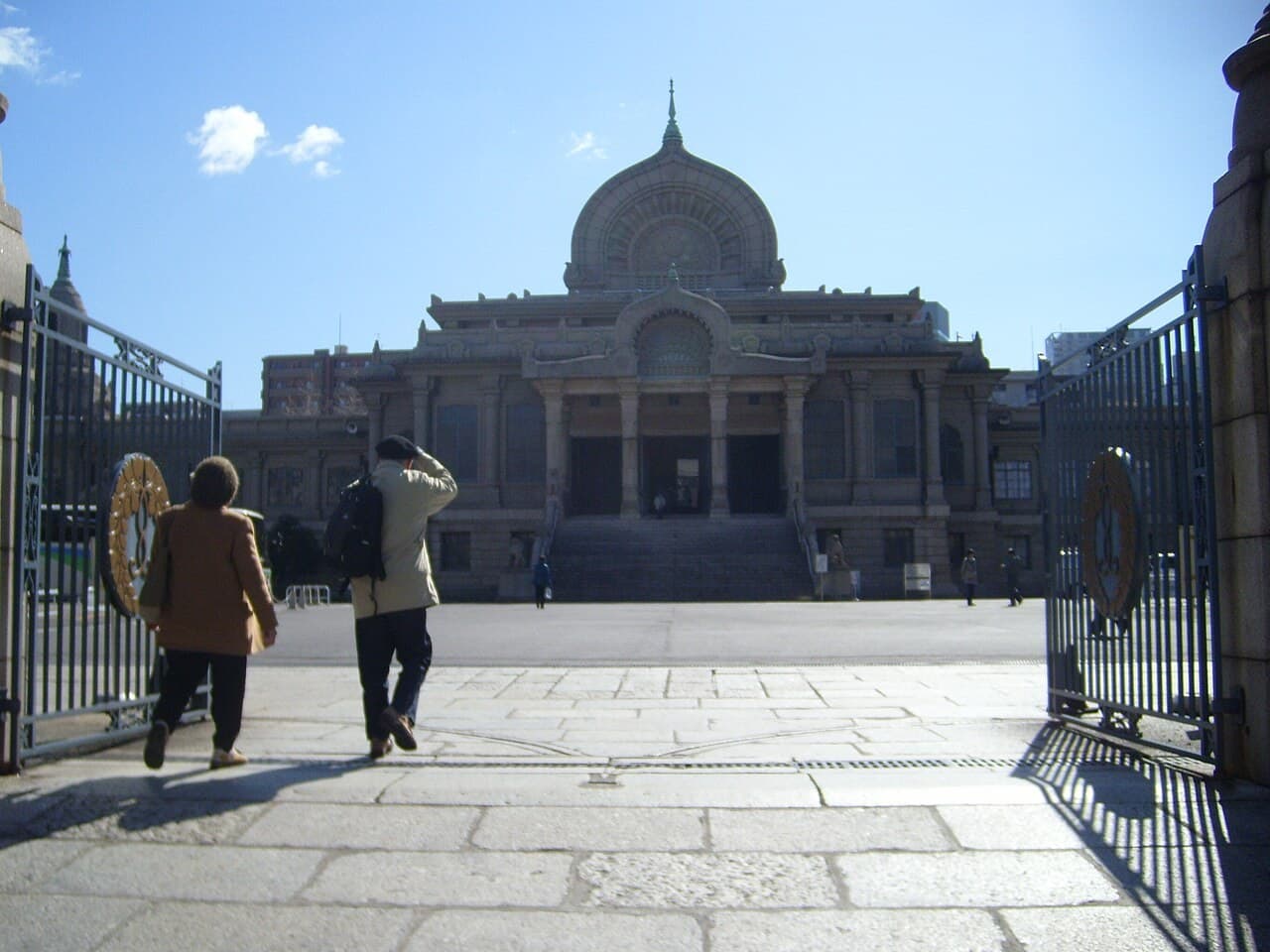
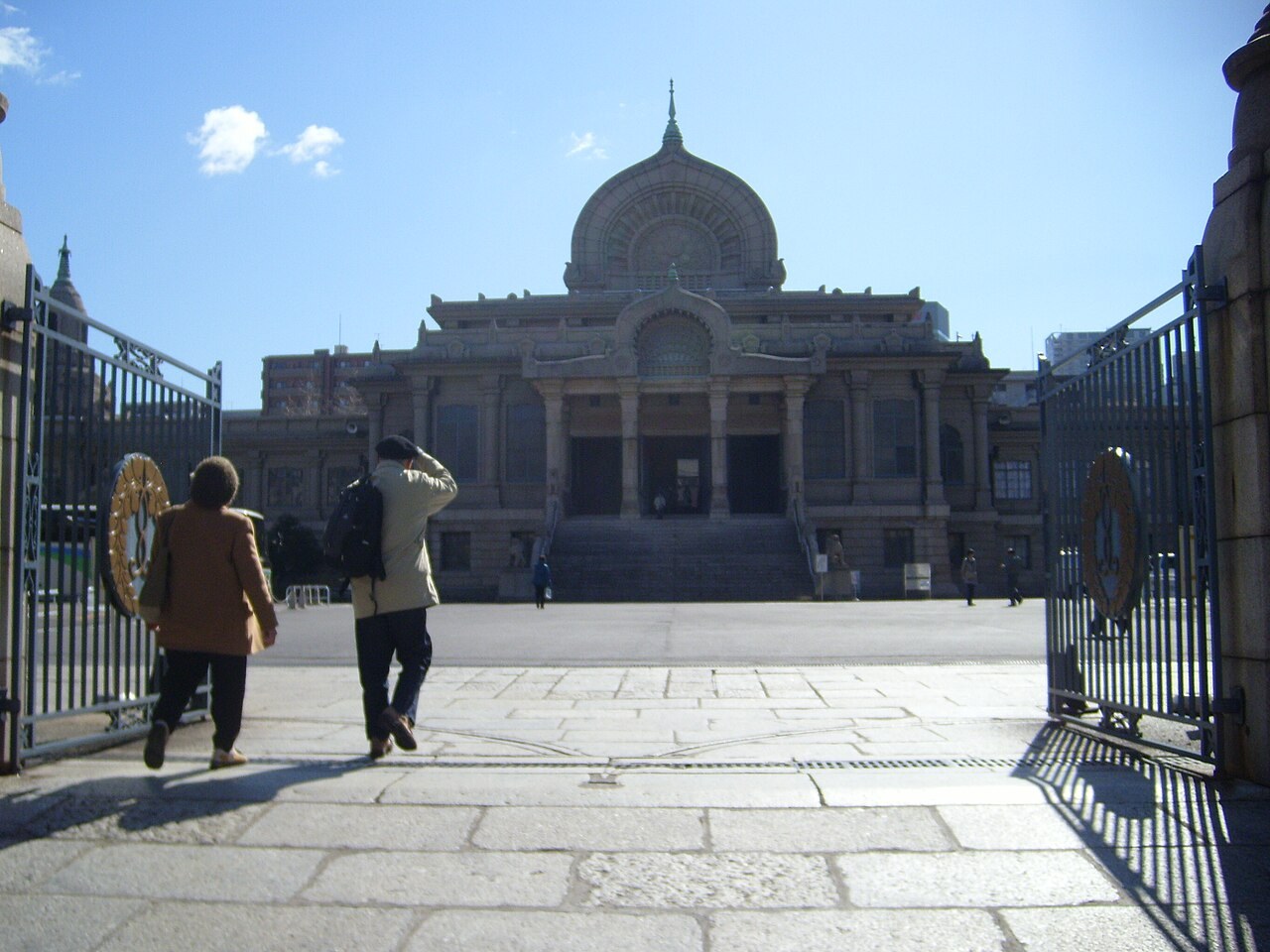
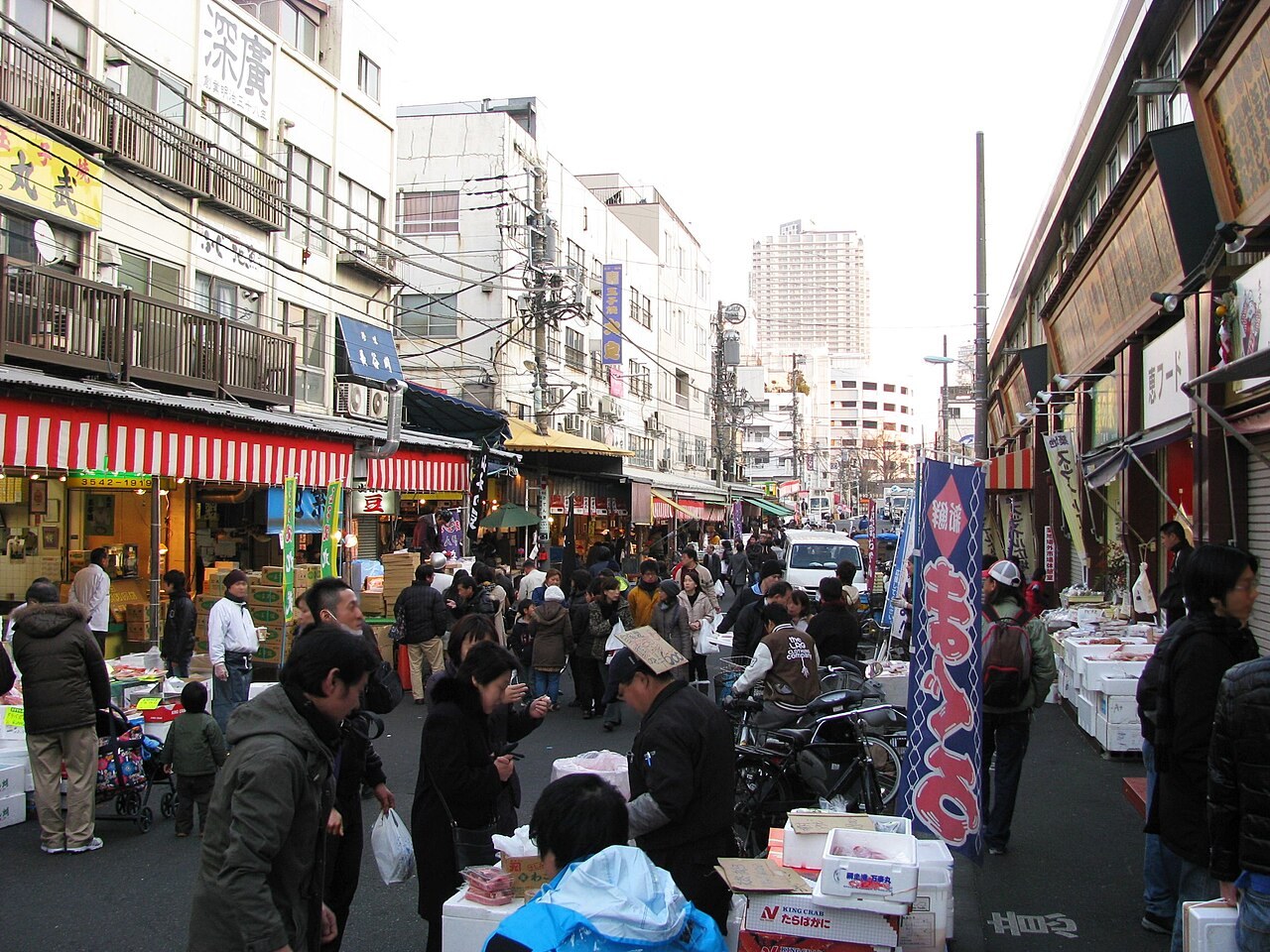
To grasp the weight of this approval, start with Tsukiji’s identity shift. When the Toyosu Market opened in 2018, Tsukiji’s wholesale function moved out, leaving the Outer Market’s visitor flows, the Tsukiji Hongwanji as a religious and cultural landmark, and a vast swath of metropolitan-owned land awaiting a new definition.
The real changes these past years are not about tourism, but land values. In the 2026 official land price release, the standard point in Tsukiji 5-chome (Chuo 5-10) printed JPY 3.55 million/m², up about 9.2% from 2025’s JPY 3.25 million; in Tsukiji 4-chome, Chuo 5-42 reached JPY 5.29 million/m².
That rise isn’t extreme for central Tokyo, but it signals this: the market no longer prices Tsukiji as an “old fish market,” but as a “core Chuo Ward location next to Ginza, one stop away on the Hibiya Line.”
What’s truly scarce is not land per se, but large, contiguous parcels that can be redeveloped. Tsukiji’s edge lies in holding a 190,000 m² metropolitan-owned tract plus several blocks that can be assembled—virtually a once-in-a-generation setup in central Tokyo.
2) What exactly was finalized: the Tsukiji 2-chome district redevelopment
The fact pattern is simple, but each node matters for investors. The implementers are Nippon Steel Kowa Real Estate and NTT Urban Development. The project area lies in part of 11-banchi, Tsukiji 2-chome, Chuo Ward, adjacent to Tokyo Metro Hibiya Line “Tsukiji” Station, with a zone area of roughly 0.6 ha.
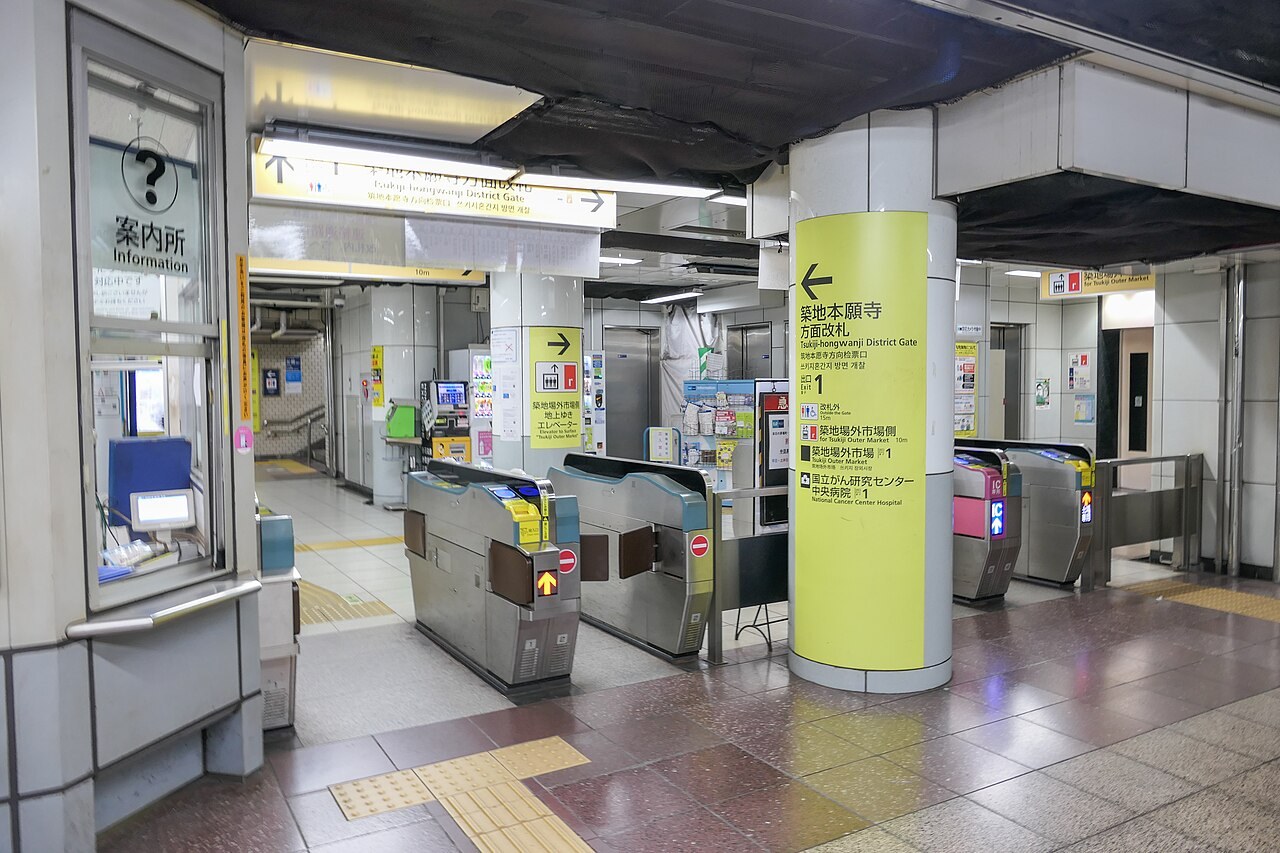
Scale-wise, the site area is about 5,050 m², total floor area about 56,300 m²; 20 stories above ground and 2 below, approx. 110 m tall, with a typical office floor of about 590 tsubo. The existing building will be demolished and replaced by a station-connected office-and-retail complex.
The timeline is clear: urban planning decision in August 2023; implementation approval in July 2024; rights conversion approval in July 2026; start of construction in February 2027, completion in November 2030.
The public-realm elements deserve their own mention. Tsukiji Station has lacked a station-front plaza; one will be newly created. The plan also covers utility pole undergrounding on Ward Road No. 675, sidewalk upgrades, and cooperation to widen sidewalks on Heisei-dori. The site will include a large community plaza and substantial greenery.
For surrounding holders, the value of this public investment often outlasts the building itself—it reshapes walkability and disaster resilience, the two foundations of long-term rent.
3) Institutional lens: why “rights conversion approval” is the real starting gun
Many investors treat the “urban planning decision” as a buy signal; that’s too early. In urban redevelopment, the pivotal milestone is the Rights Conversion Plan—it reallocates the rights of existing land/building owners into designated floors (condominium ownership) and corresponding shares in the new structure under statutory procedures.
In other words, before rights conversion approval, any “scheduled completion year” is only intent; once rights are legally swapped, the project moves from negotiation to execution, and the schedule becomes binding for the first time. That’s why implementers spotlight this node.
The same-day recognition of the Private Urban Renaissance Project Plan also matters. Under the Act on Special Measures for Urban Renaissance, it makes the project eligible for financial and tax support—in effect, an insurance policy for the funding side.
Taken together, the uncertainty premium for Tsukiji 2-chome has been getting priced out since this summer.
Nor is it alone. On the former market site, the “Tsukiji District Machizukuri Project,” led by a consortium including Mitsui Fudosan, covers roughly 190,000 m² of land, approx. 1.26 million m² of total floor area, and around JPY 900 billion in total project cost. Plans call for nine buildings, including an all-weather, multi-purpose stadium for about 50,000 people, with reports pointing to a district opening in FY2033 and partial openings from FY2029.
The two projects overlap in time, meaning Tsukiji will be both a vast construction zone and a live repricing venue for years.
4) Investor lens: do the numbers say Tsukiji is expensive now?
At the end of the day, numbers drive trades. On the Urbalytics platform, within a 10-minute walk of Tsukiji Station there are 116 lease samples for condominiums (for-sale apartments being rented out). The average monthly rent is about JPY 205,500 with an average area of 40.17 m², translating to an average unit rent of roughly JPY 16,200/tsubo·month.
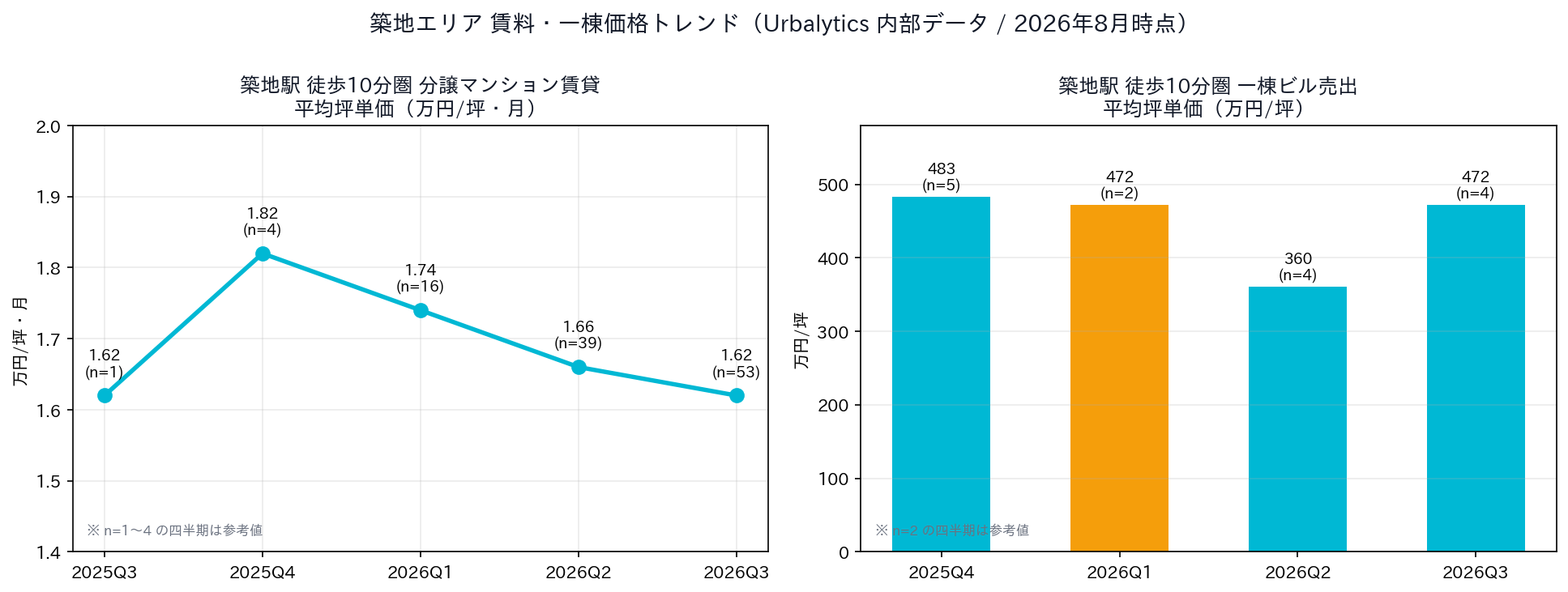
The quarterly path is the interesting bit: 17,400 JPY/tsubo·month in Q1 2026, 16,600 in Q2, 16,200 in Q3—the curve alone looks softer. But sample size jumped from 16 to 53 over the same period, indicating clear supply expansion, while unit rents only eased, not broke.
This looks more like a normal giveback after demand absorbed increased supply than a weakening in rental demand. Note that Q3 and Q4 2025 had just 1 and 4 samples—reference points only, not evidence of a “peak-to-decline.”
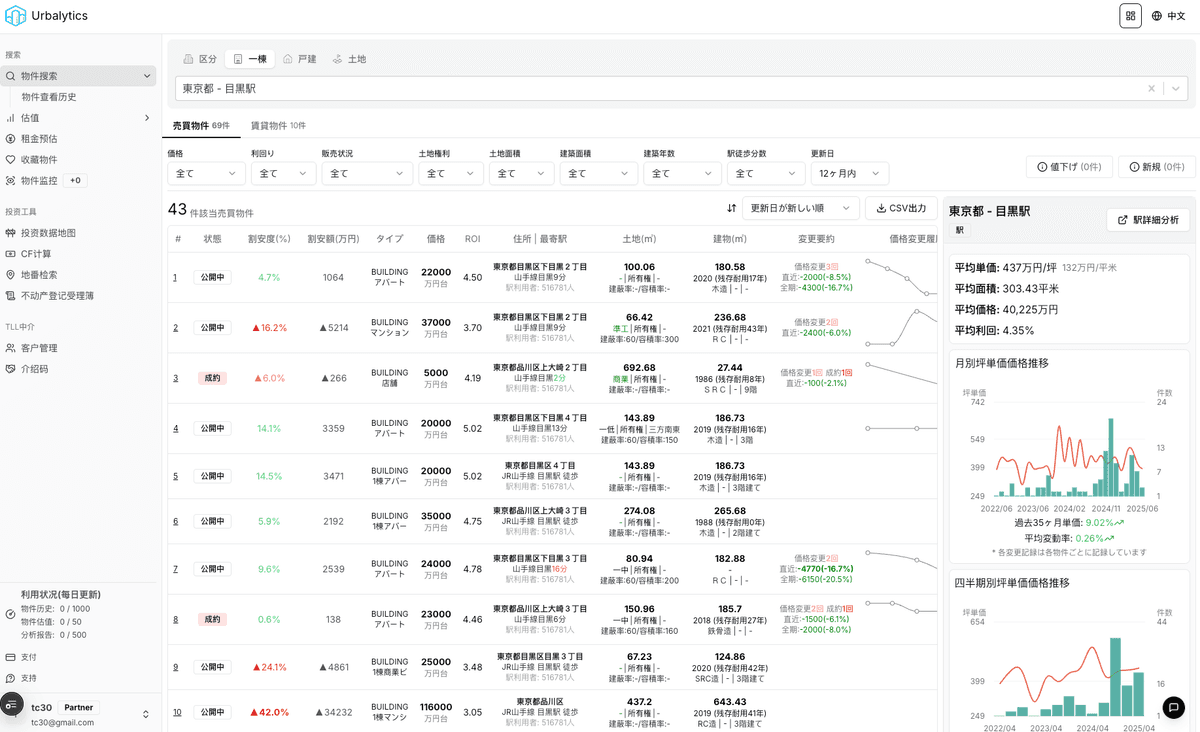
The whole-building for-sale side is far thinner. Within a 10-minute walk there are only six listings, with a median gross yield of about 3.67%, ranging from 2.30% to 8.10%, an average price around JPY 186 million, and average annual income around JPY 11.32 million.
Urbalytics Insight Placed side-by-side, rents and trades show a classic “expectations first” profile: unit rents have been in a narrow band around JPY 16,000/tsubo·month for three quarters, while the median gross yield on whole buildings has already compressed to 3.67%. In other words, prices have front-loaded the redevelopment’s future upside, while cash flows have yet to catch up. Urbalytics’ regional yield distributions and rent statistics help quantify how much of that “redevelopment premium” is already priced in, rather than relying on gut feel.
So what do these numbers mean for different buyer types? Three answers:
First, for cash flow–focused investors, a 3.67% gross yield offers almost no cushion in a rising rate environment; after operating and financing costs, net income can easily compress to near zero or negative.
Second, for long-term holders targeting asset value, Tsukiji’s logic is stronger—both redevelopments lift district quality, and such improvements typically take years after completion to be fully reflected in rents.
Third, for acquisition-and-resale operators, the true window is mid-construction: by then, certainty is well signposted, but site noise and access frictions still suppress some buyers’ psychology.
Risk note Three current risks merit attention. With only six whole-building listings, the median yield is not robust—do not treat 3.67% as a reliable area benchmark. The roughly 3 years 9 months construction period from February 2027 to November 2030, plus concurrent works on the former market site, means noise, dust, and traffic controls will weigh on near-term leasing competitiveness. And with major facilities on the former market site opening only in the early 2030s, the market has not provided a transparent read on how much of that expectation is already priced in.
Conclusion: translate “concept” into a timeline and cash flow
On the surface, this is an approval for a 110 m-tall office-retail tower; in substance, it rewrites the pricing logic for an entire district. For investors, three takeaways matter: treat rights conversion approval—not the urban planning decision—as the true starting signal; treat the nearly four-year construction period as a cost, not background noise; and break the “redevelopment story” into verifiable rent and yield data to cross-check.
Tsukiji won’t turn into a second Nihonbashi overnight, but it’s no longer a district held up solely by tourists. To see how much of the expectation is priced into the specific address you care about, use Urbalytics’ rent and yield data to run a check before you bid.
#TokyoRedevelopment #Tsukiji #ChuoWard #Tsukiji2Chome #HibiyaLine #FormerTsukijiMarketSite #JapanRealEstate #WholeBuildingInvestment #GrossYield #OfficialLandPrice #CentralTokyoOffices #JapanPropertyInvestment #UrbanRedevelopment #Urbalytics
References
- Nippon Steel Kowa Real Estate, 2026, “On the Approval of the Rights Conversion Plan for the Tsukiji 2-Chome District Type-1 Urban Redevelopment Project,” https://www.nskre.co.jp/company/news/2026/20260729.html
- NTT Urban Development, 2026, “On the Approval of the Rights Conversion Plan for the Tsukiji 2-Chome District Type-1 Urban Redevelopment Project,” https://www.nttud.co.jp/news/detail/id/n28013.html
- NTT Urban Solutions, 2026, News Release, https://www.ntt-us.com/news/2026/07/news-260729-01.html
- Kenbiya, 2026, “In November 2030, a 20-story station-connected complex will open at ‘Tsukiji’ Station; a station plaza will also be developed,” https://www.kenbiya.com/ar/ns/region/tokyo/10457.html
- Mitsui Fudosan, 2025, “Formulated the ‘Tsukiji District Machizukuri Project Basic Plan,’” https://www.mitsuifudosan.co.jp/corporate/news/2025/0822/
- BUILT (ITmedia), 2025, “‘Tsukiji Redevelopment’ to invest JPY 900 billion, building nine structures including a 50,000-seat stadium and a 210 m-tall hotel,” https://built.itmedia.co.jp/bt/articles/2509/05/news130.html
- Nikkan Kensetsu Kogyo Shimbun, 2025, “Mitsui Fudosan and others / Tsukiji District Machizukuri (Chuo Ward, Tokyo), targeting district opening in FY2033,” https://www.decn.co.jp/?p=167321
- Ginza Keizai Shimbun, 2024, “A 50,000-seat stadium to be built on the former Tsukiji Market site; redevelopment operator decided,” https://ginza.keizai.biz/headline/4261/
- Ministry of Land, Infrastructure, Transport and Tourism, 2026, Official Land Prices (Chuo 5-10 / Chuo 5-42)
- Urbalytics platform internal data (rental statistics / whole-building yield statistics), acquired August 2026, https://www.urbalytics.jp/