Words: 1795 | Estimated Reading Time: 9 minutes | Views: 93
When data centers no longer need to erect buildings, idle plots in central Tokyo that already have power service are, for the first time, able to compete head-to-head with commercial land.
A throwaway TV report that was really about land
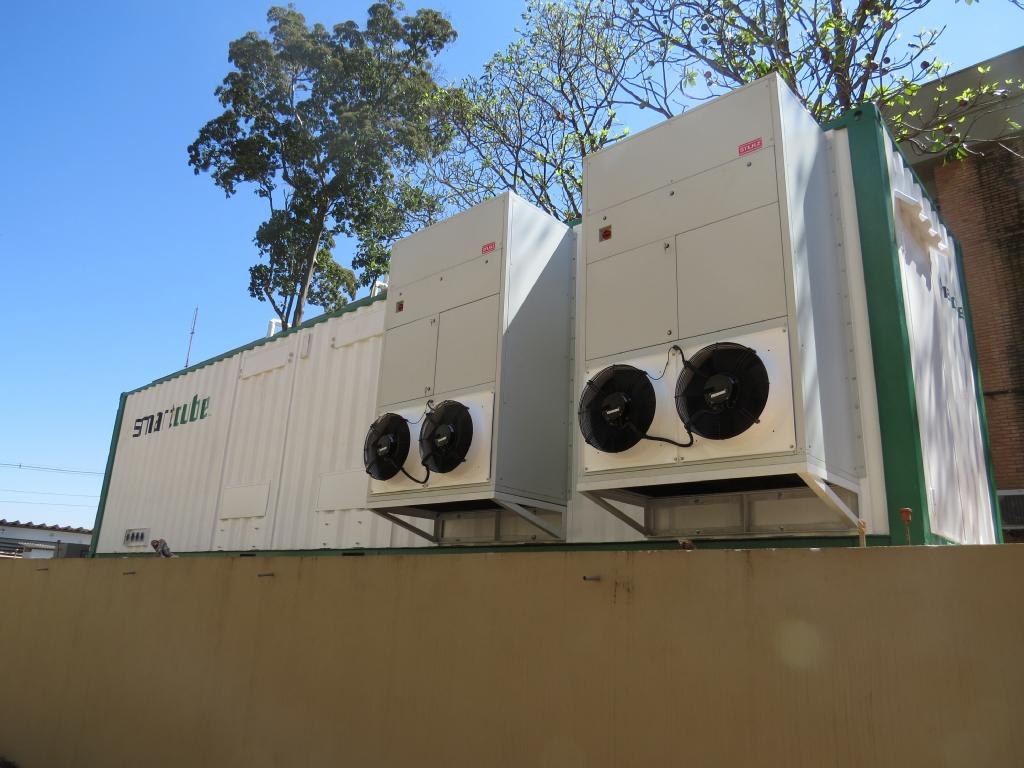
On the evening of August 27, TV Asahi aired a short, four-paragraph piece: NTT DoCoMo Business (NTTドコモビジネス) and TEPCO Power Grid (東京電力パワーグリッド) unveiled a container-type (コンテナ型) data center scheduled for installation in Tokyo’s Ota Ward. Liquid cooling, small footprint, fast delivery—it reads like a pure IT story.
But the first sentence of the report is the one worth pausing on: “Against a backdrop of soaring real-estate prices and growing difficulty securing urban land.” In other words, even the broadcaster anchored the causality in land prices—not GPUs.
This shift in lens matters. For the past three years, investors have read data centers as a story of “exurbs + cheap power” in places like Inzai, Chiba, or Ishikari, Hokkaido. This time, the demand side is explicit: we want to stay in the urban core, and we can’t find sites.
The compute surge from generative AI is forcing an industry once relegated to the outskirts back into Tokyo’s 23 wards. When conventional, building-based data centers stall because land is unavailable and approvals and construction are too slow, demand doesn’t disappear—it moves into a different container, in the literal sense.
How much is “not classified as a building” worth
To see why containerized data centers are suddenly being treated as a solution, a peer benchmark is quickest. In February, battery-maker PowerX introduced its container data center “Mega Power DC” and offered a comparison: for facilities of the same specification, a conventional building-based build, including five years of O&M monitoring, totals about JPY 2.47 billion; the containerized alternative is about JPY 1.77 billion, cutting upfront capex by roughly 25%.
The schedule gap is starker. Building-based projects typically take 4–5 years from concept to operation; a containerized deployment can be completed in about one year. In an industry where a technology generation is 18 months, this isn’t efficiency—it’s the line between feasible and not.
For real-estate professionals, the most provocative point is this: these facilities are not classified as buildings, so they require neither a building confirmation application (建築確認申請) nor real-estate registration, and they avoid large-scale construction works.
Now place that in the context of Japanese development. Floor-area ratio (FAR), zoning, slant-plane limits, daylight/shadow regulations—the variables that cap conventional development—are, to a significant extent, sidestepped by containerized schemes. Urban plots that have sat unsold due to awkward shapes, insufficient size, or inability to fully utilize statutory FAR suddenly gain an entirely new income use.
PowerX also notes that linking roughly 125 containers delivers capacity equivalent to a 25 MW hyperscale data center. In other words, this approach doesn’t require you to assemble 10,000 m² in one go—it will take that 300 m² awkward lot you already control.
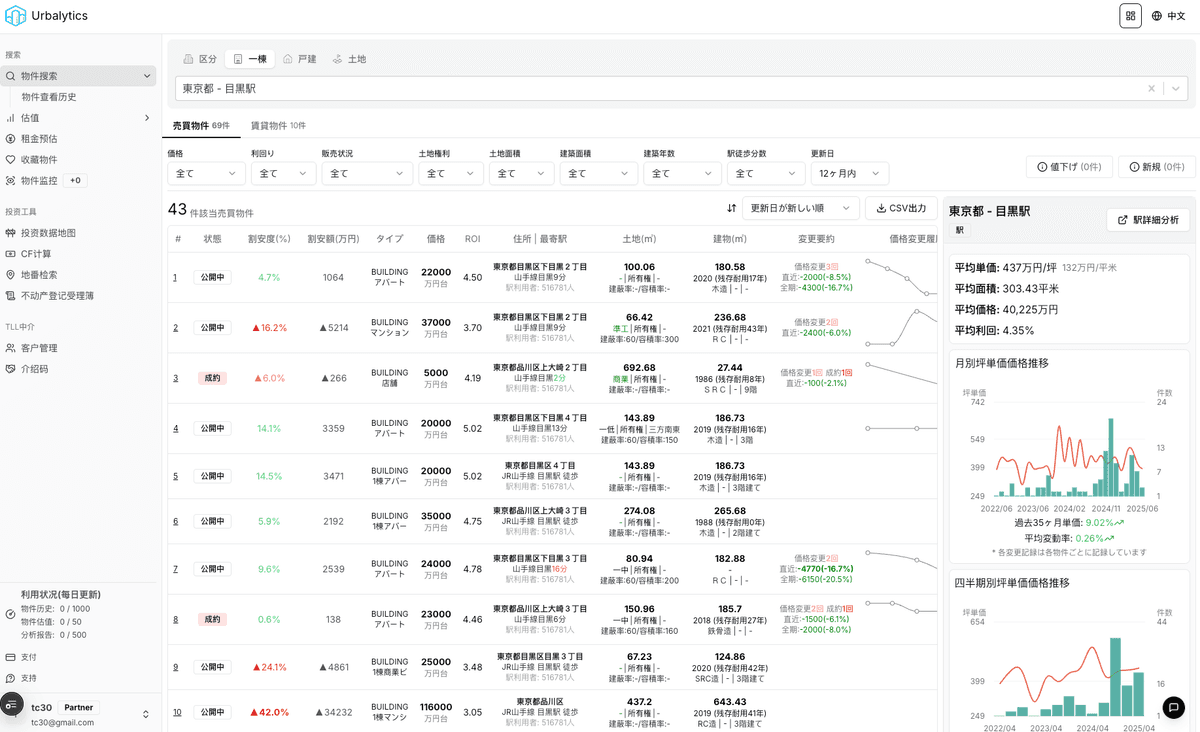
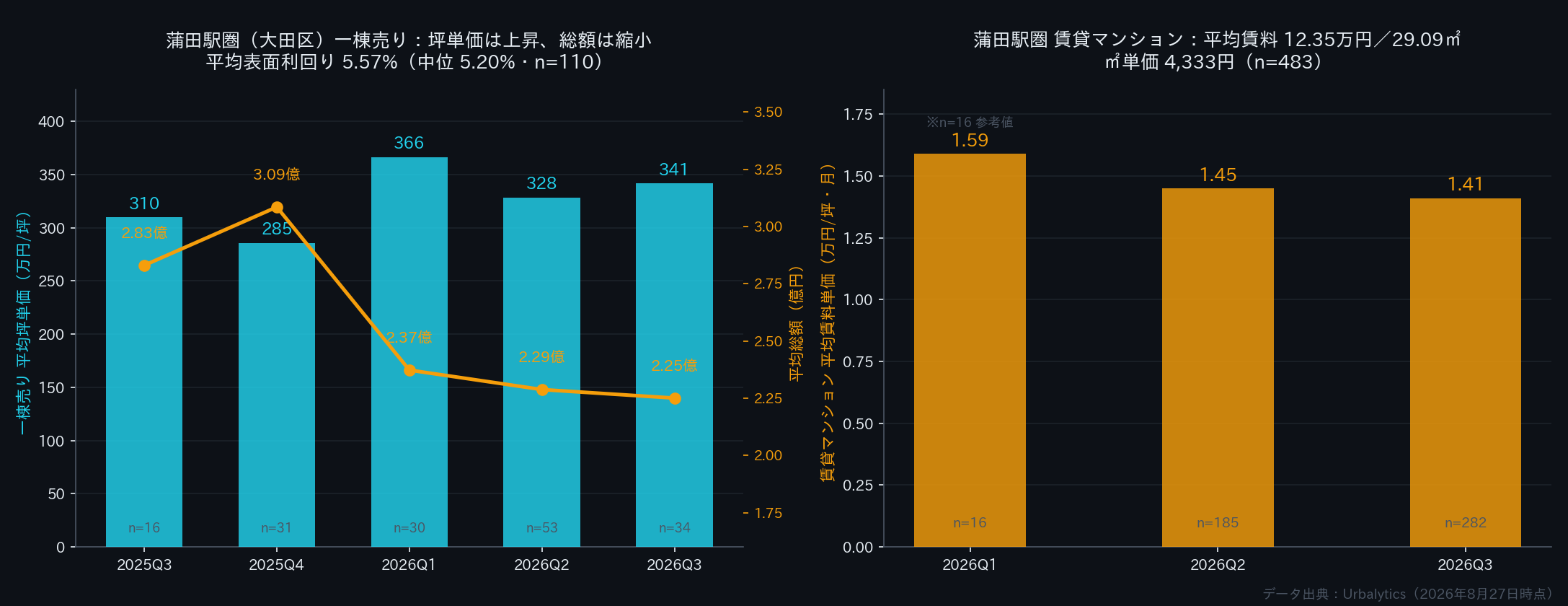
Urbalytics Insight The value of Urbalytics’ internal data lies precisely in judgments like this: public market commentary only tells you “urban land is tight,” but determining which specific plots can actually be absorbed by compute demand requires seeing land area, residual building value, power service conditions, and surrounding whole-building income yields at once. Among 110 for-sale single-building assets within a 15-minute walk of Kamata Station, the average gross yield is 5.57%, the median is 5.20%, and the average total price is about JPY 278 million—this baseline is the dividing line between “sell to traditional income investors” versus “reserve for infrastructure demand.”
Why Ota Ward, specifically
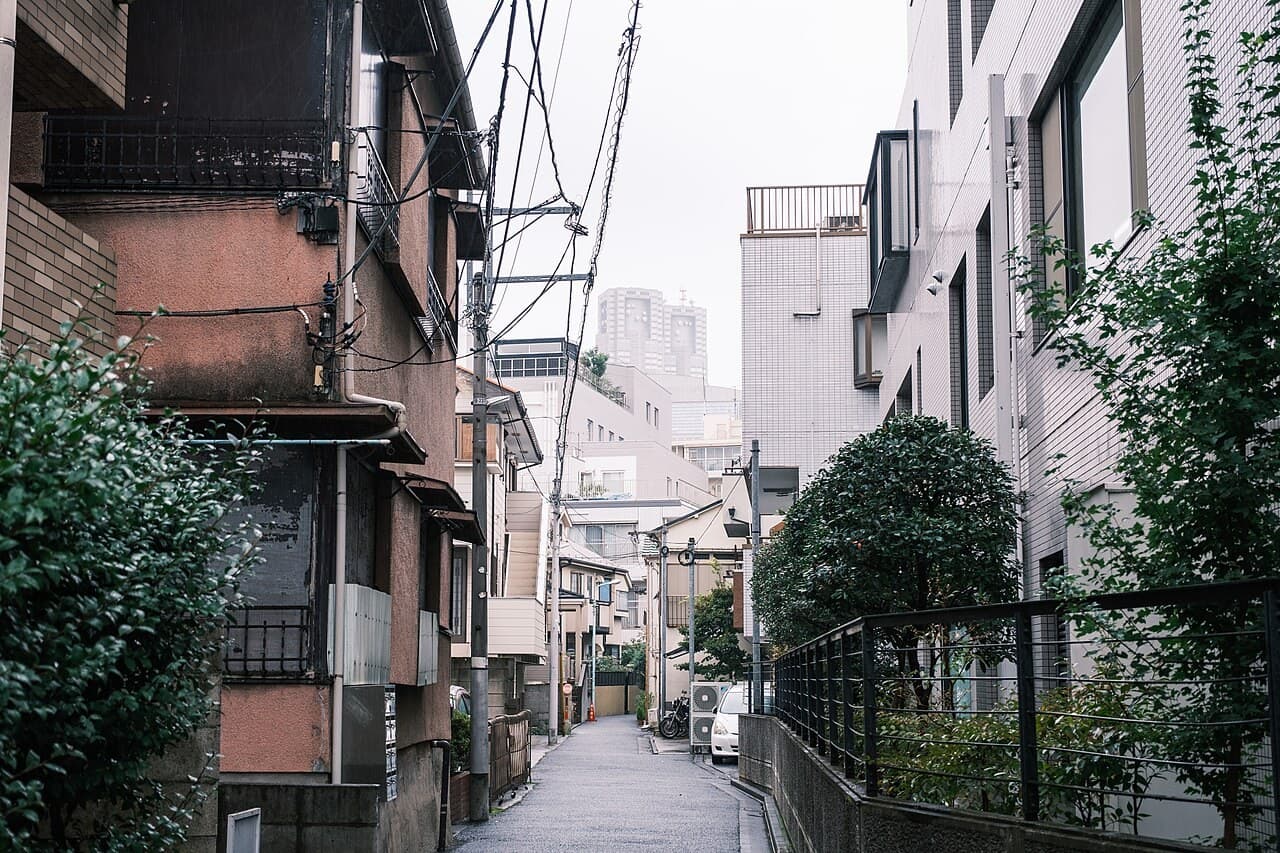
Choosing Ota Ward is no accident. It sits at the northern end of the Keihin industrial belt, with a high density of small manufacturing workshops (machikōba); Haneda Airport is within the ward; and there is a large stock of small-to-midscale sites with existing power service and a history of industrial use. Layered together, these conditions match every prerequisite for containerized data centers.
Urbalytics’ area data shows an interesting divergence. Within a 15-minute walk of Kamata Station, the average price per tsubo for single-building income assets rose over the past five quarters from JPY 3.0961 million to JPY 3.4144 million, a cumulative increase of 10.28%; over the same period, the average total price fell from JPY 283.09 million to JPY 225.07 million.
Unit prices rising while ticket sizes shrink means the market is clearing smaller and smaller assets. Buyers aren’t unwilling; under hard total-budget ceilings, they’re forced to accept smaller areas at higher unit prices.
That leaves a gap: assets with large land area but buildings so old they no longer produce income are increasingly awkward under traditional income screens. Our Urbalytics sample includes one such case—Nishi-Kamata 7-chome, Ota Ward: land 471.67 m², building 215.76 m² completed in 1963, 3 minutes on foot, asking JPY 150 million, gross yield 9.41%.
For rent-seeking investors, a 1963-vintage building is a problem to be solved. For a container operator that needs only a leveled surface, grid capacity, and ingress/egress, that old structure is inherently worth zero; the 471 m² of power-served land is the entire asset. These are two entirely different valuation frameworks bidding on the same plot.
Delivery schedules are more honest than press releases
On DoCoMo Business’s official service page, the offering is split into two delivery models, and their lead-time gap exposes the real bottleneck.
The first is “build on the customer’s own site,” with delivery from about 7 months, explicitly for clients that “own idle land with existing power service” (受電済の遊休地). The second is “colocation in a container park (コンテナパーク),” typically delivered in about 3 months, for clients that want fast access to high-performance GPUs without upfront capex.
Note the precondition for the first model: it seeks not just “land,” but “land already connected to power.” As Nikkei reported, DoCoMo Business plans to complete a containerized data center build-out across the Tokyo metro by FY2028, centered on a “container park” concept, with 2 MW receiving capacity—2 MW is not something you can casually secure in the interconnection queue.
That also explains why TEPCO Power Grid appears as a partner. In recent years, TEPCO PG has courted data centers near substations to compress construction timelines; its president this year explicitly pledged to “halve data center interconnection wait times.” The official “Watt–Bit concept” (ワット・ビット構想) speaks to the integration of power and communications.
As a result, the scarcity ranking is being rewritten: not the land, not even the location, but the grid connection capacity attached to the land.
How investors should read this signal
To be clear: this is not a “buy land and wait for a data center to take you out” trade. Containerized data centers are still small in scale; publicly disclosed urban cases are in the single digits; a 2 MW unit has near-zero direct impact on area rents. Its significance is in creating a second exit where none existed for a certain class of assets.
Following that logic, here are three practical lines to watch:
First, re-examine central-city assets with high land value proportion and low residual building value. Historically, the only exit was to demolish and rebuild an income property—but in today’s environment of elevated construction costs and labor shortages, that underwriting is hard to make work. There is now a use case that requires neither building confirmation nor reconstruction; it should be included in your evaluation.
Second, add grid connection capacity to your diligence checklist. Japanese offering materials never state “how much power this parcel can secure,” but in the compute-demand pricing stack, this may carry more weight than distance to the station. Industrial-use lineage, existing service equipment, and proximity to the nearest substation—details few tracked before—are becoming quantifiable sources of premium.
Third, focus on belt-like areas that combine “industrial legacy + urban access + robust power infrastructure,” such as Ota, Kawasaki, and Koto. Long undervalued under residential logic, these areas rank very differently under a compute logic.
Risk disclosure Keep a clear head: the current market size of container data centers is far from supporting a standalone investment theme. DoCoMo Business’s build-out target runs through FY2028, and PowerX’s mass production begins in 2027, meaning this demand line is unlikely to generate enough transaction volume to reprice areas over the next two years. In addition, the legal status of “not classified as a building” is not guaranteed forever—if installs in the urban core rise and noise or heat discharge trigger neighborhood disputes, municipal-level ordinances could readily follow. Treat it as a diligence plus, not as a buy signal.
Conclusion: compute is rewriting real-estate valuation
That container in Ota Ward isn’t remarkable on its own. What matters is the direction it points to: for the first time, the valuation of central Tokyo real estate is being materially shaped by two variables—“power” and “compute.”
We used to evaluate a plot by how tall it could be built, how much it could rent for, and how many people it could house. Now add a question—how much power can it draw, and without moving a single brick, how much computation can it host?
This won’t move market prices overnight, but it will change screening criteria first. In Japan’s less-than-transparent real-estate market, screening shifts tend to lead price shifts—and are often where excess returns are made.
If you want to sanity-check where a property you own or are evaluating sits within this overlapping old/new valuation language, use Urbalytics’ area yield and rent statistics to compare land area, building vintage, and surrounding whole-building gross yields—once the numbers are laid out, the judgment is usually clearer than you expect.
#TokyoRealEstate #OtaWard #Kamata #DataCenter #AIDataCenter #ContainerDataCenter #WholeBuildingIncomeProperty #IdleLandReuse #GridConnectionCapacity #TEPCO #NTT #GrossYield #JapanRealEstateInvestment #UrbanCoreLand #Urbalytics
Sources
- TV Asahi (ANN) / Yahoo! News, 2026, "Small AI data centers set up in central Tokyo: space-saving with advantages for site acquisition", https://news.yahoo.co.jp/articles/682e4cbeebefdd3f0a480492977e0e64db385a86
- NTT Docomo Business, 2026, "Container-type Data Center" service overview (delivery patterns and lead-time estimates), https://www.ntt.com/business/services/container-dc.html
- Nikkei, 2026, "Docomo Business to develop containerized AI data centers in the Tokyo metropolitan area by FY2028", https://www.nikkei.com/article/DGXZQOUC198WG0Z10C26A6000000/
- BUILT (ITmedia), 2026, "Data centers ‘containerized’ with battery systems, just one year to go live" (PowerX “Mega Power DC” cost and schedule comparison), https://built.itmedia.co.jp/bt/articles/2602/27/news142.html
- Nikkei, 2026, "TEPCO PG president: ‘Halving data center interconnection wait times, expanding partnerships’", https://www.nikkei.com/article/DGXZQOUC277380X20C26A3000000/
- TEPCO Power Grid, 2023, "Establishment of a new company for joint development of data centers", https://www.tepco.co.jp/pg/company/press-information/press/2023/1666668_8618.html
- Urbalytics, 2026, Kamata Station area: whole-building yield statistics and rental apartment rent statistics (retrieved August 27, 2026), https://www.urbalytics.jp/