Words: 1823 | Estimated Reading Time: 10 minutes | Views: 78
This time the target is the spread from short-term flips, not foreign status itself.
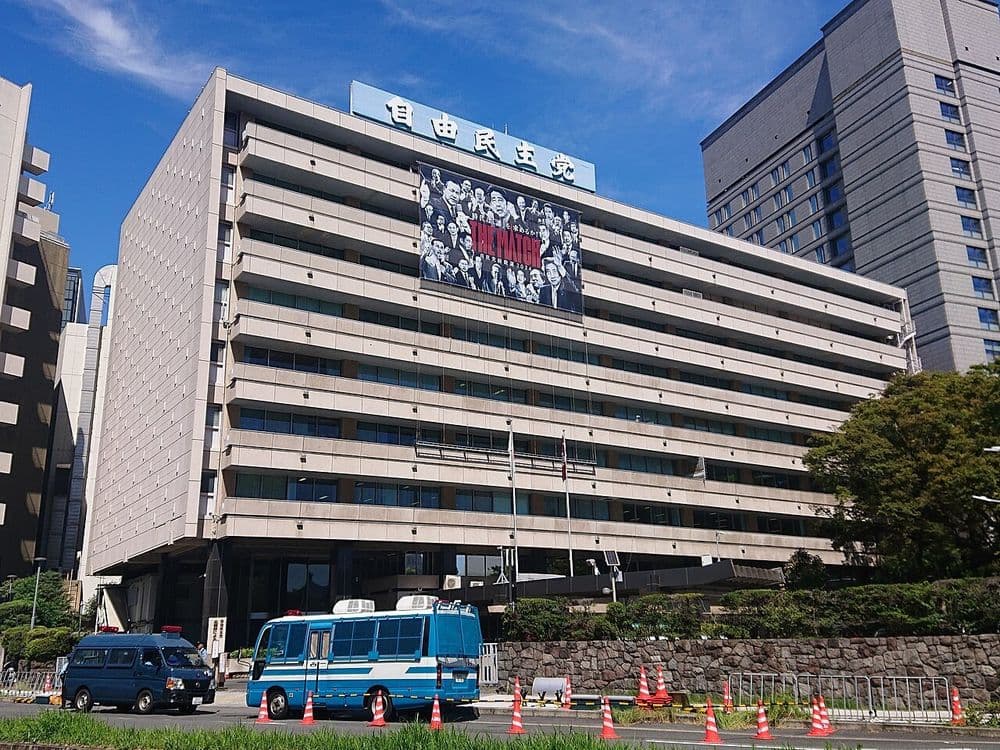
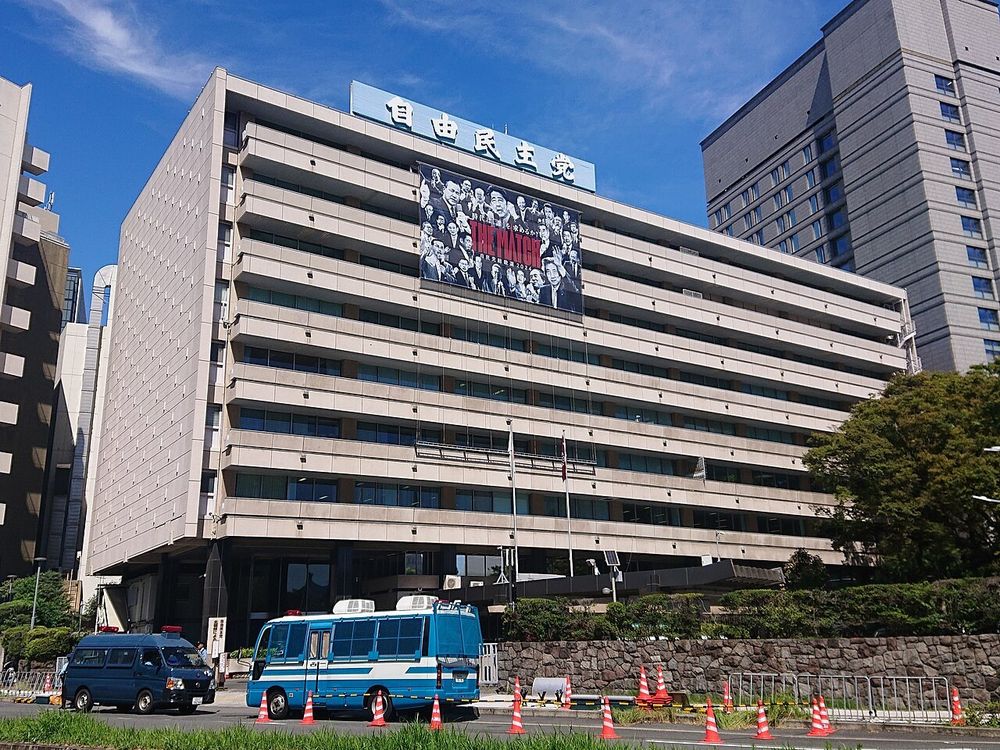
On September 24, a project team (プロジェクトチーム) under the Liberal Democratic Party's Headquarters on Policies for Foreign Nationals finalized a proposal calling for early tax measures to address surging condominium prices, which it plans to submit to the government shortly.
Its wording is worth reading line by line. The draft states clearly that speculative transactions, whether by Japanese or foreigners, should be curbed. This is not a bill targeting foreign nationality; it is a bill targeting short-term flipping behavior.
For cross-border investors who hold Japanese assets long term, this distinction determines whether you are collateral damage or largely unaffected.
Why now: prices have reached a level that politics must address
The timing is no accident. A day earlier, Tokyo Kantei reported that in August the average asking price for existing condominiums in Tokyo (70 m² equivalent) was 112.74 million yen, down 0.2% month-on-month—the first monthly drop in two years and four months.
The cooling in the six central wards (Chiyoda, Chuo, Minato, Shinjuku, Bunkyo, Shibuya) was more pronounced, down 0.7% to 180.68 million yen, marking a fourth straight monthly decline. Media explanations were blunt: with few takers for lofty asks, more sellers are cutting prices.
Yet the Greater Tokyo area overall still rose for the 25th consecutive month to 76.06 million yen, including +2.3% in Chiba and +1.4% in Saitama. In other words, cooling is limited to the priciest slice as demand continues to spill outward from the core.
With prices structured this way, policy intervention is almost inevitable. When a city's prime housing becomes entirely out of reach for local salaried households yet highly hospitable to short-term capital, political pressure tends to arrive before market self-correction.
The Ministry of Land, Infrastructure, Transport and Tourism offers a quantified sign of that pressure: in 2024, within the six central wards, newly built condos that were resold within one year of purchase accounted for 12.1% of transactions.
When one in eight new units changes hands within a year, it is hard to explain with "upgrader demand." A Tokyo Kantei researcher, in the same report, added an equally important note—underlying demand across the metro remains solid, but if rising rates lift mortgage burdens, demand could come under a cloud. Policymakers clearly heard the other half: before rates do the cooling, squeeze out the speculative slice first—at lower cost.
Two levers: one taxes the spread, the other licenses land
Operationally, the proposal boils down to two levers:
First, tax the spread on short-term flips. Under the current system, individuals' real estate gains hinge on holding period as of January 1 of the year of transfer—five years or less counts as short-term transfer income, taxed at a combined rate of 39.63%; more than five years falls to 20.315%. The proposal urges swift strengthening of taxation on short-term sale gains, explicitly regardless of the seller's nationality.
Second, shift the acquisition of important land from "notification" to "permit." Today, the Act on Surveys and Regulation of Land, etc. (重要土地等調査・規制法) only requires prior notification for certain transactions within Special Watch Areas, effectively a post-hoc review. The proposal seeks amendments to make land deals within roughly 1 kilometer of facilities vulnerable to drone attacks, as well as on uninhabited remote border islands, subject to prior permits.
This second lever comes with a key addendum: foreign governments, or persons with influence over their activities, would in principle be denied permits. This is the proposal's only nationality-referential clause, and it targets security-sensitive land—not urban residential condominiums.
Taken together, the logic is straightforward—use the tax code to curb behavior in housing, and a permit regime to curb counterparties on security-related land.
By the numbers: rents differ by 1.8x, prices by up to 3.7x
Whether policy hits the target depends on how much of pricing rents cannot justify. We ran a cross-section using first-hand listing data from the Urbalytics platform.
Around Shinjuku Station, condominium units had an average asking rent of JPY 5,360/m²/month (173 listings). For comparison, the Funabashi Station area was JPY 3,000, and the Omiya Station area JPY 2,940.
In multiples, the rent premium of the core over the suburbs is only 1.78 to 1.82 times. Over the same period, Tokyo Kantei's existing-condo prices show Tokyo at 3.69 times Chiba and 3.39 times Saitama.
A 1.8x rent gap versus a 3.4–3.7x price gap leaves a slice that cash flows from rent cannot explain. You can call it a scarcity premium or an expectations premium, and what the proposal seeks to tax is the act of crystallizing that premium in the short term.
There's also a plainer read. Asking rents per tsubo around Shinjuku have barely budged for three quarters, steady around JPY 17,500 (26Q2 and 26Q3 sample sizes were 71 and 84, respectively, and thus informative); over the same period, core-city asking prices surged and then eased. Rent is a slow variable; price is a fast variable—the speed differential itself is a thermometer for speculation.
For cross-border buyers, that means changing the yardstick. The phase when looking only at "how much it rose" was enough to make money is ending; whether you can hold onto returns now depends on how far your entry price sits from what rents can support.
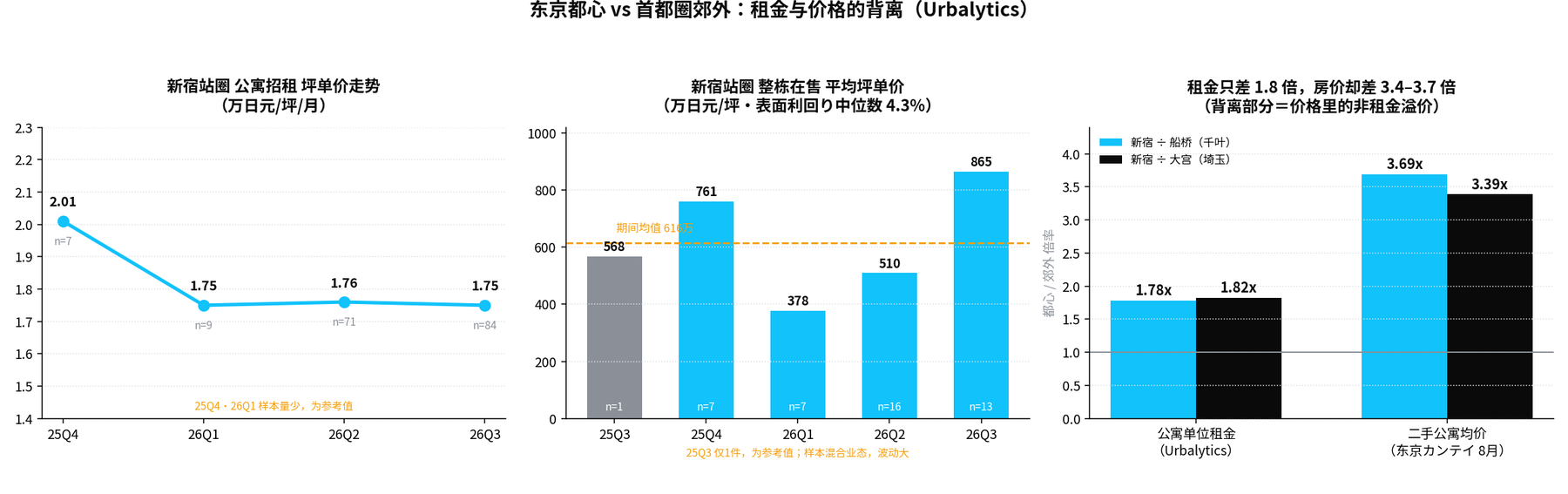
Urbalytics Insight Urbalytics data also show a median gross cap rate of about 4.3% for whole-building listings around Shinjuku Station (31 listings). At that level, rent alone would take more than twenty years to recoup principal, so short-term capital gains naturally become the primary return—which happens to be the slice of the payoff structure that tax intervention would rewrite first.
In cross-country and historical context: Japan's move is not radical
Internationally, the force of Japan's proposal is quite restrained.
Singapore's Additional Buyer's Stamp Duty (ABSD) on foreigners buying residential property was raised to 60% in April 2023; Canada has prohibited non-Canadians from purchasing residential property since 2023 and has extended the measure multiple times; Australia will, for two years starting April 2025, prohibit foreigners from buying secondhand residential property.
By contrast, Japan has neither imposed a separate rate on foreign buyers nor enacted purchase bans, opting instead to tax behavior. This path is slower, but less contentious and harder to sidestep through identity structuring.
Historically, this is not a sudden pivot but a five-year continuum: passage of the Act on Surveys and Regulation of Land, etc. in 2021; from 2024, implementation of a new inheritance tax valuation circular for residential sectional ownership (plugging the so-called tower-mansion tax shelter); and this year, putting tougher taxation of short-term transfers on the table.
Each step tightens the room to use "housing" for non-residential ends. Previously the focus was the succession stage; this time it's the transfer stage.
Who gets hit: flippers, long-term holders, and corporates
From an investor's perspective, the blast radius is not uniform:
First, short-term arbitrageurs take the hit. For sales one to two years after purchase, if taxation is increased on top of the current 39.63% short-term rate, transaction costs and taxes formerly covered by the spread could flip your net return negative.
Second, long-term holders are largely unaffected. Individuals holding for more than five years for rental purposes would still face the 20.315% long-term rate; the proposal does not suggest changing this bracket.
Third, corporates do the math differently. For Japanese corporations, real-estate transfer gains are folded into corporate income and taxed on an aggregate basis without regard to holding period, so tougher short-term transfer taxation has a smaller direct impact—yet that also implies that if policy eventually extends to corporations, the rules could be rewritten in another form.
Another often-overlooked group comprises buyers seeking land in security-sensitive areas. Once a permit regime is in place, approval timelines and uncertainty will rise materially, and the definition of those "in principle not permitted" leaves ample room for interpretation.
Note that this item applies to land within roughly 1 kilometer of facilities such as Self-Defense Forces bases and to uninhabited remote border islands; it does not overlap with the vast majority of residential properties within Tokyo's 23 wards. Reading it as "foreigners need approval to buy homes in Japan" is an over-interpretation.
Conversely, what will actually change the cadence of day-to-day deals is the tax lever. It requires no identity screening—only an extra look at the acquisition date at filing—hence it is more likely to land first.
Risk disclosure The proposal remains a document at the party project team stage and has not entered the legislative process. The tax rate level, effective date, and any transition arrangements are all undecided. Rebalancing holdings early on the assumption of outcomes carries more risk than reward; a steadier approach is to confirm whether your holding period and target exit fall within the potential "short-term" window.
Conclusion: not exclusionary, but separating "homes" from "chips"
If you fixate on the "Foreigners PT" label in the headlines, it's easy to read the proposal as a turn toward exclusion. Read end to end, however, it is really about separating two uses of the same residential asset—owner-occupation and long-term rental stay in the low-tax bracket, while short-term flips move into the high-tax bracket.
For cross-border investors centered on rental yield and long-term holds, this direction is not bad news; it may reduce speculative bidding and help bring entry valuations back toward rationality.
What merits close attention next are the formulations in the government's Tax Commission and the annual Tax Reform Outline, especially the definition of "short term" and how the clock starts. Before then, consider using Urbalytics' transaction and rent data to pin down the rent coverage ratio of your holdings and your intended exit timing.
#JapanRealEstate #TokyoCondos #LDPProposal #ShortTermCapitalGains #PropertyTaxRegime #ImportantLandAct #ForeignBuyers #CentralSixWards #GreaterTokyoMarket #TokyoKantei #RentalYield #InvestmentStrategy #CrossBorderInvestment #TowerMansions #Urbalytics
References
1. Yomiuri Shimbun Online, 2026, "Early tax measures on speculative condo purchases; permit system for land acquisition around bases... LDP Foreigners PT proposal", https://www.yomiuri.co.jp/politics/20260924-GYT1T00503/
2. Yomiuri Shimbun Online, 2026, "Used condos in Tokyo fall below previous month for first time in 2 years and 4 months to 112.74 million yen... August: some high-priced listings find no buyers", https://www.yomiuri.co.jp/economy/20260924-GYT1T00325/
3. National Tax Agency, Tax Answer No.3211 "Calculation of tax on short-term transfer income", https://www.nta.go.jp/taxes/shiraberu/taxanswer/joto/3211.htm
4. National Tax Agency, Tax Answer No.3208 "Calculation of tax on long-term transfer income", https://www.nta.go.jp/taxes/shiraberu/taxanswer/joto/3208.htm
5. e-Gov Law Search "Act on Surveys and Regulation of the Utilization of Land, etc. in Areas Around Important Facilities and on Remote Border Islands" (Act No. 84 of 2021), https://laws.e-gov.go.jp/law/503AC0000000084
6. National Tax Agency, Tax Answer No.4667 "Valuation of residential sectional ownership property", https://www.nta.go.jp/taxes/shiraberu/taxanswer/hyoka/4667.htm
7. IRAS Singapore, 2026, "Additional Buyer's Stamp Duty (ABSD)", https://www.iras.gov.sg/taxes/stamp-duty/for-property/buying-or-acquiring-property/additional-buyer%27s-stamp-duty-(absd)
8. Justice Laws Canada, "Prohibition on the Purchase of Residential Property by Non-Canadians Act", https://laws-lois.justice.gc.ca/eng/acts/P-25.2/
9. Foreign Investment Review Board (Australia), https://foreigninvestment.gov.au/
10. Urbalytics platform internal data (rent_stats / building_cap_rate_stats, obtained September 2026)
Copyright: This article is original content by the author. Please do not reproduce, copy, or quote without permission. For usage requests, please contact the author or this site.