Words: 1639 | Estimated Reading Time: 9 minutes | Views: 55
A roughly 30% gap between asking and contract prices can only be closed by sellers backing down—because rents have not risen in tandem.
On September 2, 2026, real estate strategist Tomohiro Makino noted in an interview that prices for existing condos in Tokyo’s Central 3 Wards (Chiyoda, Chuo, Minato) have been hitting a ceiling since late 2025. That in itself isn’t news. What should make investors pause is the number he put on it: the current gap between sellers’ asking prices and actual contract prices is roughly 30%.
The industry in Japan has a vivid nickname for this gap—the “Crocodile Mouth” (ワニの口). Contract prices lie flat while asking prices keep rising, and the two lines on the chart open wider and wider. For any cross-border investor holding core assets or preparing to enter, when—and from which side—this mouth closes matters far more than “how many points up this year.”
1. A 30% gap is arithmetic you can actually work out
Makino offers an anchor you can sanity-check. The industry commonly believes that the main buying force—dual high-income households (“power couples,” パワーカップル)—can stretch to a total purchase price of about JPY 120–130 million within mortgage affordability. That is effectively the ceiling on contract prices.
Add 30% on top of that ceiling and sellers’ asking ambitions land in the JPY 170–180 million range. The issue isn’t whether that’s expensive; it’s that it physically exceeds buyers’ borrowing capacity—it’s not unwillingness to buy; loans simply won’t be approved.
Makino also highlights a detail that’s easy to miss: the recent media stories about “declines in central-city condo asking prices” refer to sellers’ aspirational prices, not contract prices. The fact that even aspirations are softening shows sellers are running out of resolve—that’s the weight of the signal.
The real coordinates to watch are the “registered (listing) price” and the “contract price” lines published by the Real Estate Information Network for East Japan (REINS). When the gap is so wide that sellers must move toward buyers, the market is no longer debating “how much more upside,” but “who blinks first.”

2. This surge wasn’t fueled by demand; it was fueled by resellers’ balance sheets
To understand why asking prices ran so far, look at who is quoting them. Makino points to the resale behavior of small and mid-sized real estate operators, whose economic logic is straightforward.
They buy 15–20-year-old condos in the bayside area, do a light renovation, and relist roughly six months later. The shift from brokerage to principal positions occurred because pure brokerage only earns a 3% fee; in a market that at one point showed 30–40% YoY gains, buying to flip is obviously more lucrative.
Principal buying became the industry habit, and the pricing framework began to follow operators’ cost bases rather than end buyers’ ability to pay. In an upswing, those two curves can move in parallel; once end-user demand falls behind, the distance between them turns into inventory.
That’s exactly what is clogging the market now. Makino believes that cutting from the JPY 170 million asking level would push operators into a loss, so in recent months they have chosen to hold their ground rather than cut—this is price rigidity dictated by the balance sheet, not by demand. It delays the reset, but it also makes the eventual reset larger.
3. The rental side gives a different answer: the true level in the Central 3
To judge which side the mouth will close from, the most reliable reference is not asking prices but rents—because rents are the only variable priced by real usage demand and cannot be pushed up by resellers’ balance sheets.
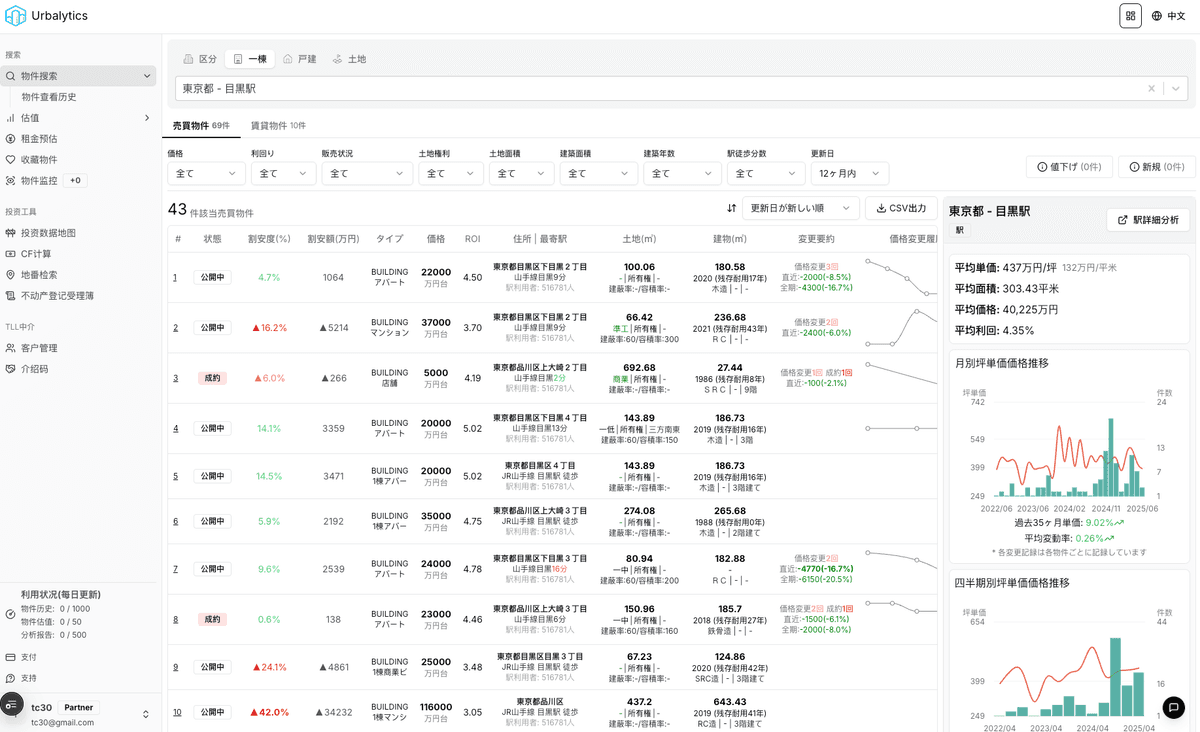
Urbalytics data show that in the Tamachi station area, rent for rental condos rose from JPY 17,100 per tsubo per month to JPY 17,200 per tsubo per month over the past four quarters, a cumulative change of just +0.58%, with the sample expanding from 4 to 143 cases—evidence of a solid, flat trend. Jimbōchō over the same period printed −1.42%. The Ginza station area has thin samples (6–12 per quarter; indicative only) and recorded −26.02% over two quarters.
In other words, during the period when asking prices were up 30–40% YoY, residential rents in the Central 3 Wards were essentially flat, with pockets of weakness. That knocks out much of the foundation under the narrative that “prices are rising because the core is undersupplied.”
Whole-building income properties (一棟収益物件) read even more directly. In the Tamachi station area, average gross yield (表面利回り) on on-market buildings is 3.68%, with a median of 3.88%, and an average asking price of JPY 730 million; in the Ginza station area, the average is 3.28% and the median just 2.68%, with an average price of JPY 1.138 billion. At a time when long-term interest rates are brushing 3%, the yield gap (イールドギャップ) has been almost compressed away.
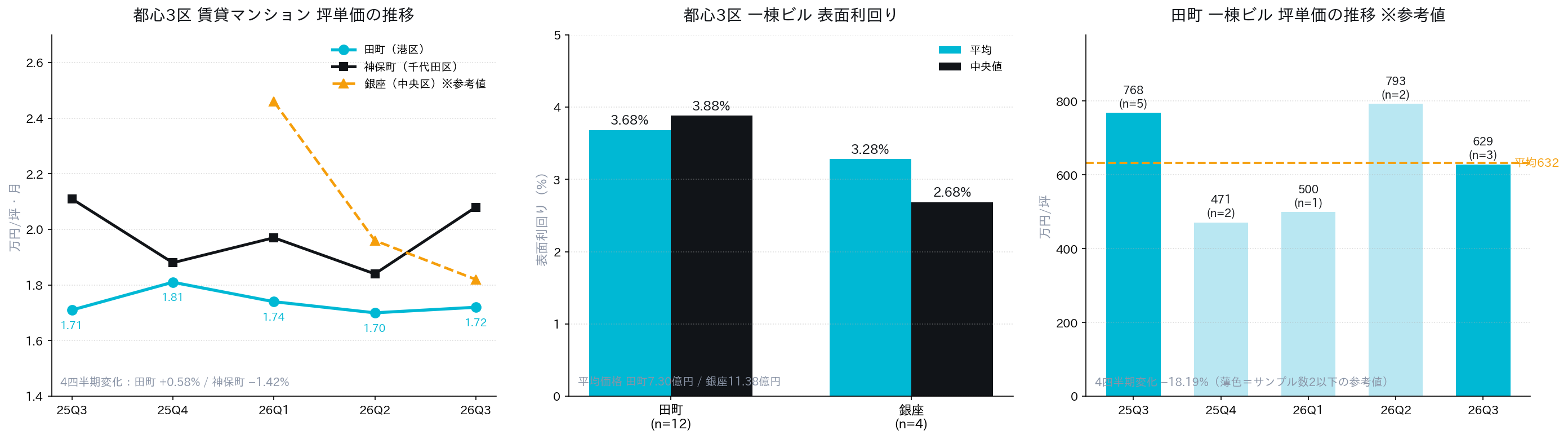
Urbalytics Insight The value of Urbalytics’ internal data lies in tracking actual listings and actual leases, rather than association-weighted indices. When asking and contract prices are at odds, lining up rent per tsubo and whole-building gross yields is the only way to bypass the seller-side narrative for cross-checking—Tamachi’s near-zero rent growth across four quarters alongside gross yields of only 3.68% together form the most direct rebuttal to “the core can climb another 30%.”
4. Rates have yanked away the last cushion
Time can digest price gaps—but only if funding costs stand still. As of September 2026, that premise no longer holds.
Reports the same day show Japan’s long-term interest rate briefly touched 3% for the first time since 1996, against a backdrop of mounting fiscal concerns. At the retail end in September 2026, mortgage rates saw variables on hold for now, while the 10-year fixed and Flat 35 (フラット35) both rose.
The damage here is less about amortization tables and more about buyer psychology. Many buyers had assumed “I’ll run a variable; interest can be ignored.” Once hikes enter daily view, the same person’s willingness to pay for the same home automatically ratchets down.
Makino’s view: operators can still grit their teeth for a few months, but end-user demand is clearly lagging; the market is turning lower. When asking prices hover 30% above contracts, rents are flat, and rates are rising, the direction of travel is no mystery—only the cadence is.
5. Where the reset starts—and where it spreads
Makino is explicit that the adjustment will not stop in the Central 3 Wards, nor in the Central 6 (adding Shinjuku, Shibuya, and Bunkyō), but will diffuse outward. Two opposing forces are embedded in that diffusion path, and investors should separate them:
First, some buyers squeezed out of the Central 6 will shift beyond those wards. This spillover demand will, to a degree, tighten supply-demand in surrounding areas and support peripheral prices—the recent strength in single-family (戸建て) markets in Chiba, Kanagawa, and Saitama is a direct result of households “priced out of Tokyo” buying in the suburbs.
Second, if overall interest rates continue to climb, more buyers will fall below mortgage underwriting thresholds and demand itself will contract—at which point spillover may not hold the line. In other words, the periphery is receiving a relocation of demand, not an increase; these behave very differently in a rising-rate phase.
For investors already holding core assets, the real risk now is not mark-to-market shrinkage but liquidity. When asking and contract prices are 30% apart, listing volume does not equal executable volume; exit cycles will lengthen materially.
Risk alert Beware mistaking “declining asking prices” for “a buy-the-dip window.” What is softening now are sellers’ aspirations; contract prices have not moved down in step. This means the gap is compressing from above, not being lifted from below. With flat rents, sub-4% gross yields, and long-term rates around 3%, the window for capital-gain (キャピタルゲイン) plays has closed. Only cash flow can carry the hold period.
6. Conclusion: the mouth will close from the top
Put together, the Central 3’s position is clear. Asking prices are pinned high by reseller cost structures; contract prices are capped around JPY 130 million by borrowing capacity; rents have been essentially flat for four quarters; and funding costs are rising at levels not seen since 1996.
Of the four variables, only the asking price can move. The “Crocodile Mouth” will most likely close from the top—i.e., through seller-led markdowns, not buyers chasing higher. For buyers, patience itself is a return; for holders, exit plans should be re-laid on a longer timeline.
This market will reward those who validate prices with rents and yields, not those who keep reading asking quotes. If you want to overlay rent per tsubo, whole-building gross yields, and live for-sale samples for any station area on one chart before you act, Urbalytics’ regional rent statistics and yield distribution tools can give you that coordinate system in minutes.
#TokyoCentral3Wards #Chiyoda #Chuo #Minato #ExistingCondos #CrocodileMouth (ワニの口) #ContractPrice #REINS (Real Estate Information Network for East Japan) #GrossYield #WholeBuildingIncomeProperty (一棟収益物件) #MortgageRates #LongTermRates #JapanRealEstate #Urbalytics
References
- Money Post WEB / Yahoo! News, 2026, “Prices of existing condos in Tokyo’s Central 3 Wards are ‘declining’: the ‘Crocodile Mouth’ between asking and contract prices has opened wide!”, https://news.yahoo.co.jp/articles/29a2cb024b69ca68cb52844173b81beec84365b5
- TBS NEWS DIG “news23” / Yahoo! News, 2026, Long-term interest rates briefly at 3% for the first time since 1996—implications for mortgages and the fiscal concerns behind the move, https://news.yahoo.co.jp/articles/513f4c4dc25477c62a1890363cf7e739b76216bf
- Yahoo! News, 2026, September mortgage rate trends: variable rates on hold; 10-year fixed and Flat 35 raised, https://news.yahoo.co.jp/articles/9d0f56636c8d51f8a90df238e29ff9a431fbc885
- Real Estate Information Network for East Japan (REINS), Monthly Market Watch, https://www.reins.or.jp/trend/
- Tomohiro Makino, “Inter-City Disparities” (Chuo Koron Shinsha, Chuko Shinsho), 2025
- Urbalytics (internal data: quarterly trends in rental condo rent per tsubo for Tamachi, Jimbōchō, and Ginza station areas; distribution of whole-building gross yields; as of September 2, 2026), https://www.urbalytics.jp/