Words: 1844 | Estimated Reading Time: 10 minutes | Views: 7452
Within the grand narrative of Tokyo real estate investment, the comprehensive redevelopment of Shinagawa Station’s west (Takanawa) exit is not merely a geographic refresh but a core anchor in Tokyo’s evolution into a global hub. With Toyota Motor Corporation relocating its new Tokyo headquarters and major players such as Keikyu and Seibu forming strategic alliances, the area is shifting from a traditional hotel-hosting district into a super-complex that integrates advanced technology, international business and high-net-worth residential living. For professional investors, understanding this region’s value reconstruction requires examining the city’s historical depth, micro data trends and the flow of global industrial capital.
Historical Resonance and the Urban Evolution of the Takanawa Exit
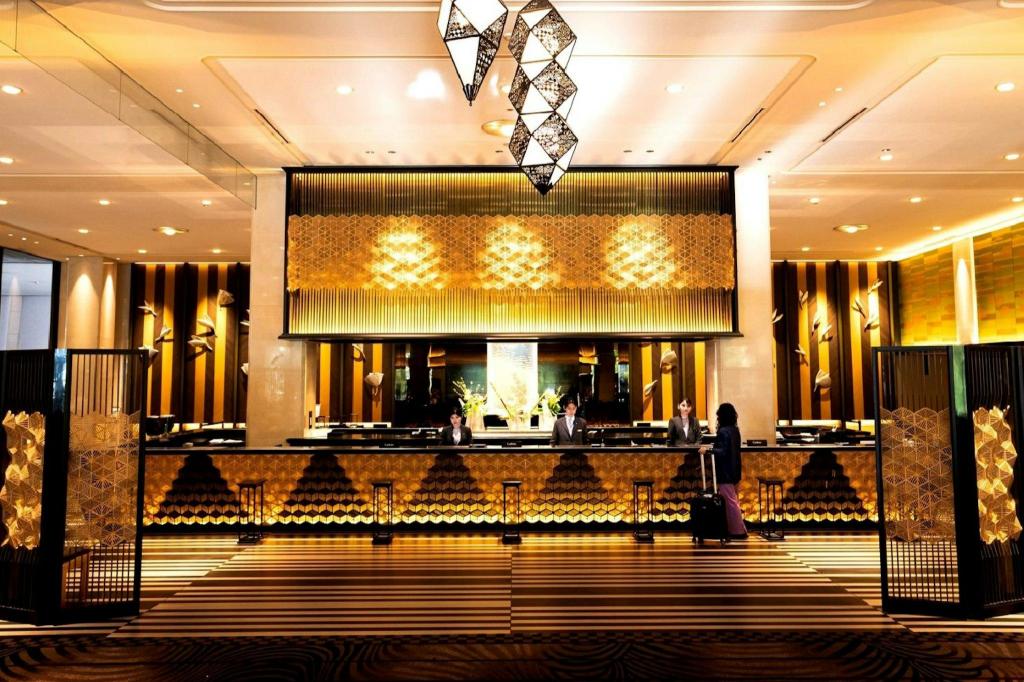
The development history of Shinagawa Station’s west exit dates back to the Edo period, when it served as an important gateway on the Tokaido and a transportation hub connecting Edo (Tokyo) with western Japan. Because of Takanawa’s higher elevation and superior views, it became a concentration of imperial residences and elite estates from the Meiji era onward, creating a distinct cultural legacy as a “reception city.” In the modern era, the Takanawa area gradually formed a hospitality center centered on the Prince Hotels cluster operated by the Seibu Group. The opening of facilities such as the Grand Prince Hotel New Takanawa in the 1970s–80s cemented its role as a representative social and conference district for Tokyo.
Find properties in 東京都港区
Individual listings, price-change history, closed transactions and AI valuations are available on a free account.
However, the low-density, hotel-dominated development model has shown limitations in the 21st century. Physical severance has long been a pain point for Takanawa: the wide National Route 15 (Daiichi Keihin) slices Shinagawa Station off from the Takanawa neighborhood on the west side, preventing the station’s very large pedestrian volumes from translating into neighborhood vitality. As Shinagawa’s international transport importance has leapfrogged—particularly its positioning as a gateway to Haneda Airport and as a planned origin point for the future maglev—its former role as a hotel-and-conference district no longer matches its strategic role as Tokyo’s southern gateway. The current redevelopment is being carried out within the broader framework of an “International Exchange Hub—Shinagawa,” aiming to fundamentally reorganize land use, remove physical barriers and deeply integrate historical assets with future technologies. This transformation is more than taller buildings; it is a redefinition of urban function: evolving from a place of transient stays into a source of creation and exchange.
Core Data Trends: Land Price Premiums and Strong Leasing Support
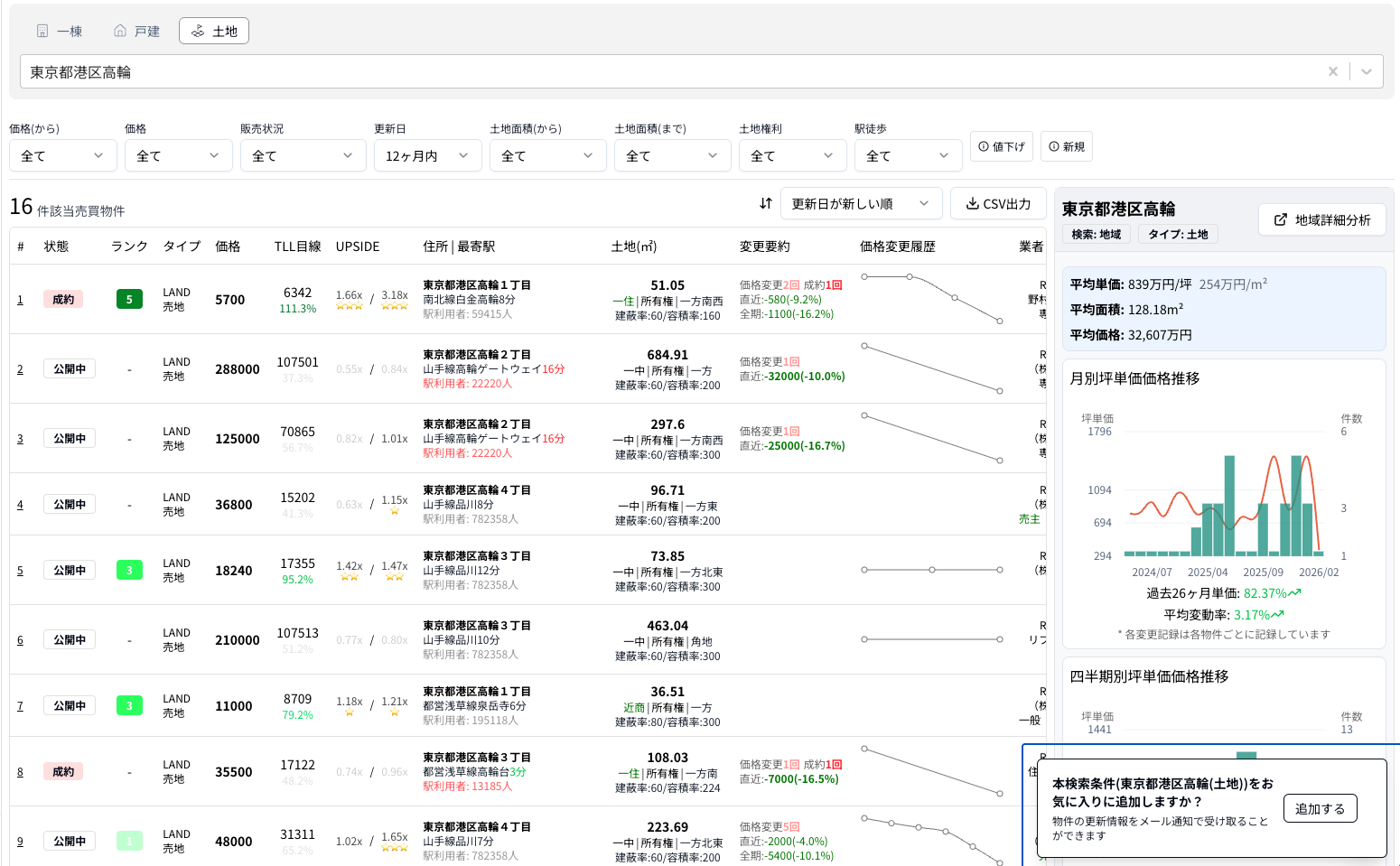
According to Urbalytics monitoring and government-published land prices, Takanawa has demonstrated strong defensive performance and growth potential in land values. Based on the latest published land prices for 2025, commercial land in Minato-ku, Takanawa 3-chome, reached a peak of ¥6.55 million per square meter—a significant year-on-year increase. This over-14% annual rise (overall land price average up 14.43%) not only outperformed the Tokyo-wide average but also reflects the market’s strong premium in expectation of redevelopment.
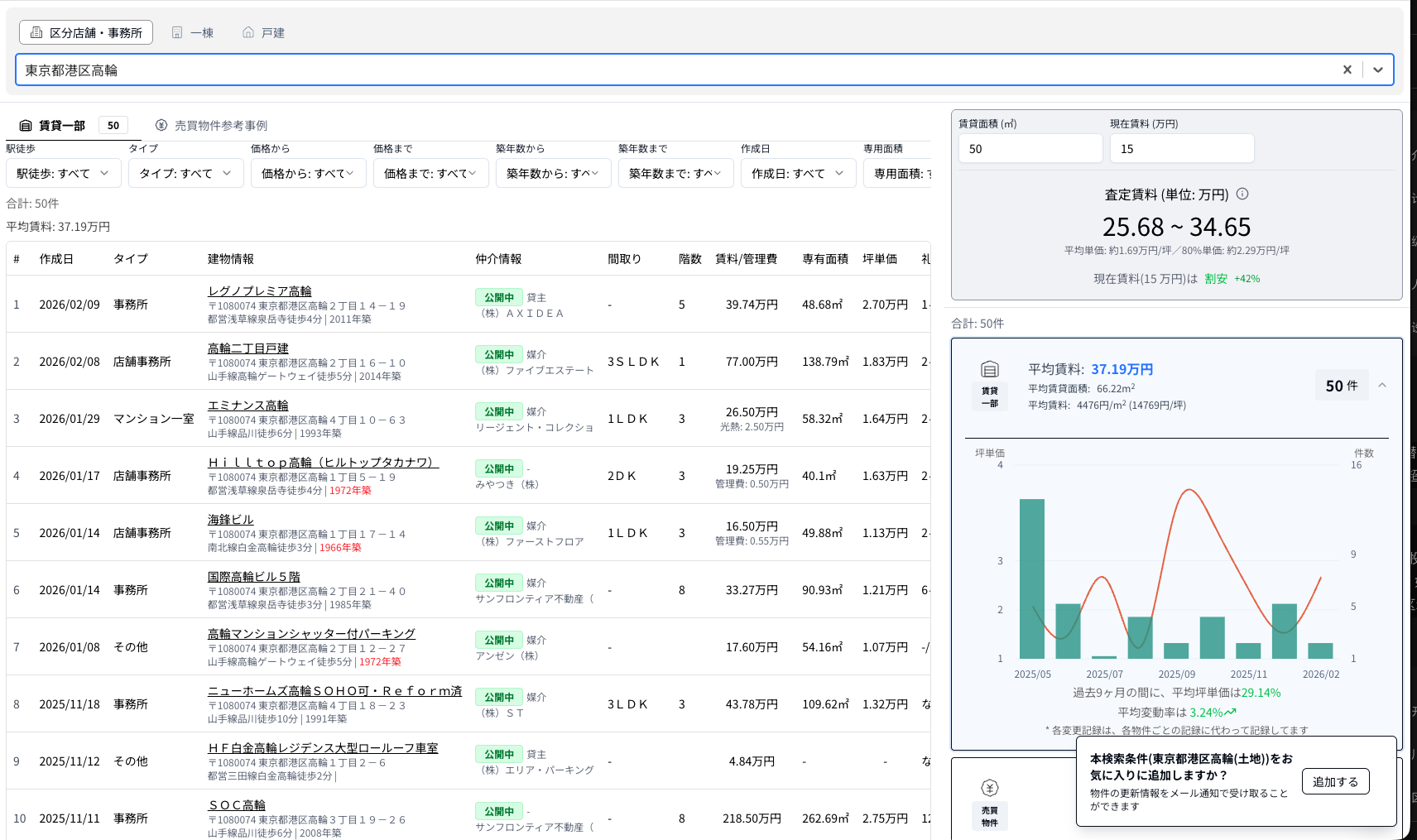
On the leasing side, office vacancy rates in Minato-ku, where Shinagawa sits, have fallen to approximately 2.12%, indicating an extremely tight supply-demand dynamic. Of particular note in Takanawa is the long absence of newly constructed Grade A office buildings; the refurbishment of existing stock and strong pre-leasing expectations for new projects are therefore robust. For residential investors, rents in Takanawa are among Tokyo’s top tier—the median monthly rent remains between ¥300,000 and ¥500,000—and select branded new developments near Shirokane-Takanawa have seen asset value increases of roughly 40% over the past two decades. Behind these strong indicators is high-income demand betting on job-residence balance and the area’s future prospects.
Deep Dive into the Four Districts: From Toyota HQ to a MICE Landmark
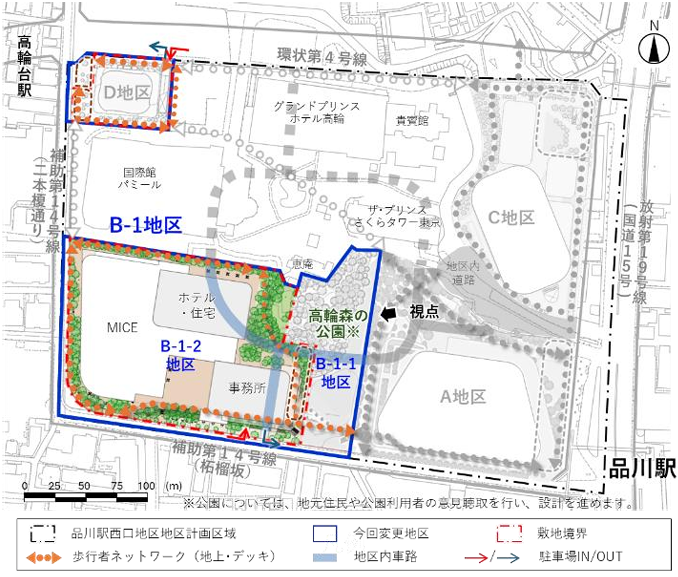
The west exit redevelopment of Shinagawa Station is composed of four main districts—A, B, C and D—with a combined gross floor area approaching 810,000 square meters. Each district carries different strategic functions and together form a synergistic urban ecosystem.
A District: Toyota’s “Software-First” Strategic Foothold
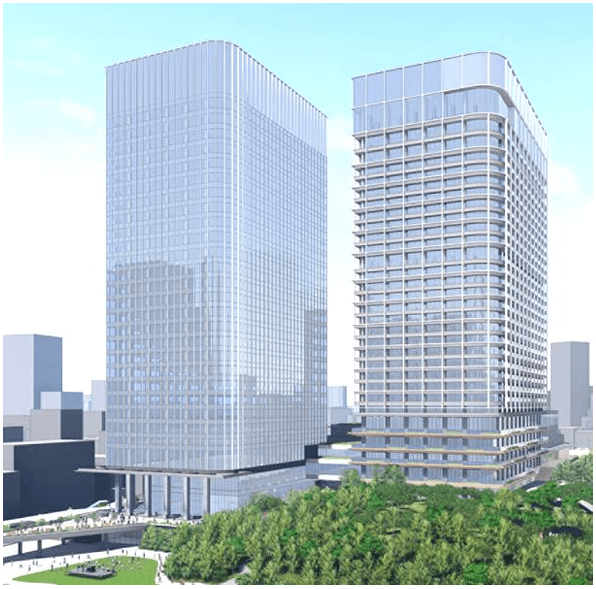
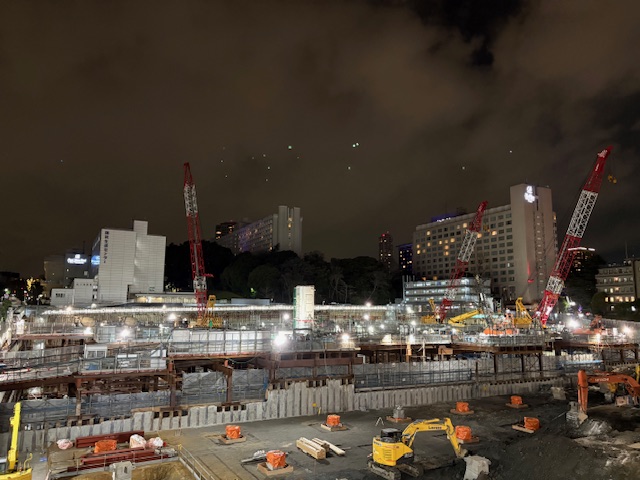
Developed jointly by Keihin Kyuko Electric Railway (Keikyu) and Toyota Motor Corporation, District A is the most transformative element of the plan. This roughly 29-story, approximately 160-meter-high tower will not be merely an office building; it will house Toyota’s new Tokyo headquarters, scheduled to open in fiscal 2029. Toyota is not only a tenant but a capital partner and co-manager—reflecting its strategic shift from traditional automaker to a mobility company.
Architecturally, KPF has adopted the concept of “Flow,” shaping the façade into a streamlined trapezoidal form designed to channel sea breezes from Tokyo Bay and reduce impacts on the surrounding environment. Its lower levels feature a skirt-like canopy that shelters from wind and rain while creating an open public exchange space. Programmatically, District A integrates office, retail, hotel and large-scale MICE (meetings, incentives, conferences and exhibitions) facilities, with a total GFA of 313,000 sqm. Toyota plans to deploy advanced software development functions and AI R&D centers here, including test spaces that allow full-size vehicle and mobility devices to be brought directly into the office. This engineer-first environment signals Shinagawa’s transition from a blue-collar hub to a “geek Silicon Valley,” drawing thousands of high-income technology professionals.
B District: Seibu Group’s Urban Resort and Business Regeneration
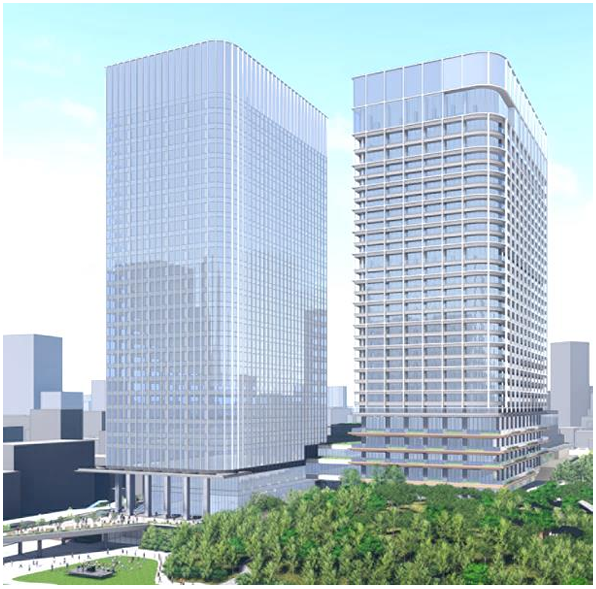
B District (primarily B-1) is led by Seibu Real Estate and covers the former site of the Grand Prince Hotel New Takanawa. The plan calls for a roughly 31-story, 140-meter mixed-use tower with about 268,000 sqm of GFA. For investors, B District’s core value lies in its concept of “working in the forest.”
Seibu intends to integrate the area with the adjacent Takanawa Mori Park by substantially increasing green space to create an ecological environment where nature and business coexist. The development will include large-scale MICE facilities aimed at attracting top-tier international business events and further internationalizing the district. The Grand Prince Hotel New Takanawa is scheduled to cease operations in fiscal 2026 and be demolished, with the new facility expected to be completed by fiscal 2032.
C and D Districts: Completing High-End Living and Lifestyle Amenities
If A and B are responsible for work and exchange, C and D are charged with life and residence. District C will deliver a roughly 155-meter super-tall tower integrating offices, residences and retail, scheduled for completion in 2028. District D is particularly scarce: located on the former site of Diet members’ Takanawa housing and now jointly developed by Keikyu, Seibu and Tokyu, it will feature a 34-story, approximately 135-meter residential tower. The project is expected to be completed in 2030 and will directly address the long-standing shortage of high-quality, large-scale new housing in the Takanawa area—making it a key target for residential investors to monitor closely.
Step-Change Infrastructure: The Birth of an Elevated Pedestrian City
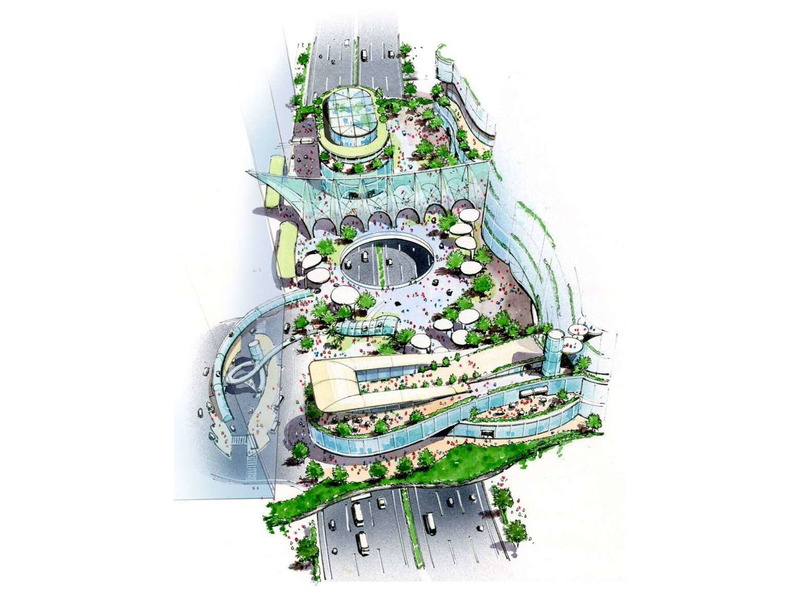
The engineering highlight of the Shinagawa west exit redevelopment is the construction of a pedestrian deck. Currently, the west exit is severed by National Route 15, producing a poor pedestrian experience. To resolve this, the plan uses the elevated road system to build a massive pedestrian deck above Route 15, extending the station’s second-floor ticket gate level directly westward and creating seamless level connections with buildings in Districts A and B.
This pedestrian deck is more than an overpass; it is envisioned as a next-generation station plaza. According to design schemes, the area will include extensive planting, seating and digital interactive facilities, forming a roughly 10–15 meter-high, large “green sky corridor.” In this way, Shinagawa Station’s daily passenger flows—already extremely high—will be smoothly channeled into west-exit retail and office buildings. For real estate investors, this physical elimination of distance creates significant value spillover: land that was previously on the opposite side of the highway will be upgraded to effectively zero-distance, ultra–station-front land.
Policy Tailwinds: Asia Headquarters Special Zone (AHQ) and Tax Incentives
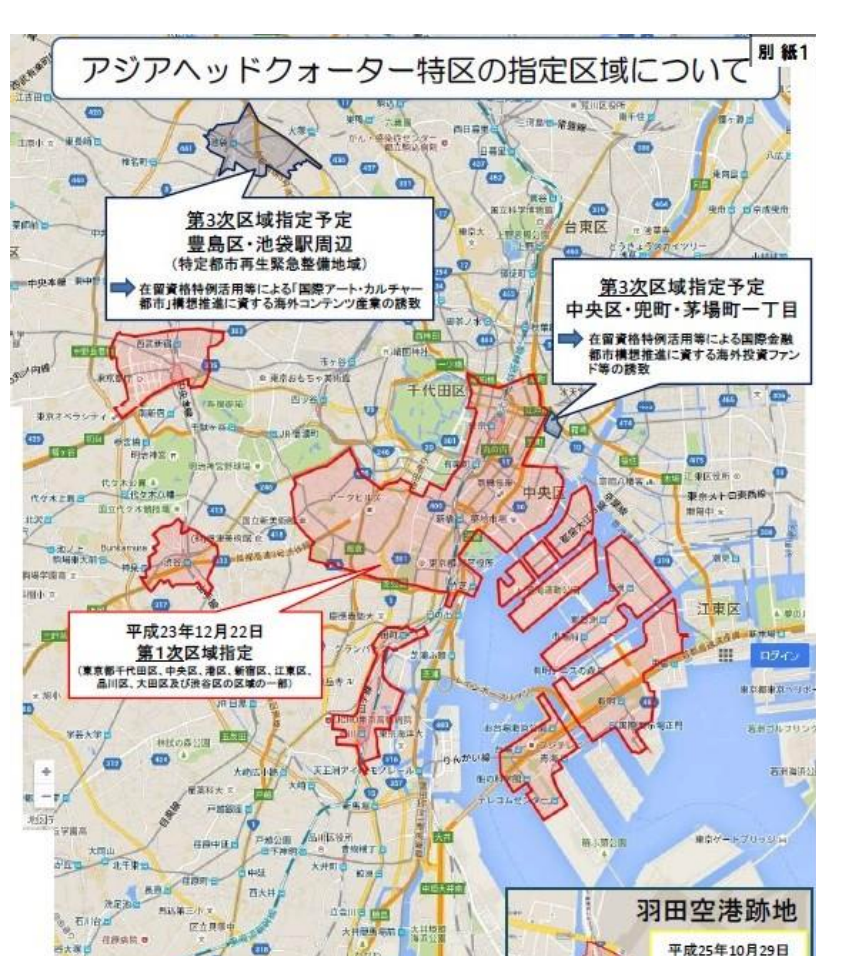
As an important component of Tokyo’s Asia Headquarters Special Zone, Shinagawa benefits from policy advantages that are difficult to obtain elsewhere. To attract overseas firms—particularly R&D centers and regional headquarters—the special zone offers a suite of attractive incentives:
Corporate tax reductions: Newly established R&D bases within the zone may qualify for a 20% income deduction or accelerated depreciation for machinery and equipment.
Local tax exemptions: The Tokyo Metropolitan Government provides full or partial exemptions for enterprise tax, fixed asset tax, city planning tax and real estate acquisition tax for designated businesses within the zone, with cumulative benefits reaching into the hundreds of millions of yen.
Talent residency facilitation: Fast-track immigration procedures for high-end foreign talent, supported by international schools and premium medical facilities.
This government-driven industrial clustering effect significantly lowers tenant onboarding costs and strengthens rental support. For investors, this means that even amid global economic volatility, demand for office leasing in the Takanawa area retains a high degree of certainty.
Investment Opportunities and Potential Risks
Investment Opportunities
Scarcity-driven residential appreciation: Large land parcels in Takanawa are largely held by major conglomerates, so new residential supply is extremely limited. New tower projects in District D, for example, exhibit strong rental premiums and asset appreciation potential—suitable for long-term hold strategies.
Renovation upside in existing stock: In Takanawa 3-chome, 4-chome and nearby Kita-Shinagawa, many low-FAR older apartments and houses remain. Once the pedestrian deck is completed, properties within walking distance stand to receive passive uplifts from enhanced area functionality.
Upgrading of retail and service mix: With the commercial components of Districts A and B opening, the previously quieter Takanawa area will attract high-caliber dining and retail brands, prompting a revaluation of street-level retail assets nearby.
Potential Risks
Timing risk from long construction horizons: The overall program spans more than a decade. Prior to the 2030s, the area may remain a long-term construction zone, creating short-term headwinds for the existing leasing environment.
Rising construction costs compressing margins: Labor shortages and increasing materials costs may cause budget overruns or specification reductions on subsequent B, C and D projects.
Further delays to maglev commencement: The maglev represents the largest long-term upside; prolonged delays could dent confidence among institutional investors targeting ultra-long-term appreciation.
Conclusion: Positioning Shinagawa as Tokyo’s Strongest Asset over the Next Decade
In summary, the Shinagawa Station west (Takanawa) exit redevelopment is not merely a real estate project but a microcosm of Tokyo’s strategic urban transformation. By introducing a technology engine such as Toyota’s headquarters and combining it with infrastructure innovation that removes physical barriers—like the pedestrian deck—Shinagawa is rapidly evolving into a global node comparable to Singapore’s Marina Bay or the City of London.
For investors, Takanawa’s investment profile should be seen as a highly certain growth blue-chip. The land price appreciation here is not driven by speculative excess but is underpinned by real industrial relocation, tax incentives and step-change transport infrastructure. With Toyota’s headquarters opening in 2029, Takanawa’s value coordinates will be finally anchored. Within Tokyo’s current real estate map, the Shinagawa west exit remains the most explosive and highest-tolerance strategic high ground.
#ShinagawaRedevelopment #TakanawaExit #ToyotaNewHeadquarters #JapanRealEstateInvestment #MinatoWardLandPrices #MICE #Maglev #KeikyuRailway #SeibuGroup #UrbanRegeneration #AsiaHeadquartersSpecialZone #UrbalyticsInDepth #TokyosSouthGate #HighNetWorthResidential #AIIndustryCluster
Copyright: This article is original content by the author. Please do not reproduce, copy, or quote without permission. For usage requests, please contact the author or this site.
Photos in this article: 20110405-TokyoTower-Sakura 東京太郎/CC BY-SA 3.0(トリミング) Wikimedia Commons·Shinagawa Station - Aimaimyi/CC BY-SA 3.0(トリミング) Wikimedia Commons·Shinagawa Prince Hotel Abasaa/Public domain(トリミング) Wikimedia Commons·Shirogane 20061221 0 CC BY-SA 3.0(トリミング) Wikimedia Commons